Holy Spirit in the Book of Acts, Part 1

I did not mean for this to be a multi-part blog post, but I didn’t get all the way through studying the book of Acts this week so I’ll have to split the post in half. When I was in Cincinnati last weekend for Sabbath services and square dancing, there was one particular part of the sermon message that caught my attention. The speaker said “We can’t use the Holy Spirit if we don’t understand what it is” and that we don’t talk about the Holy Spirit today the way it was viewed by the early church in the Book of Acts.

That got me thinking, just how did the early church talk about the Holy Spirit? We usually look at the first two chapters, which chronicle the baptism of the Holy Spirit at Pentecost, and then go no further in Acts when we talk about the Holy Spirit. That’s where I’ll start as well, and then next week I’ll plan to write a post about what my study turns up in the remainder of Acts.

Enter The Holy Spirit

There were people who had the Holy Spirit before this notable Pentecost, but not many. So few, in fact, that it says in John’s gospel that “the Holy Spirit was not yet given, because Jesus was not yet glorified” (John 7:39). Before Jesus ascended to heaven in the first chapter of Acts, He promised the disciples, “you shall be baptized with the Holy Spirit not many days from now” and “you shall receive power when the Holy Spirit has come upon you” (Acts 1:5, 8). That promise was fulfilled in the next chapter.

And suddenly there came a sound from heaven, as of a rushing mighty wind, and it filled the whole house where they were sitting. Then there appeared to them divided tongues, as of fire, and one sat upon each of them.  And they were all filled with the Holy Spirit and began to speak with other tongues, as the Spirit gave them utterance. (Acts 2:2-4)

Not only was the Holy Spirit given to the disciples, but a miracle was performed at the same time which left no doubt of the effectiveness of the power God was giving. Men “from every nation under heaven … heard them speak in his own language” (Acts 2:5, 8). As we’ll discuss more in next week’s post, this is not the only time this particular miracle accompanied the giving of the Holy Spirit (Acts 10:44-48).

Receiving the Spirit

When some doubted what was going on, Peter said this:

Men of Judea and all who dwell in Jerusalem, let this be known to you, and heed my words. For these are not drunk, as you suppose, since it is only the third hour of the day. But this is what was spoken by the prophet Joel: “And it shall come to pass in the last days, says God, that I will pour out of My Spirit on all flesh; your sons and your daughters shall prophesy, your young men shall see visions, your old men shall dream dreams. And on My menservants and on My maidservants I will pour out My Spirit in those days; and they shall prophesy. (Acts 2:16-18)

He also revealed a recipe for receiving the Holy Spirit which is repeated several times in later chapters.

Repent, and let every one of you be baptized in the name of Jesus Christ for the remission of sins; and you shall receive the gift of the Holy Spirit. For the promise is to you and to your children, and to all who are afar off, as many as the Lord our God will call. (Acts 2:38-39)

I am finding it interesting, and inspiring, to read through the book of Acts taking note of every time the Holy Spirit is mentioned and seeing how the promises and prophesies mentioned in chapter 2 enfold in the early Church. I look forward to sharing more of my thoughts on this with you next week, and hope you’ll weigh-in as well — it seems like a topic that could lend itself well to discussion.

Fruit and Seed Granola Bars

Fruit and Seed Granola Bars marissabaker.wordpress.com

My brother has been begging me to come up with some kind of healthy, filling snack that he can munch on when he feels hungry (which seems to be all the time). Enter the Healthy Homemade Granola Bars from Beth at redandhoney.com. They are amazing, though you do have to keep them chilled to prevent melting, which makes them a bad choice to stuffing in a backpack or purse … not that we would know this from experience.

Fruit and Seed Granola Bars marissabaker.wordpress.com
Granola bar add-ins

There are many variations on these bars depending on the nut butter and add-ins you choose, but the version I’m posting today is my favorite. I’ve decided dried cherries are an essential ingredient. So are pumpkin seeds — I like the flavor and the green color looks great with the red dried fruit.

As an added bonus, these granola bars are unleavened, so they will still be perfect for snacking once the Days of Unleavened Bread start next month.

Fruit and Seed Granola Bars

print this recipe

2/3 cup peanut butter
2/3 cup coconut oil
2/3 cup honey
2 cups oats
1 cup dried fruit (raisins, cranberries and/or cherries)
1 cup seeds and nuts (peanuts, pumpkin, flax, chia and/or sunflower seeds)Fruit and Seed Granola Bars marissabaker.wordpress.com

Mix first three ingredients together, microwaving in 15 to 20 second bursts and stirring until the coconut oil is melted.

Stir-in the oats, dried fruit, seeds and nuts. Press the granola bar mixture into an ungreased 13×9-inch baking pan. Place granola bars in the refrigerator for 2 to 3 hours.

Once granola mixture is cooled and set, cut into bars. Wrap individually or package in snack bags. Store in the refrigerator or freezer.

Variations
You can replace the peanut butter with almond butter if you prefer the taste or have an allergy.

The two cups of dried fruit, seeds, and nuts can be substituted for a wide variety of add-ins, including chocolate chips, coconut flakes, and almonds. My sister prefers her add-ins to be 1 cup chocolate chips, 1/2 cup coconut flakes, and 1/2 cup peanuts. Just keep experimenting until you find a few mixtures that you love.

Fruit and Seed Granola Bars marissabaker.wordpress.com

Songs by Mood

marissabaker.wordpress.comLast week, I learned that Neurowear launched a set of headphone about a year ago that scans your brainwaves and matches music on your iPod to your mood. As border-line creepy as that sounds to me, it’s just the next step from websites like Moodstream and Musicovery that play music based on whether you’re feeling happy, sad, calm, dark, lively, inspired, positive, creative, or pretty much any other mood you like.

I have genres or playlists that I’ll turn to for different moods, but I also have specific songs that I like to play for specific feelings. Is this just me? Or do you have a song you play every time you’re sad? A favorite song to match a happy mood? What about songs that help you deal with anger?

Angry

You know that feeling when you’re angry and you know you shouldn’t be, but you still need to do something with those feelings? That’s when I sing these songs. I feel much better afterwards and it means I’m not taking out my anger on anyone else, so they’re happy (although I have been told it’s creepy to witness).

No Good Deed — from Wicked (Idina Menzel)

Mordred’s Lullaby — Heather Dale

Blown Away — Carrie Underwood

Sad

These songs are like a pat on the back or a hug when I need reassurance. I listen to them when I’m feeling down and want to move out of that mood.

Everything is Fine — Josh Turner

Little Miss — Sugarland

You Are Loved — Josh Groban

Sub-category for when I’m discouraged about being single:

As Fast As I Could — Josh Turner

Melancholy

These songs are for sadness that I want to enjoy. It’s the “sad is happy for deep people” feeling rather than being sad for a reason that makes you not want to be sad any more.

Wine After Whiskey — Carrie Underwood

September — Daughtry

Katie — Celtic Thunder /Colm Keegan (which I’m afraid there’s no video for, but you can hear a clip)

Inspired

These are the songs I play when I want to feel like I’m fearless and I can do anything.

Defying Gravity — from Wicked (Idina Menzel)

Wide Open — Jason Aldean

I Stand — Idina Menzel

Happy

I was trying to think up songs for this category, and my sister said, “Don’t you sing One Direction when you’re happy?” As embarrassing as that may be,  yes I do. I’ve whittled it down to just one song from them, though.

What Makes You Beautiful — One Direction

Nil Se’n La — Celtic Woman

Hopeful

Since “Waiting For Superman” didn’t quite fit in with the happy or the melancholy songs, I’ve added this category.

Waiting For Superman — Daughtry

Wedding Day — Casting Crowns

This Is The Moment — from Jekyll and Hyde (Robert Cuccioli)

Peaceful

I play these songs when I want to relax and I’m trying to encourage a peaceful feeling. They’re usually the first songs I play, then I move on to a playlist of related songs and artists. Or I listen to instrumental music with dolphins.

Hero — Il Divo

So She Dances — Josh Groban

Worshipful

These are my favorite stand-in-awe of God songs.

Blessed Be Your Name — Robin Mark

Who Am I — Casting Crowns

In Christ Alone — Keith and Kristyn Getty

Works That Make Faith Live

"Works That Make Faith Live." marissabaker.wordpress.comI’ve been thinking about our role as the body of Christ, particularly in how we relate to other people. In the past two weeks here, I’ve written about and studied the fact that we need to be acting as Christ’s hands and feet in reaching out with compassion, healing, and love. I also wrote about Jesus wanting us to love indiscriminately.

In settling on a new topic for this past week of study, I turned to the last place I’d left my ribbon bookmark. It was James 2, for the verse I quoted last week about respect of persons based on their wealth being a sin. Right after that is the famous “faith without works” passage. That started me wondering, What specific kinds of works are we supposed to be doing as members of the body of Christ?

Faith Without Works

What does it profit, my brethren, if someone says he has faith but does not have works? Can faith save him? If a brother or sister is naked and destitute of daily food, and one of you says to them, “Depart in peace, be warmed and filled,” but you do not give them the things which are needed for the body, what does it profit? Thus also faith by itself, if it does not have works, is dead. (James 2:14-17)

We know from Romans 3:20 that “by the deeds of the law no flesh will be justified,” but these verses in James also show that we cannot claim to have true faith unless it is accompanied by some kind of works. It kind of reminds me of 1 Corinthians 13, where even the best gifts are useless without love.

But someone will say, “You have faith, and I have works.” Show me your faith without your works, and I will show you my faith by my works. … Was not Abraham our father justified by works when he offered Isaac his son on the altar? Do you see that faith was working together with his works, and by works faith was made perfect? And the Scripture was fulfilled which says, “Abraham believed God, and it was accounted to him for righteousness.” And he was called the friend of God. You see then that a man is justified by works, and not by faith only. Likewise, was not Rahab the harlot also justified by works when she received the messengers and sent them out another way? For as the body without the spirit is dead, so faith without works is dead also. (James 2:18, 21-26)

As shown by these examples, the actions we take demonstrate to God whether or not our faith is genuine. Both Abraham and Rahab showed by their works that they believed in God enough to actually follow His orders.

Care For Others

Abraham and Rahab are positive examples of faith supported by works. The discussion opens, however, with a negative example of someone who sees “a brother or sister is naked and destitute of daily food” but does “not give them the things which are needed for the body.” Apparently, it is a sin to not help someone when it is in our power to do so.

It’s a simple idea. If you have two coats, give one to someone without a coat. If you have food, share it with someone who is going hungry (Luke 3:11). The parable of the Good Samaritan teaches that “love your neighbor” includes anyone in our sphere of awareness who needs aid. Simple, but so easy to ignore. Someone else will do it … How do I know they’re really homeless? it could be a scam … That’s what welfare’s for — I pay my taxes.

I’m as guilty of using these excuses as the next person, and they might even be true in some cases. But I suspect God would rather have us error on the side of giving too freely than withholding help from someone who actually needs it.

“I do not believe one can settle how much we ought to give. I am afraid the only safe rule is to give more than we can spare. In other words, if our expenditure on comforts, luxuries, amusements, etc, is up to the standard common among those with the same income as our own, we are probably giving away too little. If our charities do not at all pinch or hamper us, I should say they are too small. There ought to be things we should like to do and cannot do because our charitable expenditure excludes them.” – C.S. Lewis

True Religion

"Works That Make Faith Live." marissabaker.wordpress.comIn the first chapter of James, we are given the following definition of religion that pleases God:

Pure and undefiled religion before God and the Father is this: to visit orphans and widows in their trouble, and to keep oneself unspotted from the world. (James 1:27)

Did you know there are 100,000 legal orphans in the United States and 300,000 Christian churches? That’s 3 churches that profess to follow Christ per child who is waiting for adoption (from iCareAboutOrphans.org). I started crying the first time I read this statistic.

God is in the business of setting “the solitary in families” (Ps. 68:6). Jesus promised, “I will not leave you orphans; I will come to you” (John 14:18). If He’s doing that on a spiritual level, doesn’t it make sense that He would approve of efforts to do something similar on a physical level? Not everyone is in a position where they can adopt — I’m not right now — but we can help by sharing awareness of this need, doing what we can to help families who are able to give children homes, and supporting ministries like Focus on the Family’s Orphan Care Initiative.

Wash yourselves, make yourselves clean; put away the evil of your doings from before My eyes. Cease to do evil, learn to do good; seek justice, rebuke the oppressor; defend the fatherless, plead for the widow. (Is. 1:16-17)

Learning to do good involves speaking out on behalf of people — both old and young — and defending those who don’t have families to protect and care for them. Even if we feel like we can’t “do” anything, we should be praying and speaking up when necessary.

Bear Fruit

The really cool thing is, when we stop focusing on ourselves and focus on helping other people, it benefits us as well.

Is this not the fast that I have chosen: to loose the bonds of wickedness, to undo the heavy burdens, to let the oppressed go free, and that you break every yoke? Is it not to share your bread with the hungry, and that you bring to your house the poor who are cast out; when you see the naked, that you cover him, and not hide yourself from your own flesh? Then your light shall break forth like the morning, your healing shall spring forth speedily, and your righteousness shall go before you; the glory of the Lord shall be your rear guard. Then you shall call, and the Lord will answer; you shall cry, and He will say, ‘Here I am.’  “If you take away the yoke from your midst, the pointing of the finger, and speaking wickedness, if you extend your soul to the hungry and satisfy the afflicted soul, then your light shall dawn in the darkness, and your darkness shall be as the noonday. (Is. 58: 6-10)

God is glorified, and pleased, when we “bear much fruit” by abiding in Jesus Christ and keeping His commandments (John 15:4, 8, 10). The commands involve an active interest in helping other people with the same attitude we would have if serving Jesus Christ directly.

Then the King will say to those on His right hand, ‘Come, you blessed of My Father, inherit the kingdom prepared for you from the foundation of the world: 35 for I was hungry and you gave Me food; I was thirsty and you gave Me drink; I was a stranger and you took Me in; 36 I was naked and you clothed Me; I was sick and you visited Me; I was in prison and you came to Me.’ … ‘Assuredly, I say to you, inasmuch as you did it to one of the least of these My brethren, you did it to Me.’ (Matt. 25:34-36, 40)

The reverse of this is also true — if we ignore people in need, we are ignoring Jesus Christ (Matt. 25:41-46). Godly love, agape, is not passive. It acts for the good of others, even as Christ did when He died for our sins.

For you, brethren, have been called to liberty; only do not use liberty as an opportunity for the flesh, but through love serve one another. For all the law is fulfilled in one word, even in this: “You shall love your neighbor as yourself.” (Gal. 5:13-14)

Crock-Pot Italian Roast

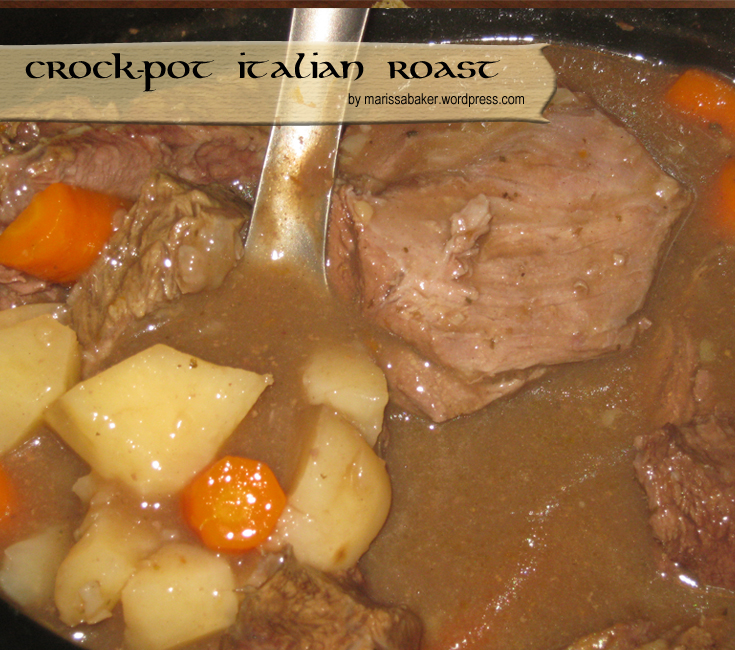
Crock-Pot Italian Roast recipe, marissabaker.wordpress.com

When we started raising our own beef, I decided it was time to experiment. So one time when I was putting a roast into the crock pot, I just started dumping spices in, added some of that red wine vinegar that was left over from a salad dressing, and thickened it to make a gravy. This is the result. My brother, who can single-handedly eat 1/3 to 1/2 of the roast by himself, tells me this is one of his favorite meals.

Crock-Pot Italian Roast

Crock-Pot Italian Roast recipe, marissabaker.wordpress.com
I love my purple crock pot. It’s so pretty

print this recipe

1/2 cup tapioca or corn starch

2 cups water

2 cups beef broth

3/4 teaspoon Italian seasoning

1/2 teaspoon black pepper

3 cloves fresh garlic, minced

3 Tablespoons red wine vinegar

1, 3-pound roast of beef, unthawed

4-5 potatoes, cut

4-6 carrots, cut

Crock-Pot Italian Roast recipe, marissabaker.wordpress.com
I add as many vegetables as the crock-pot will hold

In crock-pot, whisk the tapioca starch with about ½ cup of the water. Add the remaining water, broth, and seasonings. Whisk until thoroughly combined.

Place roast in the crock-pot. Cut enough potatoes and carrots to fill most of the remaining space in the crock-pot. Turn the crock pot on to cook at low or high heat (see below). Stir at least once in the first hour, to prevent starch from sticking to the bottom of the crock pot as it thickens.

Cooking times will vary between crock pots. As a general guide, cook on low heat for 6 to 7 hours, or until the meat is cooked through and falls apart. If speed is important, cook on high heat for about 4 hours. In this case, the roast will be less tender.

Music In My Mind

Phantom of the Opera marissabaker.wordpress.comWhen my cousin went to see The Phantom of the Opera, she was disappointed because the Phantom had a lack-luster voice. That was not the case last night at the Ohio Theatre in Columbus. Cooper Grodin turned in an amazing performance, which was well-supported by a talented cast including Grace Morgan as Christine and Ben Jacoby as Raoul.

This was my second time seeing a touring Broadway production in Columbus (the first was Wicked, last July). My sister and I are in serious danger of becoming theater addicts. We love the atmosphere (especially in a theater as lovely and historic as this one in Columbus), the excuse to dress elegantly, the quality of the music, and the set changes. Before going to Wicked, I had no idea set design was so elaborate.

One thing I love about Phantom is that since it is a play about stage actors, the audience switches from being viewers at the play The Phantom of the Opera to being part of the play as an audience for the plays enacted in the Opera Populaire. We became part of the Phantom’s opera house. Sometimes, he seemed to be singing just over my shoulder because of speakers at the back of the theater (which were only used for his character). Then, near the end when Raoul orders the doors bared against the Phantom’s escape, we heard doors shutting behind us.

Christine’s has long been one of my favorite roles to sing, and the English major in me also likes to analyze her character. From reading stage directions (included in the booklet that came with my copy of the CD), it often seems like she’s in a trance — as if the Phantom is a student of Franz Mesmer and has been practicing a form of hypnotism on Christine. She’s not mad — at least insofar that she’s not imagining the Phantom — and she’s not stupid. She, like the entire play and audience, is under the Phantom’s spell.