• You’re Not “A Temple of God.” You’re Part of The Temple Of God

    We’ve probably all heard that Christianity is about your individual relationship with Jesus. I’ve said that myself. But while God is very much concerned with the state of every individual heart and wants a relationship with you, Christianity is not an individualistic religion. We get that idea from Western culture, not from scripture.

    The Bible is written for all peoples and all cultures. But it was also written by people living in a Middle Eastern society, and those of us in the Western world can miss some things Biblical writers took for granted. It rarely occurs to us that Americanized Christianity might not be the same thing as Biblical Christianity, but our culture does color how we read the Bible and in some cases it leads to inaccurate assumptions.

    When I was reading Misreading Scripture With Western Eyes by E. Randolph Richards and Brandon J. O’Brien, one of the misconceptions that really stuck with me had to do with the verses about spiritual temples. We tend to read the verses that say “you are a temple of God” and think the “you” is singular” and treat “temple” as plural, assuming that we are each one of God’s temples. But we’re wrong.

    Confusion of Plurals

    There are three passages where Paul talks with the Corinthians about them being God’s temple. They’re 1 Cor. 3:16, 6:19; and 2 Cor. 6:16. Richards and O’Brian only talk about one of these, but I checked the others in the Greek and their point holds true for all three. They write,

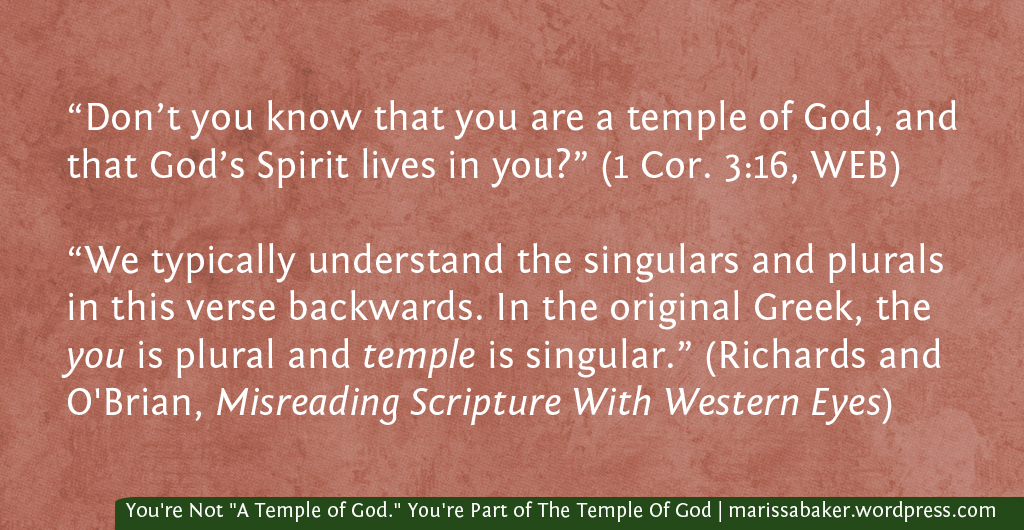
    Biblical Greek could differentiate between you singular and you plural, but we miss this in our English translations. … We typically understand the singulars and plurals in this verse backwards. In the original Greek, the you is plural and temple is singular. Paul is saying, “All of you together are a singular temple for the Holy spirit. God doesn’t have millions of little temples scattered around. Together we make the dwelling for the spirit (p. 108)

    (more…)

  • Great Is Thy Faithfulness, O Lord. But What About My Faithfulness?

    What happens when only one person in a relationship is faithful? The one who’s committed might be able to hold some kind of relationship together, but there won’t be the sort of closeness and trust they long for. There will be heartbreak, conflict, and disunity.

    It’s pretty obvious that faithfulness has to go both ways for human relationships to work well. And we don’t approve of the sort of people who would say, “You have to be faithful to me but I don’t have to be faithful to you.” But have we ever thought something similar in our relationship with God?

    We expect God to be faithful to us and keep His promises to shower us with blessings, never forsake us, and welcome us into eternal life. But do we expect ourselves to be faithful in return? We should.

    God Keeps All His Promises

    God is faithful. He is Ehyeh asher Ehyeh — I AM who I AM. We can count on Him existing forever as Himself, the faithful one who does not change (Mal. 3:6).

    If his children forsake my law, and don’t walk in my ordinances; if they break my statutes, and don’t keep my commandments; then I will punish their sin with the rod, and their iniquity with stripes. But I will not completely take my loving kindness from him, nor allow my faithfulness to fail. I will not break my covenant, nor alter what my lips have uttered. (Ps. 89:30-34, WEB)

    God is never going to break the promises He’s made or stop trying to restore broken relationships. But His promises include consequences if we are unfaithful to Him. We can’t just go about living however we want and assume it doesn’t matter to God. Our actions affect our relationship with God and can even destroy it, though His commitment doesn’t change.

    (more…)

  • Making Some New Paths In Our Minds

    One of the more helpful (for me, at least) analogies that my counselor has used as we work on my anxiety is that we can think of our minds as a big open field. As we live and grow, our thoughts travel over this field and we start to wear-down paths as we think along the same lines over and over.

    For example, little Marissa grew up in a safe, cozy home with parents who told her she was loved. So the “I am loved” thought-path got a lot of travel. It became an easy path to go down. But at some point, a conflicting message came in and it shifted the path. No longer “I am loved” without qualifiers, but now “I am loved by my family and God” because those are the ones who haven’t let me down or rejected me. And even though there’s evidence to the contrary coming from many friends, anxiety adds the idea “and no one else” to that thought-path.

    Your Brain Can Lie

    Your brain can be a dirty, rotten liar (to quote my counselor again). And while anxiety doesn’t look the same for everyone who deals with it, one of the common things it does is push your brain toward overestimating worst-case scenarios. You wear deep paths in your mental field that reinforce all the negative things and push positive ones off somewhere in the tall grass.

    And so my mind likes to wander down the “no one will accept you as your full, authentic self” path even though I have plenty of evidence to the contrary. For example, all the comments on the post where I told you about my breakup and anxiety are evidence that my brain is lying when it wants to head down that road. But that’s still what the brain wants to do. And this is also how you can end up thinking things like, “no one appreciates my contributions” when there are dozens of people who love what you’re doing but those one or two people who criticize you become the only voices you can hear. (more…)

  • Finding God In Your Heartbreak

    “God said, ‘Let us make man in our image, after our likeness’” (Gen. 1:326, KJV). I think we often think of this in a physical sense — God has hands so I have hands, etc. But perhaps the bodily similarities aren’t what God had at the front of His mind when He made this statement.

    There’s much debate over exactly what it means to be made in God’s image. The Hebrew word tselem (H6754) refers to a representation or likeness of an original. The Theological Wordbook of the Old Testament says, “God’s image obviously does not consist in man’s body which was formed from earthly matter, but in his spiritual, intellectual, and moral likeness to God from whom his animating breath came.”

    In other words, God breathed a spirit like His into man. He did not mold man from the same material as Himself (Gen 2:7). It would follow, then, that our primary method of image-bearing is in things that go beyond what we look like. And if so, we can learn something about God from things like emotions that are common to all human beings.

    Take heartbreak for example. Someone you trusted betrayed you, or you can no longer walk in unity with someone you love, or a person dear to you dies. Does God understand that feeling? Or to think of it another way, do we experience heartbreak because we’re made in the image of a God who can have His heart broken? (more…)

  • Even If You Don’t: Holding On To Hope In Dark Times

    We know God can do anything. So how do you react when He doesn’t do something that you beg him to? When your loved one isn’t healed? When your heartbreak feels unbearable and then something else piles on top of that? When you just don’t know how to go on, yet you have to anyway?

    I’ve been going through a rough patch emotionally, especially over the past few weeks but really for a few months now. And I feel like God has thrown me some songs as “lifelines” in this time. First it was “I Am Not Alone” by Kari Jobe and more recently it was “Even If” by MercyMe.

    I know You’re able and I know You can
    Save through the fire with Your mighty hand
    But even if You don’t
    My hope is You alone
    I know the sorrow, and I know the hurt
    Would all go away if You’d just say the word
    But even if You don’t
    My hope is You alone

    I didn’t much want to sing this when it popped into my head. Actually, I couldn’t at first since all I remembered was the “But even if you don’t” line. But I looked the song up, grasping for some hope to anchor my soul, and after playing through it a few times I could breath and pray again. I’ll admit, though, that there was still a part of me crying out, “Why?” when I thought about Him choosing not to take away the sorrow and hurt. And it’s okay to do that. As my counselor said, God is big enough to handle it when His kids are frustrated with Him.

    Hope is one of the key things that gets us through the times when we’re frustrated with God and don’t understand what He’s doing. And it’s something I don’t think we talk about enough. Paul tells us “faith, hope and love remain”  (1 Cor. 13:13, WEB). They’re all three virtues that aren’t going away, but we talk about faith and love a whole lot more than hope. Which is a shame, because hope is something that’s very much needed in this world. (more…)

  • It’s been hard for me to come up with Monday posts lately. I’ve actually skipped several weeks in the past few months. I have a few ideas saved, but Sunday (when I usually write Monday’s posts) rolls around and I have zero energy to write them. I can’t focus on “Avoiding ‘Us vs. Them’ Mentality When Studying Personality Types” right now. And I’m not yet at the point where I can write “Tips For INFJs Going Through Heartbreak.” But I didn’t really want to share what’s going on with me either. So I just let the posting schedule slip.

    I guess I’m going to share it now, though. My boyfriend and I broke up a little over a month ago. The cat I wrote about two weeks ago ran away the last day of March. And if you rank anxiety on a 0-10 scale (0 being none and 10 being a panic attack), mine last week was hovering at 3-4 and jumped up to a 9 one morning.  I feel like my life is unraveling and my mind keeps swirling through weird thought patterns.

    • Update: I wrote this Sunday evening and Monday morning before the blog post went live my cat came home! He was there when I woke up, hungry for food and attention. Praise the Lord, for He is good and answers prayers even about missing kitties!

    If I take a mental step back, it’s clear my life isn’t really spiraling out of control. The breakup was emotional, but we both decided we didn’t really see a future in the relationship so we agreed to end it and stay friendly. I feel terrible that I still haven’t been able to find my poor little kitty, but there wasn’t much I could do about it (wind rattled open two locked doors leading out through the garage — what are the odds?!). And I am seeing a counselor to work through my anxiety, so for the first time since my inaugural panic attack over 10 years ago I’m getting help.

    But knowing that breaking up was the right thing to do, that I can’t control whether or not my cat comes home, and that I’m working toward healing and coping doesn’t really help me feel like writing. At least not writing anything to share on this blog, other than typing up my weekly Bible studies. So that’s why there isn’t a real post today. And there wasn’t one three weeks ago.

    I almost just skipped this Monday again, too. But sometimes I think it’s good to let people know things aren’t really okay. If we all just go through life keeping up this “I’m fine, how are you?” facade, then no one gets the chance to be authentic or to experience authenticity in other people. And if we believe that everyone else is “fine,” then we can feel guilty for the times when we’re not at all fine. So it’s okay to share when you’re not fine. To stop hiding and invite people to share in your tears as well as your triumphs. Because it’s okay if I’m struggling. And it’s okay if you’re struggling, too. We’ll get through this together.