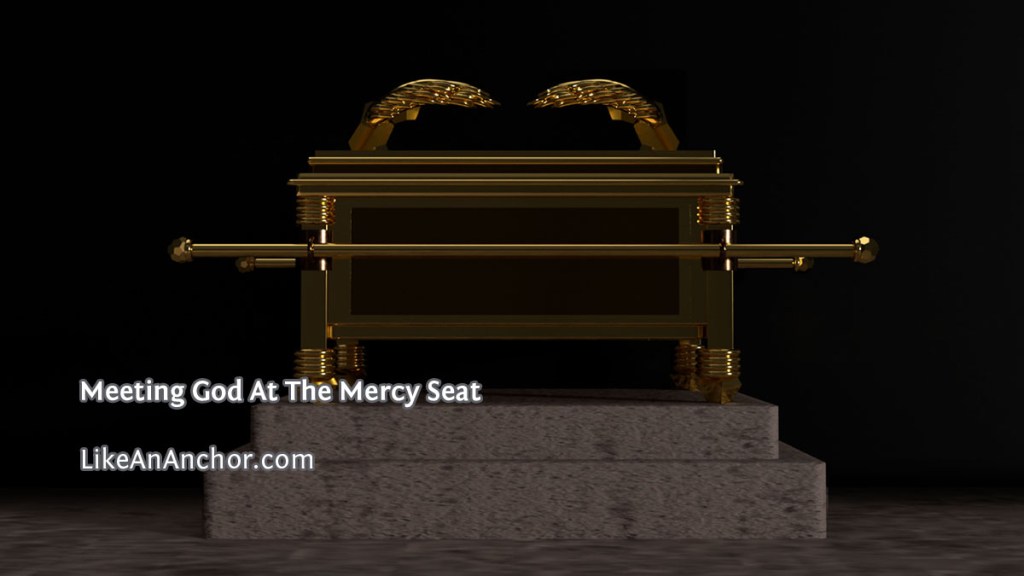
One of the Bible verses that I find both intriguing and frustrating is found in the book of Hebrews. When talking about Jesus’s role as high priest, the author reminds readers of how the earthly sanctuary in the temple was laid out. The author describes the ark of the covenant, then says, “And above the ark were the cherubim of glory overshadowing the mercy seat. Now is not the time to speak of these things in detail” (Heb. 9:5, NET).
I would very much like to know what the author would have said if they had taken the time to “speak of these things in detail.” Unfortunately, we are left with questions that we really can’t answer. We can, however, look at what else the Bible has to say about the mercy seat.
Mercy and Atonement
Our pastor made a comment in a recent sermon that prompted me to take another look at this topic. He read from Exodus 25:17-22 and pointed out that the mercy seat was centralized in the tabernacle. It’s where God met with Moses. God wanted them to remember that He speaks from the mercy seat (not a judgement seat).
You shall make a mercy seat of pure gold. Two and a half cubits shall be its length, and a cubit and a half its width. You shall make two cherubim of hammered gold. You shall make them at the two ends of the mercy seat. Make one cherub at the one end, and one cherub at the other end. You shall make the cherubim on its two ends of one piece with the mercy seat. The cherubim shall spread out their wings upward, covering the mercy seat with their wings, with their faces toward one another. The faces of the cherubim shall be toward the mercy seat. You shall put the mercy seat on top of the ark, and in the ark you shall put the covenant that I will give you. There I will meet with you, and I will tell you from above the mercy seat, from between the two cherubim which are on the ark of the covenant, all that I command you for the children of Israel.
Exodus 25:17-22, WEB
Here, “mercy seat” is the traditional English translation and has been since 1530. However, the modern NET version uses “atonement-lid” because the noun kapporet “is formed from the word ‘to make atonement.’ The item that the Israelites should make would be more than just a lid for the ark. It would be the place where atonement was signified. … The value of this place was that Yahweh sat enthroned above it, and so the ark essentially was the ‘footstool.’ Blood was applied to the lid of the box, for that was the place of atonement” (NET footnote on Ex. 25:17).
You don’t see it in English, but the connection with atonement is there in the Greek as well. In Hebrews 9:5, “mercy seat” is translated from hilasterion (G2435). This word is “related to an appeasing or expiation, having placating or expiating force, … a propitiation” (Thayer). Thayer’s dictionary further explains the word is “used of the cover of the ark of the covenant in the Holy of Holies, which was sprinkled with the blood of the expiatory victim on the annual day of atonement … hence the lid of expiation, the propitiatory.”
Linguistically, the Hebrew or Greek words for “mercy” aren’t linked to the part of the ark of the covenant we now call the “mercy seat.” However, the atonement or propitiation of our sins happens because of God’s mercy. He does not need to lift the consequences of sin off of humanity; He does it because of His great love, grace, and mercy.
Jesus at the Mercy Seat
We’re fast approaching the Day of Atonement (Yom Kippur) on God’s sacred calendar. This year, it falls on September 21. That makes this month a particularly appropriate time to consider the role of the mercy seat in God’s temple and the connection with atonement.
As my pastor pointed out in Exodus 25:17-22 , the mercy seat was centralized in the tabernacle as part of the Holy of Holies and that is where God met with and spoke to His people. The author of Hebrews tells us that “the place where” earthly priests “serve is a sketch and shadow of the heavenly sanctuary” (Heb. 8:5, NET). This means there is a mercy seat/atonement-lid in God’s heavenly realm. The tabernacle and later the temple were patterned after a “heavenly sanctuary,” and that is where Jesus performed His duties as High Priest.
And above the ark were the cherubim of glory overshadowing the mercy seat. Now is not the time to speak of these things in detail. So with these things prepared like this, the priests enter continually into the outer tent as they perform their duties. But only the high priest enters once a year into the inner tent, and not without blood that he offers for himself and for the sins of the people committed in ignorance. The Holy Spirit is making clear that the way into the Holy Place had not yet appeared as long as the old tabernacle was standing. This was a symbol for the time then present, when gifts and sacrifices were offered that could not perfect the conscience of the worshiper. They served only for matters of food and drink and various ritual washings; they are external regulations imposed until the new order came.
But now Christ has come as the high priest of the good things to come. He passed through the greater and more perfect tent not made with hands, that is, not of this creation, and he entered once for all into the Most Holy Place not by the blood of goats and calves but by his own blood, and so he himself secured eternal redemption.
Hebrews 9:5-12, NET
Jesus is the fulfillment of all those atonement sacrifices in the Old Testament and the final High Priest needed. We still keep the Day of Atonement as God commanded, but now instead of looking forward to the Messiah atoning for our sins we give thanks that Jesus serves as the only High Priest over God’s people and that the atonement He made on the heavenly mercy seat covers all sin for all time.
for all have sinned and fall short of the glory of God. But they are justified freely by his grace through the redemption that is in Christ Jesus. God publicly displayed him at his death as the mercy seat accessible through faith. This was to demonstrate his righteousness, because God in his forbearance had passed over the sins previously committed. This was also to demonstrate his righteousness in the present time, so that he would be just and the justifier of the one who lives because of Jesus’ faithfulness.
Romans 3:23-26, NET
Meeting With God
It’s significant that God chose to meet with His people from the mercy seat or atonement lid. It was so much a part of ancient Israel’s conception of God that He is frequently called the one who “sits enthroned above the cherubim” (1 Samuel 4:4; 2 Samuel 6:2; 2 Kings 19:15; Psalm 80:1; 99:1; Isaiah 37:16).
Now when Moses went into the tent of meeting to speak with the Lord, he heard the voice speaking to him from above the atonement lid that was on the ark of the testimony, from between the two cherubim. Thus he spoke to him.
Numbers 7:89, NET
Remember, normal people couldn’t just walk in to see the Holy of Holies. God could choose to appear to people outside of this space (and occasionally did), but people couldn’t just waltz in whenever they wanted to have a talk with God. There were rules separating the holy and common, rules for who could enter the temple, and rules keeping everyone but the high priest from going in where the ark was kept and even he only went in once a year. Sin separates people from God (Is. 59:1-2) and it cannot be removed except by atonement sacrifice. When Jesus died, the veil in the temple ripped in half from top to bottom (Matt. 27:51; Mark 15:38; Luke 23:45).
Therefore since we have a great high priest who has passed through the heavens, Jesus the Son of God, let us hold fast to our confession. For we do not have a high priest incapable of sympathizing with our weaknesses, but one who has been tempted in every way just as we are, yet without sin. Therefore let us confidently approach the throne of grace to receive mercy and find grace whenever we need help.
Hebrews 4:14-16, NET
Access to God opened up at the moment Jesus made the ultimate atonement sacrifice as the propitiation for the sins of all people. Through Jesus’s atoning sacrifice, we can boldly approach God’s seat of mercy and grace whenever we want. We get to meet with God freely, going directly to the Father in prayer through the name of Jesus Christ. That is an incredible privilege and gift.
Featured image by jeffjacobs1990 from Pixabay

Song Recommendation: “Mercy” by Casting Crowns


Leave a Reply