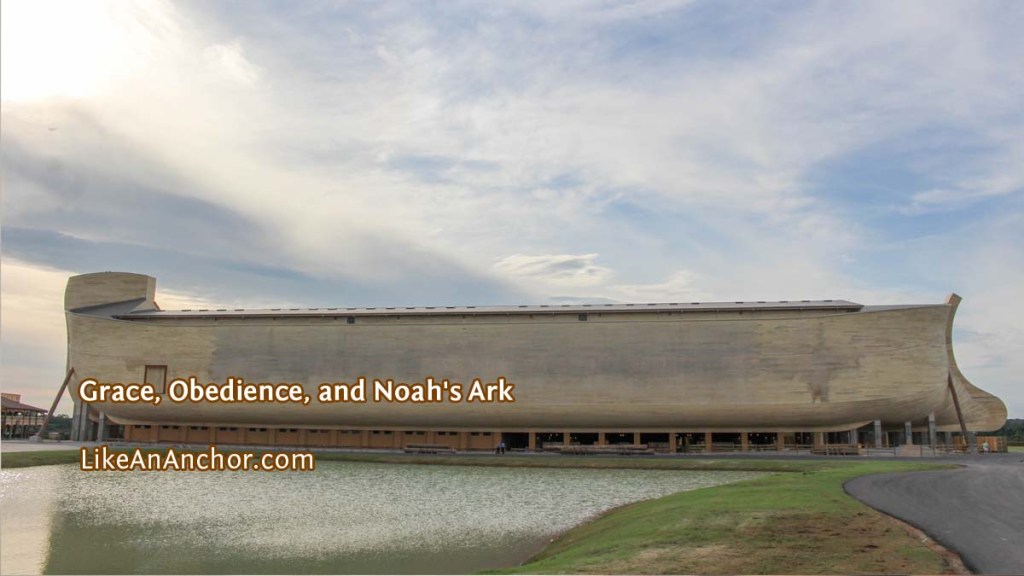
Almost a decade ago I wrote a blog post called “Grace to Build An Ark” inspired by a sermon I’d heard on grace. Even now, whenever I think of grace I think of the story of Noah.
Many Christians struggle to understand the relationship between grace and obedience, and between mercy and law. Some say that the law is done away with and grace is all that matters, while on the other extreme some say that law-keeping and obedience are the key to salvation. The story of Noah helps us understand that grace and mercy are linked with, not separate from, obedience to God’s commands.
Received Grace
Yahweh saw that the wickedness of man was great in the earth, and that every imagination of the thoughts of man’s heart was continually only evil. Yahweh was sorry that he had made man on the earth, and it grieved him in his heart. Yahweh said, “I will destroy man whom I have created from the surface of the ground—man, along with animals, creeping things, and birds of the sky—for I am sorry that I have made them.” But Noah found favor in Yahweh’s eyes.
Genesis 6:5-8, WEB
Verse 8 can also be translated, “Noah found grace in the eyes of the Lord.” The word “grace” or “favor” comes from the Hebrew word chen (H2580). In this context, the “expression ‘find favor [in the eyes of]’ is an idiom meaning ‘to be an object of another’s favorable disposition or action,’ ‘to be a recipient of another’s favor, kindness, mercy.’ The favor/kindness is often earned, coming in response to an action or condition” (NET translation note on Gen. 6:8). This might not sound like what you think of as “grace,” but it actually aligns with the New Testament well because “grace” was originally understood as part of a reciprocal covenant relationship.
The idea of “grace” as a free gift that God is obligated to give without having any expectations of the recipients was not originally part of the Greek language or of Christianity. Several centuries before Christ’s first coming and until at least the 4th century after, charis (the Greek word translated “grace” in the Bible) was understood as something that involved obligation and reciprocity ( Relational Grace: The Reciprocal and Binding Covenant of Charis, 2015, Brent Schmidt, ch. 2 and 3). This meaning infused Greek, Roman, Jewish, and later Christian society to the point that everyone knew “receiving charis implied entering into reciprocal covenantal relationships” (Schmidt, p. 63).
With that background, we can see the similarities between us and Noah. We live in a world full of people who don’t follow God, but God has offered us grace and a relationship with Him. This grace is not something we could earn and God offers it freely, but He does expect a specific response after He makes the offer.
Received Instruction
Noah found favor/kindness/grace in the eyes of the Lord. God then moves to provide Noah with salvation, and He does it by giving Noah specific instructions to follow.
This is the history of the generations of Noah: Noah was a righteous man, blameless among the people of his time. Noah walked with God. …
God said to Noah, “I will bring an end to all flesh, for the earth is filled with violence through them. Behold, I will destroy them and the earth. Make a ship of gopher wood. You shall make rooms in the ship, and shall seal it inside and outside with pitch. This is how you shall make it. …
Everything that is in the earth will die. But I will establish my covenant with you. You shall come into the ship, you, your sons, your wife, and your sons’ wives with you. …
Thus Noah did. He did all that God commanded him.
Genesis 6:9, 13-15, 17-18, 22, WEB
God told Noah exactly how to build the ark and what to put in the ark. This is very much like what He does with us when He tells us what He expects from people who accept salvation through Jesus Christ. The salvation would not happen without God, yet at the same time He expects us to be active participants in the process of our salvation.
Learning about how God extended grace to Noah, brought salvation to him and his family, and expected obedience to His commands help us understand the similar process that God invites us into. Grace and salvation come to us through Jesus Christ, and we need to accept that salvation the way Noah did: by trusting God, listening to His instructions, and doing what He says.

ARC team applications for my new book are now open!
If you like reading and reviewing Christian historical fiction, click here to learn more about receiving a free advance copy.
Featured image by Greg Reese from Pixabay

Song Recommendation: “Grace Upon Grace” by Matthew West


Leave a Reply