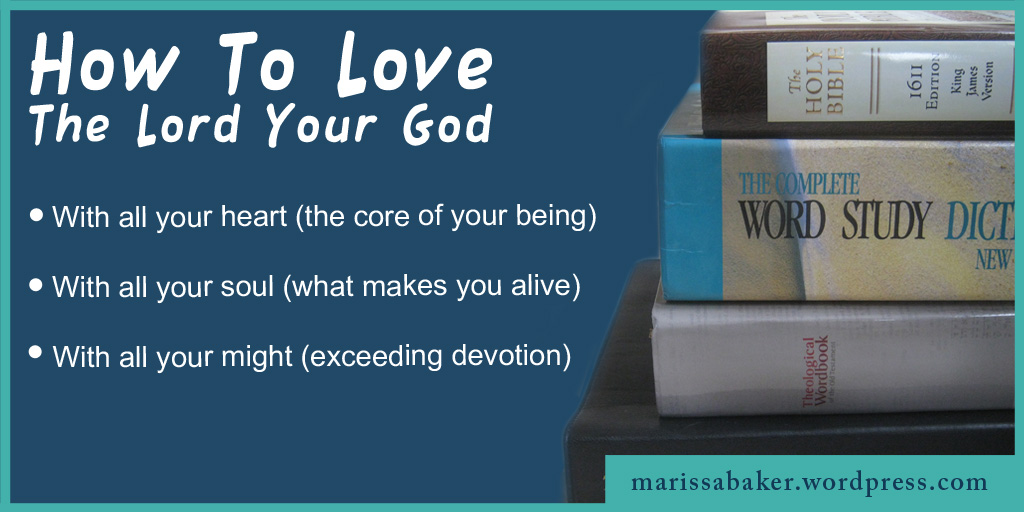
• How To Love The Lord Your God

    Jesus told us “The first of all the commandments is: ‘Hear, O Israel, the Lord our God, the Lord is one. And you shall love the Lord your God with all your heart, with all your soul, with all your mind, and with all your strength.’ This is the first commandment” (Mark. 12:29-30).

    Even though this commandment forms the basis of all other commands and is most important for us to remember and obey, it can also be easy to overlook. It sounds so simple: “Love God, check. Yup. I’m good.” But Jesus went into more detail than just “love God.” He started out by reminding us Yahweh is echad. He is united, preeminent, and the only one worthy of the title Lord.

    With that reminder in place, Jesus goes on to quote an Old Testament passage telling us how to love God. The way we should love our Lord isn’t left up to our imagination or emotions. We’re told what we’re supposed to do.click to read article, "How To Love The Lord Your God" | marissabaker.wordpress.com

    With All Your Heart

    As today, most people in Jesus’s day didn’t just think of the heart as a muscle pumping blood. It was seen as the “seat of emotions” and the core of your “inner man” (labab, H3824). In Greek, kardia metaphorically referred to the “center of all physical and spiritual life” and the “fountain and seat of thoughts, passions, desires, appetites, affections, purposes, endeavors (G2588, Thayer). That’s the first way we’re supposed to love God — with all our emotions, thoughts, and yearnings that come from the very core parts of who you are inside. (more…)
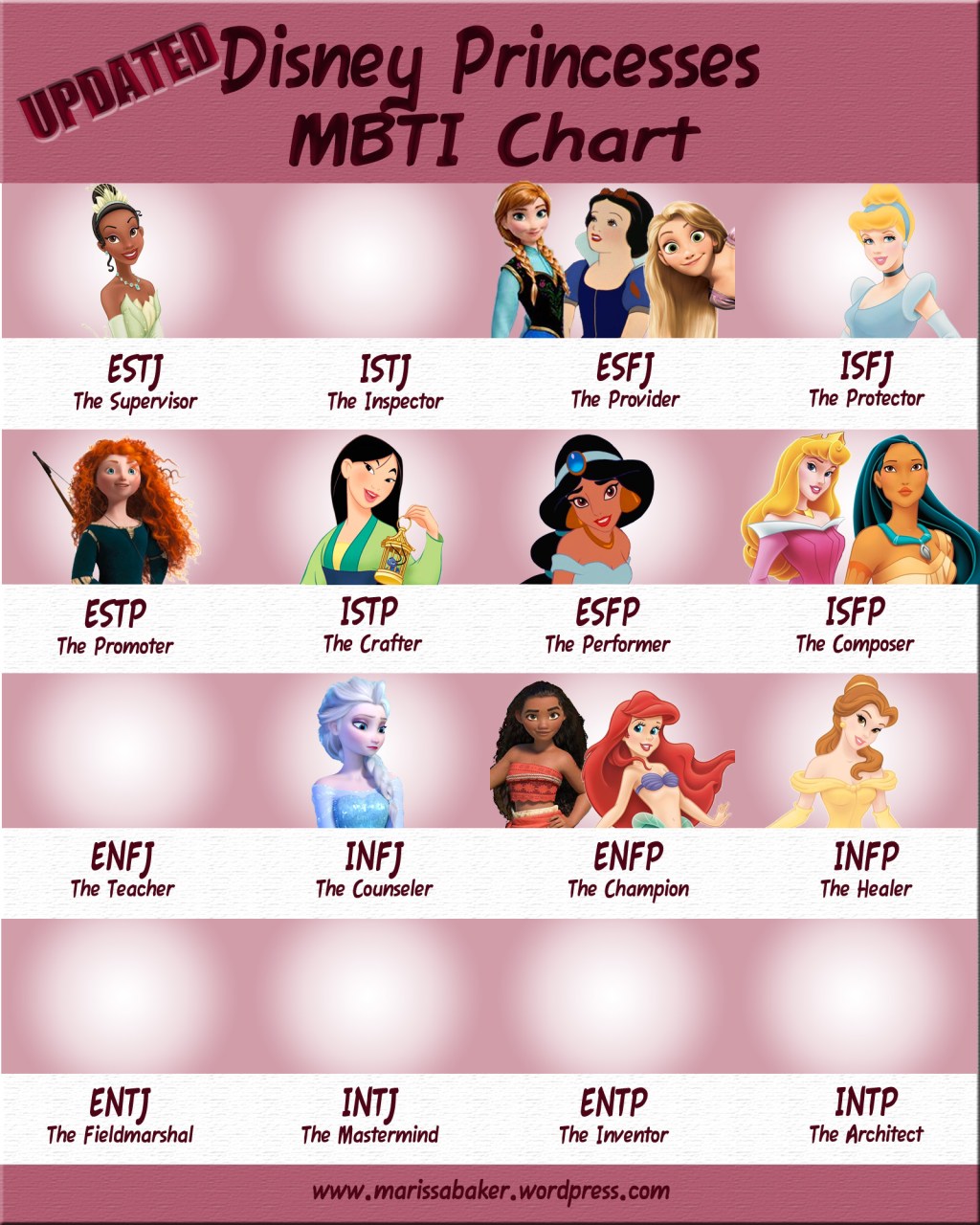
  • Updated Disney Princesses MBTI Chart

    A couple years ago, I made a Myers-Briggs chart called The Missing Disney Princesses that quickly became one of the more popular posts on my blog. Now (finally!!!) I get to update it to include our new princess, Moana.

    But I’m not just adding Moana to my chart. I’m also moving around a few of the other princesses. Last time, my focus was on showing that we don’t see all the personality types represented by the Disney princesses. Both Intuitive and Thinking types are under represented among Disney’s ladies. That’s still the case, but this time my focus is on explaining why I typed each princess the way I did.

    In the two years since publishing the last chart, I’ve learned more about Myers-Briggs typing. I’ve also re-watched several of these movies, considered comments from readers on the previous post, and asked advice from fellow personality type and Disney enthusiasts. In response, I’ve re-typed several characters (which is noted and explained in the individual character discussions).Updated Disney Princesses MBTI Chart | marissabaker.wordpress.com

    Note: I type using cogitative functions. If you’re not familiar with that aspect of Myers-Briggs theory, click here and here for a two-part introduction. Read on for detailed explanations for why I chose these types for each character. (more…)

  • Our Feelings Don’t Define God’s Truth

    “Do what feels right.” “Follow your heart.” That’s the sort of advice we’ve steeped in living in Western culture. Problem is, that’s not really good advice. Sometimes your heart is wrong. Sometimes what feels good isn’t right.

    Speaking more specifically to Christians, one of the hard truths we need to learn is that something can feel okay to you yet still be a sin in God’s eyes. Just because you’re okay with something doesn’t mean God is. And, on the flip side, your dislike of something doesn’t make it a sin. In short, how we feel does not define God’s truth.

    God defines truth. Those truths are contained in His word (John 17:17), His law (Ps. 119:142), and His commandments (Ps. 119:151). Either you accept His standards as the basis for truth, or you’re not a Christian. You might be a decent sort of person on the whole, but you’re certainly not a follower of Christ. The Bible is our main link with God. It’s how He has revealed Himself to us. Rejecting the standards outlined in God’s word means we reject His mind and block the Spirit’s work to enlighten and transform us.click to read article, "Our Feelings Don't Define God's Truth" | marissabaker.wordpress.com

    A Simple Test

    Accepting an outside source as our ultimate authority doesn’t sit well with modern society. We tend to focus on individual freedom and self expression to the exclusion of objective morality. But the Bible says “Cursed is the man who trusts in man and makes flesh his strength, whose heart departs from the Lord” (Jer. 17:5). A heart following its own desires is moving away from God.

    (more…)

  • Don’t Hate Me For Rejecting Your Holiday

    The season touted as “the most wonderful time of the year” is my least favorite. I’ve found a few things I can appreciate about December (BBC specials, Star Wars film releases, Hanukkah, sales on baking ingredients). But mostly the unrelenting holiday cheer blaring from radios and dripping from public locations tries my soul.

    Even though I don’t keep Christmas I try not to be a Grinch about it (which, by definition, means a person “who is mean-spirited and unfriendly” and “spoils or dampens the pleasure of others”). If you wish me a “Merry Christmas” I’ll just smile and thank you. I might even appreciate it because I understand the sentiment behind your greeting. I’m certainly not going to launch into a rant about how much Christmas offends me or how insensitive you are to assume everyone keeps Christmas.

    But for some reason, not enjoying/keeping Christmas  horrifies some people. In an age where people go nuts if someone tries to “cram your religion down my throat,” you can still be shamed for not keeping Christmas. And I think that’s weird. Don't Hate Me For Rejecting Your Holiday | marissabaker.wordpress.com

    Here’s one example of people “grinch-ing” someone for not being Christmassy enough. Yesterday I saw an article from Young Conservatives critiquing the fact that the Obama’s final White House Christmas card doesn’t feature the White House and wasn’t explicitly Christmas related. “It’s basically a ‘Holiday’ card,” they wined, “because writing the word ‘Christmas’ would hurt too many feelings.” Apparently, their feelings were hurt by the leader of a very diverse country trying to cover all the winter holidays observed by the people he’s leading.

    It’s not just articles from biased political sites about public figures. It’s the unrelenting Christmas music for a full month on the radio. It’s the pressure to enjoy the decorations and participate in the “spirit of Christmas.” It’s when you say don’t keep Christmas and someone shoots back “Couldn’t you just go caroling?” or “Don’t you love Jesus?”

    I don’t really deal with much pressure to keep Christmas. Most of the people I attend church with don’t keep Christmas either (a few Messianics do, but most people I know gave up Christmas when they discovered God’s holy days). When people ask, I’ll explain why I don’t keep Christmas. Mostly, though, I just try to ignore it. But I still see people, mostly online, talking about Christmas and shaming those who don’t get into the seasonal spirit. I don’t care if you want to keep Christmas. I’d just like a little space peacefully not keep it without being bombarded with holiday cheer that makes me feel anything but merry.

    Save

    Save

    Save

    Save

  • Grace To Build An Ark

    Grace To Build An Ark

    When we think of “grace” we typically throw out definitions like “unmerited favor,” “free gift,” and “unearned salvation.” And those concepts are certainly included in the meanings of the Hebrew chen (H2580) and Greek charis (G5485). Both words translated “grace” are about good things we don’t deserve being graciously given to us by God.

    But we also tend to make assumptions about God’s grace that aren’t necessarily found in scripture. For example, we assume that because the favor is unearned there aren’t any expectations laid on those who accept it. We think because the gift is free it can’t be revoked, rejected, and/or lost. We project cultural and traditional assumptions onto scripture that can cloud the meaning.

    Several weeks ago, a Messianic Rabbi gave what’s probably the best message I’ve ever heard on grace (click here to listen to it). My goal in this post isn’t to share his entire message, but to narrow-in on one of the points he made that really captured my attention.click to read article, "Grace To Build An Ark" | marissabaker.wordpress.com

    Saved By Grace

    The very first time we see the word “grace” in the Bible is in reference to Noah. At this time, God looks down from heaven and sees “the wickedness of man was great in the earth, and that every intent of the thoughts of his heart was only evil continually” (Gen. 6:5). For that reason, God chose to bring judgement on the earth in the form of a flood. “But Noah found grace in the eyes of the Lord” (Gen. 6:6). (more…)

  • The Problem of Being Too Agreeable

    INFJs place a high value on interpersonal harmony. Often, that manifests (especially in less mature/confident INFJs) as an unwillingness to just flat-out turn someone down. We’d much rather use “maybe,” “someday,” and “that might be nice” rather than “no,” “never,” and “I don’t think so.”

    But that can back-fire on us and create discord in friendships. Other types can interpret our “maybes” as commitments, then get upset at us for breaking our word. Or they might recognize that we’re brushing them off and become frustrated by our refusal to give them a direct answer. Our attempts to avoid conflict can actually make things worse.

    click to read article, "The Problem of Being Too Agreeable" | marissabaker.wordpress.com
    Photo credit: “Smile Harder” by Kevin Galens, CC BY-SA via Flickr

    Last week, we talked about one problem that can plague INFJ friendships — the fact that we have a tendency drop out of contact with our friends. It’s fairly easily explained from the INFJ’s perspective, but it can have an unintentional affect of hurting the people around us. Another similar (and in some ways related) problem is our temptation to noncommittally agree with what we think people want to hear, then ignore them and hope they forget about it. (more…)