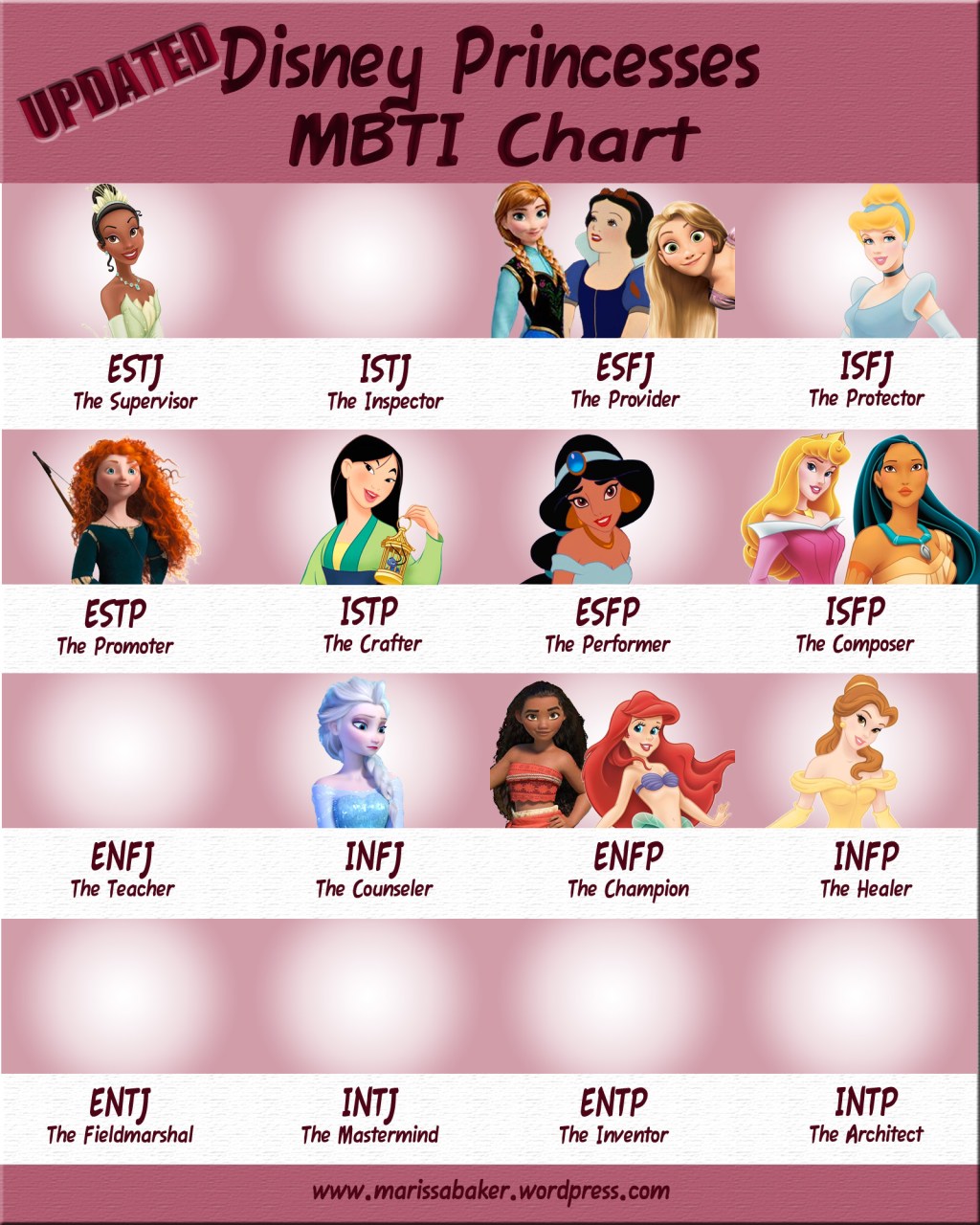
A couple years ago, I made a Myers-Briggs chart called The Missing Disney Princesses that quickly became one of the more popular posts on my blog. Now (finally!!!) I get to update it to include our new princess, Moana.
But I’m not just adding Moana to my chart. I’m also moving around a few of the other princesses. Last time, my focus was on showing that we don’t see all the personality types represented by the Disney princesses. Both Intuitive and Thinking types are under represented among Disney’s ladies. That’s still the case, but this time my focus is on explaining why I typed each princess the way I did.
In the two years since publishing the last chart, I’ve learned more about Myers-Briggs typing. I’ve also re-watched several of these movies, considered comments from readers on the previous post, and asked advice from fellow personality type and Disney enthusiasts. In response, I’ve re-typed several characters (which is noted and explained in the individual character discussions).
Note: I type using cogitative functions. If you’re not familiar with that aspect of Myers-Briggs theory, click here and here for a two-part introduction. Read on for detailed explanations for why I chose these types for each character.
Anna – ESFJ
 This is probably my most unpopular typing choice, so I’m going to spend some extra time on Anna. Literally everyone else types her as an ESFP or, more rarely, and ENFP. But I really think ESFJ is a better fit and here’s why.
ESFJs lead with a function called Extroverted Feeling (Fe, or “Harmony”). Fe is a decision-making process that’s concerned with connection and meeting other peoples’ needs. Throughout Frozen, we constantly see Anna prioritizing connection and putting others’ needs before her own. (In contrast, ESFPs lead with Extroverted Sensing. They can be people oriented, but their primary mental process is more concerned with sensation experiences than harmonious connection.)
When Anna laments her isolation, it’s not all about the things and experiences she feels like she’s missing. Her focus when young is on convincing Elsa to be her friend again, and then later after accepting Elsa wants left alone she is excited by the prospect of meeting everyone else. In particular, she wants to meet “the one.” Healthy, mature ESFJs are more cautious, but one that’s desperate for connection might jump into a relationship with a master manipulator like Hans (an ENFJ) who knows exactly which buttons to push.
You’ll notice her Harmony lead throughout the film. She’s concerned with where to stand at the party so she doesn’t make Elsa uncomfortable. She puts up with dancing with Duke Weselton because it’s polite and expected. She won’t let Kristof warn Olaf about summer because it would hurt his feelings. Her only plan for stopping Elsa is talking and forming a connection with her sister. She believes “no one wants to be alone.” She asks Kristoff, “Are you going to be okay?” while she’s dying.
I was once told Anna is far too clumsy to be an ESFJ. Remember their sensing is introverted — it’s about subjective impressions of the real world (click to visit a post with a great discussion of Si in the comments). That argument about clumsiness does help rule out ESFP, though (Extroverted Sensing types are the ones most in-tune with their physical bodies and environments). It could fit ENFP, but clumsiness isn’t enough to type a person. Anna doesn’t want to explore, push buttons, or try things just to see what will happen. She wants to build lasting connection.
And her less-developed functions fit as well. When she’s stressed out or uncomfortable, you see tertiary Introverted Intuition and Inferior Introverted Thinking as she talks before thinking (“This is awkward. Not ‘You’re awkward.’ But just ’cause we’re… I’m awkward. You’re gorgeous. Wait, what?”) and panicking about the future (“Ohh, what am I gonna do?ǃ She threw me out! I can’t go back to Arendelle with the weather like this! And then there’s your ice business, and–!”). Yup, I’m pretty convinced ESFJ is Anna’s best-fit type.
Ariel – ENFP
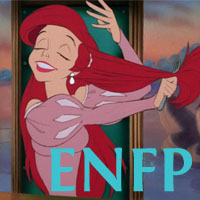 Most people type Ariel as an ESFP or an ENFP. After much deliberation, I decided to go with ENFP this time. Typing her is complicated by the fact that she’s only 16 and it doesn’t appear she’s had much encouragement to “grow up.” I wouldn’t describe her as a particularly mature version of either type.
Her rebelliousness, impulsiveness, insistence on living her own life, and obsession with experiencing another world could be traits of either ExFP type. And it can be hard at times to tell whether she’s so interested in the human world because she wants new sensory experiences or because she wants to explore and gather knowledge. But ultimately, I think it comes down to the fact that Ariel isn’t interested in experiencing her here-and-now world so much as she is with expanding her horizons. She’s “pushed all the buttons” in the world below the seas and how she needs to explore something new.
Aurora – ISFP
 This typing is more of a hunch than anything else. Aurora is only on screen for 18 out of the 76 minute film and only has 18 lines of dialogue. Because of that, I’m mostly relying on general impressions of her and how that fits with broad, stereotypical descriptions of the different types.
ISFPs like to work with people and meet their needs, but are generally quiet and reserved. Isabel Myer says they often “have a special love of nature and a sympathy for animals,” which we do see in Aurora. Like other SP types, they work well with their hands and are in tune with external sensory details (including things like music). Given what we know about her, I think ISFP is the “best fit” type.
Belle – INFP
 Beauty and the Beast is still my favorite Disney film and I identify with Belle so much even though we’re not the same type (click here for a great article on the differences tween INFJ and INFP types).
I wrote in my previous Disney Princess post that INFPs value internal harmony and have deep feelings that are rarely expressed to other people. They often seem like outsiders in their society and are more concerned with their inner moral code than with external expectations. Even so, they interact well with other people and are very loyal. It still seems a perfect description of Belle.
INFPs lead with a mental process called Introverted Feeling (aka “Authenticity”). It’s a decision making function that is deeply in touch with the person’s own feelings. They make decisions based on an internal sense of right and wrong, and Personality Hackers says that “often an INFP won’t know the right decision to make until after they’ve made it.” I think that’s what happens when Belle offers, “Take me instead.” You can see her thinking about it, offering to take her father’s place, and then after she says it being very decided about her choice.
As an intuitive, Belle is interested in abstract patterns and conceptual ideas. Intuitives only make up about 30% of the population and, assuming that translates into the world of Beauty and the Beast, it’s no wonder she seems out of place and “odd” to the villagers (as does her father, who’s probably an INTP). INFPs use Extroverted Intuition, and Belle perfectly models why it’s nicknamed “Exploration.” She can’t just stay locked up in her palace room or stick to Cogsworth’s tour — she has to see what’s out there and do as much “button pushing” as possible.
Cinderella – ISFJ
 I wrote about Cinderella as an ISFJ after the live-action film came out. Though it’s a different film, many of the same arguments apply, so I’ll just direct you to that post (click here).
Elsa – INFJ
 For many INFJs, Elsa is the quintessential example of this personality type in fiction. Or, as I hear more often, “she’s my spirit animal.” Non-INFJs often type her as an ISTJ or INTJ, though, so let’s take some time to look at her type.
The thing about Elsa (click here to read my post about her) is that she’s been told not to develop her feeling side and she spends most of the film in stress-mode. When people look at her and see signs of a Thinking process, they’re seeing her unhealthy Introverted Thinking desperately trying to cope. Like many INFJs when they’re hurt and stressed, Elsa decides the solution is shutting people out. As is typical for Intuitives in the grip of their inferior Sensing, she isolates herself and becomes angry, suspicious, and hostile.
Elsa’s powers are controlled by her emotions. She’s extroverting her feelings in the most literal, tangible way possible. When her parents tell her “conceal, don’t feel” they’re actually crippling her only way to control her powers. Denied her feeling side, Elsa gets trapped in an Ni-Ti loop that builds a completely subjective reality. When she learns to express her feelings in a healthy way, she also learns to control her powers. And at the end of the movie we see a glimpse of what gives INFJs their reputation as one of the more social introverts — a promise to never close the gates again.
Jasmine – ESFP
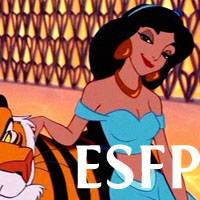 This re-typing is basically me admitting I totally dropped the ball last time. I said Jasmine was an ENTP (I cringe now thinking about how off-base that was). In my defense, though, she’s a hard character to type. This is one character I had the chance to chat about with other type enthusiasts, and I think we narrowed it down to her best-fit type.
Jasmine’s insistence on living her own life, longing to be seen as herself rather than an abstract prize to be won, and her ability to understand Aladdin’s motivation for lying to her all point to her using Introverted Feeling (aka “Authenticity”). She wants others to respect her individuality even if they don’t understand it and she’s willing to respect other’s decisions (even when Aladdin’s choice at the end to “stop pretending to be something I’m not” would take him away from her). When she’s using a more impersonal, decisive decision-making process, it’s outward focused (an ESFP has Extroverted Thinking as their tertiary function).
Jasmine’s impulsiveness could (like Ariel’s) be a sign of either Extroverted Sensing or Extroverted Intuition. Unlike Ariel, though, Jasmine isn’t concerned with seeing what could happen. She doesn’t want to miss out on what is happening. And so she runs away from home without a plan and immediately immerses herself in the marketplace. She pole-vaults the space between rooftops. She goes back to Aladdin’s place with him right after they meet. She takes off with Prince Ali when he offers her a magic carpet ride. She’s eating up new experiences without worrying about consequences.
I’m going with ESFP for Jasmine instead of ISFP because I feel like Se is her most dominant function. This type is also known as the Performer, a role we see Jasmine playing when she leads Ali on for a while on the balcony (before verbally attacking him) and in the performance she puts on to distract Jaffar. Choosing this type also puts Extroverted Thinking as her tertiary function (which we glimpse when she makes decisive, impersonal decisions and threatens Jaffar) and Introverted Intuition as her shadow function (which typically shows up under stress as impulsiveness, irritability, and paranoia).
Merida – ESTP
 Merida is a strong example of a type using Extroverted Sensing. She excels at skills requiring hand-eye coordination and has an adventurous spirit (archer, rock climbing, horseback riding). You’ll also see other examples of this. For example, she believes in magic because she saw a wisp and therefore it’s true. What’s real and observable is what’s real to her, not what could be or anything abstract (as would be the case with an intuitive type).
I’m torn between typing her as an introvert or an extrovert (click here for an analysis of ESTP vs ISTP). But she is very focused on the external world and she’s still very young. ESTPs are often natural leaders, and I think Merida will show that in time (I suspect this strength was hidden by her resistance to be the type of leader her mom wanted her to be. When her mother starts encouraging Merida to lead as herself, she’s able to stop violence between the clans with a speech).
Being an ESP type means Merida either uses Introverted Feeling or Introverted Thinking for her secondary mental process. Fi types are concerned with being the most authentic versions of themselves and making decisions based on emotional criteria. Ti types are more concerned with making sense of something for yourself and checking new information against previous convictions. When Merida is not stressed, I’d say she’s more interested with accurate information (which then feeds in to the actions she takes) than with authentic self-expression. When she does make emotional decisions, she’s using less-developed tertiary Extroverted Feeling. It’s fitting, then, that the worst decision she makes in the film is the one fueled by emotion and lack of information (asking a witch to change her mother). The best decisions she makes are the ones where she analyzes available information and acts on it (figuring out the spell’s history, mending the tapestry, and saving her mother).
Moana – ENFP
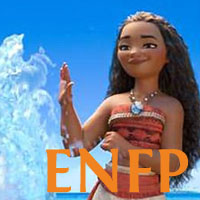 Moana gives us another Disney princess who’s an ENFP personality type. She’s much more responsible than Ariel, and I’d say this is largely due to her upbringing with two stable parent figures who encouraged her to find her place in her village (whereas Ariel was a bored, spoiled princess).
Note: mild spoilers Follow for Moana. Even as a child, Moana demonstrates the constant possibility seeking characteristic of types leading with Extroverted Intuition. As she grows, she continues to focus on what could be more than what is. Even when dealing with the day-to-day realities of the village, she thinks outside the accepted box. For example, when a villager’s repeated attempts to re-thatch a leaky roof don’t work, she explores different solutions and finds out it had nothing to do with the thatch. She also uses possibility to encourage others.
Moana’s Introverted Feeling, also called Authenticity, is core to the story. “Find who you are” and “Be who you are” refrains echo throughout the film, reinforcing a focus on staying true to inner perceptions and acting in a way aligned with one’s personal beliefs. Though Moana tries to fit into the village and be who’s she’s told to be, her discovery of the ships in the caves overjoys her because it validates the inner self she’s been building. Once she learns that what feels right also has outside support, there’s no stopping her heroic journey.
An ENFP leads with Extroverted Intuition, has Introverted Feeling as a copilot, and their tertiary process is Extroverted Thinking. Most young ENFPs wouldn’t use this much, but we do see hints of it in Moana. The decision-making function she presents to the outer world is blunt, factual, and non-nonsense. Unlike an Extroverted Feeling type, who would try to fit their presentation style to the audience, Moana with her blend of Fi and Te bursts into a village meeting and announces that they have to go voyaging and fix things. She’s puzzled when what’s perfectly obvious to her is shot-down in favor of traditional “this is how we’ve always done things.”
That leads us to her inferior function, Introverted Sensing. While it’s in her function stack, it’s more of a blind spot than a strength. She’s never going to be the type of leader who prioritizes tradition or works to maintain the status quo. I suspect she’ll learn to value that in other people, but she’ll always be the exploration-leading wayfinder.
Mulan – ISTP
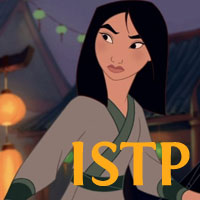 People generally type Mulan as either an INFJ (which she’s definitely not), ISFP, or ISTP. Those last two types both lead with an introverted judging function (feeling or thinking) and interact with the outer world using auxiliary Extroverted Sensing. That’s the easiest to see, since it’s directed toward the outer world and is therefore observable.
SP types learn through interacting with their environment and generally excel at physical tasks. Though Mulan struggles with training at first, remember she’s been discouraged from developing these types of skills her whole life and still becomes one of the best fighters in the time it takes the entire group to pass basic training. That indicates an aptitude for sensory skills. She’s also driven by a need to take action that affects the real world. It’s not the sort of button-pushing an extroverted intuitive would do just to see what happens — she’s either exploring real things she doesn’t yet understand or taking action that she knows will lead to a predicted outcome.
When Mulan fires the cannon into the mountain to start an avalanche, several things happen. She’s taking observations about the physical location (Se), analyzing the possibilities with her introverted judging function (Ti), predicting what will happen with tertiary intuition (Ni), and then taking action (Se). That all happens in a moment, but it’s a great snapshot of how her mind works.
It’s hard to pin-down which introverted function she’s using. We see her pondering her choices, but we’re not privy to what’s going on in her head. We have to ask two questions: Is she leading with a logical function that is checking for the most accurate solution (Ti), or with an emotional function searching for what feels right (Fi)? And is her mostly subconscious “stress function” manifesting as emotional outbursts (Fe) or as excessive criticism and convoluted logic (Te)?
As you can see, I went with dominant Ti and inferior Fe. The decisions she makes don’t seem based on trying to be true to herself. She’s taking the most logic steps she can to protect her father and act with honor. Her struggle to fit in as a typical woman in her culture also points to her being a Thinking type (Feeling traits have traditionally been seen as more feminine). The one time we see her snap at someone (her father) it’s while using an emotional argument in away that a type with less-developed Fe might. And on a healthier level, inferior Fe would explain her attachment to duty and honor better than an Fi/Te combination.
Pocahontas – ISFP
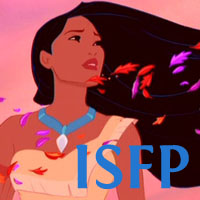 I’d previously typed Pocahontas as an INFP. Both types use Introverted Feeling (or Authenticity) as their driver process. This is the aspect of Pocahontas’ personality we see when she checks-in with her inner core to align her every decision with what matters to her.
You’d think it would be easy to tell the difference between Extroverted Sensing and Extroverted Intuition. One’s focused on experiencing sensations in the outer world, the other’s interested with exploring possibility. But let’s take “Just Around The Riverbend” as an example. Is Pocahontas interested in seeing what lies ahead and not tying herself down to Kokoum because she doesn’t want to put bounds on her in-the-moment experiences of the new and exciting (Sensing), or because she doesn’t want to risk missing out on exploring new and novel ideas and discovering patterns in the outer world (Intuition)?
With more careful consideration, I think it’s Extroverted Sensing. She’s mainly focused on what’s happening now. She lives in the moment (a key concept of “Colors of the Wind”), without worrying all that much about future concerns (like what will happen when her tribe finds out about John Smith). Introverted Intuition is an ISFP’s tertiary function, so we do get some of that showing up (that’s what people typing her as an INFJ see), but the aspect of her personality presented to the outer world is fun-loving and sensation seeking.
Rapunzel – ESFJ
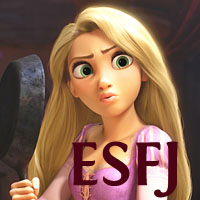 I thought I didn’t need to re-watch Tangled because I had Rapunzel typed as an ENFP. Then I did a quick Google search for others typing her that way and couldn’t find any. Nada. Zip. So I re-watched the film last night and re-typed her right before scheduling this post.
#1: there’s no way an ENFP would stay in that tower for nearly 18 years. There’s a reason Personality Hacker nicknamed Extroverted Intuition “Exploration.” Even a scared, intimidated ENFP would have at least left the tower and explored the hidden valley.
#2 Rapunzel is using Extroverted Feeling to make decisions, not Introverted Feeling. The whole reason she stays in the tower so long is to maintain her relationship with her mother. And when she finally does decide to leave, she sets things up carefully so (if her plan had worked) her mom wouldn’t have learned Rapunzel ever did something to damage the relationship. And her vacillating feelings about leaving her tower are a hallmark of the guilt Fe types feel when they put their desires over maintaining Harmony in their relationships. Even her desire to have “life begin” isn’t about being true to her core self or doing what feels right — it’s about filling her role in the world.
More support for her using Fe comes when we see her interact with other people. She instantly connects with others on an emotional level and soon has all the ruffians at The Snuggling Duckling singing, Maximus working with her and Flynn to fulfill her dream, and the entire town dancing in unison.
I have seen her typed as and ENFJ, another type which uses Fe as their primary function. But Ni is about pattern recognition and figuring out what’s “behind the curtain.” And I don’t see Rapunzel doing that. When she’s exercising an intuitive function, it’s Ne (lead function for ENFPs and tertiary for ESFJs). But in general, she’s displaying classic SJ type traits. She’s organized and follows a routine to keep herself busy and productive. She’s willing to stand up to her mother only when it compromises her principles, but is also willing to sacrifice her freedom to save Flynn. Once she learns about her past, she’s convinced she needs to find her real family and fill her traditional role as princess.
Snow White – ESFJ
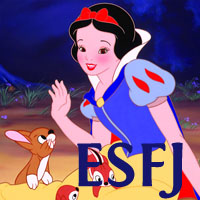 Poor Snow White isn’t as nuanced and fleshed-out a character as many of the later princesses. She’s mostly a feminine stereotype. And she’s only 14 years old, which means her personality type might be hard to pin-down anyway since she’s so young. A female character in 1937 intended to serve as a model for young girls would most likely be the “feminine ideal.” I’m not saying all ESFJs fit that stereotype, but there is overlap in the descriptions.
I can’t find the study I’m thinking of right now, but I’ve seen people online talk about how ESFJ has long been considered the ideal sort of personality for women in the U.S. Broadly speaking, that does seem to be the case. And Snow White fits the most stereotypical ESFJ woman. She’s just extroverted enough to maintain warm friendships and is mothering and domestic (both related to dominant Extroverted Feeling). She’s comfortable with tradition and has no desire to upset the established order (typical of SJ types). It’s not an ideal way to type characters, but I think it’s the best we can do in this case.
Tiana – ESTJ
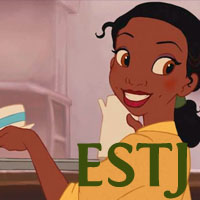 I’ve shifted Tiana over from ISTJ to ESTJ for this new chart. After re-watching the film, I feel like she’s leading with her Extroverted Thinking function, rather than leading with the Introverted Sensing side. She’s never shy about sharing her thoughts on a given topic. She’s assertive and expressive in the face of friends, creditors, and villains alike. She has no trouble sharing her judgements (“When I’m a human being, at least I’ll act like one”) or with making decisive decisions. And her dream involves creating a business that will immerse her in the outer world and means constantly working with people.
With her strong work ethic, family-focus, and adherence to doing what’s right, Tiana is strong example of the SJ Guardian types. But she’s also not just a SJ steriotype. Many people assume types using Introverted Sensing as one of their functions are unimaginative, solidly traditional, and somewhat boring. That’s far from being true.
As one reader pointed out in a comment on my Introduction To Cognitive Functions, “Si is difficult to explain because it’s different in every person who uses it — a cognitive process entirely shaped by that individual’s framework of reality.” Like other Sensing types, SJs are concerned with taking in information about the world around them. But they’re also interpreting that information in a highly subjective way.
And so you get Tiana, building up a dream of the future that’s doesn’t look practical to outside observers, but makes perfect sense within her framework of reality. Her dream is solid, detailed, planned, and responsible. And she also has another unexpected marker I’ve noticed in SJ types — they are, as Naveen observes, “secretly funny.”
Feel like someone’s missing?
I’ve included several of the “unofficial” Disney princesses on a separate chart (though, technically, there are three unofficial princesses on this one — Elsa, Anna [Frozen made so much money they have their own line] and Moana [who hasn’t been crowned yet]). Click here to read Part Two of this post.


Leave a comment