• Love On Fire

    Sometimes, Bible study ideas can come from an unexpected source. One of the speakers at our Feast of Tabernacles site last month was a man whose messages rarely catch my attention, but he gave an excellent sermonette about falling in “true love” with God.

    Though the holy days for this year are several weeks in the past, these subjects are relevant year-round. Since the Feast, or Sukkot, pictures Christ’s millennial reign, it’s also connected with the marriage to His church, which takes place a little earlier. We will be living and reigning with Jesus as His bride, teaching and serving alongside Him (Rev. 20:4). But first, we have to get there.

    Love On Fire | marissabaker.wordpress.com
    photo credit: Indi Samarajiva, CC BY via Flickr

    True Love

    God is love. it’s not just something God has like a person can have feelings of happiness or a sense of humor. Love (and the word is agape) is God. All real love — that selfless seeking of another’s good because you care about them so much — is of God.

    And we have known and believed the love that God has for us. God is love, and he who abides in love abides in God, and God in him. (1 John 4:16)

    When we’re filled with love, we’re filled with God’s essential character. “If we love one another, God abides in us, and His love has been perfected in us” (1 John 4:12). The opposite is true as well: it’s impossible to love God or abide in Him while harboring an attitude of hate (1 John. 4:20).

    He who has My commandments and keeps them, it is he who loves Me. And he who loves Me will be loved by My Father, and I will love him and manifest Myself to him. … If anyone loves Me, he will keep My word; and My Father will love him, and We will come to him and make Our home with him. (John 14:21, 23)

    Love creates relationship with God. It’s also inseparably connected to commandment keeping — if we love God, we’ll live as He said to, thereby showing love for God. This results in a relationship Jesus described as “abiding in” Him and His Father, and Them in us.

    As the Father loved Me, I also have loved you; abide in My love. If you keep My commandments, you will abide in My love, just as I have kept My Father’s commandments and abide in His love. (John 15:9-10)

    Perfect love results in perfect unity — mutual indwelling like the Father and Jesus have together and want to share with us (John 17:21-23). God’s love is the only love that can build the kind of relationship that leads to eternity, and that’s why we have to keep sharing the same love we’re being given (John 13:34; 15:12).

    Burning Love

    We’ve spent quite a lot of time on this blog, and in my God’s Love Story ebook (which you can download free), talking about what God’s love is like. Our love for God and each other is supposed to be exactly like God’s love for us. It’s selfless, sacrificial love. it’s unabashed seeking of what is best for the beloved. It’s love shared between the best of friends. It’s the highest form of romantic love (non-sexual; we’re talking about agape, not eros).

    Set me as a seal upon your heart, as a seal upon your arm; for love is as strong as death, jealousy as cruel as the grave; its flames are flames of fire, a flame of YAH. Many waters cannot quench love, nor can the floods drown it. If a man would give for love all the wealth of his house, it would be utterly despised. (Song 8:6-7)

    You might say these lovely verses from the Song of Songs are the Old Testament companion scripture to 1 Corinthians 13. Love is a fire fueled by YAH (which is a poetic form of YHWH usually hidden in English translations of this verse). Love like that can’t be put-out by anything the world throws at it, and it can’t be bought anymore than you can buy the holy spirit (Acts 8:18-21).

    After Jesus’ resurrection, He appeared to two disciples on the road to Emmaus (Luke 24). He walked with them incognito and “expounded to them in all the Scriptures the things concerning Himself.” After they were allowed to recognize Him over dinner and He “vanished out of their sight” these disciples make an interesting observation (which I’m indebted to the aforementioned sermonette for connecting with the subject of God’s love).

    And they said to one another, “Did not our heart burn within us while He talked with us on the road, and while He opened the Scriptures to us?”(Luke 24:32)

    They recognized that “burning hearts” was a sign of Jesus being alongside them. When we’re abiding in Him and walking in obedience, we will be filled with the unquenchable love of God like a burning fire.

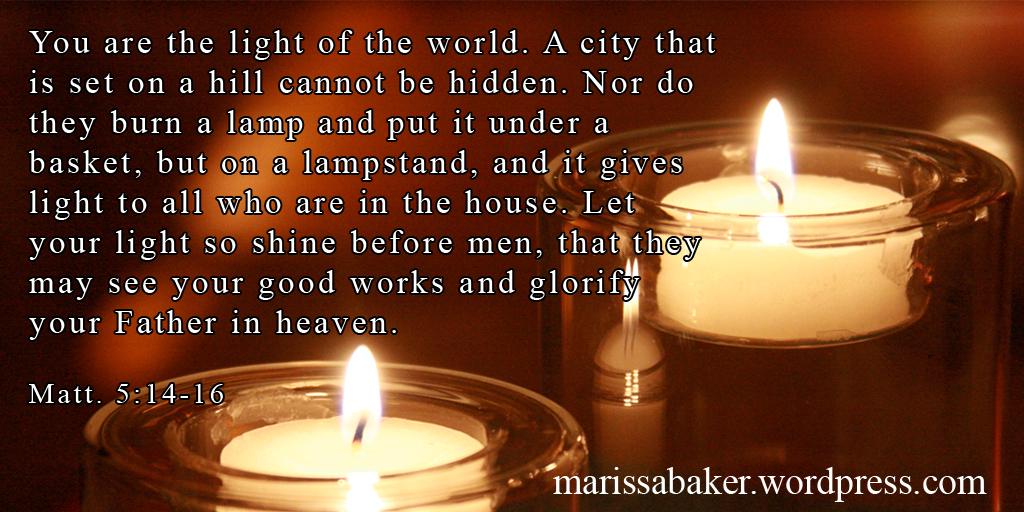
    The Greek word translated “burn” in Luke 24 can refer to a literal flame, but there are several other places in scripture where it’s used to describe a condition inside people (G2545, kaio). John the baptist was described as “the burning and shining lamp” (John 5:35). We’re told to be watchful servants and ordered, “Let your waist be girded and your lamps burning (Luke 12:35). Kaio is also the word used when Jesus talks about us letting our lights shine like a burning lamp in the world (Matt. 5:14-16).
    Love On Fire | marissabaker.wordpress.com
    photo credit: Ashton, CC BY-SA, via Flickr

    We need to let our lights, fueled by God’s love, burn so they can be seen. As we walk in the love of God, keeping His commandments and abiding in Him, unquenchable love should flow out from us to our brethren and neighbors.

  • Finding Your Real Myers-Briggs® Type

    It’s so easy to take a pseudo-Myers-Briggs® test on the internet. You can click through a quick quiz, get your result and think, “Wow, I guess that does sound like me.” A few weeks later, you might stumble across another short quiz and take it again. Maybe you get a different answer and the description still sounds like you. Now you’re wondering whether this whole Myers-Briggs thing is all it’s cracked up to be, and if it is, then why were your results different?

    This is one of the reasons Myers-Briggs tests have come under fire from critics who don’t really understand how the Myers-Briggs Type Indicator (MBTI®) is supposed to work. They look at the short little quizzes with generic feel-good results, and say it’s too simple and unreliable. But if you dive into the theory behind Meyers-Briggs, and especially cognitive functions (click here for an introduction to type functions), you start to realize how helpful the MBTI can be as a tool for understanding yourself and other people.

    One of the principles of Myers-Briggs theory is that people only have one type, which stays consistent throughout their lives. You grow and develop within your type, but you don’t change from an INFP to an ENFJ to an ISTP or any other combination of letters. So with that in mind, how can you find your true type with so many conflicting results floating around?Finding Your Real Myers-Briggs® Type | LikeAnAnchor.com

    Take A Good Test

    Disclaimer: some of the links in this post are affiliate links. This means that, at no additional cost to you, I will receive a commission if you click on the link and make a purchase on that website.

    If you can’t take the official MBTI, there are a few decent substitutes out there on the internet. My favorite by far is Personality Hacker’s Genius Style test.* They ask for an e-mail address, but it is free. One of my favorite bloggers, Susan Storm, also recently released a test. You can click here to take that.

    Similar Mind’s Jungian test is another I’ve recommended (note from May 2017: recent changes to the test questions may skew results. You might want to try HumanMetrics instead). Some people really like the test from 16Personalities, but it’s not my favorite. These tests all give you a series of questions which are designed to learn what cognitive functions you use, then give you a four-letter test result.

    I’d recommend starting with the Personality Hacker test, and then taking one or both of the other tests to compare results. Try not to read the full results of one test before you take the others — you want to take each one as unbiased as you can. If they all give you the same result, that’s a pretty good indication you’ve found your personality type. If they’re different, though, it’s time to start reading.

    Compare Results

    Now that you have one or more personality type results, start reading descriptions of your potential personality type(s). Here are some excellent resources:

    Read the descriptions for each of your type results. Even if you only got one result, it’s a good idea to look at similar types that use some of the same cognitive functions. Here are a few guidelines for which other types to look up based on your test results.

    If you test as an …

    • Introvert, read about the type which is opposite you on the J/P scale. The J/P preference describes how we interact with the outer word through our extroverted function, so an IJ type actually leads with a perceiving process and an IP type leads with a judging process. This can affect test results.
    • EJ, take a look at the type opposite you on the S/N scale. The tests found that you lead with an extroverted judging/decision making process, but might not have accurately found your introverted secondary process.
    • EP, take a look at the type opposite you on the F/T scale. The tests found that you lead with an extroverted perceiving/learning process, but might not have accurately found your introverted secondary process.
    • SFJ or NFJ, read results from ENFJ, INFJ, ISFJ, and ESFJ. These types all use Extroverted Feeling, and can often be mistaken for each other. Shy ESFJs and ENFJs can be mis-typed as introverts, and outgoing ISFJs and INFJs can be mis-typed as extroverts.
    • NT types, read the type opposite you on the E/I preference. ENT- types, especially ENTJs, are among the most “introverted extroverts” and might mis-type.

    Think About Stress

    Most tests look at your primary and secondary function — the driver and co-pilot processes that lead in our personality. This makes sense, since other functions are less well developed and we don’t use them as much unless we’re stressed. When we’re trying  to discover our true type is, though, how we react under stress is a good indication of which type matches us best.

    Good type descriptions will also talk about the inferior function. An excellent book on this topic is Was That Really Me? How Everyday Stress Brings Out Our Hidden Personality* by Naomi Quenk.

    Keep In Mind …

    No personality test result is going to be a 100% perfect match. You’re looking for the one that fits you best. You will find elements of other descriptions that sound like you, but there should be one that fits better than the others. Pay close attention to descriptions of how your type uses cognitive functions. Descriptions of INFJ and INFP types, for example, sound similar but they lead with very different mental processes.

    Good luck on your journey of self discovery! There’s a plethora of resources out there that can help you, including type-based Facebook groups and forums where you can talk with people of different types to see how they think. And if there’s anything I can help with, just ask!

    *indicates affiliate links

    Featured image credit: StockSnap via Pixabayy

    Save

  • Best Way To Humility

    Best Way To Humility

    What comes to mind when you think of humility before God? Do you think about abasing yourself? thinking of yourself less? or thinking less of yourself?

    The problem with these approaches to humility is that they’re still focused on the self. To truly become humble, we have to shift our focus to God. Instead of wondering, “How can I think of myself less?” we should ask, “How can I think of God more?”

    During the Feast of Tabernacles this year, a message given at our Feast site contained this gem of wisdom: “Elevating God is the best way to develop a spirit of humility and meekness.” Instead of focusing on abasing self, we focus on exalting God.

    Best Way To Humility | marissabaker.wordpress.com
    photo credit: Lightstock, Temi Coker

    Joy In Exalting Him

    The Psalms are a perfect place to begin studying God’s exaltation. David — the man after God’s own heart — penned many of the psalms. In his words of praise, we see an attitude of humility inspired by an awe of the Creator.

    I will bless the Lord at all times; His praise shall continually be in my mouth. My soul shall make its boast in the Lord; the humble shall hear of it and be glad. Oh, magnify the Lord with me, and let us exalt His name together. (Ps. 34:1-3)

    Gladness probably isn’t the first word we’d associate with humility, and yet that’s what David does. Exalting God fills the humble with joy, and it also increases their humility.

    But I am poor and sorrowful; let Your salvation, O God, set me up on high. I will praise the name of God with a song, and will magnify Him with thanksgiving. This also shall please the Lord better than an ox or bull, which has horns and hooves. The humble shall see this and be glad; and you who seek God, your hearts shall live. For the Lord hears the poor, and does not despise His prisoners. (Ps. 69:29-33)

    This carries over in the the New Testament as well, which we can see in Jesus’ first recorded sermon. He says the “poor in spirit” have “the kingdom of heaven” and that the meek “shall inherit the earth” (Matt. 5:3, 5). Then near the end of the Beatitudes, He tells people to “Rejoice and be exceedingly glad” when they are “persecuted for righteousness’ sake” (Matt. 12, 10). I suspect that’s impossible without an attitude of compete submission to God and a desire to find your joy in and glorify Him.

    Pointing To God

    John the Baptist is an excellent example of humility that exalts God. He consistently identified himself simply as a tool, a messenger whose sole purpose was to point others to Messiah. Every time someone asked about John, he pointed them to Jesus instead.

    John answered them, saying, “I baptize with water, but there stands One among you whom you do not know. It is He who, coming after me, is preferred before me, whose sandal strap I am not worthy to loose.” (John 1:26-27)

    Later, after Jesus’ ministry began, John had to deal with people who seemed worried that Jesus was undercutting John’s fame (John. 3:22-26). Once again, John handled this by stepping out of the way and finding joy in his Lord’s exaltation.

    You yourselves bear me witness, that I said, ‘I am not the Christ,’ but, ‘I have been sent before Him.’ He who has the bride is the bridegroom; but the friend of the bridegroom, who stands and hears him, rejoices greatly because of the bridegroom’s voice. Therefore this joy of mine is fulfilled. He must increase, but I must decrease. (Jn. 3:28-30)

    Jesus Himself did much the same thing while here on the earth. He “humbled Himself and became obedient to the point of death” as an example to us (Phil 2:8). He consistently honored his Father, and did not glorfy Himself.

    I can of Myself do nothing. As I hear, I judge; and My judgment is righteous, because I do not seek My own will but the will of the Father who sent Me. (John 5:30)

    Jesus answered, “If I honor Myself, My honor is nothing. It is My Father who honors Me, of whom you say that He is your God. (John 8:54)

    Jesus Christ — God in the flesh — was humble and meek (Matt. 11:29; 2 Cor. 10:1). We who are flawed, imperfect sinners have far more reason for humility. As those rescued from sin and brought from death into life, we have even more cause to exalt our Savior and God.

    Best Way To Humility | marissabaker.wordpress.com
    I took this photo at the Feast

    A Share In Glory

    Humility is an essential quality in the family of God. Our Messiah modeled it, the people of faith all had it, and we must develop it to receive a reward.

    Likewise you younger people, submit yourselves to your elders. Yes, all of you be submissive to one another, and be clothed with humility, for “God resists the proud, but gives grace to the humble.” Therefore humble yourselves under the mighty hand of God, that He may exalt you in due time,  casting all your care upon Him, for He cares for you. (1 Pet. 5:5-7)

    Our humility and meekness will be rewarded. There’s an element of ironic humor in the fact that the people who refuse to humble themselves will lose the glory they seek in this life, while those who submit to God and don’t care about themselves will be exalted.

     But he who is greatest among you shall be your servant. And whoever exalts himself will be humbled, and he who humbles himself will be exalted. (Matt. 23:11-12)

    This is the pattern Christ modeled for us — submit to God’s will, be humble, and He will exalt you (Phil 2:8-9). One of the most incredible things about Christ’s exaltation is His desire to share His glory with us. In His John 17 prayer, He talks about giving His disciples “the glory which You [Father] gave Me,” and prays that in the future His followers “may be with Me where I am, that they may behold My glory” (John 17:22, 24).

    Glorifying Jesus and exalting our Father can only lead to our good. It’s the best path to humility, it gives a proper view of God, and it multiplies our joy.

  • My sister and I had yesterday all planned out. Doctor Who in the morning, lunch with our cousin, then an afternoon of dress shopping for a dance in a couple weeks. The first complication happened when we thought we were running early so we swung by a dance store looking for shoes. We got lost, finally stopped at the store, and when we left the car wouldn’t start. Not too much of a complication though — we changed out the faulty fuse that’s been plaguing my sister’s car, and finally got to lunch 1/2 an hour late.

    Lunch was great, so that part of the plan went well. But then the car wouldn’t start again and changing fuses didn’t cut it (the mechanic warned this day would come). So there we were, stuck in Raising Cane’s parking lot waiting for a tow truck driver and my sister was starting to see things, to put it delicately, in a rather negative light.

    Now, I’m all for the occasional cry-and-eat-chocolate pity party, but the sun was shining and it was a beautiful fall day and we just ate an awesome lunch with our cousin. I mean, it’s not like we were in the middle of nowhere when it was raining and dark. So I rolled out a guaranteed negativity buster:

    I watched this film more times than I care to admit when I was younger. I’m worried it won’t hold up well to rewatching, especially after reading Jules Verne’s original In Search of the Castaways, so I haven’t seen it in a while. But I could still (mostly) sing this song.

    There’s really quite a bit of truth in “Enjoy It” for such a silly little song. So much of whether or not we have a “bad day” or a “good day” depends on how we respond to the things that happen to us. Advice like, “A hurricane comes your way, enjoy the breeze” sounds ridiculous, but the principle of reframing incidents and looking on the bright side is sound. As the song points out, there’s no point in crying about things we can’t change — “Each moment is a treasure, enjoy it!”

    If there’s a complication, enjoy it!
    You’ve got imagination, employ it!
    And you’ll see roses in the snow,
    Joie de vivre will make them grow,
    Voila, that’s life, enjoy it!

  • Eternity Has Begun

    “Eternity has begun for us.”

    That phrase was used in a message on the First Day of the Feast of Tabernacles this year, and it kept cropping up in conversations and sermons throughout the rest of the week where I was keeping the Feast.

    In my churches, we teach that people who are not called today will get a chance at salvation after the second resurrection. The books will be opened, giving them understanding of the Bible, and then after an unspecified period of time they’ll be “judged according to their works” (Rev. 20:11-13). For those in God’s household today, though, judgement has already begun. This is our chance at eternal life.

    Eternity Has Begun | marissabaker.wordpress.com

    Great Responsibility

    Those of us who’ve responded to God’s call and entered a covenant with Him have been given great gifts of understanding. After we receive an invitation to become firstfruits, God teaches us “things which angels desire to look into” (1 Pet. 1:12). The kingdom of God is a mystery that isn’t shared with just anyone yet, and for a very good reason.

    And that servant who knew his master’s will, and did not prepare himself or do according to his will, shall be beaten with many stripes. But he who did not know, yet committed things deserving of stripes, shall be beaten with few. For everyone to whom much is given, from him much will be required; and to whom much has been committed, of him they will ask the more. (Luke 12:47-48)

    The more someone knows, the more they’re accountable for. Today, God is working with a select few — people He knows can make it if they will truly follow Him and love with all their hearts, minds, and souls. Even so, we’re warned quite clearly that there will be people in the churches who think they’re serving God but still don’t “get it.”

    Not everyone who says to Me, ‘Lord, Lord,’ shall enter the kingdom of heaven, but he who does the will of My Father in heaven. Many will say to Me in that day, ‘Lord, Lord, have we not prophesied in Your name, cast out demons in Your name, and done many wonders in Your name?’ And then I will declare to them, ‘I never knew you; depart from Me, you who practice lawlessness!’ (Matt. 7:21-23)

    We can’t follow God however we want, even if it looks good from the outside, and expect to make it into His kingdom. We have to follow God the way He commands, and cultivate a relationship with Jesus Christ.

    Run To Obtain

    As God gets to know us on our walk with Him, He’s purifying and molding us into a “new creation” in Jesus Christ (2 Cor. 5:17). At the same time, we’re being judged to see how we measure up. Are we growing? Do we desire a relationship with Him? Will we submit to His headship in our lives?

    In Matthew 25, Jesus says that when He “comes in His glory” He will gather people before Him and divide them into two groups. By this time, the judgement is already made — He knows who is a sheep and who is a goat (Matt. 25:31-46). When we stand before Christ, it will be too late to try and convince Him you really were a sheep who just acted like a goat sometimes. We have to commit ourselves to His way of life now.

    Do you not know that those who run in a race all run, but one receives the prize? Run in such a way that you may obtain it. And everyone who competes for the prize is temperate in all things. Now they do it to obtain a perishable crown, but we for an imperishable crown. Therefore I run thus: not with uncertainty. Thus I fight: not as one who beats the air. But I discipline my body and bring it into subjection, lest, when I have preached to others, I myself should become disqualified. (1 Cor. 9:24-27)

    God isn’t going to make you or me a firstfruit just because we showed up for church. There isn’t a participation prize. Not everyone who runs a race wins, and not everyone who claims to follow Jesus will be in His kingdom. We have to discipline ourselves to run in a way that qualifies us to receive the ultimate prize.

    God wants people in His family who are teachable and humble — who respond to His work in their lives and take an active role. Only God can transform us, but we can chose whether or not to let Him. We can choose to strive for “an imperishable crown.”

    Judgement Today

     For if we would judge ourselves, we would not be judged. But when we are judged, we are chastened by the Lord, that we may not be condemned with the world. (1 Cor. 11:31-32)

    The uses of “judge” in 1 Corinthians 11:31 come from two different Greek words. “If we would judge” — diakrino, to discern (G1252) — “ourselves, we would not be judged” — krino, tried in a solemn judicial manner (G2919). If we would exercise discernment and take a good look at ourselves, we would behave in such a way that there was no need for a divine judicial ruling to correct and motivate us.

    There’s still cause for hope even when we don’t exercise perfect discernment in judging ourselves. God’s first response when judging someone is to give them a chance to change, not destroy them. He judges and chastens us as a Father does His children (Heb. 12:5-11). It’s for our correction and growth.

    For the time has come for judgment to begin at the house of God; and if it begins with us first, what will be the end of those who do not obey the gospel of God? Now, “If the righteous one is scarcely saved, where will the ungodly and the sinner appear?” (1 Pet. 4:17-18)

    “The time has come,” Peter said, and that was almost 2,000 years ago. The house of God is still going through “a solemn judgement, a judicial trial” (Zodhiates, G2917, krima). God is looking at us right now, refining us and correcting us to make certain of our character. He wants us to fill important roles in His family, and He won’t give us those roles if we aren’t a good fit — it wouldn’t be fair to the people God’s family is serving and teaching in the Millennium.

    Becoming like Christ is the key to our transformation from someone who would be judged as a goat to someone who will hear, “Well done, good and faithful servant.” We have to follow His example completely, develop a close relationship with Him, and learn to obey God’s commands. Hebrews tells us that even Jesus, “learned obedience by the things which He suffered” (Heb. 5:8). If God in the flesh had to learn and suffer, it follows that we will as well. Indeed, the context of 1 Peter 4:17-18 is suffering “according to the will of God” without being ashamed (1 Pet. 4:16, 19).

    In a proper Christian context, trials are seen as a good thing because they are a tool God uses to bring us closer to Him. Suffering, chastisement, and judgement are part of the refining, discipline process of turning us into firstfruits. It’s meant as a stepping stone — not a stumbling block — on the way to eternity.

  • The Myth of the Good Little INFJ

    Last week, I stumbled across an article on Pinterest talking about female INFJs. Well, technically it was about INFj in the Socionics system, which is a bit different than the MBTI type and may include INFPs as well, but for purposes of this article we’ll just talk about INFJ types. The original article, written in 2011 by someone identified only as Beskova, paints a portrait of the INFJ type that is beautiful on the surface but doesn’t quite manage to reach their heart. It’s part of a disturbing trend in portrayals of INFJs, though this is the most extreme example I’ve seen.

    Like many people who treat the INFJ type as quasi-mythical, this writer describes INFJs as flawless, naive, pure and submissive. They even describe a typical INFJ appearance: “Women of this type are very feminine and are delicate, modest and even shy. … They have a very ephemeral body, and sometimes lightly stooped posture.”

    Reading on, it seems the INFJ has no faults. They never gossip or argue, meet adversity with mild gentleness, focus on humanitarian efforts, fit into any job, and submit themselves selflessly to helping the people in their lives. In short, the article says, “When a female INFj becomes your wife, know that in your home there lives a quiet angel” who “makes for one of the most obedient wives.”

    The Myth of the Good Little INFJ | marissabaker.wordpress.com
    photo credit: Cameron Nordholm

    The biggest problem with this portrait of an INFJ isn’t just that it’s untrue; it’s the fact that INFJ women may try to fit into this mold if they end up in a relationship with someone who expects “their” INFJ to act like this. One thing that’s become clear in the months I’ve been reading things INFJs share online is that we’re one of the types most vulnerable to getting involved in unhealthy relationships with narcissists. And INFJ descriptions that make us out to be perfectly submissive and obedient aren’t helping discourage interest from unhealthy people.

    Myth: INFJs won’t start a fight

    It’s true that INFJs are one of the most conflict-avoidant types. Until a person does something the INFJ can’t live with, we’ll often just nod and smile at most conversations and suggestions. This happens with casual acquaintances when we don’t want to wast energy on conflict, and in closer relationships when we don’t want to deal with the emotional fall-out of conflict unless there’s a very good reason. I talk about this at greater length in my INFJ Handbook.

    But if you think INFJs can’t get angry or won’t take a stand when things aren’t as they should be, think again. INFJs tend to draw a line in their minds, and once it’s crossed we’ll make sure we let you know. Once we get started, we’ll probably tack on a list of every other way you’ve ever let us down as well. The closer we are to you, the better we’ll know how to tear you apart (note: we’re not proud of this fact, and many INFJs work hard at controlling their anger). The best way to avoid this in a relationship is to keep open lines of communication, which is the number one thing many INFJs are looking for in a relationship. INFJs prefer to keep our emotions out in the open, and if we feel safe and heard then there’s no need to bottle up our feelings until we explode.

    Myth: INFJs are always agreeable

    In this socionics article, the writer talks about how INFJ women often need/want other people to make decisions for them. They write, “If you are her husband take responsibility for making major decisions in development of your family and she will with pleasure obey you.” Now, I’ll be honest — sometimes I do want people to make decisions for me. But if an INFJ is consistently told she can’t be trusted with important decisions and is left out of the planning process, then she’s going to stop trusting you.

    The other party might not even notice an INFJ doesn’t agree with him if he’s expecting her to be what the article says: “friendly and dutiful, never quarrel nor ask much for themselves.” We place a high value on trust and communication in relationships, and assuming we agree with you instead of really asking us what we think is a good way to experience the INFJ door slam.

    The Myth of the Good Little INFJ | marissabaker.wordpress.comA tip for people who know INFJs: If we don’t actually agree with you, or simply don’t care, we’ll typically make non-committal sounds, nod our heads, and avoid eye contact. If pressured to commit to something we don’t want to do or think, but won’t openly disagree with, we’ll try to push it off to an unspecified future date. When an INFJ actually agrees with you, we’ll make eye contact, our face will light-up, and we’ll say things like “Oh, yes” instead of just nodding. Usually, we’ll also be able to explain why we agree with you in specific terms.

    Myth: INFJs are completely altruistic

    One last quote from the socionics article: “watch that her emotional resources aren’t spent on her girlfriends, who inadvertently will use your wife as a psychotherapist. She will never refuse them herself, of course. Out of compassion. Therefore, it will be best if you take the matter into your own hands and limit the flow of those desiring to obtain psychotherapeutic sessions and useful advice from her.” Excuse me! What gives someone else the right to limit an INFJ’s contact with her friends? That’s the sort of controlling behavior that’s a huge red-flag in any relationship.

    In addition to being incapable of taking care of herself, INFJ wives are apparently so dutiful they’ll do all the housework without any complaint even though they hate cleaning and cooking. For the record, this INFJ loves cooking and the housework doesn’t always get done in a reasonable amount of time. Also, one reason INFJs will avoid conflict and try to help people is because of how it affects us. Sometimes I do what people ask just because I don’t want to stay awake for three hours that night re-hashing every word of the resulting argument. It’s a self-protecting mechanism. That’s not to say INFJs don’t care about people — we do, deeply, and we will support our friends and family whenever possible. It’s a good thing. We can stretch ourselves too thin at times, but INFJs value their introvert time and don’t usually need someone to step in an control their lives to keep them from burning out. We’re not that altruistic.

    In conclusion …

    I may have dispelled some of the “mystic unicorn” aura surrounding INFJs, but perhaps that’s a good thing. Our rarity doesn’t make us better than other types, and type portraits that make us out to be something ephemeral and idyllic really aren’t helpful. As my siblings (and no doubt other people who INFJs have let into their lives) can testify, we’re not perfect.


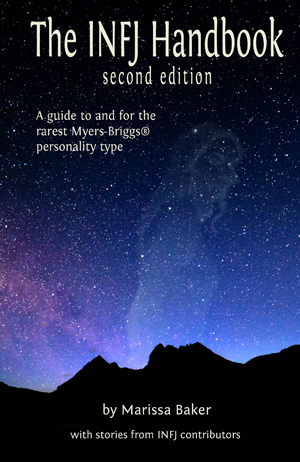
    If you’d like to know more about the INFJ personality type, check out my book The INFJ Handbook. I just updated it with a ton of new information and resources. You can purchase it in ebook or paperback by clicking this link.