• Here’s How Each Personality Type Can Change The World

    Every personality type has something incredibly valuable to offer the world. Each comes with a slightly different way of learning new information, seeing the world, making decisions, and interacting with others. And that means that we each have the potential to positively impact the world in different ways.

    A person’s Myers-Briggs® type doesn’t explain everything about them. But it does describe how our minds work, and that can give us an idea of how each type can use their strengths to make the world a better place.

    For this list, I’ve paired the types that use the same primary and co-pilot functions together. For example, both ESFJ and ISFJ use Extroverted Feeling and Introverted Sensing as their preferred functions, just in a different order. If you’re new to Myers-Briggs® theory or want a quick refresher, you can click here for a quick intro to how functions work.

    ESFJ and ISFJ

    ESFJs and ISFJs change the world by connecting with and supporting other people, as well as preserving and passing on valuable lessons of the past. 

    Having Extroverted Feeling as either their primary or co-pilot function gives SFJ types a strong desire to help and support other people. They tend to personalize everything they do and care so deeply about others that they may forget their own needs while selflessly serving those around them. They’re also really good at picking up on what other people are feeling.

    With Introverted Sensing as either their primary or co-pilot function, SFJs have a strong desire to learn from the past. It’s the function that helps us make sure we remember what was learned in our personal and collective histories so we don’t keep repeating failures as we go forward.

    ENFJ and INFJ

    ENFJs and INFJs change the world by bridging gaps between people who have different perspectives and offering a vision for what the future could look like on both personal and societal levels. (more…)

  • Fighting For Truth Within God’s House

    Dear friends, although I was making every effort to write to you concerning our common salvation, I considered it a necessity to write to you to encourage you to contend for the faith delivered once and for all to the saints. (Jude 1:3, LEB)

    Way back in the first century, Jude had planned to write fellow believers concerning their common salvation. However, he had to change the topic because “certain men have slipped in stealthily” (v. 4) to spread destructive heresies.

    When we read an instruction to “contend for the faith,” we typically think of preaching to the world and fighting for God’s truth in an ungodly society. But Jude is talking about the need to do this inside the church. And if they were dealing with problems like this back in the first century, you can be sure we’ll be facing them today as well.

    A List of Wickedness

    Jude said that we need to fight for the faith even inside the church because of ungodly people who sneaked in. As the letter unfolds, he explains in detail what sort of things these people were doing. It’s a long list, but I think it’s an important one to look at in detail. (more…)

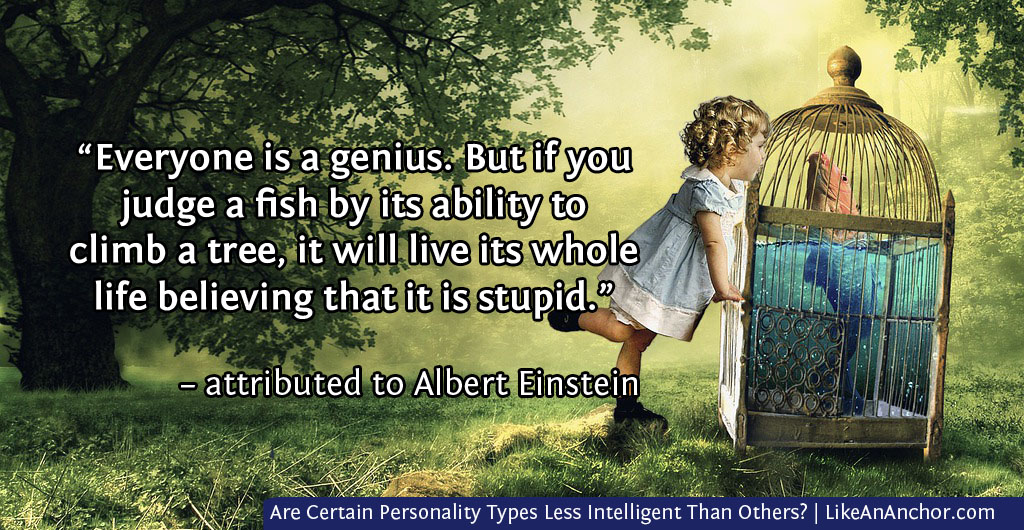
  • Personality Type Myth-Busting: Are Certain Personality Types Less Intelligent Than Others?

    If you’ve done much reading about Myers-Briggs® types, you’ve probably come across the claim that Intuitives are smarter than Sensors. Or perhaps you’ve seen people talk about Thinking types being more intelligent than Feeling types.

    Both of these ideas are untrue. They’re based on inaccurate stereotypes about the types and/or misunderstandings about the unique sort of intelligence that each type uses. In reality, every personality type is intelligent and no one type is smarter than any other. They do have different kinds of intelligence, though, and there are situations where one type might appear smarter than others just based on what skills the situation calls for.

    Are Certain Personality Types Less Intelligent Than Others? | LikeAnAnchor.com
    Photo credit: Marianne Sopala via Pixabay

    The Problem of Measuring Intelligence

    The idea that Sensing types aren’t smart is actuality based on something Isabel Meyers mentions in her book Gifts Differing. She said that Intuitive types tend to score higher on IQ tests. What people who spread this rumor miss is that she also pointed out that the structure of IQ tests puts Sensors at a disadvantage which has nothing to do with whether or not they’re smart. (more…)

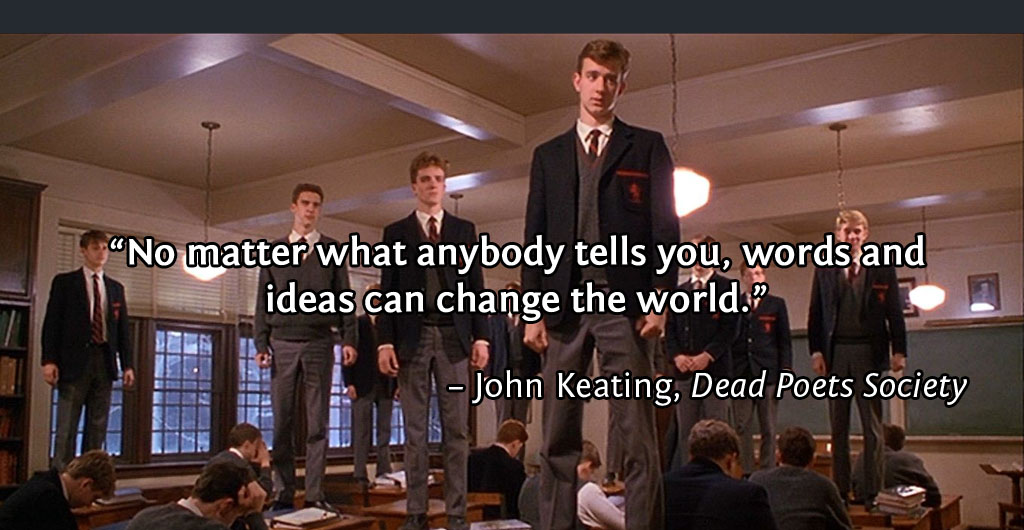
  • ENFJs, the Dead Poet Society, and Ways To Change the World

    When I wrote my list of 7 Fictional Characters That You’ll Relate To If You’re An ENFJ, I rewatched the movie Dead Poet Society. I think both John Keating and Neil Perry are ENFJs, but they’re often typed as ENFPs and that got me thinking about some of the main differences between these types. And that led me to pondering the ways that NF types, and ENFJs in particular, work to change the world.

    Most people don’t think of ENFJs as a type that would buck the status quo. We see them as harmony creators, best friends, and mentors but not necessarily as someone who swims against the flow of culture. I think that’s the main reason people type Mr. Keating and Neil as ENFPs, who we more often think of as the outspoken champions of causes. But ENFJs do have a rebellious streak. In fact, all NF types are idealists who typically find some way to seek a better world. Though the ways they work toward this change (and what a better world means to them) differ depending on their individual personalities, interests, and experiences most of them do want to change the world in some way.

    Just to be clear, NF types aren’t the only ones who care about social change or want to see improvements in the world. Every one of the 16 types does that in their own way, and I’ll be working on a post that covers all of them in the near future. But just for today, I want to focus on ENFJs, ENFPs, and Dead Poet Society.

    The Teacher

    I’m not a huge fan of giving the Myers-Briggs types nicknames because there’s so much more to each type than can be neatly packaged into a single description. But we can look at the different nicknames as roles that each type fills often enough for it to stick as a label. Teacher, Mentor, Giver, and Charismatic Leader are all descriptions that are used to try and sum-up the key traits of ENFJs. Interestingly, all those labels could be applied to John Keating from Dead Poet Society. (more…)

  • Am I Living A Flesh Life Or A Spirit Life?

    Do you desire the same things God desires? That’s one of the questions asked in a new book I’m reading called What Does Your Soul Love? It’s written by Alan and Gem Fadling, and it’ll be available for purchase September 17th. I’m about halfway through right now and it’s given me quite a bit to think about. One thing I really like is the way they explain how our resistance to living a godly way of life is connected to Paul’s discussion of flesh versus spirit.

    Our desires lie at the root of why we act the way we do. But even when we line-up the things we say we want with the things God wants, we might still find ourselves in the same position Paul was in his letter to Rome. He said he delights “in God’s law after the inward person,” but still finds “the good which I desire, I don’t do; but the evil which I don’t desire, that I practice” (Rom. 7:14-25). When we try to follow God, we encounter resistance from within ourselves as well as from without.

    The resistance from outside is usually easier to identify and counter, at least to a certain extent. But what about the resistance inside? What can we do about that?

    What Is “The Flesh”?

    Just a couple weeks ago, I shared a 2-part post about Galatians. It’s on my mind again now since that letter seems particularly relevant to today’s discussion. If we’re going to talk about how our flesh resists living in the spirit, the last two chapters of Galatians are crucial. But first, let’s clear up a potential misunderstanding.

    “The flesh here is not the physical body, but a way of life we’ve grown used to living in a world that does not recognize the reality of God and his kingdom. It is a dynamic within whereby we grab for what we need, not trusting (or knowing of) God’s generosity to provide. It is an ‘I can do it myself’ approach to living that presumes the absence of the loving God” — Alan and Gem Fadling

    I’d also add that “flesh” includes an attitude of “I can decide right and wrong for myself” that presumes to know better than God or to think that He doesn’t really care. When we look at Paul’s description of the flesh, it includes following desires and taking actions that God has said are wrong. To keep doing those things when we should be walking in the spirit is to disregard our Creator and Savior’s wishes (Gal. 5:16-21). (more…)

  • 7 Keys to Increase Productivity

    This article first appeared on MadebyHemp. I’ve partnered with them to share and promote each other’s articles. Though I haven’t tried CBD oil myself yet, I did some research on it when writing for a client and it sounds like something that really could help a lot of people. Plus, these articles have some excellent content.


    We’ve all had those days when we feel like we are not accomplishing anything no matter how hard we work. Looming deadlines, increasing workload, multitasking, and stress could all disrupt a person’s productivity. “Work smarter, not harder” has become a famous motto among the workforce. And this statement actually has merit. Sometimes, when we wear too many hats, take on too much work, instead of becoming more productive, our productivity actually decreases. So what can we do to increase our productivity?

    1. Have a healthy breakfast… or skip it!

    I don’t mean to confuse you, but there are studies showing that skipping the most important meal of the day can benefit various brain functions. Intermittent fasting has been gaining popularity lately, and there are scientific studies to back it up. However, if you want to give this a try, it is best to ask for a doctor or a nutritionist’s advice first. For anything to work, one has to have the know-how and the right motivation. On the other hand, if you are a huge fan of breakfast and could not possibly start a day without it, by all means, eat! Fuel your body with the right food. Make healthy choices.

    2. Take that coffee break

    Though it might be tempting to just keep plugging away at work and skip your breaks in order to meet your deadlines, it would not be a very good idea. You need to relax and take a breather. This will give your brain a much-needed break and you a chance to walk around and enjoy a nice cup of joe, maybe even socialize with your other harried co-workers.

    3. CBD Oil

    Adderall has been making the rounds around colleges and even workplaces. However, if you prefer a more natural approach to boost your concentration and productivity, why not give CBD oil a try. It has been known to increase alertness, help calm nerves, and boost your mood. So when you find yourself stressed with your head all over the place, why not try popping a CBD gummy, a flavored tincture, or even straight up CBD oil to help ease your stress and calm your nerves. Unlike its addictive cousin, THC, CBD will not get you high.

    4. Don’t multitask

    Multitasking is not something the human brain is built for. It has proven to cause loss of productivity. Doing too many things at once will take away your concentration from the crucial things that need doing. This will make your work prone to errors and cost you time that you were trying to save by multitasking in the first place. Do one thing at a time before moving on to the next task. This way you can ensure each task is accomplished properly. Try doing the tasks that take the least amount of time to accomplish first. This will get these tasks out of the way and allow you to focus on the more complicated ones.

    5. Take exercise breaks

    Isn’t it ironic that a post about being productive is talking about breaks a lot? That’s because taking breaks in between tasks is a good way resetting your brain and preparing it for the whole new task ahead. Exercising will send a rush of much-needed oxygen to your brain and will help loosen your muscles that might have bunched up from getting the previous task done. Taking a brief walk, or a short stretch will allow your brain to stop thinking about work and “breathe”. This will help bring your focus back to where it is supposed to be – your looming tasks.

    6. Use tools

    Using online tools or apps to track your work and tasks for the day is one easy way of getting your day organized. When you have your day organized, you won’t need to spend extra time trying to remember what to do next; you would already have it laid out for you. Most of these tools are free and can be linked to your personal or work email. Just make sure that the apps abide by your company rules and risk profile.

    7. Say no to meetings

    Meetings take time. And a lot of the time, these meetings are not even really necessary. If you have a lot of things to do, and someone schedules a meeting, try to find out if your presence is necessary for the meeting. Or if the items on the agenda could be discussed through email, that would be a better venue. You only get so many hours in a day, after all.


    Featured image credit: rawpixel.com via Pexels