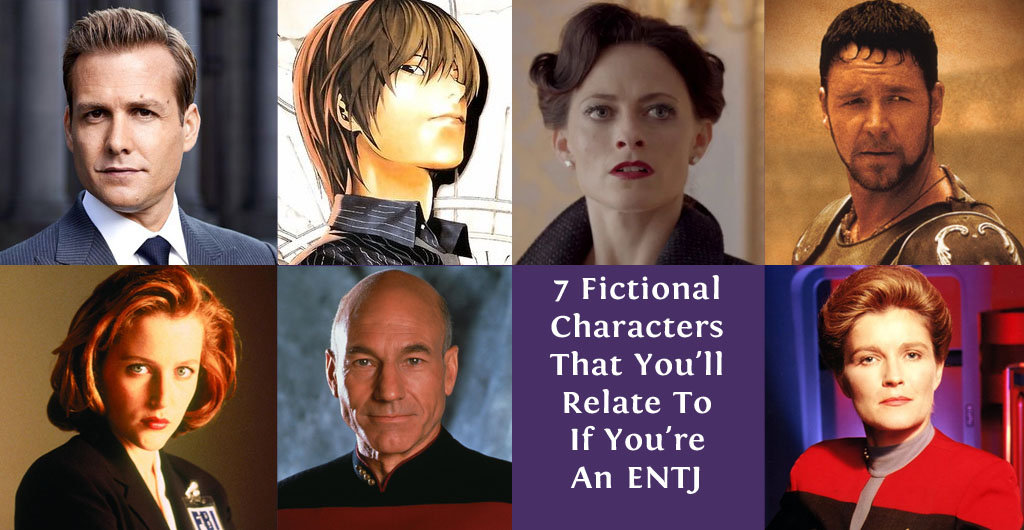
• 7 Fictional Characters That You’ll Relate to If You’re An ENTJ

    What fictional characters do you relate to as an ENTJ?

    Just as we can describe real people using the Myers-Briggs® typology system, we can also use the system to type well-written fictional characters. Some of fiction’s most iconic and intriguing characters are ENTJs, and today we’re going to talk about seven of them that I think real-life ENTJs will find relatable.

    Another great thing about looking at character personality types is that it helps us to better understand people who have different types than we do. Fictional ENTJs can serve as examples for what real-life ENTJs might be like, and also show how much variation can exist between individuals with the same type.

    Dana Scully

    Lenore Thomson types Dana Scully from X-Files as an ENTJ in her book Personality Types: An Owner’s Manual. She talks about the “inspired” decision to pair INTJ Fox Mulder “not with an ESP action hero (which is the usual gambit in a science fiction series), but with an ENTJ pathologist.” Thomson further says, “Scullys’ by-the-book Judgement is consistently subverted by Mulder’s appeal to her secondary function” of Introverted Intuition (p. 233).

    Many real-life ENTJs can relate to Dana Scullys’ desire for logical, objective truths. That’s what ENTJs, as dominant Extroverted Thinkers, prefer to rely on. But their Introverted Intuition is too good at seeing things from other perspectives to completely ignore an intriguing idea even when the evidence for it doesn’t line-up with established theories. This makes Scully a perfect choice to work on the X-Files because she questions everything while also thinking outside the box enough to dig for the truth rather than dismissing Mulder’s theories out-right. (more…)

  • Are We Making The Most Of God’s Gifts?

    Salvation is a free gift that we cannot earn, but which we can lose or refuse because God always gives people a choice. Adam and Eve had access to a close relationship with God, but they also had the option to choose sin and death instead. Ancient Israel was asked to choose between “life and prosperity, and death and evil,” and implored to pick life (Deut. 30:15, 19). The Lord is not willing that any should perish (1 Tim. 2:4; 2 Pet. 3:9), but He also won’t force you into His kingdom. You need to choose, and then act on your choice.

    We also can’t say “I choose life” and then keep living as if we chose death. We will be judged by what we do with the gifts given to us by God, and for those in His church today this judgement has already started (1 Pet. 4:17). God is watching us now to see what we do with all the gifts He gives us.

    As we think about our relationship with God and examine ourselves as Christians, we all need to ask if we’re doing what God would want us to do with the gifts He’s entrusted us with. That includes examining how we respond to salvation, how we heed and use His Spirit inside us, and whether or not we’re truly following the example of Jesus Christ.

    The Parable of The Talents

    Shortly before His death, Jesus told a parable that illustrates how important it is for us to do something with the gifts we’ve been given. He compares His absence from earth between His first and second coming to “a man, going to another country, who called his own servants, and entrusted his goods to them” (Matt. 25:14, WEB).

    This man divided his goods between his servants, entrusting each with a certain number of talents (a “talent” is  measure of weight, typically used for silver, that is equal to 30 kg or 66 lb). This pictures the time that we’re in now as servants awaiting our master’s return. Like the servants in the parable, we’ve each been given gifts “according to his own ability” and must now decide what to do with them (Matt. 25:15). (more…)

  • Sherlock Holmes and The Trouble With Typing Fictional Characters

    Discussions about Sherlock Holmes’ Myers-Briggs® type can get pretty heated in the online community. He’s either an INTJ or INTP and whichever side you come down on (if you care about this sort of thing) is worth passionately defending. I’ve weighed-in on this myself in a blog post arguing that Sherlock as portrayed by Benedict Cumberbatch in the Sherlock BBC series, Robert Downy Jr. in the Sherlock Holmes movies, and even the Basil of Bakerstreet version from Disney’s The Great Mouse Detective are all INTPs.

    I do think that’s the best-fit type for all three of those versions, but they aren’t the only portrayals of Sherlock Holmes. We ought not forget, for example, the original character in the stories penned by Sir Arthur Conan Doyle. I’ve been reading and re-reading several of those for my Classics Club book list and Sherlock doesn’t seem very much like an INTP in those stories. In fact, the only thing I can say with absolute certainty is that he’s a Thinking personality type.

    Typing People Who Aren’t Real

    Sherlock Holmes and The Trouble With Typing Fictional Characters | LikeAnAnchor.com
    image courtesy of The Sherlock Holmes Museum

    That brings us to the second part of this post’s title: the trouble with typing fictional characters. Though I love looking at fictional characters’ personality types, there are limits to how accurately you can type them. It gets especially tricky in the case of someone like Sherlock Holmes or Batman because so many writers and actors have been involved in portraying this character over quite a long period of time. There’s bound to be some inconsistencies in how each creative sees the character they’re working with. Plus, I doubt very many of them think about the character’s Myers-Briggs® type and how they can keep it consistent in every portrayal.

    Going back to Sherlock Holmes as our example, Sir Arthur Conan Doyle sometimes writes him in a way that looks like ISTJ, sometimes more like one of the NTJ types, and sometimes with traits of a TP type. He also calls Dr. Watson by two different first names (John is used three times, James once), so I think it’s safe to say Doyle wasn’t all that concerned with consistency. In any case, Doyle’s Sherlock Holmes stories were written about 30 years before Jung published Psychological Types, so we know he wasn’t relying on those theories when writing the character.

    So Why Type Fiction?

    Since it’s difficult to type fictional characters with a high degree of accuracy, why do it? For one thing, it’s fun. It’s one of the ways to turn an interest in Myers-Briggs® into an entertaining pastime as well as a useful hobby.

    Typing fictional characters can also sharpen our skills typing real people. It gives us a chance to study how characters react and puzzle out which psychological functions they’re using based on what they say and how they act. In addition, well-written characters provide familiar examples of the different types to use in every-day conversation. If someone asks me what an ENTP or ISFJ, for example, looks like in real-life then Tony Stark and Samwise Gamgee are there to help clarify things.

    Do you enjoy trying to figure out fictional characters’ personality types? Tell us about your favorite characters and what you think their types are in the comments!

  • 5 Crucial Tips For Standing Up For Yourself As An INFJ

    For many INFJs, the feeling that we don’t stand up for ourselves well enough is a frequent one. We find ourselves in uncomfortable conversations that we don’t know how to leave, or we let people cross our boundaries because we’re not sure what to say, or we don’t speak up when someone assumes something about us that isn’t true. And then we feel guilty about it, but we aren’t sure how to change.

    5 Crucial Tips For Standing Up For Yourself As An INFJ | LikeAnAnchor.com
    Photo credit: lavnatalia via Pixabay

    For this post, we’re going to define “standing up for yourself” as sharing your ideas, choices, and opinions with others and not compromising on your personal standards, morals, or beliefs. You’re not obnoxious or dismissive of others when you “stand up for yourself” in this way, but you are honest and upfront about who you are, what you believe, and where your boundaries are.

    Some people reading this, including some INFJs, already live their lives in the way I just described. If that’s you, then wonderful! Keep doing what you’re doing (and maybe share some tips for the rest of us in the comments). For others, standing up for yourself is a real challenge.

    INFJs aren’t the only ones who deal with this either — any personality type can struggle with asserting themselves and practicing authenticity. Today, though, we’ll be focusing on INFJ-specific tips for getting comfortable with standing up for yourself. Other IN types (like INTJ or INFP) and FJ types (like ENFJ and ISFJ) might also find these tips helpful. (more…)

  • The Problem With Following People (Including Yourself)

    If you’ve been a Christian for any length of time, you’ve probably noticed people in the church don’t always act Christ-like. For many, the worst hurts they’ve suffered from another human being came from someone who called themselves “Christian.” Even if that’s not the case for you, I’m sure you’ve seen pettiness, hypocrisy, and other issues among God’s people.

    Yet even though we know human beings aren’t perfect, there’s still a tendency to align ourselves with them. We’ve all known people who found a teacher they like so much they’ll follow him even if he contradicts the Bible. Maybe we’ve even been there ourselves, often without even realizing it. We might also have seen churches break into factions when leaders disagree over a point of doctrine, and then followed one of those leaders as the group splits apart.

    When you go through something like that often enough, it’s easy to lose trust in other people. Maybe we stop relying on other Christians, or refuse to listen to the ministry, or become obsessively critical of others. We might decided we’re the only reliable authority on scripture and that it’s dangerous to listen to anyone else.

    Wanting someone to follow as an authority, or rejecting others and their ideas to avoid getting hurt, are both natural human impulses. But that doesn’t make either of them a good thing. Whenever we trust a human being (including ourselves) more than God, we’re going to get into trouble. We need to find a balance that lets us live in unity with our brethren while following God first and foremost. (more…)

  • A Tale of Two Saviors

    A Tale of Two Saviors

    Do you ever wish someone loved you enough to die for you?

    Not that you’d actually want them to die, of course. But you’d just like to know that someone cared enough about you that they would give up their life to keep you safe and well.

    I was thinking about that last week while reading A Tale of Two Cities. I’d planned on reading two of Charles Dickens’s books that I’d never read before for my Classics Club list, but ended up swapping out Bleak House for re-reading A Tale of Two Cities. I liked it so well when I read it 12 or 13 years ago in high school that I wanted to see if it still captured my interested.

    I think it’s safe to say this book is just as powerful now as it was back then, considering the last few chapters left me in tears. I love books that are so real, so well written that they can make me cry and let me tell you there were plenty of that by the last sentence. (more…)