
Beauty and the Beast has always been my favorite fairy tale. Favorite Disney movie, favorite Robin McKinley fairy tale retelling, favorite original tale … basically, I’m a fan. So you can imagine that I was beside myself excited when Disney announced their live-action remake of my favorite fairy tale. And yesterday, I finally got to see it.
It’s been a while since I wrote about fairy tales, so many of you probably don’t know that I’m not just a fan of Disney. I love the original tales as well. In many cases, I like them more than the lighter, tamer, happier versions. It’s hard to believe there was a time when it was considered normal to read children bedtime stories where stepsisters hack their own toes off, children throw witches in ovens, and princes fall from towers into thorns that blind them.
They weren’t just creepy stories for kids, though. Fairy tales represent a rich folkloric tradition passed along and refined by both male and female storytellers. And plenty of research has gone into documenting these stories’ histories, discussing their role in society, and cataloging the different styles. Beauty and the Beast, for example, is 425C in the Aarne–Thompson classification system. It’s one of a surprisingly large number of animal groom fairy tales and most likely has it’s roots in the story of Cupid and Psyche.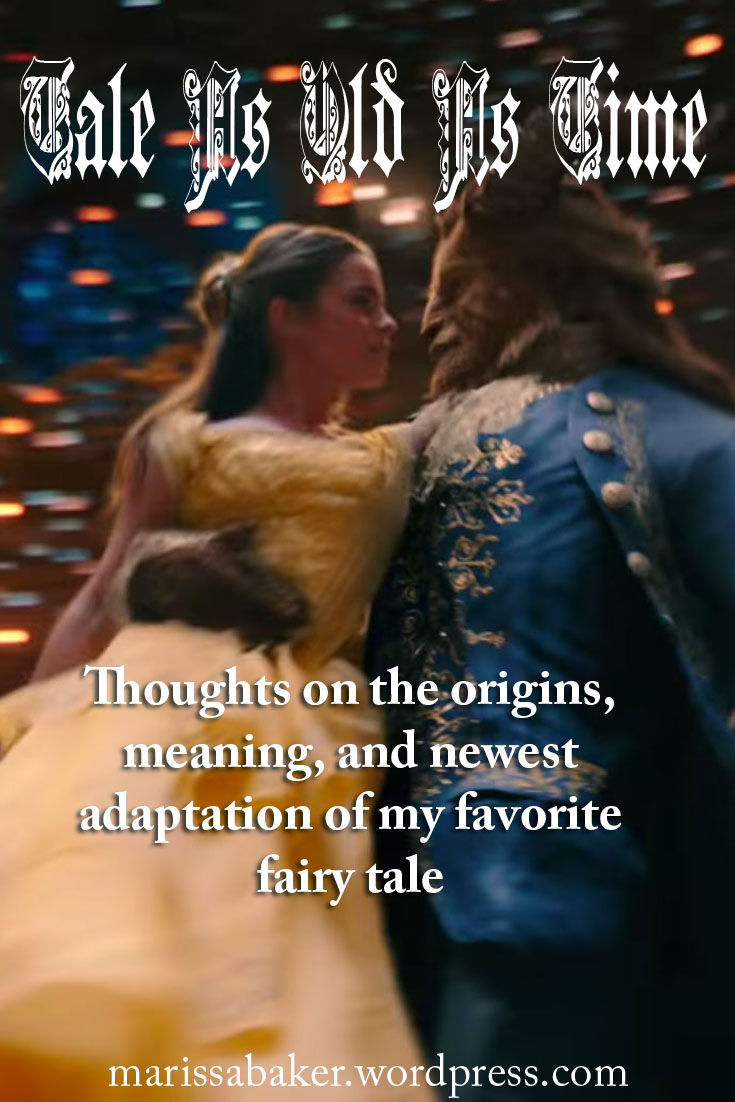
Fairy tales have always generated discussion and debate. This time around, people are talking about bestiality and wondering why this “tale as old as time” has endured for so long with such twisted ideas at its roots. But if we equate the Beast with an animal we miss the point of the tale. Psychoanalyst Bruno Bettelheim believed the “animal groom” stories were “intended to reassure virginal brides about sex” (i.e. he seems scary, but once you get to know him he’s not so bad).
Beauty and the Beast goes deeper than most tales of this sub-type, though. What we know as Beauty and the Beast was first written by Gabrielle-Suzanne Barbot de Villeneuve and published in 1740. In this earliest version, as in subsequent versions, the Beast has to prove himself worth loving. It’s no longer a story telling women they need to put up with whatever husband they’re given in an arranged marriage. It’s giving women permission to choose who they marry based on the man’s merit. As Marina Warner says in From the Beast to the Blonde, this fairy tale argues “for marriages of true minds.” Much the same theme carries into later stories such as Pride and Prejudice and Jane Eyre.
The marriage to two minds aspect is more visible in Disney’s new live-action remake than any film version I’ve encountered before. In this version (unlike the Broadway adaptation, for example), the Beast has read nearly every book in his library and the first real conversation he and Belle have is about Shakespeare. In fact, he’s probably become my favorite version of the Beast. (Mild spoiler warning: I love the new version of the library scene where he casually leads Belle in there to settle an argument. He seems more comfortable in that room than any other in the castle and it’s the first place he makes a joke.)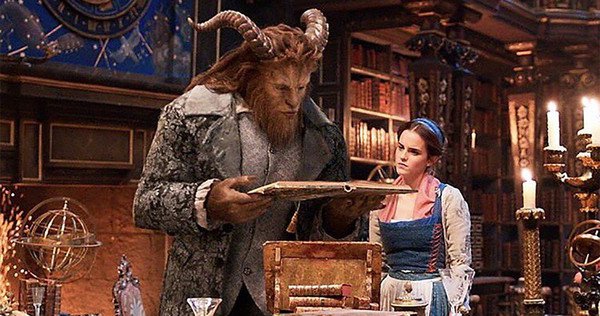
Overall, I really liked the live-action Beauty and the Beast when I finally saw it yesterday. Visually, it’s spectacular. And as disappointment as I was not to have the Beast’s solo “If I Can’t Love Her” make it over from the Broadway play, “Evermore” is a more than acceptable substitute. Most of the plot additions satisfactorily answered questions that have pestered fans for the past 26 years (including, “Why would the Enchantress curse a child?” and “How’d the villagers forget there’s a big castle in their woods?”).
Though minor (as are the spoilers that follow), the other changes represented significant shifts. I really think they should have kept the Beast saying, “I love her” to explain his decision to let Belle go rather than giving the line to Mrs. Potts as “He loves her.” It’s a more powerful scene when he can express his own feelings than when he’s silently brooding and the line goes to another character. Gaston’s character also changes. He’s given hints of backstory that could have made him more sympathetic, then suddenly his character takes a darker turn than he shows even in the animated version. And there’s a subtle, but drastic, tone shift between the two versions of “Gaston.” Instead of a town celebrating their hero, Lefou pays the people in the bar to play-in to Gaston’s ego-driven fantasies. It’s an interesting choice to make.
Beauty and the Beast is a story that speaks of the power love can wield when it looks beyond outer appearances and chooses to encourage goodness. And it’s also a story of waiting — not only for the right person, but also to see if the person we’re falling in love with proves worthy of our trust before we commit to them for a lifetime. I’m deeply in love with the idea of peering into people’s souls and finding something truly beautiful inside. But simply finding something to love about a person isn’t enough to make them good. What’s so beautiful about the Beast’s transformation is that it goes far more than skin deep. He starts out his story as arrogant and entitled as Gaston, but he didn’t stay that way because he chose to become a better person and he proved by his actions that the change was real. The spell is broken as much by the Beast’s choice to be a man worth loving as by Belle’s choice to love him.


Leave a Reply