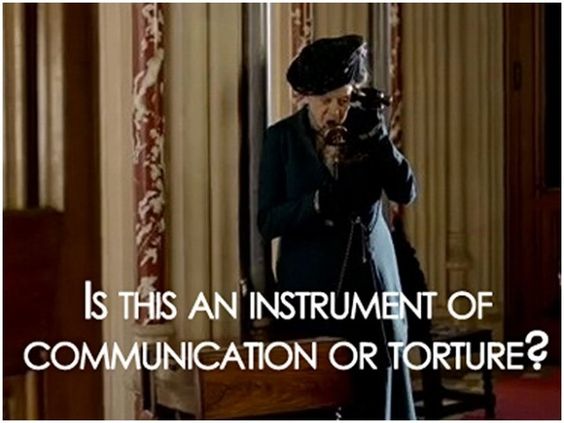
Some of you might think that title is strange, but my fellow introverts will understand. The hours of mental preparation that go into making a two minute phone call. The sense of dread when the phone rings and you aren’t ready to talk with someone. The pressure of sounding engaged and alert while thinking fast enough to avoid awkward silences. Most of us view the telephone in much the same way the Dowager Countess of Grantham does.
But I had a truly enjoyable phone conversation with a friend this weekend, and I realized this wasn’t an isolated incident. When he asked for my number my first instinct was panic, then I realized there wasn’t any reason to. I talk with my sister on the phone for hours almost every day. I chat with my dance team when we’re coordinating practice times. I enjoy the unexpected call from my cousin or a select group of friends. Chatting on the phone really isn’t all that scary.
Now, in the interest of full disclosure, I am in many ways a stereotypical introvert in regards to the telephone. We don’t have caller ID on the landline and the calls are rarely for me, so I refuse to answer when it rings unless I recognize the voice and want to talk with them now. My cell phone is set so it doesn’t even ring unless the number is in my contacts list and, in general, I much prefer written communication. There are times, however, when telephones are a preferable method of communication. (more…)
Christians and non-Christians alike typically assume that our religion teaches good Christians go to heaven when they die and bad people, or those who’ve never given their lives to Jesus, go to hell. As more and more Biblical scholars, Christian churches, and individual believers are realizing, though, this isn’t the most accurate picture of what the Bible teaches regarding life after death.
I grew up in churches that taught the resurrection. It’s straight out of the scriptures, but I hadn’t come across other churches teaching something similar until reading a book called Desiring the Kingdom by Catholic theologian James K.A. Smith. In this book, Smith made a comment about Christians not really going to heaven when they die and footnoted it with three book suggestions for further reading. I could only locate one book from that list in the library: Surprised by Hope by New Testament scholar and Anglican bishop N.T. Wright.
Wright’s powerful exegesis on the meaning of the resurrection is inspiring and some of the thoughtful, well-researched ways he diverged from my church’s traditional teachings made me realize there are alternative explanations for a few difficult scriptures that deserve a second look. I also admire his style. Instead of telling people “You’re wrong,” he says, “We’ve been misinformed, and here’s the more wonderful plan God has for us.” That’s what I want to focus on today. The deeper our understanding of what God is actually planning for us, the firmer our hope and faith becomes.
What Happens When We Die?
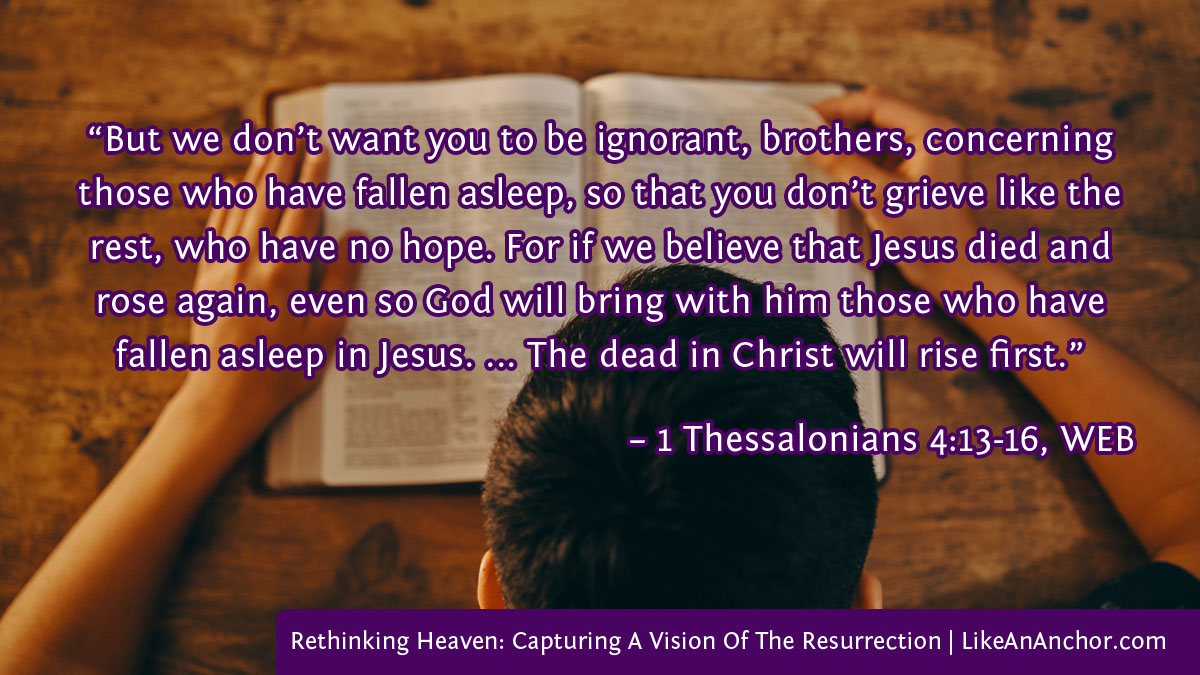
The idea that human beings have immortal souls does not come from the Bible, It traveled into Christian theology from Greek philosophy, specifically Plato (see “Plato’s Shadow” by Gary Petty for more details). The Bible teaches that God “alone possesses immortality” (1 Tim. 6:16, NET). Immortality is not something inherent to humans. We didn’t even have a chance at eternal life until Jesus Christ broke “the power of death and brought life and immortality to light through the gospel!” (2 Tim. 1:10, NET).
In Hebrew thought and New Testament theology, the soul refers “not to a disembodied entity hidden within the outer shell of a disposable body, but rather to what we would call the whole person or personality” (Wright, p. 28). In Hebrew, the word translated “soul” is nephesh (H5315). It refers to a living thing with breath (Thayer’s Dictionary).
Yahweh God formed man from the dust of the ground, and breathed (naphach) into his nostrils the breath (neshamah) of life; and man became a living soul (nephesh).
Genesis 2:7, WEB
The New Testament does talk about different parts of a human. We have a body — the soma , which is fleshy, physical, and “that which casts a shadow” (Thayer G4983). We have a soul — psuche , the vital force of life and personality (G5590). And we have a spirit — pneuma , the “rational spirit, the power by which the human being feels, thinks, decides” (Thayer G4151). The three can’t really be separated in any useful way, though; they all go together to make us human beings in the image of God.
Now may the God of peace himself make you completely holy and may your spirit (pneuma) and soul (psuche) and body (soma) be kept entirely blameless at the coming of our Lord Jesus Christ.
1 Thessalonians 5:23, NET
So, we are human bodies that God created from dust and breathed into, making us living beings with spirits that can communicate with His Spirit. Ecclesiastes says that, at death, “the dust returns to the earth as it was, and the spirit returns to God who gave it” (Ecc. 12:7, WEB). Wright believes that this spirit is conscious while awaiting the bodily resurrection, but I lean more toward my church’s traditional teaching that this isn’t the case.
While there are a couple verses hinting at the possibility of consciousness after death (Luke 16:19-31; Rev. 6:9-10), the bulk of scripture compares death to sleep (John 11:11-13; 1 Cor. 15:6, 18, 31; 1 Thes. 4:13-15; 5:10; 2 Pet. 3:4; Dan. 12:2; and many others). Furthermore, “in death there is no memory of you” (Ps. 6:5, WEB), “the dead don’t praise Yah” (Ps. 115:17, WEB), and ” the dead don’t know anything” (Ecc. 9:5, WEB). Two scriptures–one in a parable and one in Revelation– that aren’t necessarily clear/straightforward do not seem to be enough evidence to counter the many, many other scriptures describing the dead as unconscious and sleeping.
Image by Matt Vasquez from Lightstock
For The Firstfruits
Eternal life is a gift God promises to those who follow Him now, in this life (we’ll save those who don’t for a follow-up post next week). The promises to believers are spelled out clearly in scripture, and nowhere more clearly than in 1 Corinthians 15. Here in the resurrection chapter, Paul reminded the Corinthians that he declared to them the gospel: “that Christ died for our sins according to the scriptures,and that he was buried, and that he was raised on the third day according to the scriptures, and that he appeared to” the apostles and hundreds of other believers (1 Cor. 15:3-5, NET). Jesus’s resurrection is central to the gospel message.
Paul then addressed a group of people who didn’t believe in the resurrection of the dead. He stated in no uncertain terms that if there is no resurrection the gospel is empty, and “if Christ has not been raised, your faith is useless; you are still in your sins. Furthermore, those who have fallen asleep in Christ have also perished” (1 Cor. 15:17-19, NET). There is no alternative. Either there’s a resurrection of the dead or we have no hope at all; physical death would be permanent.
Paul spent the next few verses talking about how and when we’ll be raised. N.T. Wright summed up the “how” by saying, “the risen Jesus is both the model for the Christian’ future body and the means by which it comes about” (p. 149). The “when” for the resurrection of faithful believers is Jesus Christ’s second coming (1 Thes. 4:13-18; 1 Cor. 15:23). This resurrection is for “the firstfruits”–a select group of people who actively, faithfully followed God during their physical lives. It’s not enough to verbally accept Jesus as your savior; we also have to live like Christians. And so the resurrection chapter also includes the injunction not to be deceived or corrupted, but rather “Sober up as you should, and stop sinning!” (1 Cor. 15:34. NET).
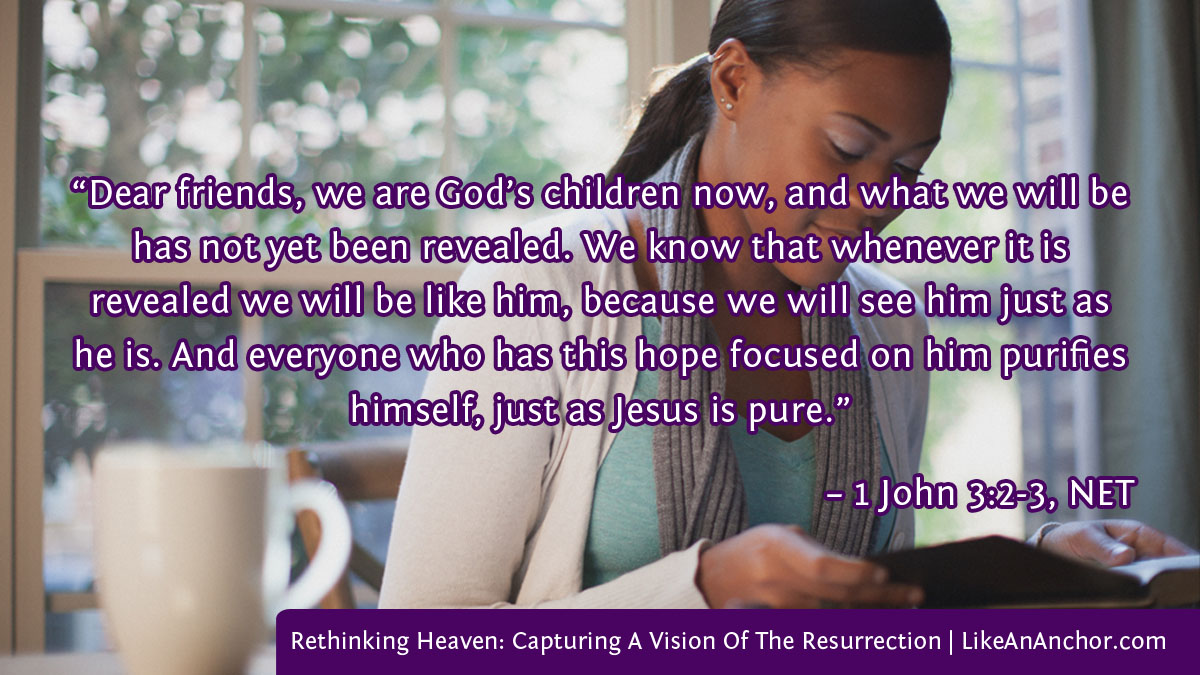
Image by Pearl from Lightstock
A Bodily Resurrection
Paul anticipated one question that many will have about the resurrection when he said, “But someone will say, ‘How are the dead raised? With what kind of body will they come?’” (1 Cor. 15:35, NET). It’s an understandable question, especially today given the confusion about what “soul” actually means. The short answer is given by John: “we will be like him, because we will see him just as he is.” (1 John 3:2, NET). When we’re resurrected, it will be to an existence like God’s.
Paul addresses this question in more depth. He likens our bodies now to “a bare seed” sown in a field with the expectation that it will grow into a mature, flourishing plant (1 Cor. 15:37, NET).We currently have a “natural body” that bears the image of the first human being that God breathed into and made a living being. Those who rise from the dead in the first resurrection will have a “spiritual body” that bears the image of Jesus Christ (1 Cor. 15:42-49).
It is the same with the resurrection of the dead. What is sown is perishable, what is raised is imperishable.It is sown in dishonor, it is raised in glory; it is sown in weakness, it is raised in power;it is sown a natural body, it is raised a spiritual body. If there is a natural body, there is also a spiritual body.
In Greek, the words “natural” and “spiritual” are psychikos and pneumatikos. Wright points out that “Greek adjectives ending in -ikos describe not the material out of which things are made but the power or energy that animates them” (p. 155, emphasis in original). We currently have a body animated by the human soul. We will have a body “animated by God’s pneuma, God’s breath of new life, the energizing power of God’s new creation” (p. 156).
When Jesus rose from the dead, people could touch Him (John 20:27) and eat with Him (John 21:9-13). He told them, “Look at my hands and my feet; it’s me! Touch me and see; a ghost does not have flesh and bones like you see I have” (Luke 24:39, NET). Though He could appear in the middle of a locked room or vanish from sight (Luke 24:30-31, 36), Jesus wasn’t a ghost or a disembodied spirit. His spiritual body was something more than His physical one.
We’re not waiting for an escape from the body, but rather “the redemption of our bodies” (Rom. 8:23, NET). We long “to put on our heavenly dwelling … because we do not want to be unclothed, but clothed, so that what is mortal may be swallowed up by life” (2 Cor. 5:1-5, NET). We’re not waiting to go to heaven when we die — we’re waiting for Christ to come down from heaven to raise His people from their sleep of death and transform us all to have a spiritual life and body like His (1 Cor. 15:51-58). And it doesn’t end there!
Blessed and holy is the one who takes part in the first resurrection. The second death has no power over them, but they will be priests of God and of Christ, and they will reign with him for a thousand years.
Revelation 20:6, NET
We don’t have a ton of information about what happens after the first resurrection, but God does sketch out the final stages of His plan for us. We know that for 1,000 years, those firstfruits who were resurrected from the dead or who were alive and transformed at Jesus’s second coming reign alongside Him in what we call the Millennium (most details about this come from the prophets and Revelation). After that, there will be a resurrection of the remaining dead, a final judgment, Satan’s total defeat, a new heaven and new earth, and God will come to dwell with humanity on earth (Rev. 20-22). It’s an incredible future that God has planned for His creation! Let’s not settle for any teaching that offers less than His glorious plan that He has revealed to us in scripture.
I’m so excited to share with you my first article published on Introvert, Dear. Read an excerpt below, then follow the “Read More” link for the full article.
Dear fellow highly sensitive person,
Like many of you, I didn’t know I was a highly sensitive person (HSP) for a long while. I just knew I was “different.” For me, this was particularly marked in social situations. Other people went shopping together to unwind, but I felt tense in brightly lit malls bombarded by flashing advertisements, milling crowds, and heavy perfumes. My friends didn’t wince at dances when the music was turned up, they danced harder. My classmates in college seemed like they could relax and focus, while I noticed the flickering lights, the quality of air, the spot on the professor’s shirt, the scratch of pencils on paper.
Sound familiar? If you were like me, you were sure this wasn’t normal—but you weren’t sure what to do about it. I couldn’t understand why it was so hard to get over my shyness and start acting like other people. I had discovered my Myers-Briggs personality type was INFJ when I was preparing to graduate high school as a homeschooler, but it wasn’t until I was floundering through the social landscape of college that I started really researching it. I began at the library, desperately digging through books, looking for ways to cope with my introversion. …. Read More
In 1 Corinthians 11:1, Paul said, “Be ye followers of me, even as I also am of Christ” (KJV). If we want a how-to guide for the way Paul follows Jesus, we can find a succinct version in the 3rd chapter of Philippians. This chapter is a bit unusual. Rather than speaking generally to his fellow believers or addressing a specific issue in the church, Paul gets real about his own walk of faith.
We break into the middle of the letter to the church in Philippi. Paul has been warning against “dogs, “evil workers,” and “the mutilation.” He gives a general principle that physical things like circumcision aren’t what determines whether or not you’re part of God’s chosen people. “We are the circumcision,” he writes, “who worship God in the Spirit, rejoice in Christ Jesus, and have no confidence in the flesh” (Phil. 3:2-3). He then shifts to using himself as an example.
Though I also might have confidence in the flesh. If anyone else thinks he may have confidence in the flesh, I more so: circumcised the eighth day, of the stock of Israel, of the tribe of Benjamin, a Hebrew of the Hebrews; concerning the law, a Pharisee; concerning zeal, persecuting the church; concerning the righteousness which is in the law, blameless. (Phil 3:4-6)
What a pedigree! Under the Old Covenant, Paul was as perfect as you could get. There was no stain on his Israelitish lineage. His parents kept the Law and had him circumcised. He became an elite leader in the Jewish community and an expert in the Law, which he kept to the letter. He even actively persecuted heretics.
Then, suddenly, Jesus Himself showed up and told Paul those weren’t heretics. The Messiah had come and Paul was fighting the next step in God’s plan. In response, Paul gave up power, prestige, and (parts of) the belief system he’d poured his entire life into to follow Jesus. And that’s an aspect of Paul’s life that we’re supposed to imitate. (more…)
Well, I’ve been on Facebook for a while, but I now have a public page for my blog that you can all like. Click here to visit and “like” my page. Also, if you actually want to see my posts in your newsfeed, don’t forget to hover over the like button and choose “see first.”
When people in the Christian churches talk about gender roles, it often ends up being a discussion about women and submission. If you’ve been keeping up with these discussions even a little, you’ve surely learned that good Christian women should view their role as a blessing. You’ve been told that submission isn’t a dirty word, but rather part of God’s ordained order for the church and the family. When we submit, we’re following the example of Jesus Christ and putting ourselves under His authority.
Even though I still hear ministers joke about how discussing submission will get them in trouble, I actually talk with very few women in the churches today who haven’t embraced, or at least acknowledge, the value of being a virtuous woman with a meek and gentle spirit. We might disagree on exactly what it looks like and we all still have much to learn about being godly women (though it really should be simple — a godly woman is a woman who’s following God), but we have a pretty good idea what our gender role is.
We talk about men’s roles in the church far less often (at least from what I’ve heard and seen). Women hear “submission is a good thing. It’s not always easy but it’s part of God’s plan and sometimes you just have to do it.” But how often do men hear, “leadership is a good thing. It’s not always easy but it’s part of God’s plan and sometimes you just have to do it”?
I wonder if one reason we overlook this is because we don’t understand why men might not want to take on their role as head, lover, provider, and protector. We might think, Why wouldn’t men want to be the ones in charge? Isn’t it much easier to “love your wife” than “submit to your husband”? They should be thankful they get to be leaders in the family and that they’re the ones who hold public ministry positions. After all, that’s the role everyone wants. That’s why we have to talk about submission for woman so much, because otherwise she’d be trying to steal men’s role, right?
But maybe that’s not an accurate viewpoint. Maybe both genders are tempted to shirk the responsibilities God has given us and avoid living up to His expectations. Maybe this is a human struggle we all share, and which also impacts how we live as godly men and women.
 But I had a truly enjoyable phone conversation with a friend this weekend, and I realized this wasn’t an isolated incident. When he asked for my number my first instinct was panic, then I realized there wasn’t any reason to. I talk with my sister on the phone for hours almost every day. I chat with my dance team when we’re coordinating practice times. I enjoy the unexpected call from my cousin or a select group of friends. Chatting on the phone really isn’t all that scary.