• What Does It Mean to Be the “Best Version” of Yourself? and How Can We Use That to Live More Authentically?

    I once really puzzled someone by talking about being the best version of your true self. They wondered how there could be different versions of you. Aren’t you “yourself” all the time? What else could you be?

    In some ways, this young man had an excellent point. For example, if you do something that hurts a friend and then say, “That wasn’t really me,” because it’s something your ideal self wouldn’t do that doesn’t make your friend feel better. That might not be how your idea self would act but you actually did the hurtful thing in real life.

    Other people interact with each of us based on the assumption that what they see is the real version of you. They might also see your potential and encourage you toward it, but for them who you are right now is the only version of yourself that exists.

    But there are also different roles we play based on context. And many of us struggle with feeling like there’s a true self we hide from the world and then a different self that we show other people. We might also think about an ideal self we don’t measure up to yet. So even though who you are right now is “yourself,” you might also feel like your true/best self isn’t who you’re living as right now.

    What is a “best version” of you?

    The idea that there’s a “best version” of you assumes there are several different versions. There’s the version of you that your parents, teachers, bosses, and other authority figures wanted you to be. There’s the version of you that fits in with the people you want to call friends. There’s the version of you that you don’t like very much when you look at yourself. There’s the version of you that makes you feel whole and authentic. I’m sure you could come up with others as well.

    But are those really different versions of the real you? Or are you simply “you” and all those other “versions” are masks you wear or roles you choose to play?

    This might just sound like nit-picking word choice, but there’s a difference between believing there are many versions of you and believing that you’re already your real self. If we go with the latter, being the best “version” of yourself isn’t about picking one of many versions that you want to be but rather about living authentically as the self you already are. (more…)

  • Personality Type Myth-Busting: What’s The Rarest Personality Type?

    Note: before you read this post, you should know that it quotes outdated information about type distributions. Currently, ENTJs are the rarest type in the population. I may rewrite/update this post at some point in the future, but for now you can read more about current type distributions at this link: “How Rare Is Your Myers-Briggs® Personality Type?”

    As an INFJ, I often see people talking about how it’s the rarest personality type. According to every type distribution I’ve seen this statement is true. However, I’ve also seen quite a few INFJs treat this rarity as if there’s a huge gap between how rare we are compared to the other personality types. Some also treat this rarity as meaning that we INFJs are so rare no one else can relate to us and/or that it makes us extra special.

    While INFJs are the rarest type overall, there are other types that are almost as rare. And when we break type distributions down by gender, INFJ is not the rarest type among women (though it is among men). You can see the Estimated Frequencies of the Types in the United States Population in this chart:

    Personality Type Myth-Busting: What's The Rarest Personality Type? | LikeAnAnchor.com

    Relative Rarity For Each Type

    As you can see from the type distribution chart at the start of this post, most of the Intuitive types each make up less than 5% of the population. The estimates from Center of Application for Psychological Type cover a pretty broad range, though. The Myers-Briggs® Foundation offers more specific estimates in addition to the ranges. These percentages pin-point INFJ at 1.5%, ENTJ 1.8%, INTJ at 2.1%, and ENFJ at 2.5%. They’re all pretty rare. (more…)

  • Are You Participating in God’s Forgiveness?

    How do you think of God’s forgiveness? So you see it as a finite resource; something that He gives you once but if you mess-up too badly that’s it? Do you see it as something He gives continually so that no matter what you do He’ll cover it up for you?

    We tend to error in one of those two directions when we think of forgiveness. We might see our sins as too big for God to forgive, or ourselves as worth to little for Him to bother. Or we might think that since He forgives and loves us, He’ll keep ignoring our sins no matter how bad they might be even if we don’t bother to repent again. Neither one is true.

    What if we instead saw forgiveness as an incredible gift that’s freely given and always available, yet is also a gift with certain conditions attached?

    Most of us don’t like the idea of conditional gifts, especially if we’re coming from a Western cultural mindset. We might even resent the idea that something freely given might come with an expectation that we’ll respond in a certain way. However, the Bible does speak of things we must do if we want to be forgiven. Let’s take a look at them.

    Repent and Commit

    The first thing to do if you want forgiveness is ask. We receive forgiveness after we repent of our past sins and come to Jesus. Forgiveness is not initiated by us — it is an act of rich grace available because of the death of Jesus (Eph. 1:3-7; Col. 1:14; 2:13). There is a participation aspect, though.

    John the baptist came “preaching the baptism of repentance for forgiveness of sins” (Mark 1:4). Peter reaffirms this process in Acts 2:38, saying we must “repent and be baptized, every one of you, in the name of Jesus Christ for the forgiveness of sins.” God doesn’t impose forgiveness on people who don’t want it. He gives it to those who turn to Him and ask. (more…)

  • It’s Okay to Ask for Help with Your Anxiety

    Have you ever thought that maybe you’re going through something that you can’t handle on your own, but something held you back from asking for help?

    That’s a feeling quite a large number of people who struggle with anxiety (and I’m sure other mental health issues as well) can relate to. Maybe you don’t think it’s “bad enough” to bother with therapy, or you’re concerned that therapy won’t do you any good. Or maybe you’re worried about what other people will think of you if you seek help. Perhaps it’s a financial concern, or pressure from someone in your life, or something else entirely that’s telling you not to ask for help.

    The stigma against talking about mental health issues is lessening, but it hasn’t gone away completely. Admitting we need help with something that’s going on inside our own heads is rarely easy. But there’s nothing wrong or weak in seeking help. Rather, it’s a choice of strength and self-care to seek out the help you need when you’re struggling with anxiety.

    Waiting 10 years for treatment

    While some of the things I’m going to say in this post might apply to other mental health issues, I’m going to focus on anxiety (and to a lesser extent depression) because that’s what I have direct experience with.

    According to the Anxiety and Depression Association of America, “fewer than 5% of people of with social anxiety disorder seek treatment in the year following initial onset and more than a third of people report symptoms for 10 or more years before seeking help.” And even though anxiety disorders in general are considered highly treatable, “only 36.9% of those suffering receive treatment.” (more…)

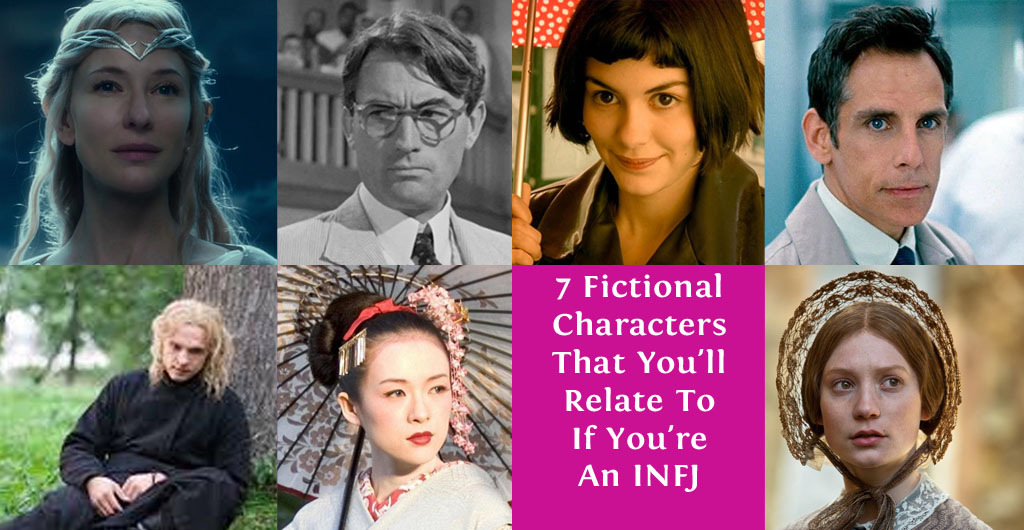
  • 7 Fictional Characters That You’ll Relate To If You’re An INFJ

    What fictional characters do you relate to as an INFJ?

    Just as we can describe real people using the Myers-Briggs® typology system, we can also type well-written fictional characters. Some of fiction’s most iconic and intriguing characters are INFJs and today we’re going to talk about seven that I think real-life INFJs will find relatable.

    One great thing about looking at character personality types is that it helps us better understand people who have different types than we do. Fictional INFJs can serve as examples for what real-life INFJs might be like, and also show how much variation can exist between individuals with the same type.

    The things that makes INFJs such great fictional characters are some of the same things that make them such interesting people. Though the rarest personality type on the planet, INFJs are fairly common in fiction. They’re thoughtful, introspective characters with a unique way of looking at the world and a keen interest in other people.

    Alyosha Karamazov

    It’s fascinating to read the narrator of Fyodor Dostoevsky’s The Brothers Karamazov discuss the story’s hero Alexi Karamazov (more often called by his nickname Alyosha/Alesha). He spends most of the introduction apologizing for presenting readers with such an unusual hero. “He is by no means a great man,” the narrator explains, but he is doubtless “a strange man, even an odd one.” He was strange “from the cradle,” growing up a quiet child preoccupied by something inside him while at the same time loving people. I’m sure many INFJs can relate to that in their own childhoods — liking other people but being too preoccupied by their inner worlds to be considered sociable.

    As the story progresses, we see Alyosha dreads conflict with a loathing that I think all INFJs (and the other FJ types as well) can relate to. We see him weeping when others are hurt, displaying the empathy that’s so much a part of real-life INFJs. We see him make social blunders in an effort to make everyone happy and at peace, all with an INFJ’s insistence on working toward harmony in all situations. Like so many INFJs, he’s sensitive, emotional, indecisive on certain things (though quite decisive in others), and isn’t afraid to appear weak so long as he’s being true to his beliefs. (more…)

  • Put on the Light: Choosing to Walk with God Instead of Darkness

    One phrase I frequently pray is, “Thank you for bringing us from darkness into light.” It’s an incredible blessing that each believer partakes of. Without God the Father drawing us to His Son, the Light of the world, we wouldn’t even know the world around us is in darkness.

    Do we really understand and value this light, though? And, equally important, do we live in the light now that we’ve been called to follow the Light?

    It’s not a popular thing in today’s society to make distinctions between right and wrong, holy and profane, light and darkness. But that’s something we must do because it is something God does. We have to know the difference between light and darkness so that we can choose the light and live in relationship with God.

    Confusing Light and Dark Hurts God

    When we read the phrase “woe to those who ___” it seems like a scary, sobering pronouncement. It means great sorrow or distress, which is what comes on those who forsake God. Hebrew carries another shade of meaning as well. “Woe” is hoy (H1945), which is an exclamation like ah! alas! ha! O! In the sort of context we’re looking at today, we can read this word as a cry of grief and despair from God at seeing the evil His people are doing that’s leading them away from the light.

    Woe to those who call evil good, and good evil; who put darkness for light, and light for darkness; who put bitter for sweet, and sweet for bitter! Woe to those who are wise in their own eyes, and prudent in their own sight! (Is. 5:20-21, WEB)

    God has good reason to exclaim hoy! over these people, for He knows what happens to those who “have rejected the law of Yahweh of Armies, and despised the word of the Holy One of Israel” (Is. 5:24). Spoilers: it’s not pretty. (more…)