
I’ve been collecting sheep and shepherd verses for putting together a new 30-day scripture writing plan. As I started sorting these verses, I was struck by the description of David as a shepherd for God’s people, then God’s scathing words for human leaders that followed Him, then by the arrival of an even greater Good Shepherd who was Lord of all and a descendent of David.
A Progression of Shepherds
David was an incredibly important Biblical figure. He was the youngest of his brothers, just a shepherd boy from the tribe of Judah, and yet God made him a war hero and Israel’s greatest king (1 Sam. 17:12; 2 Sam. 7:7-9). He plays an important prophetic role as well. One of the ways that Jesus was identified as the Messiah was as “David’s son” (Mark 12:35-37; John 7:42; 2 Tim. 2:8). There are even indications that David will rule as a prince once again in the kingdom of God, after Jesus’s second coming and the resurrection of God’s people from the dead.
As we read through the Bible as a whole, one of the things that David’s story does is highlight the failures of leaders who came after him. The Lord “chose David his servant, and took him from the sheepfolds; from following the ewes that have their young, he brought him to be the shepherd of Jacob, his people, and Israel, his inheritance” (Ps. 78:70-71, WEB). After that, though, most of the kings are described as people who did not walk in the ways of their father David. By the time we get to the prophets Jeremiah and Ezekiel, God had set Himself against the human shepherds of His people.
“Woe to the shepherds who destroy and scatter the sheep of my pasture!” says Yahweh. Therefore Yahweh, the God of Israel, says against the shepherds who feed my people: “You have scattered my flock, driven them away, and have not visited them. Behold, I will visit on you the evil of your doings,” says Yahweh. “I will gather the remnant of my flock out of all the countries where I have driven them, and will bring them again to their folds; and they will be fruitful and multiply. I will set up shepherds over them who will feed them. They will no longer be afraid or dismayed, neither will any be lacking,” says Yahweh. “Behold, the days come,” says Yahweh, “that I will raise to David a righteous Branch; and he will reign as king and deal wisely, and will execute justice and righteousness in the land.”
Jeremiah 23:1-5, WEB
This is one of the prophecies that revealed that the Messiah would be a descendant of David. For more scathing censures of human leaders who failed His people, you can read God’s words in Ezekiel 34. Here again, God calls out the human leaders for their failures and promises to personally intervene. The shepherds cared for themselves instead of the sheep, a sharp contrast to the coming Shepherd, Jesus Christ.
The Lord Yahweh says: “Woe to the shepherds of Israel who feed themselves! Shouldn’t the shepherds feed the sheep? You eat the fat. You clothe yourself with the wool. You kill the fatlings, but you don’t feed the sheep. You haven’t strengthened the diseased. You haven’t healed that which was sick. You haven’t bound up that which was broken. You haven’t brought back that which was driven away. You haven’t sought that which was lost, but you have ruled over them with force and with rigor.
Ezekiel 34:2-4, WEB
But he was pierced for our transgressions. He was crushed for our iniquities. The punishment that brought our peace was on him; and by his wounds we are healed. All we like sheep have gone astray. Everyone has turned to his own way; and Yahweh has laid on him the iniquity of us all. He was oppressed, yet when he was afflicted he didn’t open his mouth. As a lamb that is led to the slaughter, and as a sheep that before its shearers is silent, so he didn’t open his mouth.
Isaiah 53:5-7, WEB
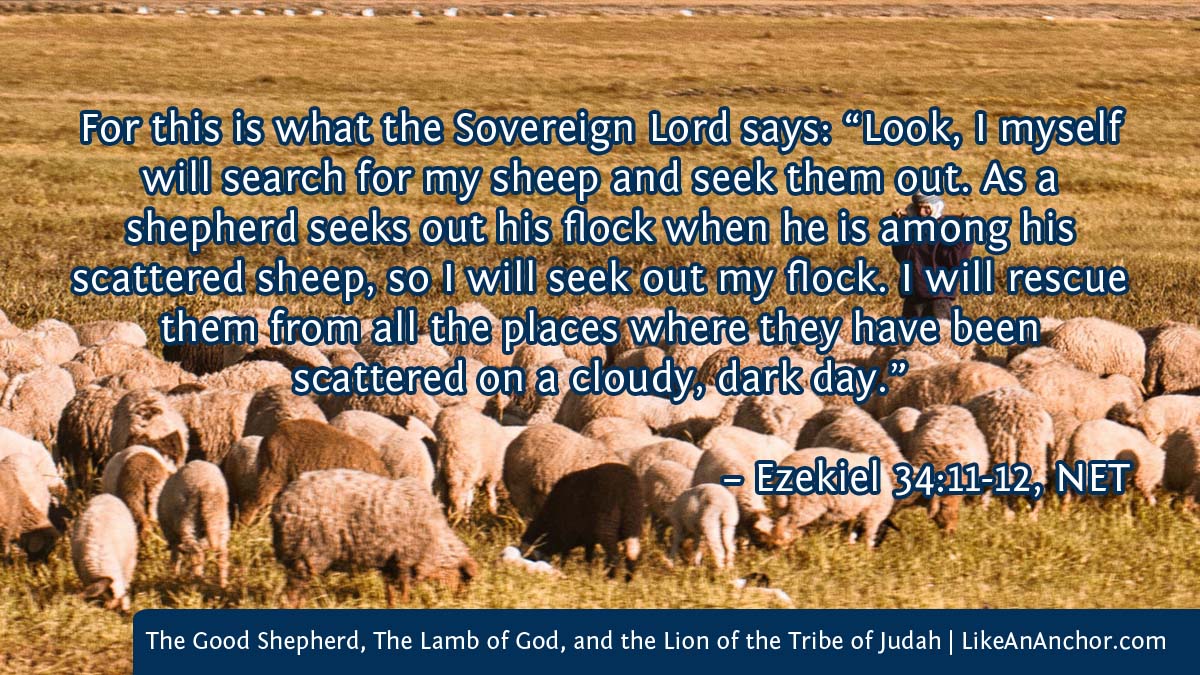
“‘For the Lord Yahweh says: “Behold, I myself, even I, will search for my sheep, and will seek them out. … I myself will be the shepherd of my sheep, and I will cause them to lie down,” says the Lord Yahweh. “I will seek that which was lost, and will bring back that which was driven away, and will bind up that which was broken, and will strengthen that which was sick; but I will destroy the fat and the strong. I will feed them in justice.”’ … I will set up one shepherd over them, and he will feed them, even my servant David. He will feed them, and he will be their shepherd. Yahweh, will be their God, and my servant David prince among them. I, Yahweh, have spoken it.
Ezekiel 34:11, 15-16, 23-24, WEB
“I am the good shepherd. The good shepherd lays down his life for the sheep.”
John 10:11, NET
The failed shepherds–leaders of ancient Israel and Judah–fed themselves and starved the flock. They ignored the diseased and refused healing to the sick. They didn’t seek out the lost. In contrast, Jesus gave His life and endured suffering to feed, heal, and save. He let those human shepherds pierce, crush, punish, and oppress Him the way they’d done to His sheep for so many years, then emerged from the grave as the Lamb slain as a sacrifice and the powerful Lion of the tribe of Judah.
The Ruling Lion and Sacrificial Lamb
David is never called a lion. He fought lions as a shepherd boy (1 Sam. 17:34-37) and he was from the tribe of Judah, which Jacob called “a lion’s cub” in his prophecies about his sons (Gen. 49:8-10), but he is not compared to a lion. This is a bit surprising to me, since “lion of Juda” seems like an obvious title to give a respected war hero turned king, especially with the promise “The scepter will not depart from Judah” being in the same prophecy (Gen. 49:10, WEB). If people at the time did say that about David, it isn’t recorded. Biblically, “lion of the tribe of Judah” is a title reserved for David’s son and Lord.
So I began weeping bitterly because no one was found who was worthy to open the scroll or to look into it. Then one of the elders said to me, “Stop weeping! Look, the Lion of the tribe of Judah, the root of David, has conquered; thus he can open the scroll and its seven seals.”
Then I saw standing in the middle of the throne and of the four living creatures, and in the middle of the elders, a Lamb that appeared to have been killed. He had seven horns and seven eyes, which are the seven spirits of God sent out into all the earth. Then he came and took the scroll from the right hand of the one who was seated on the throne.
Revelation 5:4-7 , NET
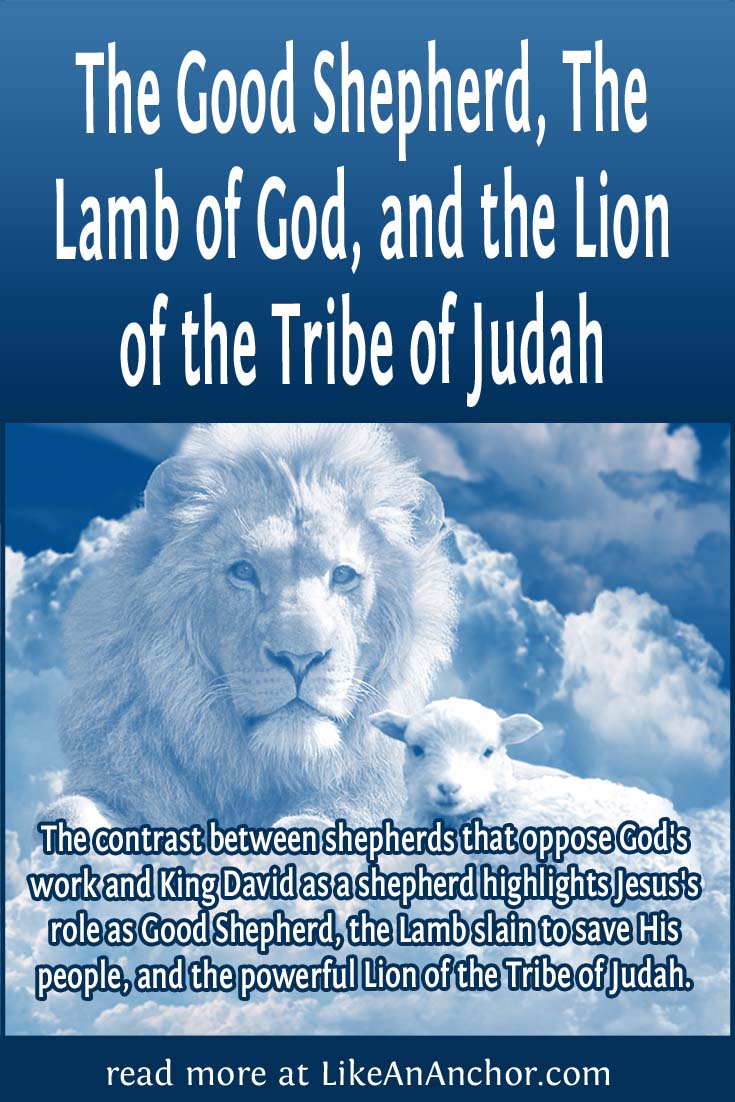
The juxtaposition of the Lamb of God slain for our sins and the Lion of the tribe of Judah taking up the ruling scepter helps us understand Jesus’s multifaceted roles. He is both sacrifice and king. None of the failed human shepherds can stand against Him when He comes as a lion to take His place as the good shepherd (Jer. 49:19; Hos. 11:10).
For Yahweh says to me,
Isaiah 31:4-5, WEB
“As the lion and the young lion growling over his prey,
if a multitude of shepherds is called together against him,
will not be dismayed at their voice,
nor abase himself for their noise,
so Yahweh of Armies will come down to fight on Mount Zion and on its heights.
As birds hovering, so Yahweh of Armies will protect Jerusalem.
He will protect and deliver it.
He will pass over and preserve it.”
One of the things I love about this study is that it reinforces how nuanced Biblical imagery is. Jesus is the Good Shepherd, but not every image of shepherds is positive. The contrast between shepherds that oppose God’s work and the Good Shepherd (who is God) highlights Jesus’s role as David’s successor and a greater shepherd. Lion imagery can be used for people who oppose God, even including the devil, but it’s also used to show Jesus conquering all those foes. We can be very grateful for our savior Jesus the Messiah, who is the Good Shepherd, the Lamb of God, and the Lion of the Tribe of Judah.
Featured image by Jeff Jacobs from Pixabay

Song Recommendation: “Lamb of God” by Twila Paris

 Like An Anchor
Leave a comment