
It’s been almost two years since I wrote an article about “The Action Words of Faith” used in Hebrews 11, but I can’t stop thinking about one of the things I noticed while doing that study. The faith chapter is all about heroes of faith, people that we look to as inspiring examples and people we can imitate in our walks with God. And you know who is listed first in that faith chapter? We are.
But we are not of those who shrink back to destruction, but of those who have faith to the saving of the soul.
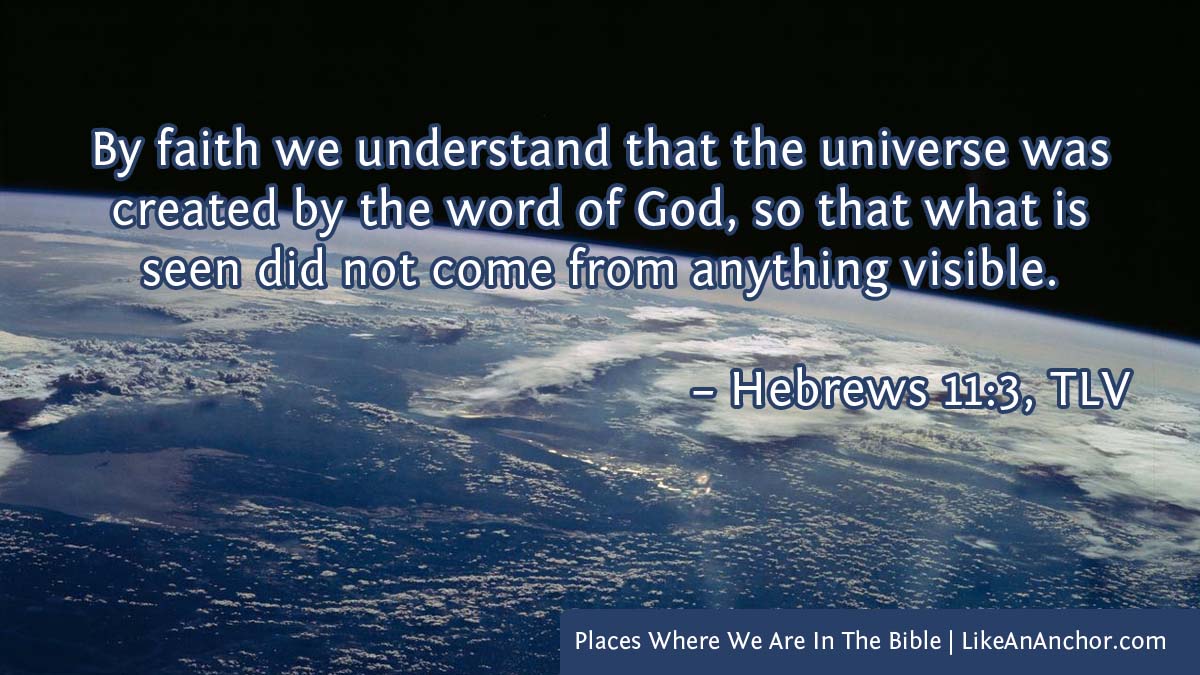
Now faith is assurance of things hoped for, proof of things not seen. For by this, the elders obtained approval. By faith we understand that the worlds were set in order at God’s command, so that the visible has its origin in the invisible.
Hebrews 10:39-11:3, NET
The first people mentioned in the famous faith chapter are “we,” the author and all the readers. None of us were there at the creation of the world, and so understanding God is the Creator is something we do by faith. That is just as true of us today as it was of first century Christians, and this “we” connects us modern readers to the ancient people of the Bible.
Even for those of us who understand the Bible is the word of God and that it is still relevant to our lives today, we sometimes struggle to see ourselves in the story. It is so far removed from us by time and (especially for Western readers) in terms of culture and what life looks like. But in many ways, people of the Bible were just like us, even the ones in the Old Testament. And there are many places in the Bible where God’s word speaks directly to us, not just to the original readers.
Those Christ Prayed For
It shouldn’t surprise us that the Bible written thousands of years ago contains verses that speak directly to and include us. We can see evidence of God doing just that within scripture. For example, Old Testament books speak of the Messiah and of the New Covenant that would include Gentiles as well as native Israelites. God’s perspective isn’t limited by time.
John 17 is one place that I often see people point out modern believers being mentioned in the Bible. This is Jesus’s prayer right before His arrest and crucifixion. He’d just kept the Passover with His disciples and then, as He was waiting to die, He prayed for them and for us as well.
“I am not praying only on their behalf, but also on behalf of those who believe in me through their testimony, that they will all be one, just as you, Father, are in me and I am in you. I pray that they will be in us, so that the world will believe that you sent me.”
John 17:20-21, NET
Jesus was thinking about the church on into the future on the night in which He was betrayed. Future believers’ inclusion in God’s family was part of “the joy set out for him” as “he endured the cross, disregarding its shame” (Heb. 12:2, NET). God’s plan to grow His family and bring many children to glory includes believers of the past, present, and future and His Bible speaks to all those people, including us.
Those Jesus Died For
In many of Paul’s writings, he is addressing a specific issue in a specific chruch. The book of Romans, though, is more general. He hadn’t yet visited this church personally and the letter contains a lot of foundational theology as Paul preached the gospel to the readers. As such, much of what Paul says in this letter applies to all people or all believers, and that includes us.
Consequently, just as condemnation for all people came through one transgression, so too through the one righteous act came righteousness leading to life for all people. For just as through the disobedience of the one man many were constituted sinners, so also through the obedience of one man many will be constituted righteous. Now the law came in so that the transgression may increase, but where sin increased, grace multiplied all the more, so that just as sin reigned in death, so also grace will reign through righteousness to eternal life through Jesus Christ our Lord.
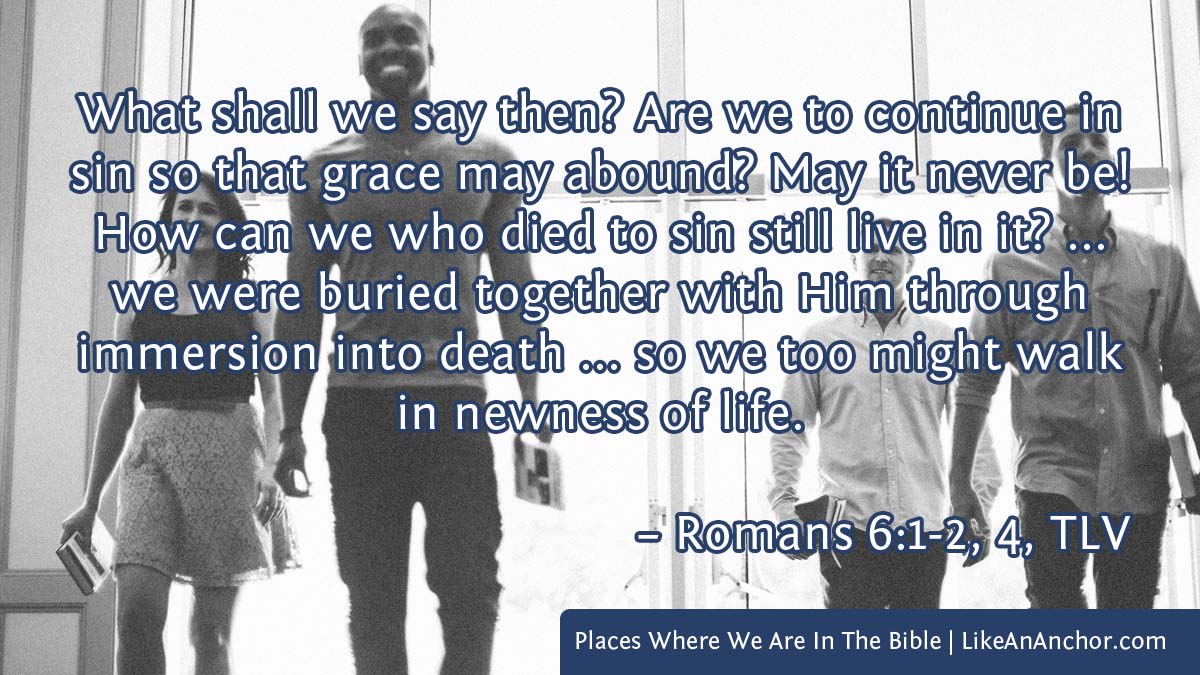
What shall we say then? Are we to remain in sin so that grace may increase? Absolutely not! How can we who died to sin still live in it? Or do you not know that as many as were baptized into Christ Jesus were baptized into his death? Therefore we have been buried with him through baptism into death, in order that just as Christ was raised from the dead through the glory of the Father, so we too may live a new life.
Romans 5:18-6:4, NET
I recommend reading all of chapters 5-6 for context, but let’s focus on these few verses. We are among the people who were condemned by Adam and Eve’s sin, and who are declared righteous by believing in Jesus Christ our Lord. And for those of us who are baptized and enter a covenant with God, we are among those who were baptized into Jesus’s death to live a new life freed from sin. Like Paul’s first-century readers, we are people Jesus died for and we have a reasonability to live in obedience, not sin, after we enter a relationship with God.
Those Building on the Foundation

When you start looking for words like “we” and “you” in Biblical writings, you see them all the time. In some contexts, it’s clear that the “you” being addressed is a specific person or group of people in the past. Sometimes the “we” clearly refers to the author and a few other specific people. But often, readers across time are being included in the “we” and “you” mentioned. Let’s look at an example in one of Paul’s letters.
We are coworkers belonging to God. You are God’s field, God’s building. According to the grace of God given to me, like a skilled master-builder I laid a foundation, but someone else builds on it. And each one must be careful how he builds. For no one can lay any foundation other than what is being laid, which is Jesus Christ. If anyone builds on the foundation with gold, silver, precious stones, wood, hay, or straw, each builder’s work will be plainly seen, for the Day will make it clear, because it will be revealed by fire. And the fire will test what kind of work each has done. If what someone has built survives, he will receive a reward. If someone’s work is burned up, he will suffer loss. He himself will be saved, but only as through fire.
Do you not know that you are God’s temple and that God’s Spirit lives in you? If someone destroys God’s temple, God will destroy him. For God’s temple is holy, which is what you are.
1 Corinthians 3:9-16, NET
Here, “we” refers to Paul and others who preached the gospel. “You” refers to all who are building on the foundation they laid, including us who are reading his words today. We get to read his letters, and through them Paul’s preaching about Jesus Christ becomes part of the foundation where we build our faith. What we build will be tested, just as believers throughout history and in the future were or will be tested. We are all–past, present, and future believers–part of the temple of God (and I’ve talked before about how the “you” in that verse is plural).
These are just a few of the places in the New Testament that speak directly to modern readers. I think it’s amazing when we can read the Bible and see ourselves there among the people throughout time that God the Father and Jesus Christ think about and want to have join their family.
Featured image by Claudine Chaussé from Lightstock

Song Recommendation: “Find us Faithful” by Let There Be Praise Singers


Leave a Reply