• How Paul Approached the Commandments of Men

    When we start talking about the relationship between God’s law and New Testament Christians, everyone wants to jump right into Paul’s writings. It’s easy to pluck verses from his epistles out of context and use them to argue that God’s law went away along with the Old Covenant and that you don’t have to keep the commandments. But is that really the best explanation for passages like Romans 7 and Colossians 2 in light of the rest of the Bible?

    I’ve written quite a bit about Romans but never Colossians, even though some commenters have asked. But a short time ago I was re-reading Paul’s letter to Colossae and felt a nudge in my spirit to “study this” as I read chapter two.

     I say this so that no one will deceive you through arguments that sound reasonable. …

    Therefore, just as you received Christ Jesus as Lord, continue to live your lives in him, rooted and built up in him and firm in your faith just as you were taught, and overflowing with thankfulness. Be careful not to allow anyone to captivate you through an empty, deceitful philosophy that is according to human traditions and the elemental spirits of the world, and not according to Christ.

    Colossians 2:4, 6-8, NET

    This verse provides context for what’s to follow. Paul is going to discuss the difference between following traditions invented by men and following Christ. The following scriptures won’t be about whether or not the Old Testament law matters since Jesus came in the flesh. It’s about following Jesus the way Jesus and His Father want us to rather than the way humans come up with.
    Image of a man reading the Bible overlaid with text from Colossians 1:9-10, NET version: "For this reason we also, from the day we heard about you, have not ceased praying for you and asking God to fill you with the knowledge of his will in all spiritual wisdom and understanding, so that you may live worthily of the Lord and please him in all respects—bearing fruit in every good deed, growing in the knowledge of God."
    Image by Matt Vasquez from Lightstock

    Jesus’s Take On God’s Law

    Before going any farther in Paul’s writings, let’s look at what Jesus says. During His ministry, Jesus and His disciples were accused of things like Sabbath breaking, defiling themselves with sinners’ company, and unclean hygienic practices. We know that Jesus lived a sinless life and never broke His Father’s commands. But He did reject the additions humans made.

    He said to them, “Isaiah prophesied correctly about you hypocrites, as it is written:

    ‘This people honors me with their lips,
    but their heart is far from me.
    They worship me in vain,
    teaching as doctrine the commandments of men.’

    Having no regard for the command of God, you hold fast to human tradition.”

    Mark 7:6-8, NET (bold italics mark a quotation from Isa 29:13)

    He’s not saying to stop following God’s commandments. He’s berating them for elevating their traditions to the same level as God’s law. The leading Jews of the time had things really mixed up. Even when they followed God’s law, they focused on the wrong things, emphasizing minute details and neglecting the “weightier matters.” That’s something Jesus criticized, but He speaks very differently about the law that came directly from God.

     “Do not think that I have come to abolish the law or the prophets. I have not come to abolish these things but to fulfill them. I tell you the truth, until heaven and earth pass away not the smallest letter or stroke of a letter will pass from the law until everything takes place. So anyone who breaks one of the least of these commands and teaches others to do so will be called least in the kingdom of heaven, but whoever obeys them and teaches others to do so will be called great in the kingdom of heaven. For I tell you, unless your righteousness goes beyond that of the experts in the law and the Pharisees, you will never enter the kingdom of heaven!”

    Matthew 5:17-20, NET

    Jesus clearly stated He had no intention of doing away with God’s law. Rather, He was there to fill it to the fullest extent. He also upheld God’s commands when giving practical advice to individuals. When a rich young man came to Jesus and asked, “What shall I do that I may inherit eternal life?” Jesus responded, “keep the commandments.” After the young man said he was already doing that, Jesus told him the only thing still lacking was a commitment to follow Jesus unconditionally (Matt. 19:16-21; Mark 10:17-21; Luke 18:18-22). Keeping God’s commands and following Jesus go hand-in-hand.
    Image of a woman studying the Bible overlaid with text from Colossians 3:1, 3, 5-6, NET version: "Therefore, if you have been raised with Christ, keep seeking the things above, where Christ is, seated at the right hand of God. ... you have died and your life is hidden with Christ in God. ... So put to death whatever in your nature belongs to the earth: sexual immorality, impurity, shameful passion, evil desire, and greed which is idolatry. Because of these things the wrath of God is coming on the sons of disobedience."
    Image by MarrCreative from Lightstock

    Not Judged For Following Jesus

    With that understanding, we can go back to Paul’s writings. Knowing he would never contradict Jesus’s teachings gives us framework for understanding difficult passages like Colossians 2. Here, his focus is on following Jesus rather than human beings. One example Paul uses is the issue of circumcision. There was a faction in the early church that believed new male converts had to be circumcised according to the Abrahamic covenant before they could receive salvation. But that was an aspect of the Old Covenants that pertained to the flesh and didn’t carry over. Rather, the emphasis is now on “circumcision not made with hands” on a spiritual level (Col. 2:11-12, WEB).

    Interestingly, the focus on spiritual circumcision was already part of the Old Testament (Deut. 10:16; 30:6; Jer. 4:4). It’s just now brought to the forefront as Jesus fills the law to its fullest. We’re to “serve in newness of the spirit, and not in oldness of the letter” (Rom. 7:6, WEB) now that Christ has taken away our condemnation for breaking the law (Col. 2:14-15).

    Therefore do not let anyone judge you with reference to eating or drinking or participation in a feast or a new moon or a Sabbath, which are a shadow of what is to come, but the reality is Christ.

    Colossians 2:16-17, LEB

    Some take this to mean no one should judge you for rejecting God’s dietary laws and holy day commands. But the focus in this chapter isn’t on moving away from keeping God’s commandments. It’s about following Jesus instead of human beings, and we have direct evidence of Jesus keeping Passover, the Feast of Unleavened Bread, and the Feast of Tabernacles. Also, the holy days weren’t something man came up with; they belong to God. If God tells His people to observe days that belong to Him, Jesus Himself observed them as holy, and His followers continued to do that (see, for example, 1 Cor. 5:6-8; 11:23-26), then one verse in a chapter that talks about rejecting human regulations doesn’t change that.

    Follow Jesus. That’s It.
    Image of three women holding Bibles, overlaid with blog's title text and the words, "Our lives should be characterized by a commitment to follow God the way He commands. The doctrines or traditions of men, whether they take away from or add to the words of God, carry little weight."
    Image by Shaun Menary from Lightstock

    We can learn even more about Paul’s intention when writing about feasts and sabbaths by continuing to read his letter. This part comes right after the verse we just looked at that mentions a feast, new moon, or Sabbath.

    Let no one who delights in false humility and the worship of angels pass judgment on you. That person goes on at great lengths about what he has supposedly seen, but he is puffed up with empty notions by his fleshly mind. He has not held fast to the head from whom the whole body, supported and knit together through its ligaments and sinews, grows with a growth that is from God.

    If you have died with Christ to the elemental spirits of the world, why do you submit to them as though you lived in the world? “Do not handle! Do not taste! Do not touch!” These are all destined to perish with use, founded as they are on human commands and teachings. Even though they have the appearance of wisdom with their self-imposed worship and humility achieved by an unsparing treatment of the body—a wisdom with no true value—they in reality result in fleshly indulgence.

    Colossians 2:18-23, NET

    Paul states that he’s talking about ordinances that are “human commands and teachings.” He’s not telling us to reject God’s commands! Rather, he’s saying to follow God the way God tells us to follow Him instead of the legalistic worship practices piled on by human beings.

    Similarly, when writing to Titus, Paul warned not to pay “attention to Jewish myths and commandments of people who turn away from the truth” (Tit. 1:14, LEB). Instead, Titus was to “say the things which fit sound doctrine” (Tit. 2:1, WEB). The standard for “sound doctrine” is the entirety of scripture, not just the New Testament and cherry-picked parts of the Old (2 Tim. 3:16; Rom. 15:4). Our lives should be characterized by a commitment to follow God the way He commands. The doctrines or traditions of men, whether they take away from or add to the words of God, carry little weight.

    There are physical parts of the Old Covenant law (e.g. hygienic practices for an encampment) that don’t apply to us today. There are parts that have been updated under the renewed covenant (e.g. we don’t stone people for death-penalty sins; they can be forgiven in Jesus Christ). But God never changes and the commandments He gave are still guides for helping us understand and develop His character. Obedience matters to God. Just look at how many times in John’s writings that loving and knowing God is linked to keeping His commandments (John 14:21;  15:10; 1 John 2:3-4; 5:2-3; 2 John 1:4-6).

    God has never done away with His law or commandments and there’s no indication He’ll do so in the future (note: law is linked with covenants, but it’s not exactly the same thing as the Old Covenant). In fact, the closing parts of Revelation say, “Blessed are those who do his commandments, that they may have the right to the tree of life, and may enter in by the gates into the city” (Rev. 22:14, WEB). The city spoken of in this passage is new Jerusalem, which comes down to earth after the resurrections, Millennium, and final defeat of Satan. If God only intents to fellowship with those who keep His commandments at that point, why would we think He doesn’t want that now?


     

    Click here to learn more about these books or to order a copy.

    Save

  • Hidden Figures and NT-type Women

    Contrary to popular belief, INTJs have emotions. They also express them, though not always to the person they’re having feelings about (for example, an INTJ might tell his best friend he likes a girl, but not tell the girl. Or an INTJ might tell her husband she hates a coworker, but never give the coworker a hint). INTJs tend to compartmentalize their feelings and process them internally, and they hate expressing deep emotions casually or to people they don’t know well.

    hidden_ntIf you’re very observant, though, and get to know the INTJs in your life, you’ll start to realize there’s a remarkable depth to their feelings. They’ll even do things, like cry at movies, that are typically associated with Feeling personality types. They might scorn the things that are “supposed” to make you cry (e.g. I’m sniffling at a Pixar film and my INTJ sister laughs out loud in the theater). But then I’ll look over and notice moisture leaking from the corners of her eyes at the end of Hidden Figures (I’ve been informed it was not crying).

    Hidden Figures (2016) is a fantastic film about “a team of African-American women mathematicians who served a vital role in NASA during the early years of the US space program. ” They were among the first African-Americans and the first women to work in such prestigious technical roles. My sister, about to graduate with a degree in Chemical Engineering, gave me one explanation for her emotional response to the film: “these women and others like them made it possible for me to be an engineer.”

    As the character Mary Jackson tells a judge, someone always has to be first. These women proved it’s possible for women to be taken seriously and make important contributions as mathematicians and engineers. But I suspect my sister’s words go deeper than referring to breaking down gender stereotypes about the kind of work women can do. It also has to do with people’s expectations for what women should be like.

    hidden_nt_2Only 24-35% of women have a personality type that relies on Thinking as their primary or secondary mental process (according to the Center for Applications of Psychological Type). INTJ and INTP women are tied for rarest at 1-3% of the female population. ENTJs come in a close third at 1-4%. ENTPs tie with ESTPs with 2-4%, just slightly more common than ISTPs at 2-3%. The STJ types aren’t nearly as rare, with ESTJs making up 6-8% and ISTJs 7-10% of the female population.

    I’m not going to type the women in Hidden Figures, but having seen the film I think it’s safe to say Katherine G. Johnson, Dorothy Vaughan, and Mary Jackson are Thinking types. Their minds are naturally wired to excel at processing facts, figures, and data — a hall-mark of the fact-checking, analytical Thinking functions that use “impersonal criteria to make decisions.” I’d say Katherine at least is probably an Intuitive type as well, pairing pattern-recognition and possibility-seeking with her Thinking side.

    That means she wasn’t just a rarity at NASA (an African-American woman working in a highly technical position). She’s also a rarity in society (a woman using both Intuition and Thinking as her most comfortable mental processes). Thinking traits are so strongly stereotyped as masculine that NT women often don’t fit cultural expectations for femininity. One of the many things I loved about Hidden Figures is that these three women seemed to have figured out a way to balance being wives and mothers with working as groundbreakingly successful mathematicians. They’re also portrayed as real people who are admired and respected for who they are instead of as the bitchy, controlling, or cold stereotype we often get when presented with Thinking female characters (take Sandra Bullock’s character in The Proposal as an example). And the men they’re in relationships with aren’t scared of them or trying to fit them back in boxes.

    It was really wonderful to see characters that embraced femininity on their own terms. While I do believe God created the two genders to be different and complementary in the roles we fill, I also think there are stereotypes in our culture that do both genders a disservice. One of those is that women are or “should” be more emotion-driven than analytically-minded. There’s room for both. And, as Hidden Figures reminds us, we would do ourselves a terrible disservice if we tried to keep these women hidden.click to read article, "Hidden Figures and NT-type Women" | marissabaker.wordpress.com

    Save

    Save

    Save

    Save

    Save

  • Spiritual PTSD

    Spiritual PTSD

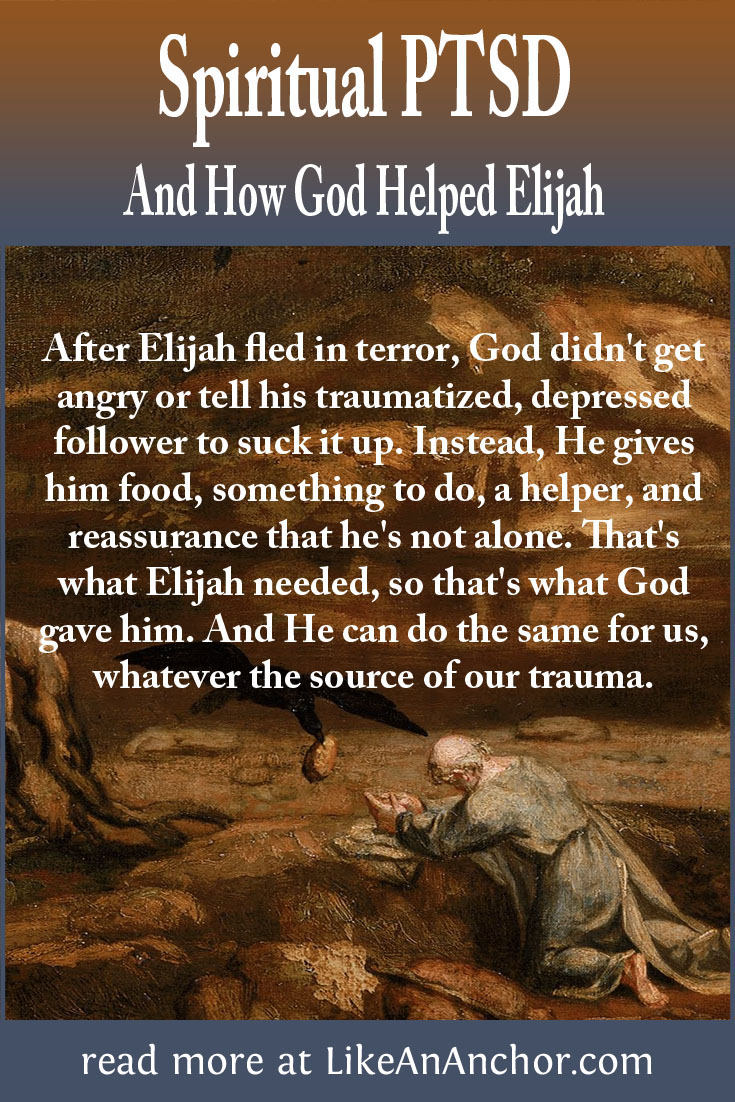
    Why did the prophet Elijah flee from Queen Jezebel in the story recorded in 1 Kings18-19? It’s a question I’ve heard asked quite often in sermons, typically with some laughter. Elijah had just faced down all the prophets of Baal, saw God work a mighty miracle, and finally got the people of Israel’s attention. Then he runs for the hills when a woman threatens him. Really? What an appalling lack of faith!

    A few weeks ago, my sister asked, “Do you think people can have spiritual PTSD?” For context, the Anxiety and Depression Association of America says that Post Traumatic Stress Disorder (PTSD) “is a serious potentially debilitating condition that can occur in people who have experienced or witnessed” a traumatic event such as “exposure to actual or threatened death, serious injury, or sexual violation.” That could very well be something Elijah was dealing with in this story. And I suspect that since you chose to click on a post with the title “Spiritual PTSD,” you or someone you know might have experienced some kind of trauma as well. Perhaps God’s response to Elijah’s trauma holds hope for us today as well.

    Elijah’s Traumatic Day

    The first time Elijah steps on the Biblical scene, he tells one of the scariest kings to ever rule Israel, “As Yahweh, the God of Israel, lives, before whom I stand, there shall not be dew nor rain these years, but according to my word” (1 Kings 17:1, WEB). We know nothing of Elijah’s background save that he was a Tishbite from Gilead. What we do know is that God promptly sent him into hiding first by himself and then with a widow’s family (1 Kings 17:2-24).

    I don’t know why God hid Elijah. Perhaps God wanted him to learn patience and trust. Or maybe He wanted to keep Elijah safe. Whatever the reason, there’s no indication Elijah was hesitant to come out of hiding when the Lord said, “Go” several years later. First Elijah presents himself to King Ahab, then he calls hundreds of pagan priests to the now famous meeting at Mount Carmel (1 Kings 18:1-20).

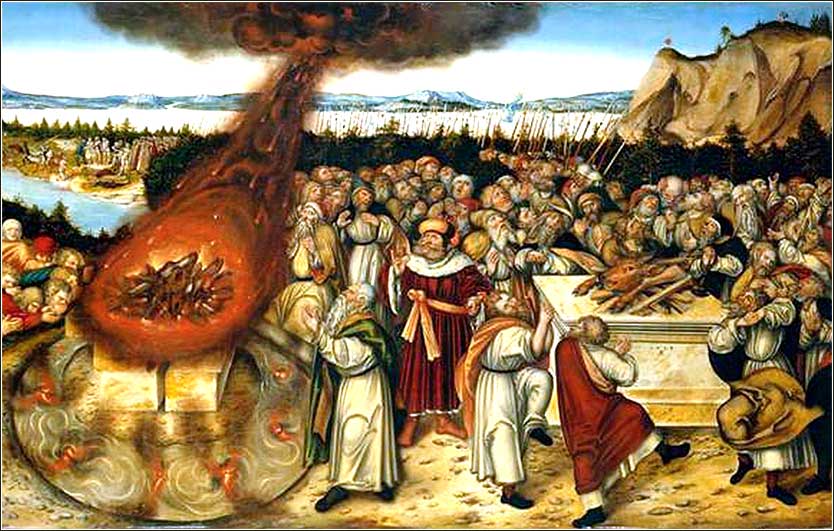
    We often read this story and focus on God’s awesome work in demonstrating that He alone is God. Today, let’s try to see it from Elijah’s perspective. He came out of hiding to talk with a king who wants him dead. He called 850 priests and prophets of a hostile religion to a meeting and spent a full day taunting them in public. The scripture records “they cried aloud, and cut themselves in their way with knives and lances, until the blood gushed out on them” (1 Kings 18:28, WEB). That couldn’t have been much fun be around. And with so many there, I doubt every evil priest stayed right by the alter. I imagine they also tried to stir up the people and spent time threatening and taunting Elijah as well.

    Elijah and the Priests of Baal by Lucas Cranach the Younger, ca. 1545
    Image credit: “Elijah and the Priests of Baal” (cs. 1545) by Lucas Cranach the Younger

    That went on all morning. In the afternoon, Elijah single handedly prepared a stone altar, butchered a bull, and set it up for an offering to God. I imagine he was physically exhausted by the time he stepped back and ordered the people to pour water over the altar three times (1 Kings 18:21-38). Then he prayed. God responded in spectacular fashion, burning up the water, stones, and dust as well as the sacrifice and wood. The people “fell on their faces” and said “Yahweh, he is God!” But Elijah’s job wasn’t done yet. He said, “Seize the prophets of Baal! Don’t let one of them escape!” They seized them; and Elijah brought them down to the brook Kishon, and killed them there” (1 Kings 18:39-40, WEB).

    Elijah killed (probably with some help) at least 450 people that evening, perhaps 850 if “the prophets of the groves” from verse 19 were included with the prophets of Baal. And that still wasn’t the end of his day. He went up to the top of Carmel and prayed earnestly for rain. Once he saw a little cloud forming “he tucked his cloak into his belt and ran before Ahab to the entrance of Jezreel” (1 Kings 18:46, WEB). That’s at least 15 miles and he was running faster than a chariot.

    There’s little indication what Elijah’s mental state was at this point. Was he exhausted but still patiently trusting God would work things out? Was he excitedly hopeful Ahab would turn back to God? We don’t know. We just know that when Jezebel promised to kill him within 24 hours “he ran for his life” (1 Kings 19:1-3, WEB). He ran about 100 miles from Jezreel to Bersheba, then goes another day’s journey in the wilderness and prays for death. In his series “Profiting From The Prophets,” Pastor Bob Deffinbaugh suspects Elijah could be “diagnosed as suicidal” and depressed at this point. I’m not a psychologist any more than Pastor Deffinbaugh is, but I’d say PTSD would be an equally valid diagnosis.

    God’s Course of Treatment

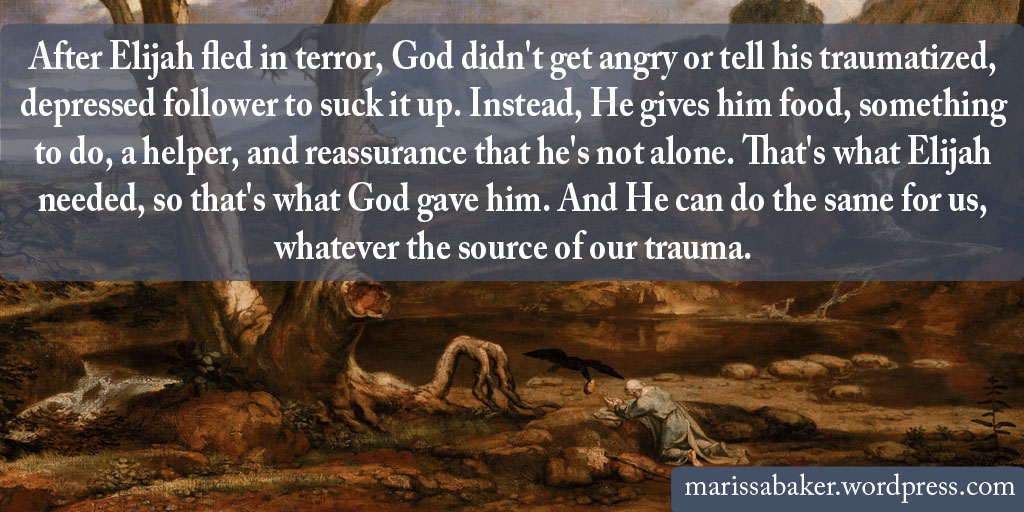
    Perhaps the most remarkable thing about this story is how God responds to Elijah’s fear. He doesn’t get angry or tell his traumatized, depressed follower to suck it up. He sends an angel to offer encouragement, food, and strength so Elijah could get to Mount Horeb. There, God asks, “What are you doing here, Elijah?” (1 Kings 19:19:9, WEB). Elijah responds,

    “I have been very jealous for Yahweh, the God of Armies; for the children of Israel have forsaken your covenant, thrown down your altars, and killed your prophets with the sword. I, even I only, am left; and they seek my life, to take it away.”

    1 Kings 19:10, WEB

    I’m not sure why God answered with “a great and strong wind [that] rent the mountains,” then an earthquake, then a fire. The scriptures say “the Lord was not in” these things. Perhaps Elijah refused to come out of his cave when God called the first time. Maybe he needed to see a display of God’s power as an encouragement or reminder. Whatever the case, he responds this time when the Lord calls in “a still small voice” (1 Kings 19:11-13, KJV). The LEB translates this as “the sound of a gentle whisper.”

    The Lord asks again, “What are you doing here, Elijah?”  Elijah gives the same answer, probably the only one he could come up with after all that. The Lord responds in three parts: He gives Elijah a mission to anoint two kings, he tells him to anoint Elisha as his replacement, and He reveals there are 7,000 faithful people still in Israel (1 Kings 19:14-18). Food, something to do, a helper, and reassurance that he’s not alone. That’s what Elijah needed and that’s what God gave him.

    What About Us?

    click to read article, "Spiritual PTSD" | LikeAnAnchor.com
    Image credit: “Elijah In The Desert” (1818) by Washington Allston

    When my sister brought up the idea of spiritual PTSD she wasn’t just talking about people in the Bible who God brought through traumatic situations. She was also asking about a kind of spiritual parallel. Can someone experience a traumatic event in their spiritual walk that gives them a sort of spiritual “PTSD” that affects how they interact with God, churches, and fellow Christians?

    I think it can. One of the perks of writing a blog is that I get to hear from many of my fellow Christians who reach out to share their stories. But the heartbreaking thing is that many of those stories are ones that involve deep hurt, much of it caused by fellow church members. We probably all know stories (or have personal stories) of being abused, dismissed, slandered, and much more all by people who claim to be following God. Even worse, the party at fault is often in a leadership position. Far too often, a Christian’s deepest hurts come from the people who should be the first ones to reach out in love and compassion.

    But that’s the great thing about God. Nothing limits Him. He can help us just as effectively as He helped Elijah, whatever the source of our trauma. Because we can look at examples like Elijah’s, we know God follows through on promises like, “‘I will in no way leave you, neither will I in any way forsake you.’ So that with good courage we say, ‘The Lord is my helper. I will not fear. What can man do to me?’” (Heb. 13:5-6, WEB).

    Click here to learn more about these books or to order a copy.

    Save

  • The Simplest Guide to Myers-Briggs® Functions Ever

    The most complicated aspect of Myers-Briggs® personality types is also one of the things that makes it a useful theory. It’s the answer to criticisms like “But people aren’t 100% introverts or extroverts” and “Sometimes I use thinking and sometimes feeling, so the test must be wrong.”

    Myers-Briggs® theory describes complex, nuanced, dynamic personalities using something called “function stacks.” That term refers to mental processes (functions) that people use in a certain order (stack) of preference. But when you start trying to study function stacks and people are throwing around phrases like “Extroverted Intuition” and “Introverted Thinking” it starts getting confusing, especially after you learn ENxJs don’t even use Extroverted Intuition and IxTJ types don’t use Introverted Thinking. What on earth is going on?

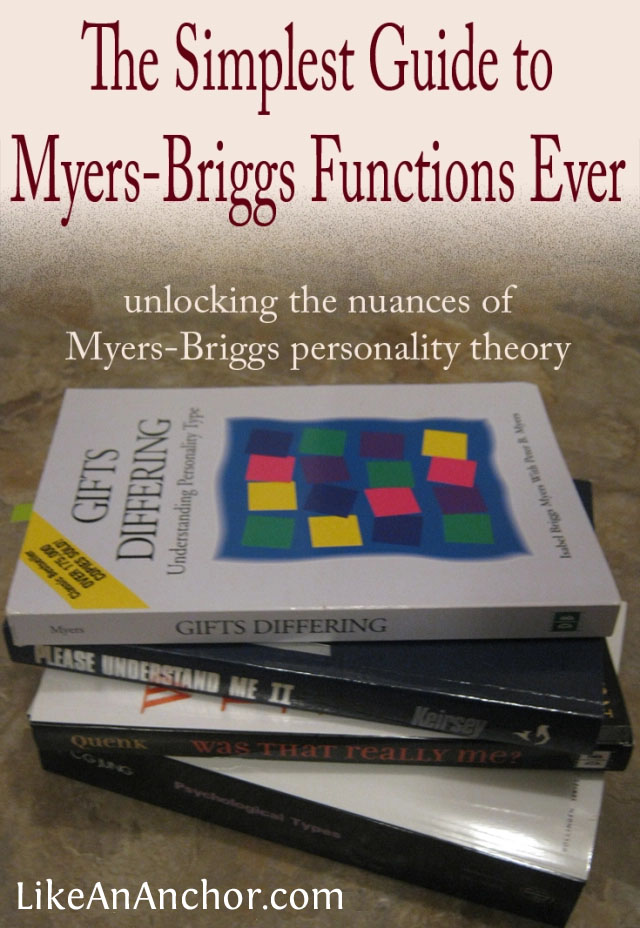
    I’ve written about cognitive functions before, but I feel like I’ve always fallen short of explaining the concept both simply and concisely. I’ll link to those more in-depth posts at the end of this article, but right now let’s try and break this topic down for the simplest function stack guide on the Internet.The Simplest Guide to Myers-Briggs Functions Ever | LikeAnAnchor.com

    What J and P Really Mean

    Contrary to popular opinion, Judging and Perceiving aren’t a sliding scale. They aren’t even meant to stand on their own as an aspect of your personality — they’re just in your four-letter type to describe how you use the other letters. Thinking and Feeling are both Judging functions because they’re involved in how you make decisions. Sensing and Intuition are both Perceiving functions because they’re about how you learn information. (more…)

  • Make It A Spring

    Make It A Spring

    Sometimes we walk through a season of life that feels like a wilderness. Barren, lonely, forsaken. We might even feel like this is the end. That things are hopeless.

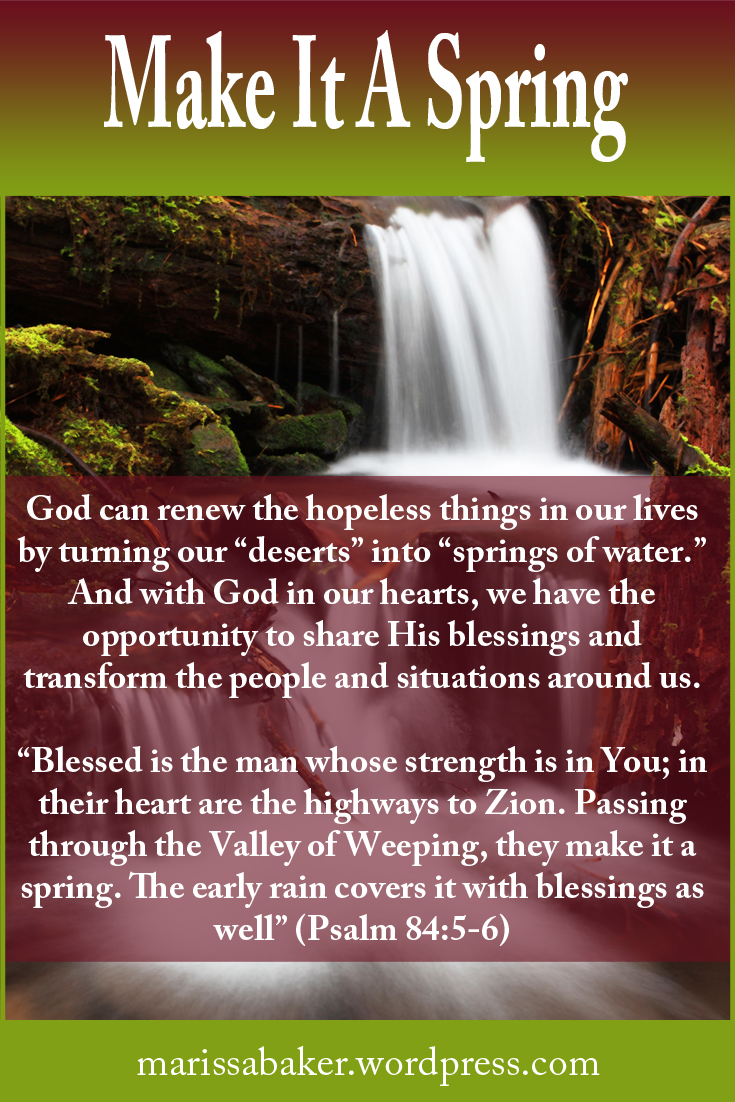
    That’s where Elijah was when he fled Jezebel. He went out in the wilderness, sat by a tree, and asked God to let him die. Instead, God gave him food and water and sent him to Mount Horeb (1 Kings 19:1-8). There, Elijah made his complaint. “Then he said, ‘I have been very zealous for Yahweh the God of hosts, for the Israelites have forsaken your covenant. They have demolished your altars, and they have killed your prophets with the sword. I alone am left over, and they seek to take my life’” (1 Kings 19:10, LEB).

    Yahweh responds by showing His power, reassuring Elijah that he was not the only believer left, and giving him a job to do (1 Kings 19:11-18). Elijah thought things were hopeless but God had other ideas. He had a plan for Elijah and an even larger plan Elijah didn’t know about.

    click to read article, "Make It A Spring" | marissabaker.wordpress.com
    Photo Credit: “Spring Runoff” by Ian Sane, CC BY via Flickr

    Transforming Your Wilderness

    For all of us, it’s easy to feel like we’re insignificant to God’s plan. But no one is too small for God to do marvelous things with. In fact, God often chooses the poor, weak, and little because those are the ones easiest for Him to work powerfully in (1 Cor. 1:26-31; 2 Cor. 12:9-10)

    When the poor and needy seek water, and there is none, and their tongue faileth for thirst, I the Lord will hear them, I the God of Israel will not forsake them. (Is 41:17, KJV)

    (more…)

  • Not Ashamed of Modesty

    Not Ashamed of Modesty

    Feminism constantly tells women we have no reason to be ashamed of our bodies, our desires, our gender, our career goals – of anything really. We can do and be whatever we want and nothing should hold us back. It sounds good in theory, but like many things humans do it can be taken to extremes.

    Take the Women’s March from a few weeks ago as an example. If you want to march around with what one blogger I follow delicately called a pink taco on your head I won’t stop you. But those of us who don’t do things like that aren’t any less “women” than you are, nor are we less interested in being treated with dignity, respect, and equality. In fact, that’s a big reason we express our notions of feminism (and femininity) in different ways.

    click to read article, "Not Ashamed of Modesty" | marissabaker.wordpress.com
    Photo credit: “Day 68” by Quinn Dombrowski, CC BY-SA via Flickr

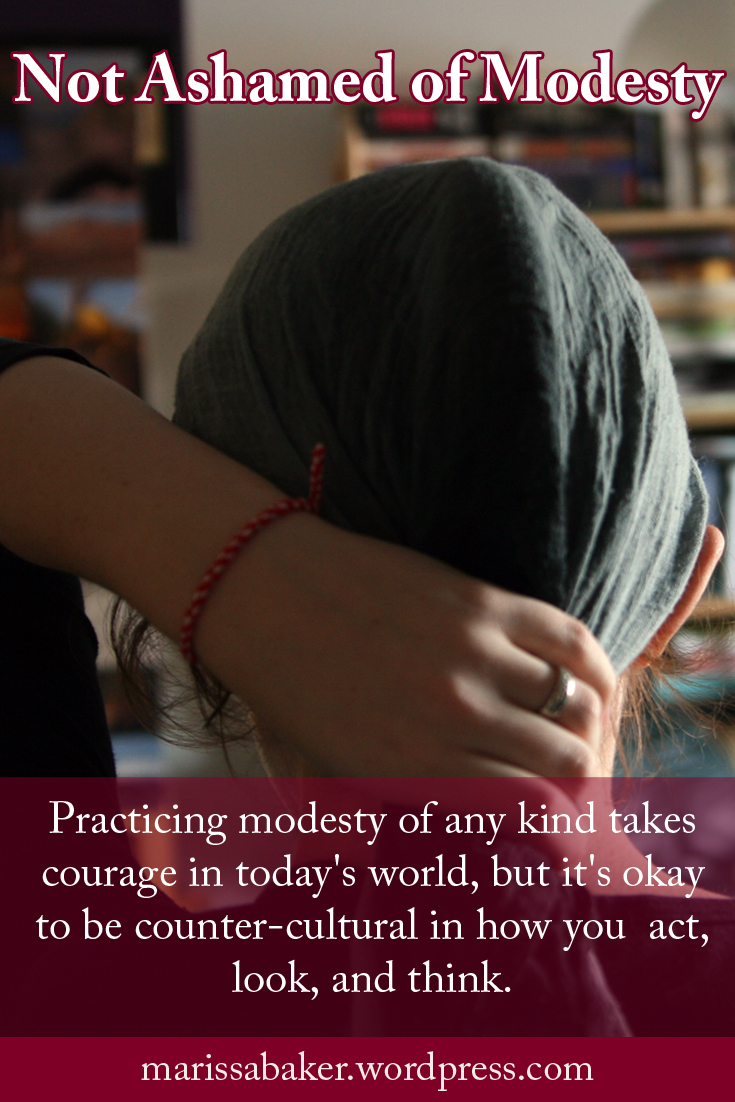
    Today, I’m going to take society’s claim that there’s no need to feel shame about the kind of woman you are to heart and say I’m not ashamed of modesty. Depending on your background this word may have provoked a strong reaction. Perhaps you think modesty is a repressive, old-fashioned list of rules telling women how not to dress and act. Or maybe you think modesty sounds safe – a way to hide from attention you don’t want any more. But modestly is about so much more than a set of rules for covering yourself up. It’s more powerful and – dare I say it? – sexy than we often think.

    Let’s start with a working definition of modesty: Modesty is concealing what you do not want everyone to know or see so that you can reveal yourself only to someone you trust. It’s typically associated with the idea of sex and how much skin you show, but it has to do with other things as well. For example, you might also exercise modesty by not calling undue attention to yourself or by reserving certain parts of your personality for people you know well. (more…)