• As you may know if you read my blog regularly, my Bible study for last week’s post was a bit too large to fit in one article. Hence, part 2 about the role of the Holy Spirit as revealed in the Book of Acts. All the intro is in last week’s post, so without further ado …

    Filled With The Spirit

    Several times when the Holy Spirit is mentioned in the book of Acts, it talks about people being “filled with” the Spirit. Sometimes it is referring to an individual’s character and relationship with God, such as Stephen (Acts 6:3,5) and Barnabas (Acts 11:24), and sometimes this filling with the Holy Spirit occurs after a specific event. For example, here’s what happened after the disciples prayed in Acts 4:24-30 following Peter and John being arrested and forbidden to speak in Jesus’ name.

    And when they had prayed, the place where they were assembled together was shaken; and they were all filled with the Holy Spirit, and they spoke the word of God with boldness. (Acts 4:31)

    It seems that God gave an extra dose of His Spirit when the disciples asked for strength to keep going through persecution. Notice also that the Spirit prompted them to speak, giving them the strength they needed to continue preaching in Jesus’ name (we’ll get back to that in a moment).

    A similar thing seems to have happened in Acts 13:51-52, when Paul and Barnabus showed up in Iconium after being expelled from Antioch. The disciples here “were filled with joy and with the Holy Spirit,” though I’m not clear on whether this was new disciples receiving the Holy Spirit because of Paul and Barnabus’ preaching or established followers of Christ being giving an extra measure of the Holy Spirit as a result of persecution (any thoughts?)

    Speaking By The Spirit

    In several cases, being filled with the Holy Spirit precedes speaking. Take, for example, Peter and John before the Jewish leaders in Acts 4:8, as they witness to the life and power of Jesus Christ. This puts me in mind of Luke 21.

    But before all these things, they will lay their hands on you and persecute you, delivering you up to the synagogues and prisons. You will be brought before kings and rulers for My name’s sake. But it will turn out for you as an occasion for testimony. Therefore settle it in your hearts not to meditate beforehand on what you will answer; for I will give you a mouth and wisdom which all your adversaries will not be able to contradict or resist. (Luke 21:12-15)

    The Holy Spirit also inspires prophetic utterances, such as when Agabus predicted a famine (Acts 11:28) and when Isaiah spoke in the Old Testament (Acts 28:25). The thing I like to note here is that no one questioned that the Holy Spirit could and would do this sort of thing — the disciple’s response to Agabus was to organize relief efforts for the predicted famine (Acts 11:29).

    Another important thing to note is what people say when speaking by the Holy Spirit. In Acts 4, Peter and John spoke God’s word boldly, bearing witness to Jesus Christ. In Acts 7:55-56, Stephen said, “I see the heavens opened and the Son of Man standing at the right hand of God.” In Acts 13:9-10, Paul spoke out against a sorcerer who was “perverting the straight ways of the Lord.”

    The common thread here is presented in 1 Corinthians. In short, the test for answering the question, “Is someone speaking by the Holy Spirit?” is to look at how they talk about Jesus Christ.

    Therefore I make known to you that no one speaking by the Spirit of God calls Jesus accursed, and no one can say that Jesus is Lord except by the Holy Spirit. (1 Cor. 12:3)

    Getting The Holy Spirit

    We generally assume that, with the exception of the the remarkable Pentecost in Acts 2,  baptism of the Spirit accompanies baptism in water, as it did for Saul/Paul in Acts 9:17-18. Similarly, believers at Ephesus “were baptized in the name of the Lord Jesus. And when Paul had laid hands on them, the Holy Spirit came upon them, and they spoke with tongues and prophesied” (Acts 19:5-6).
    "Holy Spirit in the Book of Acts, Part 2" by marissabaker.wordpress.comThe situation is similar in Samaria, but with a greater time between the two baptisms. The new disciples here were “baptized in the name of the Lord Jesus,” but did not receive the Holy Spirit until Peter and John came and “ laid hands on them, and they received the Holy Spirit” (Acts 8:14-17).  Not sure why this is — was it to help establish the apostles’ role in the early church? Set a precedent for laying on of hands?

    Another thing we can learn from this story is how not to get the Holy Spirit. The sorcerer Simon tried to buy the power to give God’s Spirit with the laying on of hands and was told, “your money perish with you, because you thought that the gift of God could be purchased with money! You have neither part nor portion in this matter, for your heart is not right in the sight of God” (Acts 8:18-21).

    God can also give the Holy Spirit without laying on of hands or water baptism. This was done in Acts 10 to prove that “God has also granted to the Gentiles repentance to life” (Acts 11:18).

    While Peter was still speaking these words, the Holy Spirit fell upon all those who heard the word. And those of the circumcision who believed were astonished, as many as came with Peter, because the gift of the Holy Spirit had been poured out on the Gentiles also.  For they heard them speak with tongues and magnify God. Then Peter answered, “Can anyone forbid water, that these should not be baptized who have received the Holy Spirit just as we have?” And he commanded them to be baptized in the name of the Lord. Then they asked him to stay a few days. (Acts 10:44-48)

    God can give His Spirit to whomever He pleases, whenever it suits Him. It’s not something that follows a set formula or automatically comes with water baptism (see Simon’s story above). This gift is much more complicated and wonderful than something that just happens to accompany being dunked in water.

    Roles and Actions of the Holy Spirit

    Here’s where we get into what the Holy Spirit is credited with doing in the early church. I think the easiest way to organize this is just to go through them chronologically.

    • Acts 8:29 “the Spirit said to Philip” to speak to the Ethiopian eunuch
    • Acts 8:39 “the Spirit of the Lord caught Philip away, so that the eunuch saw him no more,” and Philip found himself at Azotus.
    • Acts 9:31 the Holy Spirit acts as a comforter, as was promised in John 14:16, 26; 15:26; 16:7.
    • Acts 10:19-20 the Spirit told Peter to go with Cornelius’ messengers and to doubt nothing.
    • Acts 13:2 “As they ministered to the Lord and fasted, the Holy Spirit said, ‘Now separate to Me Barnabas and Saul for the work to which I have called them.’” Since the Holly Spirit itself does not call people, I think it safe to assume God was peaking through the Spirit. Still, they were hearing the Holy Spirit clearly enough to record a line of dialogue.
    • Acts 15:28 the letter to Antioc read, “it seemed good to the Holy Spirit, and to us” — collaborative letter writing with the Spirit?
    • Acts 16:7 “after they had come to Mysia, they tried to go into Bithynia, but the Spirit did not permit them.”
    • Acts 20:23 “the Holy Spirit testifies in every city, saying that chains and tribulations” await Paul. Two examples of this: Acts 21:4, 11.
    • Acts 20:28 speaking to the Ephesian elders, Paul said, “the Holy Spirit has made you overseers, to shepherd the church of God”

    This is not at all how we interact with the Spirit today. we don’t hear it talking to us (and would we listen if we did? or think we were going mad?). We don’t act like it’s real and tangible enough to physically move us from one location to another if God had good reason. We credit it with inspiring messages and study, but that’s about it. Why is that? Are we so frightened of the supernatural that we shoot ourselves in the foot when it come to using the Spirit God has given us?

    Grieve Not The Spirit

    "Holy Spirit in the Book of Acts, Part 2" by marissabaker.wordpress.comThere is a very real danger in not giving God’s Spirit the respect it deserves as a gift from Him and an aspect of His power. Ananias and Sapphira dropped down dead when the lied to and tempted the Holy Spirit (Acts 5:3-9). Stephen told his murderers, “You stiff-necked and uncircumcised in heart and ears! You always resist the Holy Spirit; as your fathers did, so do you.” (Acts 7:51). Resistance to the Holy Spirit was their legacy — we do not want it to be ours.

    We are told, “do not grieve the Holy Spirit of God” (Eph. 4:30), “do not quench the Spirit” (1 Thes. 5:19), and “do not neglect the gift that is in you” (1 Tim. 4:14), which could refer to the Spirit itself or to one of the Spiritual gifts (2 Tim. 1:6; 1Cor. 12:1-11). We have been given something incredible, and should not undervalue it.

  • Simple Chicken Stir-Fry marissabaker.wordpress.com

    I found this easy, attractive chicken stir fry recipe on Pinterest. The original recipe, from Edible Mosaic, was for a Cabbage, Carrot, and Chicken Stir-fry that served two. I trippled the recipe for our family of 5, thinking my teenage brother would eat enough for two people. Turns out I was wrong — we had enough to feed 6 or 7 people. The left-overs were a great breakfast, though!

    Cabbage, Carrot, & Chicken Stir-Fry

    Simple Chicken Stir-Fry marissabaker.wordpress.com
    marinade

    Marinade

    3 tablespoons water

    1 1/2 tablespoons sesame oil

    3 tablespoons soy sauce

    1 1/2 tablespoon rice vinegar

    1 tablespoon honey

    3 large clove garlic, minced

    1 to 1 1/2-inch piece fresh ginger, grated

    1 teaspoon sesame seeds

    1/4 teaspoon pepper

    Chicken

    Simple Chicken Stir-Fry marissabaker.wordpress.com
    chicken fried in sesame oil tastes so good. I could eat it like candy

    1 1/2 lb boneless, skinless chicken breast, sliced cross-wise into thin strips

    1/3 cup tapioca starch

    2 tablespoons sesame oil

    3/4 cup water

    1 lb green cabbage, sliced into thin shreds

    6 medium carrots, thinly sliced on a diagonal

    2 green onions, thinly sliced

    extra sesame seeds for garnish

    slivered almonds (optional)

    Whisk together marinade ingredients. Stir in the chicken and let it marinade for 5 to 10 minutes. Remove the chicken from the marinade, and reserve the remaining marinade for later use. Toss chicken with the tapioca starch.

    Simple Chicken Stir-Fry marissabaker.wordpress.com
    putting it all together

    Add the remaining 2 tablespoons of sesame oil to a wok or large skillet over high heat. Once the oil is hot, turn heat down to medium-high. Cook chicken in small batches in a single layer until browned, about 2 minutes on each side. Add more oil about halfway through cooking the chicken.

    Once all the chicken is cooked, add the cabbage, carrot, reserved marinade, and 3/4 cup water to the wok or skillet. Scrape up any brown bits from the bottom of the skillet and toss vegetables with a wooden spoon. Cook for 3 to 5 minutes or until the veggies are crisp-tender, stirring frequently.

    Turn off heat and add the chicken. Garnish with the green onion, more sesame seeds, and slivered almonds if desired. Serve over steamed rice.

    Simple Chicken Stir-Fry marissabaker.wordpress.com


  • INFJ Dark Side

    INFJ Dark Side

    Descriptions of the INFJ personality type often emphasize our peaceful natures and ignore any hint of a “dark side.” For example, one commenter on my INFJ Loki post argued my typing is inaccurate because he couldn’t imagin an INFJ “carrying on a constant fight with everyone around you for the majority of your existence.” He knows INFJs are generally peaceful and conflict-avoidant, and couldn’t buy an INFJ as this type of villain.

    People also describe INFJs as disconnected from the world, and unlikely to feel involved in the reality of what’s going on around us. All too often, people incorrectly assume this means we don’t care about what other people do or things that happen. This isn’t true. As Amelia Brown points out in her post The Dark Side Of The INFJ Personality Type, INFJs can be stubborn, judge others harshly, and abruptly cut people out of their lives. We do notice, and care, what’s going on enough to have a pretty decisive reaction in some cases.

    Though INFJs are generally peaceful, gentle, and dislike engaging in confrontations, we’re not completely harmless (just ask my siblings). Every personality type has a dark side, and INFJs can be just as scary as anyone else.

    INFJ Dark Side | LikeAnAnchor.com
    Photo by Karen_Nadine on Pixabay

    (more…)

  • I did not mean for this to be a multi-part blog post, but I didn’t get all the way through studying the book of Acts this week so I’ll have to split the post in half. When I was in Cincinnati last weekend for Sabbath services and square dancing, there was one particular part of the sermon message that caught my attention. The speaker said “We can’t use the Holy Spirit if we don’t understand what it is” and that we don’t talk about the Holy Spirit today the way it was viewed by the early church in the Book of Acts.

    That got me thinking, just how did the early church talk about the Holy Spirit? We usually look at the first two chapters, which chronicle the baptism of the Holy Spirit at Pentecost, and then go no further in Acts when we talk about the Holy Spirit. That’s where I’ll start as well, and then next week I’ll plan to write a post about what my study turns up in the remainder of Acts.

    Enter The Holy Spirit

    There were people who had the Holy Spirit before this notable Pentecost, but not many. So few, in fact, that it says in John’s gospel that “the Holy Spirit was not yet given, because Jesus was not yet glorified” (John 7:39). Before Jesus ascended to heaven in the first chapter of Acts, He promised the disciples, “you shall be baptized with the Holy Spirit not many days from now” and “you shall receive power when the Holy Spirit has come upon you” (Acts 1:5, 8). That promise was fulfilled in the next chapter.

    And suddenly there came a sound from heaven, as of a rushing mighty wind, and it filled the whole house where they were sitting. Then there appeared to them divided tongues, as of fire, and one sat upon each of them.  And they were all filled with the Holy Spirit and began to speak with other tongues, as the Spirit gave them utterance. (Acts 2:2-4)

    Not only was the Holy Spirit given to the disciples, but a miracle was performed at the same time which left no doubt of the effectiveness of the power God was giving. Men “from every nation under heaven … heard them speak in his own language” (Acts 2:5, 8). As we’ll discuss more in next week’s post, this is not the only time this particular miracle accompanied the giving of the Holy Spirit (Acts 10:44-48).

    Receiving the Spirit

    When some doubted what was going on, Peter said this:

    Men of Judea and all who dwell in Jerusalem, let this be known to you, and heed my words. For these are not drunk, as you suppose, since it is only the third hour of the day. But this is what was spoken by the prophet Joel: “And it shall come to pass in the last days, says God, that I will pour out of My Spirit on all flesh; your sons and your daughters shall prophesy, your young men shall see visions, your old men shall dream dreams. And on My menservants and on My maidservants I will pour out My Spirit in those days; and they shall prophesy. (Acts 2:16-18)

    He also revealed a recipe for receiving the Holy Spirit which is repeated several times in later chapters.

    Repent, and let every one of you be baptized in the name of Jesus Christ for the remission of sins; and you shall receive the gift of the Holy Spirit. For the promise is to you and to your children, and to all who are afar off, as many as the Lord our God will call. (Acts 2:38-39)

    I am finding it interesting, and inspiring, to read through the book of Acts taking note of every time the Holy Spirit is mentioned and seeing how the promises and prophesies mentioned in chapter 2 enfold in the early Church. I look forward to sharing more of my thoughts on this with you next week, and hope you’ll weigh-in as well — it seems like a topic that could lend itself well to discussion.

  • Fruit and Seed Granola Bars marissabaker.wordpress.com

    My brother has been begging me to come up with some kind of healthy, filling snack that he can munch on when he feels hungry (which seems to be all the time). Enter the Healthy Homemade Granola Bars from Beth at redandhoney.com. They are amazing, though you do have to keep them chilled to prevent melting, which makes them a bad choice to stuffing in a backpack or purse … not that we would know this from experience.

    Fruit and Seed Granola Bars marissabaker.wordpress.com
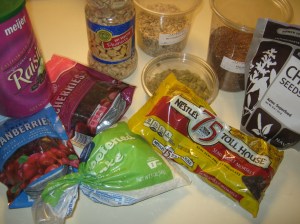
    Granola bar add-ins

    There are many variations on these bars depending on the nut butter and add-ins you choose, but the version I’m posting today is my favorite. I’ve decided dried cherries are an essential ingredient. So are pumpkin seeds — I like the flavor and the green color looks great with the red dried fruit.

    As an added bonus, these granola bars are unleavened, so they will still be perfect for snacking once the Days of Unleavened Bread start next month.

    Fruit and Seed Granola Bars

    print this recipe

    2/3 cup peanut butter
    2/3 cup coconut oil
    2/3 cup honey
    2 cups oats
    1 cup dried fruit (raisins, cranberries and/or cherries)
    1 cup seeds and nuts (peanuts, pumpkin, flax, chia and/or sunflower seeds)Fruit and Seed Granola Bars marissabaker.wordpress.com

    Mix first three ingredients together, microwaving in 15 to 20 second bursts and stirring until the coconut oil is melted.

    Stir-in the oats, dried fruit, seeds and nuts. Press the granola bar mixture into an ungreased 13×9-inch baking pan. Place granola bars in the refrigerator for 2 to 3 hours.

    Once granola mixture is cooled and set, cut into bars. Wrap individually or package in snack bags. Store in the refrigerator or freezer.

    Variations
    You can replace the peanut butter with almond butter if you prefer the taste or have an allergy.

    The two cups of dried fruit, seeds, and nuts can be substituted for a wide variety of add-ins, including chocolate chips, coconut flakes, and almonds. My sister prefers her add-ins to be 1 cup chocolate chips, 1/2 cup coconut flakes, and 1/2 cup peanuts. Just keep experimenting until you find a few mixtures that you love.

    Fruit and Seed Granola Bars marissabaker.wordpress.com

  • Songs by Mood

    marissabaker.wordpress.comLast week, I learned that Neurowear launched a set of headphone about a year ago that scans your brainwaves and matches music on your iPod to your mood. As border-line creepy as that sounds to me, it’s just the next step from websites like Moodstream and Musicovery that play music based on whether you’re feeling happy, sad, calm, dark, lively, inspired, positive, creative, or pretty much any other mood you like.

    I have genres or playlists that I’ll turn to for different moods, but I also have specific songs that I like to play for specific feelings. Is this just me? Or do you have a song you play every time you’re sad? A favorite song to match a happy mood? What about songs that help you deal with anger?

    Angry

    You know that feeling when you’re angry and you know you shouldn’t be, but you still need to do something with those feelings? That’s when I sing these songs. I feel much better afterwards and it means I’m not taking out my anger on anyone else, so they’re happy (although I have been told it’s creepy to witness).

    No Good Deed — from Wicked (Idina Menzel)

    Mordred’s Lullaby — Heather Dale

    Blown Away — Carrie Underwood

    Sad

    These songs are like a pat on the back or a hug when I need reassurance. I listen to them when I’m feeling down and want to move out of that mood.

    Everything is Fine — Josh Turner

    Little Miss — Sugarland

    You Are Loved — Josh Groban

    Sub-category for when I’m discouraged about being single:

    As Fast As I Could — Josh Turner

    Melancholy

    These songs are for sadness that I want to enjoy. It’s the “sad is happy for deep people” feeling rather than being sad for a reason that makes you not want to be sad any more.

    Wine After Whiskey — Carrie Underwood

    September — Daughtry

    Katie — Celtic Thunder /Colm Keegan (which I’m afraid there’s no video for, but you can hear a clip)

    Inspired

    These are the songs I play when I want to feel like I’m fearless and I can do anything.

    Defying Gravity — from Wicked (Idina Menzel)

    Wide Open — Jason Aldean

    I Stand — Idina Menzel

    Happy

    I was trying to think up songs for this category, and my sister said, “Don’t you sing One Direction when you’re happy?” As embarrassing as that may be,  yes I do. I’ve whittled it down to just one song from them, though.

    What Makes You Beautiful — One Direction

    Nil Se’n La — Celtic Woman

    Hopeful

    Since “Waiting For Superman” didn’t quite fit in with the happy or the melancholy songs, I’ve added this category.

    Waiting For Superman — Daughtry

    Wedding Day — Casting Crowns

    This Is The Moment — from Jekyll and Hyde (Robert Cuccioli)

    Peaceful

    I play these songs when I want to relax and I’m trying to encourage a peaceful feeling. They’re usually the first songs I play, then I move on to a playlist of related songs and artists. Or I listen to instrumental music with dolphins.

    Hero — Il Divo

    So She Dances — Josh Groban

    Worshipful

    These are my favorite stand-in-awe of God songs.

    Blessed Be Your Name — Robin Mark

    Who Am I — Casting Crowns

    In Christ Alone — Keith and Kristyn Getty