• If We Are The Body

    If we are the body, why is HIs love not showing? marissabaker.wordpress.comToday’s post is inspired by a Casting Crowns song called “If We Are The Body.” I’ll add a video of it at the end of this post, so you can listen to it if you’re not familiar with the song. It is basically a challenge to the Christian church — if we really are Christ’s body (and we know from verses like Colossians 1:18 that we are), why isn’t the church as a whole acting more like Jesus Christ?

    Arms Reaching

    ♪ ♫ But if we are the body, Why aren’t His arms reaching?

    Do we have the same kind of compassion that Christ showed? He wept over Jerusalem because His people rejected His attempts “to gather your children together, as a hen gathers her chicks under her wings” (Matt. 23:37; Luke 19:41-42). He was constantly reaching out to help, encourage, and teach people.

    But when He saw the multitudes, He was moved with compassion for them, because they were weary and scattered, like sheep having no shepherd. (Matt. 9:36)

    Each of us can bear witness to the compassion and mercy of God in our lives. Take just a moment to think about all the forgiveness He has shown you, all the times He picked you up out of hopelessness — and then look at the next chapter in Matthew.

    When Jesus sent out His twelve disciples, He instructed them to do the same thing He was doing: “preach, saying, ‘The kingdom of heaven is at hand.’ Heal the sick, cleanse the lepers, raise the dead, cast out demons. Freely you have received, freely give” (Matt. 10:7-8). It’s this last sentence that I want to focus on. Are we giving compassion, forgiveness, and help to others as freely as Christ gives those things to us? Or are we holding ourselves back from reaching out to certain people?

    Hands Healing

    ♪ ♫ Why aren’t His hands healing?

    We often seem to gloss over the phrase “gifts of healing” when reading about spiritual gifts in the church. We say that since we don’t see people today performing the same kinds of miracles that were happening in Acts 3:1-10 and 5:12-16, that these gifts are not present in today’s church. Paul did not, however, indicated that there will be a time when certain gifts simply are not around.

    But the manifestation of the Spirit is given to each one for the profit of all: for to one is given the word of wisdom through the Spirit, to another the word of knowledge through the same Spirit, to another faith by the same Spirit, to another gifts of healings by the same Spirit, (1 Cor 12:7-9)

    If we are the body, why aren't His hands healing? marissabaker.wordpress.comThe word translated “healing” here is iama (G2386). It is much like our English word, and means a “cure, the result of the process of healing.”It is used in the gospels of Christ healing with a touch or by a “word of power.” Of the gifts in 1 Corinthians 12, Zodhiates points out that iama is always plural, and that the Lord gave “gifts or abilities to provide the means of various healings in His divine providence whether they be with or without medicine.”

    I suspect that the gifts of healing can include a wide range of emotional, physical, mental, and spiritual healing. Some people have a gift for counseling others through emotional distress. Others with a gift for physical healing might practice a form of medicine. Those with a gift of faith can pray, trusting this promise:”the prayer of faith will save the sick, and the Lord will raise him up” (James 5:15).

    There is no reason to assume the lack of showy miracles means there are no gifts of healing in the church. Not every person in the body of Christ will have a gift of healing (1 Cor. 12:28-30), but if those who have been given this gift are using it, then the overall body will have healing hands.

    Words Teaching

    ♪ ♫ Why aren’t His words teaching?

    The verse I most often see/hear people turn to in the context of the church’s responsibility to teach is at the end of Matthew. Jesus told His followers, “Go therefore and make disciples of all the nations … teaching them to observe all things that I have commanded you” (Matt. 28:19-20). Often, I think churches approach this verse one of two opposite and extreme directions. One is to adopt disciplining the nations as the chief and greatest occupation of the church. The other is to ignore it completely and say it’s not our place to “shove our religion down someone’s throat.”

    As in many things, the balanced view is both rarer and a better goal. We cannot afford to ignore a clear instruction from Jesus Christ to teach, but if we adopt this as the one great commission of the church, we risk overlooking Christ’s instruction to “feed My sheep” — to care for and teach people who are already in the church. In Paul’s continuing discussion about spiritual gifts, he says,

    Even so you, since you are zealous for spiritual gifts, let it be for the edification of the church that you seek to excel. (1 Cor. 14:12)

    The reason to want spiritual gifts is so that we might build-up, teach, and help each other within the church. Then, when conditions inside the church are as they should be, God will bring in new believers.

    But if all prophesy, and an unbeliever or an uninformed person comes in, he is convinced by all, he is convicted by all. And thus the secrets of his heart are revealed; and so, falling down on his face, he will worship God and report that God is truly among you. (1 Cor. 14:24-25)

    How many of our church congregations would inspire this kind of reaction in someone who just walked through the door? TV shows, radio spots, websites, magazines, and booklets might help someone find a church group, but it’s the people who will inspire them to stay. If a new believer doesn’t see evidence that God is truly among us and hear His words being taught, they will keep looking for a church that actually acts like part of the body of Christ.

    Feet Going

    ♪ ♫ And if we are the body, Why aren’t His feet going?
    If we are the body, why aren't His feet going? marissabaker.wordpress.comWhen studying for this section, I was surprised to find how prominently feet figure in the Bible. The Lord “will not allow your foot to be moved” (Ps. 121.3), He delivers “my feet from falling” (Ps. 116:8), and His “word is a lamp unto my feet” (Ps. 119:105). The Israelites “feet did not swell” during all their years of wandering in the wilderness (Neh. 9:21). People sat at and anointed Jesus’ feet (Luke 7:38; 8:35; 10:39; John 12:3). Jesus washed the feet of His disciples (John 13:5-6). John the Baptist’s father prophesied that he would “guide our feet into the way of peace” (Luke 1:79).

    Where our feet are going indicates the direction of our lives. Are our feet headed toward evil, such as “feet swift to shed blood” (Rom. 3:15)? Or are our feet beautiful like “the feet of those who preach the gospel of peace,” and shod with that same gospel as part of our spiritual armor (Rom. 10:15; Eph. 6:15)?

    In Jeremiah, it says that “it is not in man who walks to direct his own steps” (Jer. 10:23). The only one who can direct our steps rightly is God, and He directs us to walk in the steps of Jesus.

    For to this you were called, because Christ also suffered for us, leaving us an example, that you should follow His steps (1 Pet. 2:21)

    The context here is that to endure “grief, suffering wrongfully,” is commendable before God because it gives us the opportunity to mimic Christ’s actions (1 Pet. 2:18-20). As His body, we must be willing to walk in His footsteps, wherever that might lead.

    He who says he abides in Him ought himself also to walk just as He walked. (1 John 2:6)

    Love Showing

    ♪ ♫ Why is His love not showing them there is a way? There is a way

    Love — agape (G26) — is the key to relationships. It is called “a more excellent way” compared to gifts of leadership, prophecy, healing, and working miracles. Even “the best gifts” are of no value if separated from love (1 Cor. 12:28-13:3).

    A new commandment I give to you, that you love one another; as I have loved you, that you also love one another. By this all will know that you are My disciples, if you have love for one another. (John 13:34-35)

    Jesus said that love among the breathren is how the entire world will recognize us as His disciples. This builds right upon the idea of someone being able to walk into a gathering of the church and see “that God is truly among you” (1 Cor. 14:25). As the discussion continues, Jesus also connects love to the idea following in His footsteps.

    This is My commandment, that you love one another as I have loved you. Greater love has no one than this, than to lay down one’s life for his friends. (John 15:12-13)

    Like in 1 Peter 2, following Christ includes the very real possibility of suffering. Here, with the focus on love, it also includes the idea of voluntary sacrifice for the good of another person. That is the kind of attitude that the entire church is to have.

    And if one member suffers, all the members suffer with it; or if one member is honored, all the members rejoice with it. Now you are the body of Christ, and members individually. (1 Cor. 12:26-27)

    I am so blessed to regularly fellowship with a congregation like this. As we individually and collectively grow more and more like Jesus and learn to use our spiritual gifts “for the edifying of the body of Christ,” we will be better able to serve Him by serving other people (Eph. 4:12).
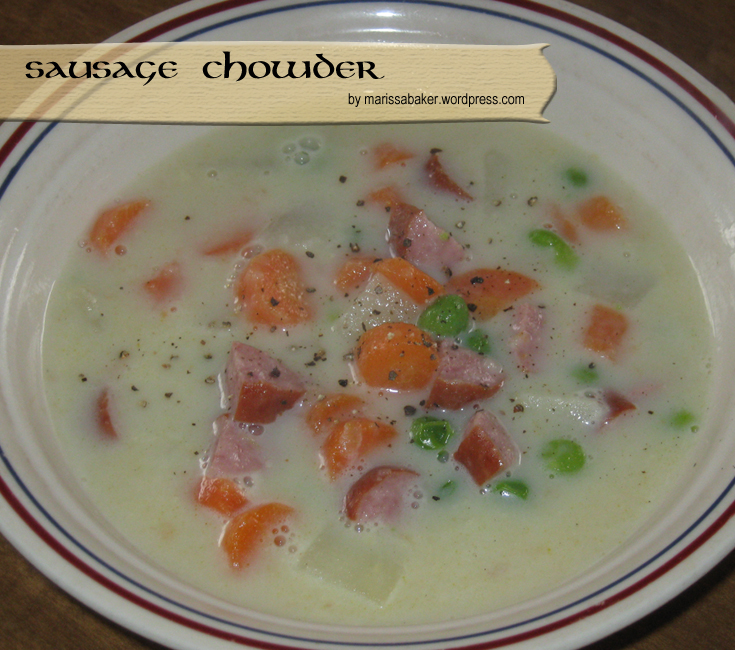
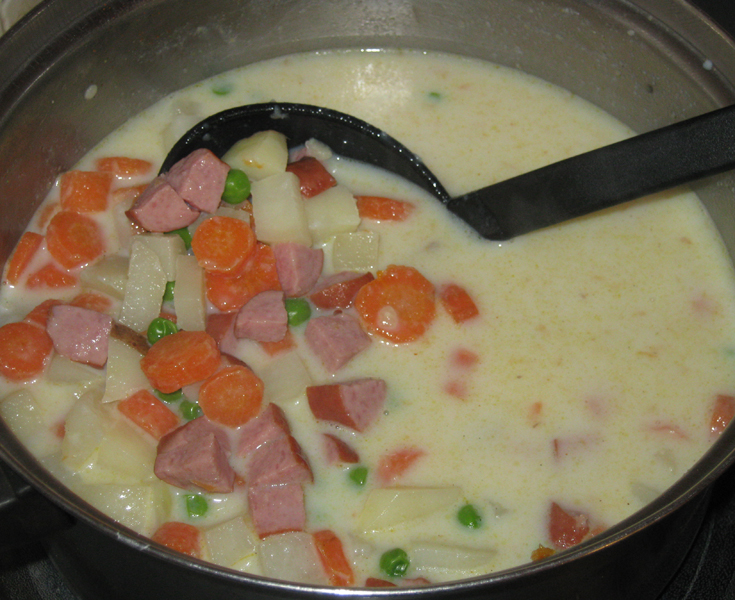
  • Sausage Chowder recipe, marissabaker.wordpress.com

    Here in Ohio, we’re back to weather that would make a penguin shiver. The only decent thing to do is make pots of creamy soup for lunch and then curl up with a warm blanket, a book, and a cat. Or you could share the soup with the cat, which Tiger seems to think is a good idea. He’s taken to begging whenever I sit down to eat anything, even if he knows he doesn’t like it (such as scrambled eggs).

    I’m not sure if there ever was an original recipe for this soup — I wrote it down while watching my mother throw ingredients in a pot. It’s tasty and easy to make, which is why it and Cheese Burger Soup figure so prominently in our eating habits this time of year.

    Sausage Chowder

    print this recipe

    Sausage Chowder recipe, marissabaker.wordpress.com3 to 4 potatoes, peeled and cubed (about 3 cups)

    4 to 5 carrots, sliced or chopped (about 2 cups)

    1 cup frozen peas

    2 cups water

    1/2 of a 13-ounce package of turkey sausage

    1 teaspoon chicken base

    2 teaspoons onion powder

    1/4 cup all-purpose flour

    Sausage Chowder recipe, marissabaker.wordpress.com1 1/2 cups milk

    black pepper and salt, to taste

    a pinch of cayenne pepper

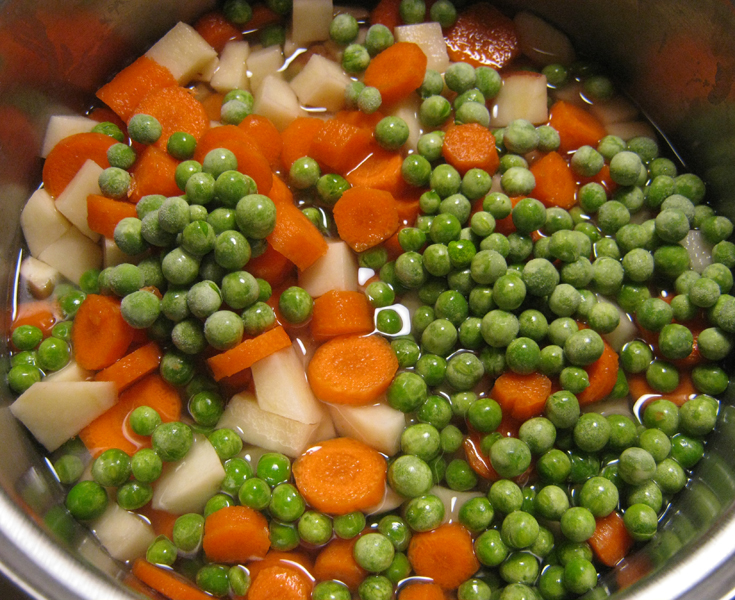
    Place chopped potatoes, carrots, and peas in a large sauce pan. Add 2 cups water and bring to a boil.

    Meanwhile, cut turkey sausage into cubes. Add sausage, chicken base, and onion powder when mixture in pot boils. Reduce heat and simmer till carrots and potatoes are done.

    Sausage Chowder recipe, marissabaker.wordpress.comWhile vegetables are cooking, place flour in a small bowl or measuring cup and gradually whisk in milk until smooth. Once the vegetables are tender, add milk and flour to cooked mixture.

    Add black pepper and salt to taste and a pinch of cayenne pepper. Turn up temperature to medium-high and stir regularly until the soup bubbles and thickens. Serve warm.

    print this recipe


    my brother photo-bombing the Sausage Chowder, marissabaker.wordpress.com
    my brother photo-bombing the chowder
  • A Relationship "Questionnaire" by marissabaker.wordpress.com

    I was talking with a friend some weekends ago about items we have on our “future husband” and “potential boyfriend” lists. We were saying how it would be nice if we could find out more easily whether or not a guy was someone we would like to date before we agreed to go out with him, and I suggested (half-jokingly) “I say we prepare a detailed questionnaire for potential boyfriends and ask for at least 3 character references.” The more we talked about it, the better the idea sounded. After all, when you apply for a job, you have to answer a whole series of questions and you’re expected to provide references that can attest to your good character. Relationships are more important, and hopefully more permanent, so why wouldn’t we give as much consideration to finding out whether or not someone is right for you and you are right for them?

    On the other hand, I’ve talked to more than one girl who was approached by a guy who was clearly working his way through a list of questions as they talked. They felt like they could see him putting mental check-marks down as he covered each topic. Ew … that’s creepy! We certainly don’t want to end up like that.

    Non-creepy Questions

    As I continued to think about this idea, I realized it would be less helpful to run people through a “prefect person checklist” than to have some kind of guideline for clarifying what we need in a relationship. There are certain things I think of as non-negotiable, such as a having a relationship with God. If I don’t clarify what that means to me before I meet someone, though, I might find myself making excuses for a guy because I like him, even if his beliefs differ from mine on significant points.

    Before our conversation about surveying boyfriends, I came across something titled “My Little Book of Whether Or Not He’s Worth It” by Brittany Baily. There is much to like about her points, particularly her emphasis on not settling for a guy who treats you with disrespect. But I feel this kind of guide misses two very important things: 1) it ignores the importance faith plays in a relationship, and 2) it focuses entirely on what I need/want in a relationship. For my list, I wanted to address the need to have God as the center of your relationship, as well as the fact that a relationship can’t be all about what you want — you also have to think of the other person’s needs and be the kind of person they are looking for.

    I’ve presented my list in a questionnaire form, mostly because of the conversation which prompted this post. I would advise against actually passing them out to potential boyfriends or girlfriends (but if you do, be sure to let me know how it goes!). Think of it as a guide to learning important things about the person you are considering, or in, a relationship with. You might want to fill one out with the answers you think you would like a potential dating partner to fill-in, and then answer one for yourself. Would your ideal match like the way you filled out your survey? If you meet someone who would answer one of these questions differently than you think you would like, will you be irritated by that or learn to live with it?

    Relationship Questionnaire

    Spiritual

    • How would you describe your relationship with God? (you can’t expect someone to love you the way you deserve/need/want to be loved if they do not love God even more than they love you)
    • What do you consider a good amount of time to spend in prayer and study on a daily basis? (how much time they give to God is an indication of whether or not they are worth your time)
    • How important is fellowship with other believers to you? What influences your decisions about which church group(s) to attend?

    Relational

    • What kind of boundaries (physical and emotional) would you want to set in a dating relationship?
    • How much time do you envision spending together in person, online, or on the phone while dating? Will you write letters and/or emails?
    • What would make you mistrust someone you were dating?
    • Why didn’t your previous relationships work out?
    • How do you handle money? Are you a spender? a saver? some other money personality?

    Personal

    • Are you typically introverted or extroverted? would you be comfortable spending time with someone who is more introverted/extroverted than you are?
    • How do you express anger?
    • How do you handle conflict?
    • Do you know what your primary love language is?
    • Is there anything in your past that you wouldn’t want to tell someone you just started dating, but probably should before you get married?
    • What do you consider your positive characteristics?
    • What do you consider your negative characteristics?

    Family

    • Do you want kids? How many? Would you consider adoption, and if so under what circumstances?
    • If you want kids, how would you like to educate them? Home school? Public school? Private school?
    • Would kids be encouraged to pursue higher education, if that’s what they want?
    • What do you consider appropriate discipline for young children? for teenagers?
    • Is it important to live near the extended family? Why or why not?
    • What kind of influence, if any, should our parents and family have over our relationship?
    • Are you closer to your mother or to your father? Why?

    One Last Note

    I hope you find these helpful. Feel free to add suggestions — I can continue to edit this based on feedback.

    I also want to add that I talked about these questions with the friend who first gave me the idea, and requested feedback from a couple who has been happily married for almost 27 years — my parents. I’ve also been reading  about psychology, love, and relationships for years, and drew upon that information for some of these points.

  • Another Five Favorite Proverbs by marissabaker.wordpress.comI’ve finished making my way through a study of Proverbs, in preparation for my church’s women’s group discussion about favorite proverbs that is taking place this afternoon. My first post covered five proverbs from chapters 1-10, the second covered five from chapters 11-20, and this last post is for chapters 21-31. I still haven’t decided which of these 15 is my favorite, but at least I’ve narrowed it down to 15.

    11: Reputation

    A good name is to be chosen rather than great riches, loving favor rather than silver and gold. (Prov. 22:1)

    I just heard a sermonette last week about God giving people names with meanings that fit the roles He designated them for — Jesus = savior; Paul = small; Peter = a little stone; Abraham = father of a multitude. From what I understand, names in Hebrew thought are inseparable from the essence, character, and reputation of a person. Therefore, it is better to have a good reputation, a name worthy of respect, than to have great riches.  The word for “favor,” which is described as better than silver and gold, is from the word chen (H2580), and it means “favor, kindness, grace, loveliness, charm, preciousness.”

    12: Deliverance

    For a righteous man may fall seven times and rise again, but the wicked shall fall by calamity. (Prov. 24:16)

    It doesn’t promise that if you are a just person you will never fall — it says you will be able to get back up rather than fall deeper into mischief. “Many are the afflictions of the righteous,” David said, “but the Lord delivers him out of them all” (Ps. 34:19). If — when — we fall, we  can be assured that God is holding our hand and will help pick us back up (Ps. 37:24).

    13: Friends

    Faithful are the wounds of a friend, but the kisses of an enemy are deceitful. (Prov. 27:6)

    King Lear would have been a very different play had the titular character been heeding this advice. When a friend wounds you, it is generally 1) an accident, or 2) with a view to your good. David wrote, “Let the righteous strike me; it shall be a kindness. And let him rebuke me; it shall be as excellent oil; let my head not refuse it” (Ps. 141.5). It might make us angry at first, but if we are honest with ourselves, we can often see that we were reproved out of love, and that we become better people with a stronger friendship as a result. In contrast, listening to the flattering words of those who secretly seek our hurt can only lead to grief.

    14: Guardrail

    Every word of God is pure; He is a shield to those who put their trust in Him. (Prov. 30:5)

    “The Guardrail,” from joyfultoons.com

    Here we leave Solomon’s proverbs and read “the words of Agur the son of Jakeh” (Prov. 30:1). This is a two-fold promise. Firstly, that God’s words are free of imperfections. As such, it is all profitable and no part should be ignored or neglected (2 Tim. 3:16). Secondly, that the Lord shields those who trust in Him. This was a frequent subject in Psalms, such as “For the Lord God is a sun and shield; the Lord will give grace and glory; no good thing will He withhold from those who walk uprightly” (Ps. 84:11). Connecting these two points is the fact that God’s commands are designed to protect us, as illustrated by this comic I saw on Facebook the other day.

    15: Beauty

    Charm is deceitful and beauty is passing, but a woman who fears the Lord, she shall be praised. (Prov. 31:30)

    This is from the end of the virtuous woman passage contained in “words of King Lemuel, the utterance which his mother taught him” (Prov. 31:1). When I was younger, I latched on to this verse as a substitute for my perceived lack of beauty — if I couldn’t be pretty, I could at least fear God and earn praise that way. As I’ve become more comfortable with myself and more mature as a Christian, my views on this verse have changed. I concentrate more on the last half of the verse, asking “How can I be a woman who fears the Lord?”

    Do not let your adornment be merely outward—arranging the hair, wearing gold, or putting on fine apparel — rather let it be the hidden person of the heart, with the incorruptible beauty of a gentle and quiet spirit, which is very precious in the sight of God. (! Pet. 3:3-4)

  • No-Knead Cinnamon Rolls

    No-Knead Cinnamon Roll recipe, marissabaker.wordpress.com

    I found this recipe on Pinterest, and it’s the only cinnamon roll recipe I make now. It’s originally from a blog called pReCiouS MoMentS. I’ve changed measurements that were in grams to cups or tablespoons, to make it easier to American cooks to follow. I also changed the scalding instructions — I wanted an exact temperature to aim for so I didn’t scorch the milk or kill the yeast, and it takes much less than an hour for my milk to cool to the right temperature. My rolls also have less filling, and I’ve added a glaze.

    No-Knead Cinnamon Rolls

    No-Knead Cinnamon Roll recipe, marissabaker.wordpress.com
    first round of ingredients ready

    Print this recipe

    Dough

    1 cup milk

    1/4 cup brown sugar

    1/4 cup canola oil

    1 teaspoon yeast

    1 cup all-purpose flour

    1 cup white whole-wheat flour

    No-Knead Cinnamon Roll recipe, marissabaker.wordpress.com
    Scald at 150 degrees Fahrenheit

    1/4 cup all-purpose flour

    1/4 teaspoon baking powder

    1/4 teaspoon baking soda

    1/2 teaspoon salt

    Filling

    1 Tablespoon cinnamon

    4 Tablespoons brown sugar

    2 Tablespoons unsalted butter, melted


    Glaze

    1/2 cup powdered sugar

    1/4 teaspoon vanilla

    1 Tablespoon milk

    No-Knead Cinnamon Roll recipe, marissabaker.wordpress.com
    dough before rising for the first time

    Mix milk, sugar and vegetable oil in a pan. Scald by heating to 150°F. Leave to cool for about 20 minutes, or until the temperatures is between 105°F and 115°F. Sprinkle yeast over the scaled mixture and let sit for about 5 minutes.

    Place 2 cups flour in a mixing bowl. Make a well in the center and add scalded mixture. Stir with a spatula until it comes together to form a thick batter. Cover and let the batter sit for at least 1 hour.

    No-Knead Cinnamon Roll recipe, marissabaker.wordpress.com
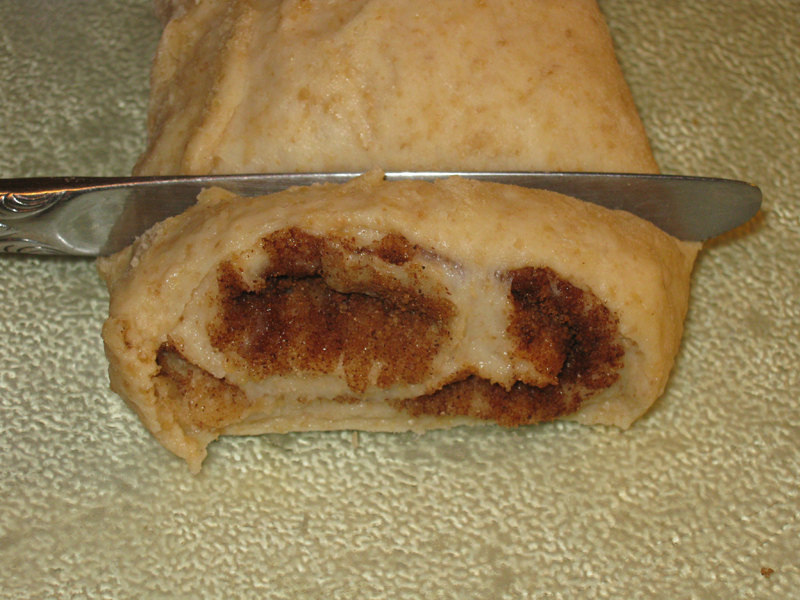
    I was probably cutting them a little less than 1-inch thick. You could also just cut it into 20 equal size slices.

    Add the remaining 1/4 cup flour, baking powder, baking soda, and salt. Stir until the mixture comes together. Rolls can be made now, or covered and chilled until needed. Dough will be easier to work with if chilled.

    When ready to make the rolls, mix ground cinnamon and sugar in a small bowl. Dust the work surface and the top and bottom of dough freely with flour. Roll out the dough into a thin, rectangular shape. Dust the dough and work surface with flour when necessary.

    Brush the rolled out dough with melted butter. Sprinkle the cinnamon sugar mixture evenly over the surface. Roll the dough neatly in a line towards you, rolling as tightly as possible. Pinch the seams to seal.

    No-Knead Cinnamon Roll recipe, marissabaker.wordpress.com
    Top image: rolls before rising. Bottom image: rolls after rising. The size change isn’t really noticeable until after baking

    Cut into 1-inch thick slices and arrange in a baking pan greased with butter. Use one 9×13-inch baking pan, or two 8×8-inch baking pans. Place the rolls close together so that they are almost touching.

    Cover and leave to rise for 30 to 60 minutes, or until the rolls double in size. Rolls can be left to chill in the fridge over night and baked the next morning. If rolls have doubled in size in the refrigerator, bake right away. Otherwise leave to sit on counter until they double. Bake in preheated oven at 375°F for 12-16 minutes, or until golden brown.

    Let rolls cool on the counter. Mix glaze ingredients and drizzle over cooled rolls.

  • Alphabet Name List

    Alphabet Names marissabaker.wordpress.comI recently set up an account with my favorite name website, NameBerry. For me, it’s almost as potentially addictive as Pinterest — I could spend hours browsing names, interacting with other writers, and discussing the best names for other people’s children. One of the forum topics I stumbled across last week was about favorite names from each letter of the alphabet.

    When I tried to fill out the alphabet chart, there were some letters (A, C, and S) that were hard to narrow down to just one name each for boys and girls. Other letters (O and U), I had hard time finding anything I liked or would actually use even on a fictional person. It was fun, though, and I decided to share it here as well as on that site.Alphabet Names marissabaker.wordpress.com

    I’ve mentioned my name obsession before, along with a few of my favorite names. This list is longer, and includes a few that I like the sound of more than the meaning. The two that aren’t linked to NameBerry or another website are from fantasy stories. Brigan is my favorite character from Kristian Cashore’s book Fire, and while it is used as a last name there doesn’t appear to be a distinct meaning. Faramir is from Tolkein’s Lord of the Rings and means “sufficient jewel” or “jeweled hunter” in Elvish.

    Boy and Girl Alphabet Names

    Alasdair and Aithne
    Brigan and Brianne
    Callen and Chasia
    Derek and Desiree
    Ethan and Eliana
    Faramir and Felicity
    Garreth and Gabriela
    Hugh and Huali
    Iain and Illiani
    Jace and Jeanette
    Kevin and Kaira
    Lance and Liya
    Merrick and Marina
    Neil and Nuriel
    Ohan and Ondine
    Peregrin and Petra
    Quade and Quarry
    Rohan and Raine
    Shane and Simone
    Tristan and Talia
    Ulric and Udelia
    Vigo and Vivian
    Wyatt and Waverly
    Xavier and Xandra
    Yevgeny and Yasmine
    Zachary and Zoe

    Alphabet Names marissabaker.wordpress.com