My dad gave a sermon this past weekend where one of the points he made involved an analogy about the Sea of Galilee and the Dead Sea. The Sea of Galilee is a healthy body of water — Israel’s main source of freshwater in fact, according to the Google — because it has an outlet that keeps the water fresh. The Dead Sea, on the other hand, has no outlet so the minerals keep building up to the point that nothing can live there. Out of curiosity, I looked up both these lakes on Google Maps satellite images. There is a striking difference even from this distance.
There’s a spiritual lesson in this, which is what was brought out in the sermon. If we don’t share and use the gifts that God gives us, we will stagnate instead of growing and bearing spiritual fruit.
The other thing I thought about in connection to this idea is how much I need an outlet for my thoughts. Apparently this is something that MBTI types who use Extraverted Feeling as a primary (ESFJs and ENFJs) or secondary function (ISFJs and INFJs) have in common. We need to express our feelings and thoughts in some way in order to process them. I’d been thinking about re-writing my About page for a while, and this idea lead me to a better way of articulating the purpose of this blog. Here’s the update:
The Sea of Galilee in Israel is a thriving, beautiful lake that acts as the main water source for all of Israel. Its outflow is the Jordan River, which flows to the Dead Sea. The water there is brackish — 25% salts — and the minerals continue to build up because there is nowhere for the water to flow out of the sea. The Dead Sea is dead because it has no outlet.
This blog is my outlet for random thoughts that pop in my head (Monday’s posts), recipes I like (Wednesday’s posts), and Bible Studies I want to share (Saturday’s posts). Monday’s posts can be about pretty much anything — MBTI types, yurts, and Doctor Who just to name a few. Cooking is something that makes me feel alive, and so Wednesday’s posts are all about making food. I love to come up with and perfect recipes and watch people enjoying the food I make. The most important outlet, though, are the posts on Saturdays. God has worked amazingly in my life, and if we keep silent about His majesty the rocks will cry out to sing his praises. When He leads my Bible study, I don’t want to keep what I learn confined to the growing stack of notebooks in my closet any more.
We were talking about The Woman at the Well last week, in the women’s book group at church (we’ve been reading Bad Girls of the Bible by Liz Curtis Higgs). One of the ladies in the group suggested that this meeting in John 4 between Christ and the woman at the well might be symbolically connected with Isaac, Jacob, and Moses all meeting their wives at a well. Does the woman here symbolize the Bride of Christ, and His invitation for us to drink from the well of eternal life?
The Living Water
On Jesus’ journey from Judea to Galilee in John 4, He stops to rest at Jacob’s well. A woman comes to the well and the Lord asks her for a drink. She wonders at this, since men did not normally talk to women and Jews had no dealings with Samaritans. A Jewish man certainly didn’t ask a Samaritan woman for a drink.
Jesus answered and said to her, “If you knew the gift of God, and who it is who says to you, ‘Give Me a drink,’ you would have asked Him, and He would have given you living water.”
The woman said to Him, “Sir, You have nothing to draw with, and the well is deep. Where then do You get that living water? Are You greater than our father Jacob, who gave us the well, and drank from it himself, as well as his sons and his livestock?”
Jesus answered and said to her, “Whoever drinks of this water will thirst again, but whoever drinks of the water that I shall give him will never thirst. But the water that I shall give him will become in him a fountain of water springing up into everlasting life.” (John 4:10-14)
This comparison between the Lord and a fountain or well of living water is not confined to this passage in John’s gospel. (Ps. 36:9; Jer. 2:12-13, 17:13; John 6:35).
Behold, God is my salvation, I will trust and not be afraid; For Yah, the Lord, is my strength and song; He also has become my salvation. Therefore with joy you will draw water from the wells of salvation. (Is. 12:2-3)
An Ambassador
In Genesis 24, Abraham sends his servant to find a wife for Isaac. When the servant reaches his destination, he stops at a well and asks God to show him a sign.
Behold, here I stand by the well of water, and the daughters of the men of the city are coming out to draw water. Now let it be that the young woman to whom I say, ‘Please let down your pitcher that I may drink,’ and she says, ‘Drink, and I will also give your camels a drink’—let her be the one You have appointed for Your servant Isaac. And by this I will know that You have shown kindness to my master.” (Gen. 24:13-14
God answered this prayer, and Rebekah not only drew water for this servant and his camels, but agreed to follow him into a different country and marry a man she had never met. Like Abraham’s servant, Jesus Christ is a messenger sent by a father who is seeking to add someone to His family. Abraham’s servant and Christ both ask the woman for a drink, and end up offering her something even more valuable than water in a desert.
A Bridegroom
For Jacob’s meeting with Rachel and Moses’s meeting with Zipporah, the woman is a shepherdess who comes to the well to draw water but is prevented by an obstacle. This obstacle is removed by the man, who then waters her flock.
Now while he was still speaking with them, Rachel came with her father’s sheep, for she was a shepherdess. And it came to pass, when Jacob saw Rachel the daughter of Laban his mother’s brother, and the sheep of Laban his mother’s brother, that Jacob went near and rolled the stone from the well’s mouth, and watered the flock of Laban his mother’s brother. (Gen. 29:9-10)
Now the priest of Midian had seven daughters. And they came and drew water, and they filled the troughs to water their father’s flock. Then the shepherds came and drove them away; but Moses stood up and helped them, and watered their flock. When they came to Reuel their father, he said, “How is it that you have come so soon today?” And they said, “An Egyptian delivered us from the hand of the shepherds, and he also drew enough water for us and watered the flock.” (Ex. 2:16-19)
Like Jacob and Moses met their wives at a well and provided water for her flock of sheep, so does the Good Shepherd Jesus Christ meet His church and offer her living water (John 10:11-16). He is a Bridegroom seeking His bride, and as a new believer this woman at the well became part of that group.
Becoming A Fountain
We have been given the same offer as the woman at the well. Come to the source of eternal life and drink freely of the living water. Become the Lamb’s bride.
For I am jealous for you with godly jealousy. For I have betrothed you to one husband, that I may present you as a chaste virgin to Christ. (2 Cor. 11:2)
This incredible offer is blessing enough, but on top of that we are offered the chance to share this living water with others. “But the water that I shall give him will become in him a fountain of water springing up into everlasting life” (John 4:14). He wants us to become fountains as well (Song 4:12-15).
I don’t often listen to contemporary Christian music, but of late I’ve become quite attached to Casting Crowns’ music. This song, from their CD “Come To The Well” seems an appropriate way to end this post.
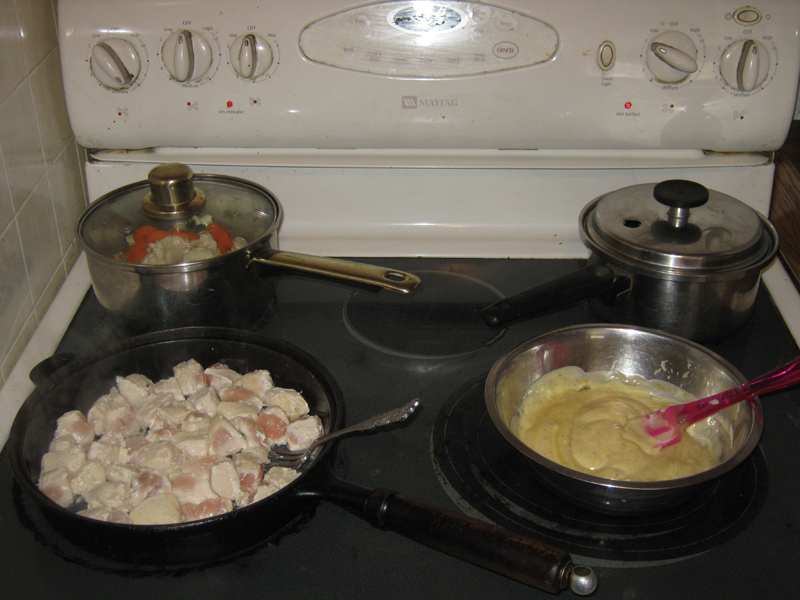
When served with a few pieces of chicken, this brown rice pilaf is one of my favorite meals. The original recipe (the origin of which I have lost track of) called for long grain or basmati rice — I’ve always used the brown rice that we keep on hand to serve with stir-fries. It has to cook longer than the original 15-20 minutes, but it’s healthy and it tastes good. There are several variations you could try on this recipe, though I like the one with basil and carrots so much that I haven’t played around with it too much. I have kept substitutions suggested by the original recipe in parenthesis if you want to experiment with some of them.
¼ cup shredded carrots (can substitute mushrooms, sweet peppers, or zucchini)
Add liquid, carrots, and basil
¼ cup rice wine (can substitute apple juice, dry white wine, or water)
¼ teaspoon dried basil (can substitute oregano or thyme)
½ cup slivered almonds (can substitute green onions, chopped walnuts, or pine nuts)
Melt butter in a medium sauce pan. Add garlic and uncooked rice. Stir in hot butter for 3 minutes. Slowly add chicken broth, then stir in carrots, wine and dried herb.
Bring mixture to boiling; reduce heat. Cover and simmer for 30-45 minutes or until rice is tender and liquid is absorbed. Add slivered almonds and serve.
For the chicken, I pour some rice wine in a baking dish, add garlic and basil, then add the chicken. Shake some basil and garlic over the chicken and top with mozzarella cheese or crushed garlic and cheese croutons
A friend of mine wrote a post about names last week that provided the inspiration for this post (he doesn’t post very often, but everything he writes is worth reading. Check out his blog here). He didn’t cover any of my main points — he took the discussion in a Biblical direction that I’m largely going to ignore for this post, but which I certainly find intriguing.
It has been several years now since I started researching names and wondering about the importance of name meanings. The meaning of my own name is hard to pin down, and searching for its origins lead me to looking up names of people I know, which lead me to collecting other names that I like.
Meaning of Names
In many cultures, names are something to be taken very seriously. Sometimes it is the meaning of the name which is important in determining a child’s destiny and character. Sometimes names are changed after a major event in a person’s life, as when God changed Abram’s name to Abraham and Sarai’s name to Sara (Gen. 17:4-6, 15-16). Some belief systems say that knowing someone’s name gives one power over them, and certain cultures make a practice of keeping true names a secret.
My own name has a confusing array of meanings. My mother tells me she saw the meaning “wished-for child” and that was what she thought my name meant when she and my dad named me. Since then, I have seen several different possible meanings for “Marissa” depending on which name/word it is derived from. If it is from the Hebrew mara, my name means “bitterness.” If it is from the Latin maris, then my name means “of the sea.” The “wished-for child” meaning is apparently associated with the Hebrew in some way, but I can find little information on it. Usually, I go with “of the sea” as my name meaning.
Naming Characters
I think part of the reason I like reading about, collecting, and researching names so much is that I’m a writer and all my characters need names. Some writers pay very close attention to the names they give their characters, and fit either the meaning or a historic significance to the character. For example, the character Cecil in A Room With A View by E.M. Forster is figuratively blind in many ways. His name is of Latin origin, and means “blind.”
In my own writings, one of my favorite characters is a man named Bryant. His name is from the Irish, and means “strong, virtuous, and honorable.” From another story set in the same world, Jamen has a name derived from Benjamin and meaning “son of the right hand.” He and his twin brother are vying for their father to name one his heir, and Jamen would like nothing more than to be his father’s right hand.
My Favorite Names
Some of the names I collect have nothing to do with my fiction. There are a few names I like that I would be hesitant to use in my writings because I might like to give the name to a child some day. I don’t think I would want want my children to think I named them after one of my fictional characters. Typically for these names, I try to put them together so the first and middle names have meanings that fit together. Most of them are just names I like, but Eileen was also my Grandmother’s name and Renee is my sister’s middle name.
I’ve been studying Ecclesiastes this past week, and a thought popped into my head that I would like to share with you. If you agree, disagree, or just feel like weighing in on this topic, let me know what you think.
To everything there is a season…
In reading Ecclesiastes, I spent Thursday morning pondering the first half of chapter 3. The idea of time as portrayed here fascinates me — it seems cyclic, steady, patterned. In my KeyWord Study Bible, Zodhiates says that what Solomon discovers here “is that there is One who keeps the world in order — that is God.”
To everything there is a season, a time for every purpose under heaven: a time to be born, and a time to die; a time to plant, and a time to pluck what is planted; a time to kill, and a time to heal; a time to break down, and a time to build up; a time to weep, and a time to laugh; a time to mourn, and a time to dance; a time to cast away stones, and a time to gather stones; a time to embrace, and a time to refrain from embracing; a time to gain, and a time to lose; a time to keep, and a time to throw away; a time to tear, and a time to sew; a time to keep silence, and a time to speak; a time to love, and a time to hate; a time of war, and a time of peace. (Ecc. 3:1-8)
Another take-away from this section of scripture is the necessity of trusting in God for our security in life. Just a few lines later, Solomon reminds readers that “no one can find out the work that God does from beginning to end” (Ecc. 3:11). Though we cannot know what is coming in our lives or exactly how the times and seasons will play-out for us, we can have confidence in God and say with Solomon, “I know that whatever God does, it shall be forever. Nothing can be added to it, and nothing taken from it” (Ecc. 3:14).
For I know the thoughts that I think toward you, says the Lord, thoughts of peace and not of evil, to give you a future and a hope. (Jer. 29:11)
No Man Knows
With this in mind, let’s go to another place in the Bible where times and seasons are mentioned. Before Christ’s ascension to His Father in the book of Acts, His disciples asked, “Lord, will You at this time restore the kingdom to Israel?” (Acts 1:6). His response is interesting. “And He said to them, ‘It is not for you to know times or seasons which the Father has put in His own authority'” (Acts 1:7).
This started me wondering if trying to pin down a date for Christ’s return is another symptom of the age-old problem people have of trying to find stability and control by taking matters into their own hands. I’m not talking about being watchful and knowledgeable about how events are prophesied to unfold — we are clearly instructed to do that (Mark 13:33; Luke 21:36; 1 Pet. 4:7). I’m talking about predictions regarding something we are specifically told is not for us to know. In another place, Jesus Christ said even He did not know the day or hour: “But of that day and hour no one knows, not even the angels in heaven, nor the Son, but only the Father” (Mark 13:32).
Like Solomon, we have to learn to accept God’s timing and trust Him to be in control. He will work out all things for good, just like He has promised (Rom. 8:28).
I found this recipe through Pinterest, and we have all fallen in love with it. The flavor is so good, yet there are very few ingredients and it is very simple to make. The original recipe is by Lizzy Writes, and I have changed nothing. Her suggestion about ginger has also been very helpful — freeze it. She chops it into sections, which I am trying, but I’ve also discovered that grating it fresh and wraping the grated ginger in aluminum foil to freeze it works as well.
1/2 – 1 teaspoon crushed red peppers (to desired spiciness)
1 bunch green onions, thinly sliced
Heat a large skillet or wok over medium heat and brown hamburger with garlic in the sesame oil. This works best if the beef is fresh or unthawed.
Drain most of the fat and add brown sugar, soy sauce, ginger, and red peppers. Simmer for a few minutes to blend the flavors. Serve over steamed rice and top with green onions.