• Living for the Present and Coming Kingdom

    What does the kingdom of God mean to you? Take a moment and picture it in your mind, as well as you can. What does it look like? Where is it? When is it? How are you defining “kingdom”?

    For a long time, I’ve noticed that many Christians I meet seem to talk about the kingdom in two different ways. One group of people talks about it as something that’s here, in-progress, right now. “We bring the kingdom come” echoes through our radios, and teachings, books, and conversation reveals the idea that the kingdom is happening today and that we’re involved. On the other hand, some talk about the kingdom as something that will happen/arrive at a specific time in the future. Again, this view of the kingdom echoes through our music, sermons, books and conversation as we talk about the kingdom.

    I’ve been going through all the New Testament scriptures talking about God’s kingdom, and I’m struck by the realization that Jesus talks about the kingdom in both senses. At one point He says, “The kingdom of God is in your midst” (Luke 17:21, NET), then He talks about the kingdom as something believers inherit after His second coming (Matt. 25:31-34). If we try to pick just one view or the other, we lose something important that God is trying to tell us about His kingdom. This kingdom is real and in-progress now, but it will not be fully realized and present until the future. Understanding this can have a profound impact on the ways that we live and worship today.

    Kingdom-Building

    We’ll return to what Jesus Himself says about the kingdom, but I think it’s helpful to start with looking at how one of the people that Jesus directly taught explained the kingdom to newer believers.

    giving thanks to the Father who has qualified you to share in the saints’ inheritance in the light. He delivered us from the power of darkness and transferred us to the kingdom of the Son he loves.

    Colossians 1:12-13, NET

    Paul says that believers have already been placed in Jesus’s kingdom by God the Father. The kingdom belongs to God, and He calls us to be there (1 Thes. 2:12). This has already happened, and is continuing today. Then, something else will happen after the resurrection.

    For just as in Adam all die, so also in Christ all will be made alive. But each in his own order: Christ, the firstfruits; then when Christ comes, those who belong to him. Then comes the end, when he hands over the kingdom to God the Father, when he has brought to an end all rule and all authority and power. For he must reign until he has put all his enemies under his feet.

    1 Cor. 15:22-25, NET

    Jesus is currently ruling, running, and bringing about the kingdom, filling a key role the Father has entrusted to Him. The Father is actively involved as well, selecting and calling people into the kingdom. This kingdom is something we’re part of today and, if we remain faithful, we’ll also be part of the future, fully-realized kingdom at the time when all enemies, including death, are eliminated (1 Cor. 15:26-28) and the kingdom is subject to the Father’s direct rule (Rev. 19-22).

    Aiming Toward the Kingdom

    A frequent description of Christ’s ministry is that He came preaching Good News of the kingdom (Matt. 4:23; 9:35; Luke 4:43; 8:1; Acts 1:3). Over and over, He talked about what the kingdom of God is like (mostly through parables) and explained what people need to to do be in the kingdom. We know that our walk with God is a relationship, and we’re supposed to obey Him because we love Him, not because we’re trying to get something out of Him. That does not, however, cancel-out the fact that we are promised a place in the kingdom as a reward for following God faithfully. There’s no shame in joyfully accepting the gifts that God is delighted to give us.

    Instead, pursue his kingdom, and these things will be given to you as well. Do not be afraid, little flock, for your Father is well pleased to give you the kingdom.

    Luke 12:31-32, NET
    Living for the Present and Coming Kingdom | LikeAnAnchor.com
    Image by Brightside Creative via Lightstock

    This is a memory scripture for many, and seems simple on the surface. But how can you actually pursue the kingdom? Is it about living as if you’re there now? Or aiming for the future kingdom? Or maybe we should set the idea of pursuing the kingdom aside and just focus on seeking a relationship with God, since that might be easier to make sense of.

    I’d been pondering these questions for over a week when I stumbled upon an idea from Jordan Peterson (through an Akira the Don song, of all things) that helped things come together. This quote is from his lecture series on Genesis, when he took a side-trip into the New Testament to talk about the “lilies of the field” passages in Matthew 6 and Luke 12.

    The idea is that, if you configure your life so that what you are genuinely doing is aiming at the highest possibly good, then the things that you need to survive and thrive on a day-to-day basis will deliver themselves to you. That’s a hypothesis, and it’s not some simple hypothesis. What it basically says is, if you dare to do the most difficult thing that you can conceptualize, your life will work out better than it will if you do anything else. Well, how are you going to find out if that’s true?

    It’s a Kierkegaardian leap of faith. There’s no way you’re going to find out whether or not that’s true unless you do it. No one can tell you, either: working for someone else is no proof that it will work for you. You have to be all-in in this game. The idea is, “seek ye first the kingdom of God, and his righteousness.” It’s like, that’s actually a fairly important caution when you’re talking about not having to pay attention to what you’re going to eat or what you’re going to wear. What it’s essentially saying is that those problems are trivial in comparison.

    Jordan Peterson, “Biblical Series VII: Walking with God: Noah and the Flood”

    One of the things Peterson points out is that Jesus is saying we need to live right now in a way that aims us toward the kingdom. That’s also where righteousness comes in, as we seek to mimic God’s character and live as if we are already part of the kingdom Christ is building now and will complete in the future. Anything else is so much less important that it’s like it doesn’t matter. The kingdom should be so valuable to use that we’re willing to let go of whatever’s getting in the way of us being there (Mark 9:43-50; Luke 18:24-30).

    Living for the Present and Coming Kingdom | LikeAnAnchor.com
    Image by Pearl via Lightstock

    Citizens of a Heavenly Kingdom

    The Bible talks of us as pilgrim travelers here on this earth and as aliens in a foreign land. When we covenant with God and give our lives to Him, we transfer our citizenship to heaven (Phil. 3:20-21). God is our king now, today, because Jesus “loves us and has set us free from our sins at the cost of his own blood and has appointed us as a kingdom, as priests serving his God and Father” (Rev. 1:5-6, NET). For us, the kingdom of God is real and relevant today, and it is also the goal we keep in mind to help bolster our faith.

    These all died in faith without receiving the things promised, but they saw them in the distance and welcomed them and acknowledged that they were strangers and foreigners on the earth. For those who speak in such a way make it clear that they are seeking a homeland. … they aspire to a better land, that is, a heavenly one. Therefore, God is not ashamed to be called their God, for he has prepared a city for them.

    Hebrews 11:13-14, 16, NET

    Our loyalties should lie with God. His kingdom is the “country” we should think of as our true home. That’s a key part of what it means to be all-in, seeking His kingdom and righteousness. It’s not about what we get; it’s about knowing who we are in Christ and committing ourselves to being part of the family He and the Father are building.


  • Why Are So Many INFJs Obsessed With Fictional Characters?

    Every once in a while, I go through the list of search terms that WordPress says leads people to my blog looking to see if there are any topics I haven’t covered. This is one of them. It’s no surprise that search term led to this blog, though, since I’m an INFJ bloggers and the number of posts I’ve written about typing fictional characters (both here and on my Star Wars Personalities blog) shows that at least this INFJ is obsessed with fictional characters.

    That doesn’t answer the question of “why” though. Nor does it explain why my posts about fictional character types were the most popular posts on my blog last year. It’s not just the posts about INFJ characters that are popular, either. All of my “7 Fictional Characters You’ll Relate To If You’re An ___” posts get a lot of views. We might not all be obsessed with fictional characters for the same reasons, but it seems that at least some people from every personality type feels an interest in and an attachment to fictional characters.

    For INFJs (and perhaps other types as well), I suspect this obsession with fictional characters comes from a few different sources. Part of it is likely because INFJs so often feel alone and misunderstood in our real lives. We struggle to find belonging and acceptance, and so we search the stories that we love for people who seem to be like us. Many INFJs feel as if they find themselves in their favorite stories, and they may feel that the characters they find within fiction could understand them better than the people in real-life do.

    This last part leads to another possible reason why INFJs are obsessed with fiction and fictional characters. We have very active imaginations and often talk about our “rich inner world.” Our minds are peopled with interesting places, people, ideas, and storylines that we encounter in fiction and real-life alongside all the imaginings we come up with on our own. Fictional characters give us fuel for the imaginative lives we lead inside our thoughts.

    INFJs are also a type that loves people, but often finds interacting with other people in real-life challenging. It’s not that we avoid spending time with people, but we’re selective about who we spend time with and for how long because we have a limited amount of social energy. Reading well-written fiction or watching a well-acted film gives us the opportunity to “interact” in a non-social way with a wider number and variety of people than we’d typically get to see in real life. Fictional characters are not by any means a substitute for real friends, but they can help fill an INFJ’s hunger to learn about as many different people and perspectives as possible without wearing themselves out.

    So there are the three reasons why I think INFJs are so often obsessed with fictional characters. We find connection with characters, we enjoy the way fiction fuels our imaginations, and we learn about people from stories.

    Do you have any other explanations you’d add to this list for why we’re obsessed with fictional characters? And if you’re not an INFJ, do these reasons resonate with you as well or are there other reasons that you enjoy engaging with fiction?

  • Guarding What God Has Put in Your Heart

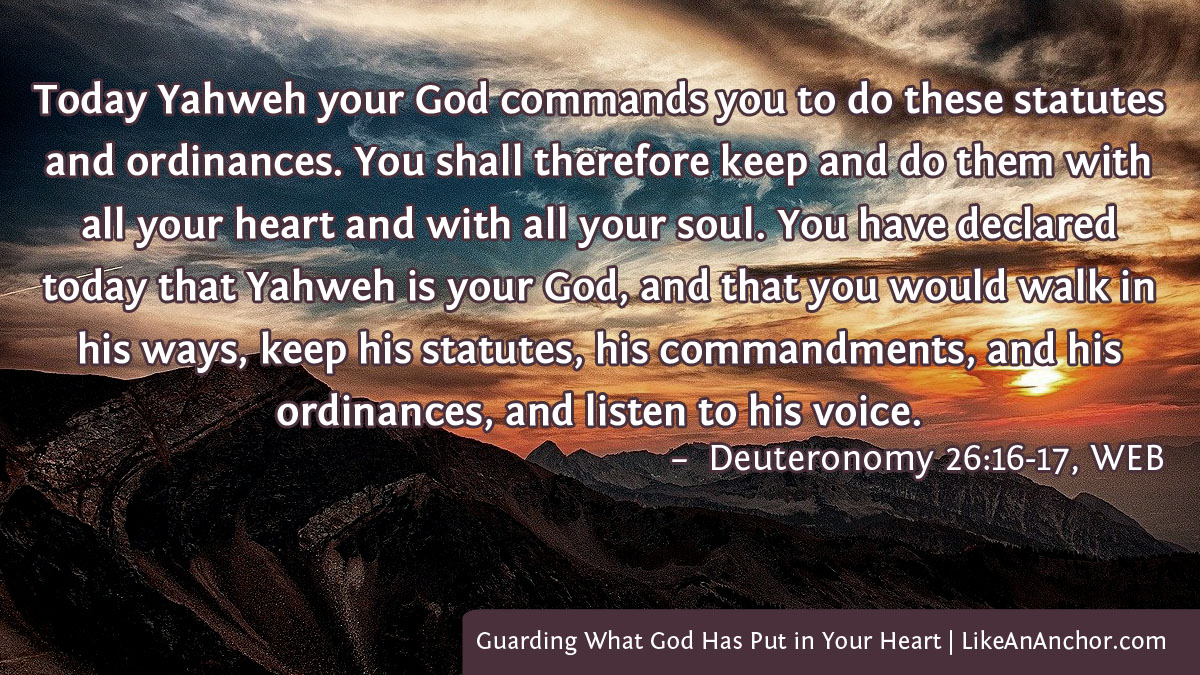
    I can’t tell you how many times I’ve heard messages on the importance of guarding our hearts. God wants relationships with people who are pure in heart and who are whole-heartedly devoted to Him. In order to be like that, we need to be careful what we let into our hearts. Guarding our hearts, we’re often told, is about not letting bad things in.

    Though that aspect of guarding our hearts is of vital importance, there’s also another side to this. To quote a daily devotional I’ve been reading, “We are to keep things in –things like the Spirit of Jesus, the humility and gentleness, the servanthood and sacrifice, the worship and thankfulness” (Chris Tiegreen, 365 Pocket Devotions, p.23). We need to be careful that we’re not so focused on keeping bad things out that we forget to keep the good things in.

    Keep Truth In Your Heart

    When Samuel was sent to anoint David, Yahweh told him, “God does not view things the way people do. People look on the outward appearance, but the Lord looks at the heart” (1 Sam. 16:7, NET). What’s in our hearts is what matters most to God. We don’t want to let in things that would corrupt our hearts, but we’re also not evaluated based on what we’ve kept out. God looks at what we keep in.

    My child, pay attention to my words;
    listen attentively to my sayings.
    Do not let them depart from your sight,
    guard them within your heart;
    for they are life to those who find them
    and healing to one’s entire body.
    Guard your heart with all vigilance,
    for from it are the sources of life.

    Proverbs 4:20-23, NET

    This is the one Bible passage that clearly instructs us to guard our hearts. It starts out by telling us to put wise words inside us and then “keep them in the center of your heart” (v. 21, WEB). It’s about guarding the good things in our hearts because what’s inside us determines what comes out of our lives, for good or evil.

    He said, “What comes out of a person defiles him. For from within, out of the human heart, come evil ideas, sexual immorality, theft, murder, adultery, greed, evil, deceit, debauchery, envy, slander, pride, and folly. All these evils come from within and defile a person.”

    Mark 7:20-23, NET

    If what’s inside our hearts is bad, the fruit our lives produce will be bad also, no matter how much we polish up the outside. We can, however, with God’s help, replace the bad things with good things. Change has to happen in our hearts as we internalize the words of God, and then we need to guard those good things that He gives us.

    Attach Your Hearts to Good Things

    Putting His law inside people’s hearts is one of the central aspects of God’s new covenant. When He prophesied the new covenant, He said, “I will put my law within them and write it on their hearts and minds. I will be their God and they will be my people” (Jer. 31:33, NET). That’s what’s happening as part of the covenant Jesus instituted with His sacrifice (Heb. 8:7-13; 10:14-18). In order to have good things come from our lives we need to have good things in our hearts, and that comes from entering this covenant with God. We also need to diligently guard what God is teaching and giving us.

    “Don’t lay up treasures for yourselves on the earth, where moth and rust consume, and where thieves break through and steal; but lay up for yourselves treasures in heaven, where neither moth nor rust consume, and where thieves don’t break through and steal; for where your treasure is, there your heart will be also.”

    Matthew 6:19-21, NET

    Part of guarding our hearts involves being careful about what “treasure” we attach ourselves to. If the things that we care about most and pour our energy into are worldly, that’s where our hearts will be. But if we put our efforts, time, and affection into good and godly things, then that is what our hearts and souls will treasure.

    Entrust God With Your Heart

    There is one other verse that uses the phrase “guard your hearts.” This time, though, it’s not an instruction for us. It’s something God does for us when we trust Him with our hearts and minds.

    Do not be anxious about anything. Instead, in every situation, through prayer and petition with thanksgiving, tell your requests to God. And the peace of God that surpasses all understanding will guard your hearts and minds in Christ Jesus.

    Philippians 4:6-7, NET

    We talked about this type of peace at length just a couple weeks ago in a post called “Finding Peace On Earth Today.” The peace that God offers is a sort of peace that’s not dependent on external circumstances. Rather, it is a product of a heart that is committed to fully trusting God. True, lasting, godly peace comes when we trust God to take care of the things that threaten to take away our peace. When we pray in every situation, God shares His peace with us and it works to guard our hearts.

    The task of guarding our hearts–keeping good things in and stopping bad things from taking over–is a life-long process. It’s something that God expects us to be actively involved in, and it’s something that He’s committed to helping us with.

    Featured image by Photo Mix from Pixabay

  • What Does It Mean To Be Double-Minded, and How Can We Fix It?

    I love it when a phrase in a book or a comment from a friend prompts an unexpectedly deep Bible study. Just last week, someone in my church’s scripture writing group suggested we study the phrase “double-minded.” Since there are only two verses in the Bible that use this word (at least in most translations), it sounded like a challenging and intriguing study. It’s also a study that’s relevant to things we struggle with today. It’s so easy to find ourselves becoming filled with worry, questions, and doubt. There are so many different versions of “truth” being marketed today, and it gets confusing. We need to be clear in our own minds what we believe and why so that we’re not double-minded. I hope you’ll find reading about this topic as fascinating–and helpful–as I did. We begin in the opening part of James’s epistle.

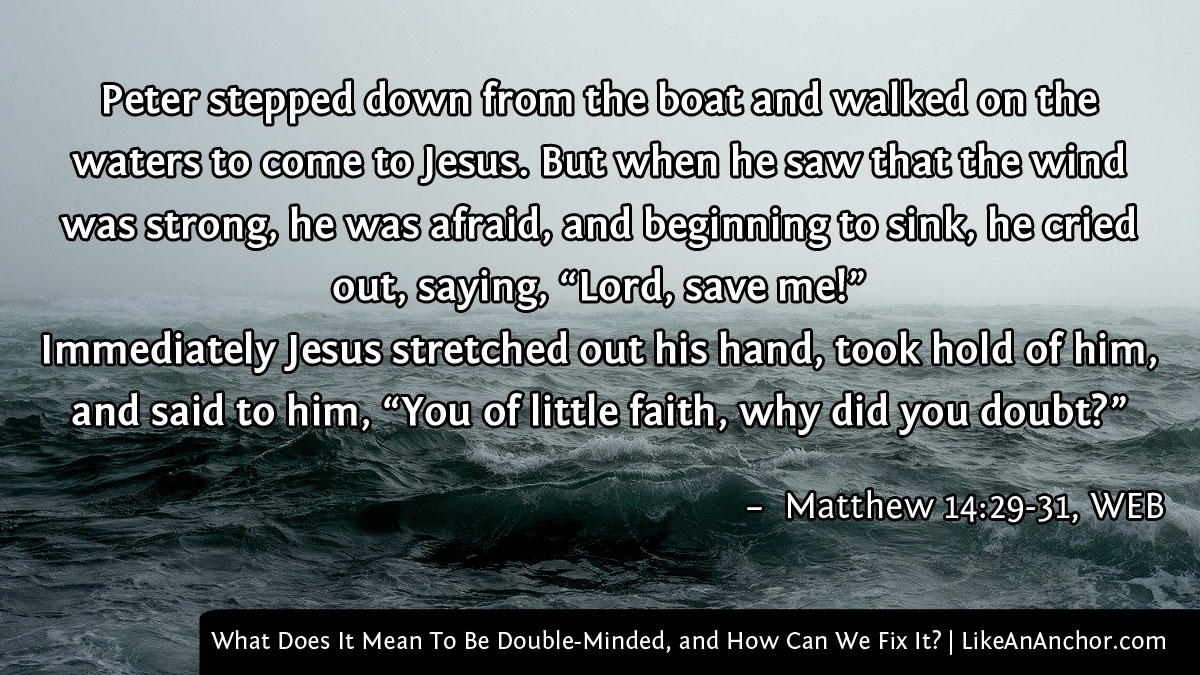
    But if anyone is deficient in wisdom, he should ask God, who gives to all generously and without reprimand, and it will be given to him. But he must ask in faith without doubting, for the one who doubts is like a wave of the sea, blown and tossed around by the wind. For that person must not suppose that he will receive anything from the Lord, since he is a double-minded individual, unstable in all his ways.

    James 1:5-8, NET

    The word translated “double-minded” is dipsuchos, meaning “two spirited,” “vacillating” (Strong’s Dictionary), “wavering, uncertain, doubting,” and “divided in interest” (Thayer’s Dictionary). It comes from two words: dis (twice, again) and psuche (breath, spirit). Zodhiates adds that “such a person suffers from divided loyalties. On the one hand, he wishes to maintain a religious confession and desires the presence of God in his life; on the other hand he loves the ways of the world and prefers to live according to its mores and ethics” (dictionary entry 1374). Sounds like something a lot of Christians struggle with today, doesn’t it? James is the only New Testament writer to use this word, and it appears once again closer to the end of his epistle.

    Be subject therefore to God. Resist the devil, and he will flee from you. Draw near to God, and he will draw near to you. Cleanse your hands, you sinners. Purify your hearts, you double-minded. Lament, mourn, and weep. Let your laughter be turned to mourning, and your joy to gloom. Humble yourselves in the sight of the Lord, and he will exalt you.

    James 4:7-10, WEB

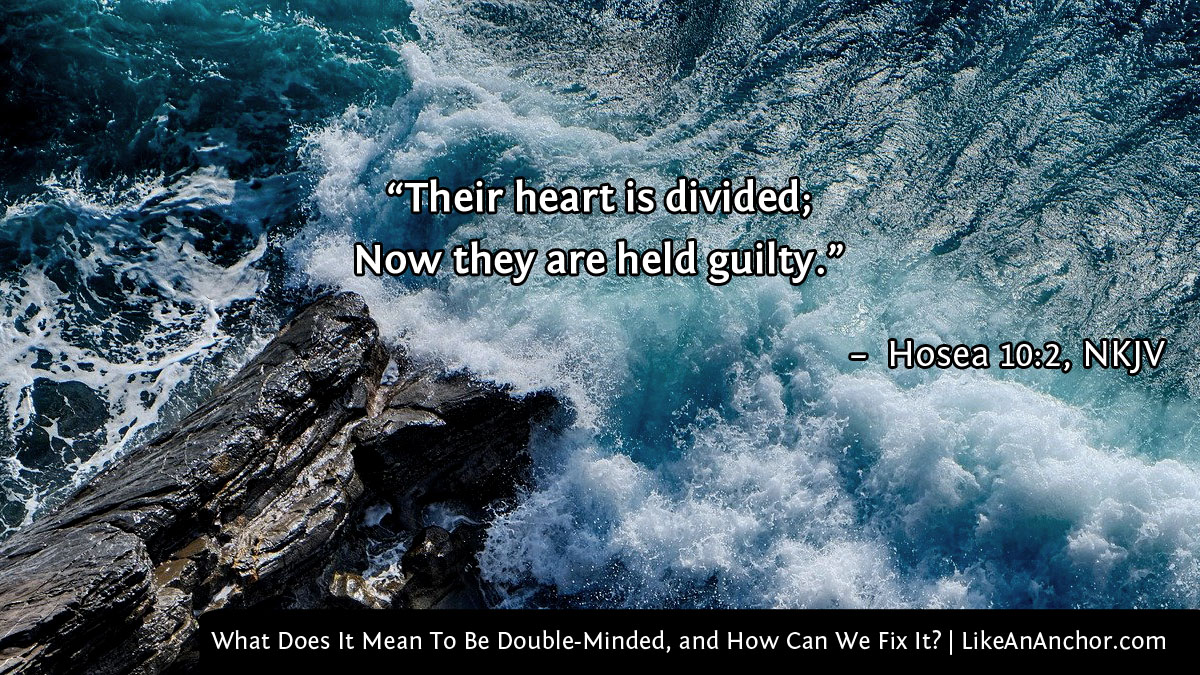
    Though there are only two verses using this word, James makes it clear that being “double-minded” is not a good thing. From the context as we read James 1:8, we can say that faith and stability are the opposites of double-mindedness. Then James 4:8 recommends that the double-minded purify their hearts, indicating that being double-minded has something to do with the state of our hearts. It also appears to be something that we can fix, and which God will help us correct.

    How Long Will You Waver?

    In the Old Testament, the prophet Elijah confronted the people of Israel about their idolatry. They’d constantly sway back and forth between faith in God and following pagan religions. This wavering, uncertain, divided loyalty was not something that pleased God.

    Elijah approached all the people and said, “How long are you going to be paralyzed by indecision? If the Lord is the true God, then follow him, but if Baal is, follow him!” But the people did not say a word.

    1 Kings 18:21, NET

    You can click here to read the entire story. Right now, I want to focus in on the phrase “paralyzed by indecision.” The more literal translation from Hebrew would be, “How long are you going to limp around on two crutches?” (NET footnote). Here, though, it’s an idiomatic phrase and does not refer to physical disability or injury. It’s a picture of someone’s thoughts and loyalty swaying back and forth unsteadily, similar to how James describes the double-minded individual as tossed by the sea. Other translations of this phrase in 1 Kings 18 include, “How long will you waver between the two sides?” (WEB) and “How long will you falter between two opinions?” (NKJV).

    The need for us to set doubt aside and be loyal to God alone is also discussed in the New Testament. In his Pentecost sermon recorded in the book of Acts, Peter said, “let all the house of Israel know beyond a doubt that God has made this Jesus whom you crucified both Lord and Christ” (Acts 2:36, NET). We’re not meant to live in a state of indecision. Knowing who Jesus is removes doubt and replaces it with faith. This sort of faith is absolutely essential, “for he who comes to God must believe that he exists, and that he is a rewarder of those who seek him” (Heb. 11:6, NET). We don’t have to get rid of all doubt before we come to Jesus, but at the very least we need to reach a point where we can say, “I believe; help my unbelief!” (Mark 9:24, NET).

    Don’t Divide Your Loyalty

    The only other Bible verse that uses the word “double-minded” is found in certain translations of Psalm 119:113. In the World English Bible it’s translated, “I hate double-minded men, but I love your law.” The New King James Version is almost identical: “I hate the double-minded.” Offering a slightly different reading, the New English Translation says, “I hate people with divided loyalties.” We cannot afford to live as double-minded people with divided loyalties. It’s impossible to be loyal to God and serve things that are incompatible with His way of life.

    No one can serve two masters, for either he will hate the one and love the other, or else he will be devoted to one and despise the other. You can’t serve both God and Mammon.

    Matthew 6:24, WEB

    Our loyalty and service belongs to God alone. We must follow Jesus’s example of rejecting the siren call of temptation and say, “Go away, Satan! For it is written: ‘You are to worship the Lord your God and serve only him’” (Matt. 4:10, quoting Deut. 6:13, NET). This is exactly what James was talking about when he said, “Be subject therefore to God. Resist the devil, and he will flee from you” right before he said, “Purify your hearts, you double-minded” (James 4:7-8, WEB). God wants the entirety of our hearts, not just the pieces leftover after we do other things in our lives.

    O Lord, teach me how you want me to live.
    Then I will obey your commands.
    Make me wholeheartedly committed to you.
    O Lord, my God, I will give you thanks with my whole heart.
    I will honor your name continually.

    Psalm 86:11-12, NET

    Learning to Have an Undivided Mind

    Though there are only 2 or 3 scriptures that directly talk about being double-minded, many scriptures talk about the importance of having “one mind” and being “like-minded” with other believers. This doesn’t mean that believers will all have the same personalities, types of lives, or individual opinions. Rather, this like-mindedness is rooted in all of us learning to think in the same way that God thinks. If we’ve been recipients of God’s spirit, then “we have Christ’s mind” (1 Cor. 2:16, WEB). The more we learn to have the same mind as Christ, the more like-minded we become with each other as well.

    Now the God of perseverance and of encouragement grant you to be of the same mind with one another according to Christ Jesus, that with one accord you may with one mouth glorify the God and Father of our Lord Jesus Christ.

    Romans 15:5-6, WEB

    God wants His people to live in unity. We’re meant to care for every follower of Christ as much as we care for ourselves. We’re to work on resolving differences peacefully and prayerfully, seeking to have God’s perspective rather than defend our own opinions. We’re to replace double-mindedness, doubt, and instability with faith and loyalty, following the example of Jesus Christ in how we act and think.

    For though we walk in the flesh, we don’t wage war according to the flesh; for the weapons of our warfare are not of the flesh, but mighty before God to the throwing down of strongholds, throwing down imaginations and every high thing that is exalted against the knowledge of God and bringing every thought into captivity to the obedience of Christ.

    2 Corinthians 10:3-5, WEB

    Through the power of God working inside us, we can choose to change our thoughts. Whether our minds are divided or whole is in large part up to us. We’re not helpless victims of our own doubt but rather mighty warriors who are strong in the Lord. Through Him, we have the power to overcome worry, doubt, and division and instead commit ourselves to lives full of faith.

    Featured image by PublicDomainPictures from Pixabay

  • 2020 On My Blog: A Year-End Review In Top 10 Lists

    With 2020 finally behind us, I’m continuing my tradition of taking a look back on the blogging part of my year. It was a crazy year in so many ways, but apparently there was one bright side: 2020 was good for blog traffic. Like An Anchor received almost 300,000 more views last year than in 2019, so thank you all for reading so much!

    Posts With The Most Traffic

    This year, my posts about fictional characters’ personality types took over the list of my top 10 most popular posts. Also, my article about being strong in the Lord (which has always been my most popular Christian post) made the top 10 this year. I suppose it was a topic that people felt was particularly relevant in 2020.

    1. 7 Fictional Characters That You’ll Relate To If You’re An INFP (published 4/15/2019)
    2. 7 Fictional Characters That You’ll Relate To If You’re An INTP (published 4/1/2019)
    3. Dating Your Mirror: ENFP and INFJ Relationships (published 11/11/2017)
    4. 7 Fictional Characters That You’ll Relate to If You’re An INTJ (published 1/14/2019)
    5. 7 Fictional Characters That You’ll Relate to If You’re An ENTP (published 12/10/2018)
    6. 7 Fictional Characters That You’ll Relate to If You’re An ENFJ (published 6/17/2019)
    7. 7 Fictional Characters That You’ll Relate to If You’re An ENFP (published 3/4/2019)
    8. What Does It Mean To Be Strong In The Lord? (12/16/2017)
    9. INFJ Dark Side (published 3/31/2014)
    10. 7 Fictional Characters That You’ll Relate to If You’re An ISFP (published 6/3/2019)

    Top 2020 Posts

    All of the posts that got the most traffic on my blog last year were published before 2020. Of the new posts I published, these 10 were the most popular.

    1. The Enneagram Types As Fictional Characters
    2. Myers-Briggs Types of the Characters in Avatar: The Last Airbender — Azula, Iroh, Mai, Ty Lee, and Zuko
    3. How Do I Know If I’m an INTP or an INFP?
    4. Myers-Briggs Types of the Characters in Avatar: The Last Airbender — Aang, Katara, Sokka, Suki, and Toph
    5. 10 Things That INFPs Find Extremely Annoying
    6. 10 Things That INFJs Find Extremely Annoying
    7. Need Something New to Do? Here’s What Hobby You Should Try Based on Your Myers-Briggs® Type
    8. 10 Things That INTPs Find Extremely Annoying
    9. 10 Things That INTJs Find Extremely Annoying
    10. How Do I Know If I’m an INFJ or an INTJ?

    Top Christian Posts

    My Myers-Briggs® posts are popular enough that they push most posts on other topics out of the top 10 for the year. Quite a large number of visitors come to my blog for the Christian content, though, so I thought those posts deserved a special mention. Here are the Christian-themed posts that saw the most traffic in 2020.

    1. What Does It Mean To Be Strong In The Lord?
    2. Water, Spirit, Fire: The Three Baptisms of Christianity
    3. Mercy and Truth Meet Together: INFJ Christians
    4. In The Secret Place: The Promises of Psalm 91
    5. As For Me, I Will Serve The Lord: INTJ Christians
    6. That Which Every Joint Supplies: INFP Christians
    7. Reasons to Pray: Building Relationship With God
    8. To Seek And Search Out By Wisdom: INTP Christians
    9. All Your Heart, Mind, and Soul: ENFP Christians
    10. Letting God Define You

    Countries My Visitors Call Home

    Instead of doing a top 10 list this year, I’ve included every country that’s home to at least 5,000 of my visitors. There are also dozens more countries not on this list–too many for one short blog post. I can’t tell you how much I love looking at the stats and seeing so many different flags listed next to the views that WordPress tracks.

    1. United States
    2. United Kingdom
    3. Canada
    4. Australia
    5. India
    6. Germany
    7. Philippines
    8. Indonesia
    9. Singapore
    10. France
    11. Poland
    12. Italy
    13. South Africa
    14. Malaysia
    15. Netherlands
    16. Turkey
    17. Mexico
    18. South Korea
    19. Spain
    20. Russia
    21. Sweden

    Thank you so much to everyone all around the world who’s reading and commenting on my blog! May this next year be one full of blessings for all of you.

    Featured image by Gerd Altmann from Pixabay

  • Finding Peace On Earth Today

    Today’s world is not a peaceful place. Wars, rumors of wars, rioting, brutality, oppression, and unrest plague the whole earth. Fears fill our minds, confusing and contradictory information comes at us from every side, and there’s always a new reason in the news for anger, anxiety, or grief. If we ever needed proof that there’s no peace on earth, this past year supplied it.

    In the midst of all this, the Bible describes peace as something God gives to His people and which He expects us to have. Finding peace while here on this earth may seem an impossible task, but God specializes in doing the impossible (Luke 1:37; 18:27). The peace God offers is not dependent on external circumstances. It comes from what He is doing inside us and it’s a special type of peace that is only available through God.

    Putting Peace in our Minds

    The peace God offers us cannot be destroyed by what’s going on in the world. Also, thankfully, it is a type of peace that we can have even during times of trouble and strife–the sort of times when we most need peace.

    Do not be anxious about anything. Instead, in every situation, through prayer and petition with thanksgiving, tell your requests to God. And the peace of God that surpasses all understanding will guard your hearts and minds in Christ Jesus.

    Philippians 4:6-7, NET

    Paul doesn’t tell us that God will take away any reason we might have for anxiety. Rather, he says not to worry about any of the situations that could cause anxiety. Instead, we take those situations to God in prayer and with thanksgiving. We can do this with confidence in the promise that God’s peace–a peace so incredible we can’t understand it, yet which we still get to participate in–will guard our hearts and minds. God doesn’t just take away anxiety and give us peace, though, without any action on our part. We have a role to play as well. In addition to praying for God’s peace, Paul also tells us to replace our anxious thoughts with something else.

    Finally, brothers and sisters, whatever is true, whatever is worthy of respect, whatever is just, whatever is pure, whatever is lovely, whatever is commendable, if something is excellent or praiseworthy, think about these things. And what you learned and received and heard and saw in me, do these things. And the God of peace will be with you.

    Philippians 4:8-9, NET

    We have the power to change how we think and even how we feel. We are not at the mercy of our outside circumstances or even our own emotions. That’s true of all human beings. Everyone of us can change and improve the way we think and process emotion. And when we have God’s spirit, we have additional aid in finding real peace. God created us and He knows how to balance and heal our minds, hearts, and souls.

    Pursuing Righteousness and Peace

    I recently heard a sermon where the speaker talked about the deep connection between righteousness and peace. He started by quoting Psalm 85:10, “Righteousness and peace have kissed each other” (WEB). It’s part of the verse I used as the title of my post about INFJ Christians, but I hadn’t realized how often these two concepts are linked. It seems you can’t have the type of peace God offers without also seeking to imitate His righteousness.

    I am Yahweh your God, who teaches you to profit, who leads you by the way that you should go. Oh that you had listened to my commandments! Then your peace would have been like a river and your righteousness like the waves of the sea.

    Isaiah 48:17-18,. WEB

    Righteousness and peace must be pursued together (2 Tim. 2:22). The type of peace God offers is only found in relationship with Him, and we can’t have a close relationship with God if we insist on living unrighteous lives. We need to follow His steps, heed His words, and embrace both His righteousness and His peace.

    For the kingdom of God does not consist of food and drink, but righteousness, peace, and joy in the Holy Spirit. For the one who serves Christ in this way is pleasing to God and approved by people. So then, let us pursue what makes for peace and for building up one another.

    Romans 14:17-19, NET

    Bearing the Fruit of Peace

    Many (perhaps most) of us saw 2020 as a year of severe trails. One of the ways the Bible talks about trials is as discipline–a tool God uses to disciple us into being like Him. Interestingly, this process is not only connected to learning to be righteous as God is righteous. It’s also connected to peace.

    Now all discipline seems painful at the time, not joyful. But later it produces the fruit of peace and righteousness for those trained by it.

    Hebrews 12:11, NET

    Times of trial are often when peace seems most elusive, but when we go through our trials with God at our side they can actually lead to peace. Several Bible verses tell us to have joy in trials (Rom. 5:3-5; James 1:2-4), and I think recognizing how much we can learn from them is one key to having that sort of joyful perspective. Challenges help to refine us, and eventually produce good fruits in our lives.

    But the wisdom from above is first pure, then peaceable, gentle, accommodating, full of mercy and good fruit, impartial, and not hypocritical. And the fruit that consists of righteousness is planted in peace among those who make peace.

    James 3:17-18, NET
    Finding Peace On Earth Today | LikeAnAnchor.com

    We spent a couple of months earlier this year talking about all these attributes of Godly wisdom, including peace. In that post, we talked about Proverbs and how that book shows us that peace is something which happens when you live with wisdom. It’s one of the fruits that comes from aligning with God’s righteousness.

    There is a way to have peace inside us even while living in a world where there is no peace. None of us knows what the year 2021 holds in store. It could be better than 2020, it could be more of the same, or it could even be worse. The outside circumstances cannot take away our peace, though, when that peace is grounded in our relationship with God.

    Featured image by Pixabay from Pexels