• What Do Other People Think of INFJs?

    INFJs are supposed to be really good at reading other people’s emotions, guessing their thoughts, and seeing things from their perspectives. In many situations, that’s true. But there’s one type of situation where many INFJs (including myself) feel like we have a blind spot.

    It’s like there’s a mental block when I’m trying to see myself from other people’s perspectives. I have to ask my closest friends how I come across in conversations, whether or not someone’s response to me was positive, and if what I said made sense. I suspect that for me personally much of this is related to social anxiety, because I’m not as paranoid around people who I know well. But I’m also not the only INFJ who struggles with this. We tend to assume that people think we’re weird and that they won’t like us because we’re so different from other people.

    However, I’ve also talked with enough non-INFJs to know that quite a few of them actually do like us. Our INFJ weirdness isn’t guaranteed to scare everyone away. In fact, what makes each of us us “weird” is also what makes us attractive to the kind of people who connect well with our unique, authentic selves. So today, let’s take a look at how other people actually see INFJs. I’d also like to invite any non-INFJs reading this post to share your thoughts in the comments section. We’d love to hear from you!

    Socially Awkward

    You’re probably wondering why this is at the top of my list, since most INFJs already know/fear that they come across as socially awkward. But I can’t write a post like this and ignore the fact that we do give others this impression. People aren’t judging us nearly as much as we think they are, but they do notice how awkward we make ourselves when we try too hard to fit in. (more…)
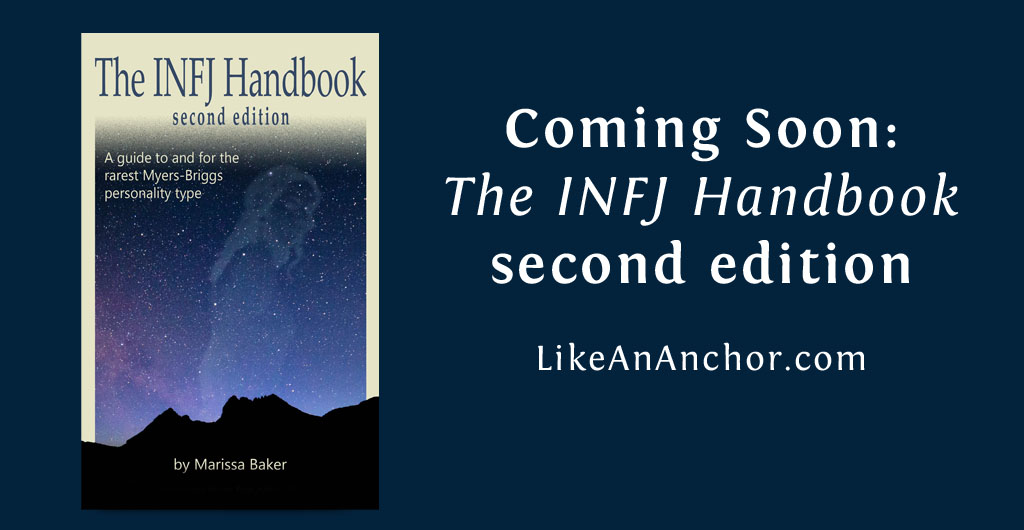

  • I’d like to hear from INFJ men for The INFJ Handbook second edition

    I’m so excited to announce that I’m releasing a second edition of The INFJ Handbook this summer. This will be an updated and expanded edition with lots of new information. Plus, I’ll be able to offer this in a print version as well as an ebook for all of you who’ve contacted me and asked where you could buy a physical copy.

    In the first edition of The INFJ Handbook, I asked several INFJs to share their perspectives on having an INFJ personality type. Since all my contributors for the first edition were women, I’d like to get some INFJ men to share their perspectives for the second edition.

    Update: Now closed to further responses. Thank you so much to everyone who contacted me to share their answers to these questions! I’ll be updating everyone soon with a release date for the book.

    If you identify as a man and an INFJ personality type, I’d love to hear from you. Here’s a list of questions that I’m curious to get your perspective on:

    • How do you experience Intuition? What happens when you try to explain your intuitions to others?
    • Even though INFJ’s use Feeling more comfortably, we also have a Thinking side to our personalities. What does it look like for you to use your Thinking side in a healthy way? (for example: playing strategy games, analyzing your favorite topic, etc)
    • What stresses you out so much that you start acting unlike your normal self?
    • What do you consider the biggest strengths and weaknesses of your personality type?
    • Are there any struggles you face that you believe are unique to INFJ men?
    • Are there any personal growth tips you’d like to share with other INFJs?
    • What do you wish other people knew about INFJs?

    You can answer as many or as few of these questions as you want. If there’s something else you’d like to share that isn’t covered in these questions, please feel free to add that as well.

    If you’d like to contribute to this second edition of The INFJ Handbook, you can leave a comment under this post or click here to email me. Thank you so much! I’m really looking forward to reading what you have to share 🙂

  • Are You Proud of Your Christianity?

    Have you ever caught yourself thinking it’s great that you aren’t like all those people who don’t know the Lord? Ever patted yourself on the back, glad you have a special truth most other people don’t know about? Or been proud that you’re one of the few God chose to make a Christian?

    The truths God has revealed to us are precious. But God didn’t give them to us because we’re anything special or because we have some innate ability to live a holier life than other people. He’s not out to make us proud of our moral or spiritual superiority. In fact, pride is hateful to God (Prov. 6:16-17; 16:5).

    I’m sure most of us don’t go around with an attitude that intentionally says, “Look at me! I’m such a very good Christian and I’m better than other people.” But I also think that it’s easy for us to slip into a habit of acting as if we think something very similar. We set up an “us versus them” in our minds where we’re the ones with special knowledge and all the people who don’t believe what we do are in some way less than us. And that’s not a good place to start if we want to reach out to people in a godly way. (more…)

  • What Advantage Is There To Using Sensing Or Intuition In Myers-Briggs® Theory?

    One of the hardest personality dynamics to navigate is Sensing/Intuition. Part of this is due to the fact that Intuitive only make up about 25-30% of the population. That can lead to Intuitives feeling misunderstood and marginalized. On top of that, because our Sensing/Intuitive preference influences so much of how we conceptualize reality, someone who doesn’t share our S/N preference seems even less “like us” than those who don’t match on the E/I, T/F, or J/P preferences.

    An unfortunate side-effect of the challenges involved in navigating Sensing/Intuitive relationships is that there’s now a bias against Sensing types in many parts of the personality type community. The myth that Intuitives are intellectually superior to Sensors and that Sensors will never understand them is now widespread among both Sensors and Intuitives.

    However, it’s simply not the case that Intuition is better than Sensing. Both preferences grant advantages in certain areas and disadvantages in others. Myers-Briggs® theory is designed to explain how our minds work. It doesn’t say one way of processing is better than another or invite us to make that judgement. So with that being the case, lets take a closer look at the advantages of using Sensing or Intuition. (more…)

  • Little Nudges From The Holy Spirit

    The Holy Spirit is the power of God in our lives. As the part of God that gets inside us and transforms us, this Spirit is essential to our walk of faith. But I don’t think we spend enough time letting these truths really sink in (I know I haven’t).

    While reading Dr. Juli Slattery’s book Rethinking Sexuality, I’ve been surprised by how many lessons in this book are applicable to the whole of our Christian walk. Pages 116-117 in particular struck me as some of the deepest Christian writings I’ve ever read. In this passage, Dr. Slattery says that embracing the truth that “the Holy Spirit is the power of God in our lives” radically changes how we try to follow God.

    It really should be an obvious concept. But far too often, I think many of us ask God for help with living His way of life and yet don’t recognize how that help shows up. We ask to be filled with power, but don’t always know how to use it or even recognize it’s there. And to further complicate matters, we keep trying to do things on our own instead of truly relying on God working in us.

    Little Nudges From The Holy Spirit | LikeAnAnchor.com
    Photo credit: Mar Dais via Pixabay

    Working Inside-Out

    “The ability to live the Christian life is impossible outside of the work of the Holy Spirit. Jesus knew this when He told His disciples, ‘Be glad I’m going away because the Holy Spirit is coming!’ His words mean that we are more equipped to live the Christian life by the power of the Holy Spirit than we would be if we could follow Jesus around everywhere.” (Rethinking Sexuality, p. 116)

    I’m sure Jesus’ disciples were confused when He said, “It is to your advantage that I go away, for if I don’t go away the Counselor won’t come to you” (John 16:7, WEB). And I think if given the choice, most of us would rather be able to see Jesus and talk with Him face-to-face than have things like they are now. But Jesus would never lie to us, so it must be true that there’s an advantage to knowing Him and the Father through the Holy Spirit that we wouldn’t have if Jesus had stayed here on earth. (more…)

  • Personality Type Myth-Busting: Is Intuition The Same As A Gut Feeling?

    I often see Intuitive types describe their experience of intuition as a “gut feeling.” It’s not something we can explain — it’s just something we know. And that is a valid way to describe a lot of what we experience from using Intuition. But if that was all there was to intuition, then we’d be able to describe a lot more than 30% of the population as Intuitive types.

    When people talk about intuition, they usually mean something different than what type theorists mean when they refer to Intuition as a psychological function. Google defines intuition as “the ability to understand something immediately, without the need for conscious reasoning.” We might also use the word intuitive to mean “suited by nature for a particular purpose in life,” as when we speak of intuitive athletes or creative types who “just know” how to do something.

    In her book Personality Type, Lenore Thomson points out, “Most of the people to whom we apply the word intuitive in this causal way aren’t Intuitives — at least not typologically. They’re usually Sensates and Introverted P types, whose right-brain abilities the left brain can’t explain to itself” (p. 199). I’ve also noticed that some of the things that Intuitives describe as part of their intuition are actually connected with other mental processes. For example, an INFJ might say they intuitively know how to blend in with different social groups when in reality that ability is tied to their harmony-seeking Extroverted Feeling process more than to their Introverted Intuition.

    So if Intuition, in the typological sense, isn’t want people usually think of when they think of intuition, what is it? (more…)