• Working Through Cycles of Personal Growth

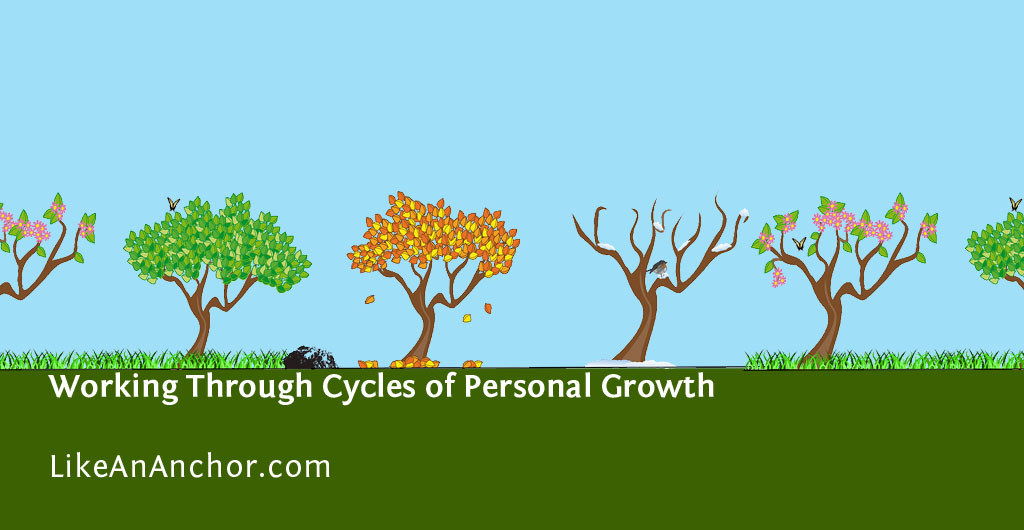
    We often think of growth as happening one direction. Growing things expand and get older, they don’t shrink or get younger. If something is not moving forward, then it’s not growing.

    But maybe that’s not always the case, especially when we’re talking about personal growth journeys. Growth like this doesn’t happen all at once or in a steady direction. Sometimes, a thing that you thought you dealt with will come back and needs to be worked through again. You often have to keep going back over the same ground in order to make progress.

    This isn’t failure to grow. But it might look like it depending on our perspective. If we’re the type of person who wants to get everything right the first time, then it can be discouraging when we find ourselves having to deal with something we thought we’d already worked through. We might even decided that since we failed once there’s no point in trying again. But that isn’t really a healthy or helpful perspective.

    New “Thought Paths” Take Time

    Last year, I wrote a post about changing thought patterns related to anxiety. In that post, I talked about my counselor’s analogy of our minds as a big open field. As we live and grow, our thoughts travel over this field and we start to wear-down paths as we think along the same lines over and over. When we identify “thought paths” that aren’t doing us any good we need to create new pathways in our mind by learning to think in a different way. To do that, you have to keep going over the new paths again and again. (more…)

  • The Romance Of Passover

    Many Christians have a complicated relationship with the Song of Solomon, or Song of Songs as it’s also called. They skip it when reading through the whole Bible, ignore it in study, and struggle to explain what it’s doing in scripture. Even the idea that the Song is an allegory for the love between God and His people and/or Christ and the church (the dominant interpretation for thousands of years) has been largely abandoned by modern Bible scholars.

    In Jewish tradition, the Song is associated with Passover (Pesach) and is read at this time of year. Some say this is just because the song references the spring season. But other rabbis describe this book as the “holy of holies” in the canon of scripture. They accept as a matter of fact that “Israel, in it’s covenant with God made on Mt. Sinai, was married to God” and the people owed Him their “absolute fidelity” (quotes from “Why Do We Sing the Song of Songs on Passover?” by Benjamin Edidin Scolnic).

    This assumption explains why the prophets speak so often of Israel’s unfaithfulness to God as marital infidelity. In reference to Hosea, Gerson Cohen said this was “because his Israelite mind had been taught from childhood to think of the relationship between God and Israel in terms of marital fidelity, in terms of love” (quote from “The Song of Songs and the Jewish Religious Mentality”). The Song of Songs might be the most explicitly romantic book in the Bible, but it’s certainly not the only time romantic imagery is used to teach us something about the relationship between God and His people. The Apostle Paul (also a Jewish rabbi) even said after giving instruction to human husbands and wives that “this mystery is great, but I am speaking with reference to Christ and the church” (Eph. 5:32, LEB).

    Covenants and Romance

    So what does all this have to do with Passover? For some writers, the Song actually functions as a midrash on Exodus — a commentary in the form of a poetic, figurative retelling of the Exodus story. With this interpretation, “the Song of Songs, according to the rabbis, is a text which describes the very events that Pesah celebrates and commemorates.” You can read more about this viewpoint in Scolnic’s paper (click here).

    Even without turning to Jewish midrash, though, we can find connections between God’s romance of Israel and the Exodus story. Take, for example, one of my favorite passages from Hosea: (more…)

  • The Awakening and This Side of Paradise

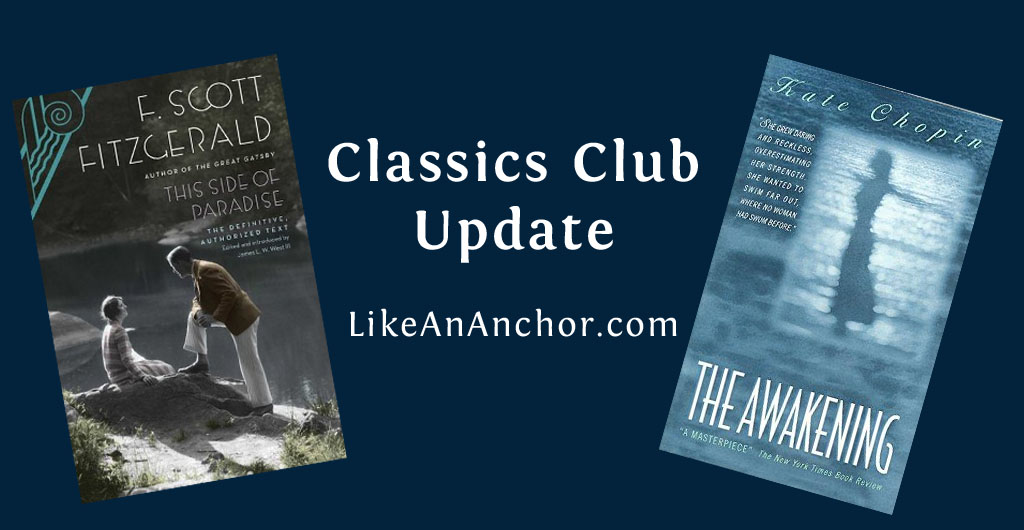
    I’ve been trying to get caught-up on my reading for my Classics Club book list that I started almost 5 years ago. This also involves blogging about the books I’m reading in the hope that we can spread our love for classic literature all over the internet. Interestingly, the last two books I read have some similar themes and it made sense to group them together. Which is good, since book reviews aren’t the main focus of this blog.

    This Side Of Paradise

    This Side of Paradise was F. Scott Fitsgerald’s debut novel (published in 1920). Its publication famously helped Fitzgerald gain Zelda Sayre’s hand in marriage because he was convinced he could win her back if he became a published novelist. It must have worked, since they married just 8 days after the novel’s first printing. The initial print run of 3,000 copies sold out in three days. (more…)

  • 7 Fictional Characters That You’ll Relate To If You’re An INFP

    What fictional characters do you relate to as an INFP?

    Just as we can describe real people using the Myers-Briggs® typology system, we can also use the system to type well-written fictional characters. Some of fiction’s most iconic and intriguing characters are INFPs, and today we’re going to talk about seven of them that I think real-life INFPs will find relatable.

    One great thing about looking at character personality types is that it helps us to better understand people who have different types than we do. Fictional INFPs can serve as examples for what real-life INFPs might be like, and also show how much variation can exist between individuals with the same type.

    Alphonse Elric

    Fullmetal Alchemist Brotherhood was the first Anime series I watched and it’s now one of my favorite TV series of all time. One of the highlights of this series (as well as the Fullmetal Alchemist series) is the character Alphonse Elric, who I’m pretty sure is either an INFP or an ISFP. Al is a sensitive, sweet young man with great strength of character. He believes deeply in doing what’s right and has a strong bond with the people he cares about, as do many real-life IFPs.

    As someone who leads with Introverted Feeling (aka “Authenticity”) Al’s preferred mental process is one that’s concerned with inner harmony. As such, he makes decisions based on what feels right to him. As I’m sure many INFPs can attest, this isn’t an easy or straightforward way of figuring things out. It involves a life-long process of checking in with oneself, figuring out who you are, and finding the right way to navigate an often confusing world. Though he’s trapped in a giant suit of armor, Al is quite a young character and though the course of his story we get to see him working through a complicated process of discovering himself that I think many INFPs can relate to from their own growing-up years. (more…)

  • When You’re Crushed Like Dust

    Have you ever felt like your spirit is crushed and your heart broken? Like you’ve been pounded into dust or smashed to smithereens?

    Those are the definitions for the Hebrew words shabar (H7665, broken) and dakka (H1793, crushed). I bring them up because I want to talk about this verse from Psalms:

    Yahweh is near to those who have a broken heart, and saves those who have a crushed spirit. (Psalm 34:18, WEB)

    When you’re ground down like dust and broken into pieces, God is there beside you. We often want Him to prevent or remove bad things but it seems that in most cases His preference is to walk with us through hardship rather than stop it from ever happening. We are promised deliverance, but in His timing, not ours.

    Suffering and Deliverance

    Let’s read some of the context for this verse (you can click here to read the whole Psalm).

    The righteous cry, and Yahweh hears, and delivers them out of all their troubles. Yahweh is near to those who have a broken heart, and saves those who have a crushed spirit. Many are the afflictions of the righteous, but Yahweh delivers him out of them all. (Psalm 34:17-19, WEB)

    It’s clear from this psalm that righteousness doesn’t exempt us from bad situations. In fact, “many are the afflictions of the righteous” and they have to cry to Yahweh for deliverance. That holds true for believers throughout the ages.

    I endured those persecutions. The Lord delivered me out of them all. Yes, and all who desire to live godly in Christ Jesus will suffer persecution. (2 Tim. 3:11-12, WEB)

    Here’s Paul, centuries after David, expressing the same truths. Those who follow God must expect to endure afflictions and persecutions, but they can also expect deliverance. (more…)

  • How To Spot An INFJ

    How To Spot An INFJ

    Adept at chameleon-like camouflage and the rarest of any type, spotting an INFJ out in the wild isn’t an easy thing to do. In fact, most people walk past INFJs without ever noticing them.

    It’s kinda like in Peter S. Beagle’s The Last Unicorn, where most people who look at the unicorn just see a sad looking white horse instead of her true, magical nature. Except for the fact that no matter how odd/ethereal they might seem from overenthusiastic type descriptions online, INFJs are not in fact magical.

    This post isn’t going to deep-dive into function stacks or walk you through how to identify someone’s Myers-Briggs type. You can click here to read a good article on that. Instead, we’ll be talking about characteristics that are often associated with INFJs and which you could spot in fairly casual interactions. Not every INFJ will have these traits, but if you spot several then there’s a good chance you might be talking with an INFJ or one of the similar types.

    In Conversations …

    If you’re in a conversation with someone you think might be INFJ, look for the following signs:

    • They listen intently, offering non-verbal and sometimes verbal feedback that lets you know they understand and are relating to you.
    • They respond in ways that let you continue directing the conversation where you want it to go.
    • Touching on a favorite topic makes their eyes light up and they get so excited to talk about it that they may even interrupt you.
    • They ask you questions and you feel like you’re really connecting, but you realize later they told you very little about themselves.
    • Argumentative conversations and debates make them visibly uncomfortable.
    • They may get flustered and have trouble organizing their thoughts if you ask them a question they don’t have a ready answer for.
    • Deep questions excite them, but they often need to think before responding.
    • Their conversations often include abstract and symbolic terms, and references that don’t quite make sense to most others around them.

    (more…)