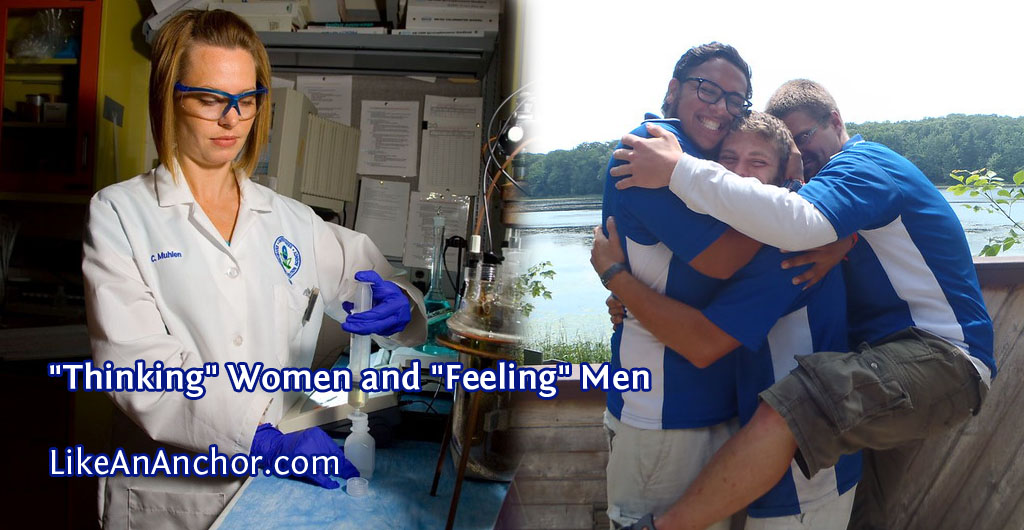
One of the ways we relate Myers-Briggs type to culture is by saying most Feeling types are women and most Thinking types are men. This seems to work quite nicely as a partial explanation for gender stereotypes in Western culture. In spite of social pushes to break-down gender distinctions, Feeling-type attributes (emotionally expressive, nurturing, relational, etc.) are typically considered “female” and Thinking attributes (impersonal, fact-oriented, business-like, etc.) are considered more “male.”
If we fit this generalization, we probably haven’t even noticed it. If you’re a woman with traditionally feminine traits or a man with traditionally masculine traits, there’s little pressure to change (though there are exceptions, of course). But if you’re a woman whose mind naturally makes decisions in an impersonal way or a man who prefers harmony to competition chances are someone has told you at some point that there’s something wrong with you.
Type Distribution
As with many generalizations, there’s a whole slew of problems related to this observation. According to the Center for Applications of Psychological Type, about 57 to 84 percent of women are Feeling types and about 47 to 72 percent of men are Thinking types. It’s hard to get exact numbers on type distribution, but even these broad estimates show that, while the generalization holds true, there are also quite a few Feeling men and Thinking women.
 Just in my family of 5, there are three good examples of exceptions to the general rule that most men are Thinkers and most women are Feelers. My dad (ISFJ) and brother (ENFJ) are both Feeling types, and my sister (INTJ) is a thinking type. My mother has asked me not to type her, but as an INFJ I might be the only one in my family who fits the “women are Feeling types” generalization.
Thinking vs. Feeling
Lest these generalizations lead you to conclude Thinking people don’t have emotions or that Feeling people can’t be intelligent, let’s take a quick look at what Thinking and Feeling refer to when we’re talking about Myers-Briggs types. Both Thinking and Feeling are Judging functions, meaning they describe how you like to make decisions.
When Thinkers make a decision, they like to base it on facts and understand the basic principle behind that decision. They aim for consistency and logic when making decisions and try not to let themselves be swayed by emotions (which they do have, but don’t trust as a basis for decision making). When Feelers make decisions, their focus is on how that decision will affect other people. They want to maintain harmony and stay in line with their personal and societal values.
In your function stack, Thinking (T) or Feeling (F) is going to be your primary or secondary function. You’ll either be most comfortable using T/F since it’s your driver process, or you’ll use your co-pilot T/F for decision making to support your primary perceiving process. If you’re a Feeler, you can access Thinking as your tertiary or inferior function, but it’s not as well developed or easy to use (same for Thinkers accessing Feeling).
- Primary Feeling types: ISFP, INFP, ESFJ, ENFJ
- Secondary Feeling types: ISFJ, INFJ, ESFP, ENFP
- Primary Thinking types: ISTP, INTP, ESTJ, ENTJ
- Secondary Thinking types: ISTJ, INTJ, ESTP, ENTP
Stress of Cultural Expectations
One of the hardest things for Feeling-type men and Thinking-type women to deal with is a sense that there is something wrong with who they are. It’s becoming more socially acceptable for men to express their emotions and women to be seen as impersonal, but not much. For example, ESFJ is often considered the preferred type for women in the United States. That leaves INTP as the opposite type. Nancy J. Barger and Linda K. Kirby’s research indicates that the words and phrases most often used to describe INTP women are negative. Moreover, all the female INTPs they interviewed reported feeling some kind of disconnect with or disapproval from other people because of their personality type. Several specifically mentioned that they think it’s their Thinking side which puts people off.
Like these INTPs, many Thinking women feel out of place in society. Growing up, they identified more with boys and men than they did with other girls and were often criticized for not being “nice” enough. Similarly, many Feeling men felt like they didn’t measure up to what a man “should be” in the eyes of their father, teachers, and peers. They found competition and conflict uncomfortable and often felt more at ease around women and girls than other boys.
Permission To Be Yourself

This is one of the reasons finding your Myers-Briggs type can have such a positive impact. Knowing that you’re hard-wired to respond with Thinking or Feeling gives you permission to finally start using the judging function you feel most comfortable with. If you’re a Thinking woman who’s trying to use Feeling or a Feeling man who is trying to use Thinking, you’re not doing yourself any favors by bypassing the way you naturally approach decisions. Learning to work with our inferior or tertiary function is useful, but it’s much easier if we start by developing our primary or secondary function first.
This doesn’t mean there won’t be any gender-related differences between male and female Feeling types or between male and female Thinking types. I know both male and female ENFJs, for example, and while they are similar in terms of personality the guys still relate to Wild At Heart rather of Captivating (books by John and Stasi Eldgredge; cited because it’s an example used by an ENFJ man I spoke with). If the judging function you’re most comfortable with doesn’t match society’s stereotype for your gender, that doesn’t mean you’re “failing” at being a man or a woman. It just means the person God created you to be doesn’t fit neatly into a box, and that’s okay.
Featured image credits: USEPA Environmental-Protection-Agency and Camp Pinewood, via Flickr


Leave a Reply