Friends who know I blog about Myers Briggs types sometimes send me links to people critiquing the MBTI and ask what I think. The arguments in videos like “Why the Myers-Briggs test is totally meaningless” and articles such as “Goodbye to MBTI, the Fad That Won’t Die” tend to follow a similar pattern and hit the same points:
- Kathryn Brigs and Isabel Briggs Myers had no formal training.
- The test doesn’t allow for complex personalities or that someone can be a little bit of an extrovert and a little bit of an introvert at the same time.
- Similarly, the judging-perceiving, thinking-feeling, and sensing-intuition “scales” don’t allow for people who use both.
- About 50% of people who take the test twice within 5 weeks get different results.
- Test fails to predict success in various jobs and doesn’t provide meaningful data.
- The test remains popular because it only gives positive results. These results are vague and hard to argue with, much like astrology and pseudoscience.
Disclaimer: some of the links in this post are affiliate links. This means that, at no additional cost to you, I will receive a commission if you click on the link and make a purchase on that website.
Setting aside the first arguments for now, I think these points are a good criticism of some of the free tests going around which make people pick just between the four letter groups. None of this, however, takes into account the science behind Myers-Briggs. In fact, if the critics would bother reading Isabel Myers’ book Gifts Differing

The Truth About Extroverts and Introverts
The video I linked above correctly states that Jung’s theory allowed for people who didn’t fit neatly into a single category. But then they say Kathryn Briggs and Isabel Myers “took Jung’s types but slightly altered the terminology and changed it so every single person was assigned only one possibility or another. You couldn’t be a little bit of an extrovert or a little bit of an introvert.”
In fact, this a complete misrepresentation of Myers-Briggs theory. Isabel Briggs never contradicted Jung’s statement that no one can be 100% introverted or extroverted. She also doesn’t describe Introversion and Extroversion in terms of where people gather their energy (a common misconception).
Another basic difference in people’ use of perception and judgement arises from their relative interest in their outer and inner worlds. … The introvert’s main interests are in the inner world of concepts and ideas, while the extrovert is more involved with the outer world of people and things. …
This is not to say that anyone is limited either to the inner world or the outer. Well-developed introverts can deal ably with the world around them when necessary, but they do their best work inside their heads, in reflection. Similarly well-developed extroverts can deal effectively with ideas, but they do their best work externally, in action. For both kinds, the natural preference remains, like right- or left-handedness. (Myers, Gifts Differing, 7)
You’re an introvert if you lead with introversion — not because you never use extroversion. You’re an extrovert if you prefer the outer world — not because you’ve cut yourself off from your inner world. When used correctly, the MBTI includes balance between the two.
Why Dichotomies Fail
Critics of MBTI apply the same argument they use against introversion-extroversion to the other letter pairings as well. To counteract that false assumption, we’ll have to dive into the more complicated side the MBTI — function stacks.
Thinking and Feeling are both Judging functions. They’re used to make decisions. If your Myers-Brigs type has a “J” in it, then that means you’re using your “T” or “F” preference when interacting with the outer world. In other words, J-types extrovert their decision making side.

Sensing and Intuition are both Perceiving functions. They’re used when we’re learning and processing new information. If your Myers-Brigs type has a “P” in it, then that means you’re using your “S” or “N” preference when interacting with the outer world. In other words, P-types extrovert their learning side.
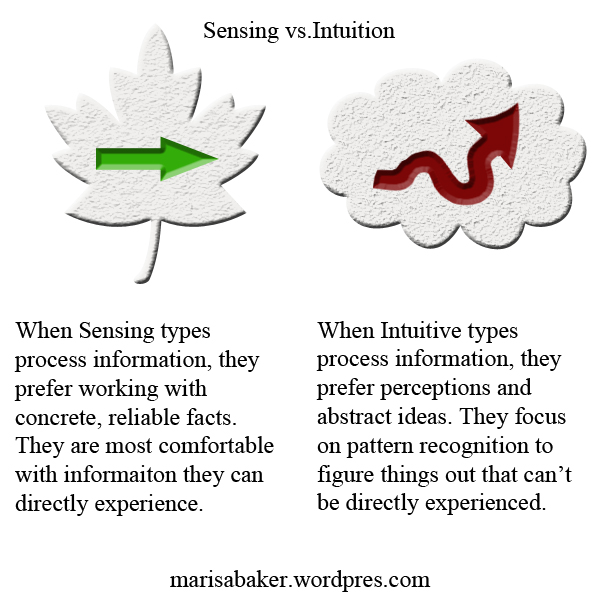
J and P don’t tell you whether you’re a “judger” or a “perceiver” so much as which function you use when interacting with the outer world. For extroverts, this is also their dominant function. An ENTP leads with their perceiving function (in this case Extroverted Intuition). They pair this with secondary Introverted Thinking (the secondary function is opposite on the E/I preference from your dominant function).
For introverts, the J/P preference tells you about their secondary function. Introverts lead with their introverted mental process. So, an ISTJ will lead with Introverted Sensing, but interact with the outer world using their secondary Extroverted Thinking. Thus, even though there’s a “J” in their type, an ISTJ is actually a dominant perceiving type.
Everyone has four functions in their type-stack. The tertiary function is opposite the secondary function, and the inferior function is opposite the primary function. So you end up having a form of both Thinking and Feeling and both Intuition and Sensing in every personality type. The higher up on your stack a function is, the better you’re able to use it. Here’s a few examples:
- INTP: Introverted Thinking, Extroverted Intuition, Introverted Sensing, Extroverted Feeling
- ISFJ: Introverted Sensing, Extroverted Feeling, Introverted Thinking, Extroverted Intuition
- ESFP: Extroverted Sensing, Introverted Feeling, Extroverted Thinking, Introverted Intuition
- ENTJ: Extroverted Thinking, Introverted Intuition, Extroverted Sensing, Introverted Feeling
Results and Usefulness
You’re probably starting to see how people can get inconsistent results when taking MBTI tests. Finding your true Myers-Briggs type isn’t something that happens just from taking a quick online quiz. If you’re a social ISFJ it’s very easy to test as an ESFJ because both types use the same extroverted mental process. If you’re a quiet ENTP you might test as an INTP because you’re using the same introverted mental process. Or if you take the test when you’re stressed-out you can test as a completely opposite type.
In that sense, Myers-Briggs tests do indeed have limited reliability. They’re really just meant as a starting point so you can either work with a counselor who will help you find your type or do your own research on function stacks and learn which type fits you best.
What about the argument that MBTI results are just feel-good drivel? In my opinion, any website that claims to tell you about your Myers-Briggs type and only gives a positive description is unreliable. Good descriptions should present a complete picture of how each type’s mind works at the best of times and at the worst of times.
One of the most popular posts here on this blog is about the INFJ Dark Side. In my e-book, I argue that knowing which areas we tend to struggle with and what pitfalls our types usually fall into is a great starting place for personal growth. Myers-Briggs is about understanding that each person has their own way of looking at the world and making decisions, and that also means each personality has their own strengths and weaknesses to work with.

Real-World Application
One thing Myers-Briggs isn’t really good for is making major decisions. Here’s where the criticism about using the MBTI for things like career predictions comes into play. When I think of using the test for this it reminds me of something I heard in a Personality Hacker podcast — that we’ll be most fulfilled and happy whenever we can use our dominant function and we feel valued and appreciated. That could happen for each type in a variety of different careers, and I don’t like it when tests results limit their suggestions to just a couple job types.
Similarly, using Mysers-Briggs theories to try and predict who we’ll be most compatible with romantically doesn’t always work. Even people who try to tell you there’s an “ideal” match for each type don’t agree. I’ve seen ENTP, ENFP and ESTP all listed as the “best” type for relationships with an INFJ, then others will counter that we’re better with INTPs or INTJs. Looking for love with the MBTI is unreliable and could keep us from a great relationship. Even Isabel Myers didn’t do this — she wrote it was most important that couples both have the same S/N preference, but she was an INFP happily married to an ISTJ.
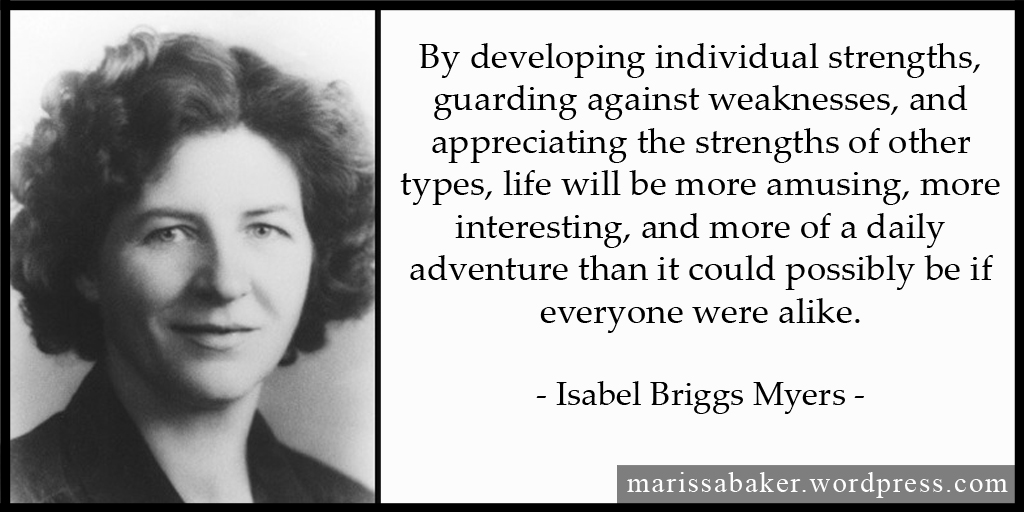
The MBTI is a tool, which is sometimes flawed, that can be used for personal growth and understanding how other people think. One of Isabel Myers’ key goals was to give everyone an appreciation for the “differing gifts” each personality types has. Our lives and relationships will improve when we understand how our minds work and when we understand that everyone around us doesn’t think the same. That’s the best real-world application for the MBTI — using it to promote understanding of self and others.
Further reading: Here’s What Your Myers-Briggs Type Can and Can’t Tell You
Closing Thoughts
I said at the beginning of this post that we’d get back to the criticism that Isabel Myers had no formal training. This is, in fact, true. And I think that’s pretty impressive. The woman who invented the most widely used and successful personality test ever was homeschooled by her mother (Kathryn Briggs, who helped develop the test), only went to college for a four-year degree (and not even in psychology), married while in school, then worked as a stay-at-home mom and writer of fiction.
Though not formally trained in psychology, she devoted half her life to its study and spent a year learning about “test construction, scoring, validation, and statistics” from Edward N. Hay (personnel manager of a large bank in Philadelphia). It took her quite some time to convince anyone she was worth listening to — not just because she was “uneducated,” but also because the academic community wasn’t interested in Jung’s personality theories at the time (Peter Myers’ introduction to the 1995 edition of Gifts Differing). We can thank her for the continuing interest in Jung’s theories of personality and for the MBTI’s persistence as the best known personality test in the world — one that stands up surprisingly well in the face of criticism.
*indicates affiliate links

![fikalo [Fiona] Avatar](https://0.gravatar.com/avatar/93617d4abf3346704ca468602cf31a9341af4ab3234556528f2bf1fedeaa9b70?s=50&d=identicon&r=G)


Leave a Reply