We’re likely all familiar with God’s promises that He won’t forsake us. Yet we also know that even Jesus cried out, “My God, my God, why have you forsaken me?” when He hung on the cross (Matt. 27:46, WEB). While God always keeps His promises–including the one not to leave or forsake us–sometimes we still feel like we’re abandoned.
Our worries about this can become worse when we read of times when God said He has or will forsake certain people. He warned ancient Israel about the consequences of forsaking Him early in their relationship, and He later bemoaned the fact that His people did forsake Him. Their choice to abandon God led to a rift in that relationship. He never breaks covenant and isn’t the first to forsake a relationship, but human actions to move away from Him can result in distance from God.
Like the covenant God made with Israel, our relationship with Him is a reciprocal one–we need to stay faithful and involved in the relationship if we want to stay close to God. As we think about the importance of not abandoning our relationship with God, there’s a collective as well as individual responsibility. We’re not supposed to abandon our individual relationships with God, but we’re also not supposed to forsake the fellowship of other believers. I think the instruction to stay committed to your relationship with God’s church is closely tied to the responsibility to not abandon God Himself.
Lord, Do Not Forsake Us
One of the things that we find in the Psalms is snapshots of different seasons we can go through in our relationships with God. Thinking of the Psalms as windows into the many different ways Godly people can relate to God is a helpful approach since we’re not going to resonate with every single Psalm at the same time. Some Psalms speak of times when the writer was confident and bold in their walk with God. Some picture times of peace and contentment in relation to God. Others show what it can be like during times of wrestling and struggle, uncertain of what God is doing and why He seems distant.
My God, my God, why have you forsaken me? Why are you so far from helping me, and from the words of my groaning?
Psalm 22:1, WEB
Do not reject me. Do not push your servant away in anger. You are my deliverer. Do not forsake or abandon me, O God who vindicates me.
Psalm 27:9, NET
Don’t reject me in my old age. Don’t forsake me when my strength fails.
Psalm 71:9, WEB
It’s not unusual to feel that God has forsaken us; even Jesus quoted Psalm 22 when He hung on the cross. It’s also acceptable to plead with Him not to forsake us, as the Psalmists do here and in other passages (Psalm 38:21; 71:18; 119:8; 138:8). People who trust and love God may still cry out to Him, “Do not forsake us.”
God preemptively answered these cries with many promises that He will not forsake us. One of these promises appeared in the Torah and would have been familiar to the psalmists. However, it was followed by a warning that if ancient Israel forsook God first, then He would forsake them in the sense that He would not dwell among them and save them from their enemies (Deut. 31:1-8, 16-17). Perhaps the psalmists were thinking of the reciprocal nature of faith and covenants when they prayed, reminding God that they haven’t forsaken Him and so He had no reason to forsake them.
Do Not Forsake the Lord
We humans tend to be self-focused, and it’s no surprise that we’re preoccupied with making sure God and the people we care about don’t forsake us. But we also need to be aware that those we’re in relationship with have similar expectations. God echoes the sentiment of “Do not forsake Me” back to us when He bemoans the rift in relationship that happened when His people forsook Him.
Yet you have forsaken me and served other gods. Therefore I will save you no more.
Judges 10:13, WEB
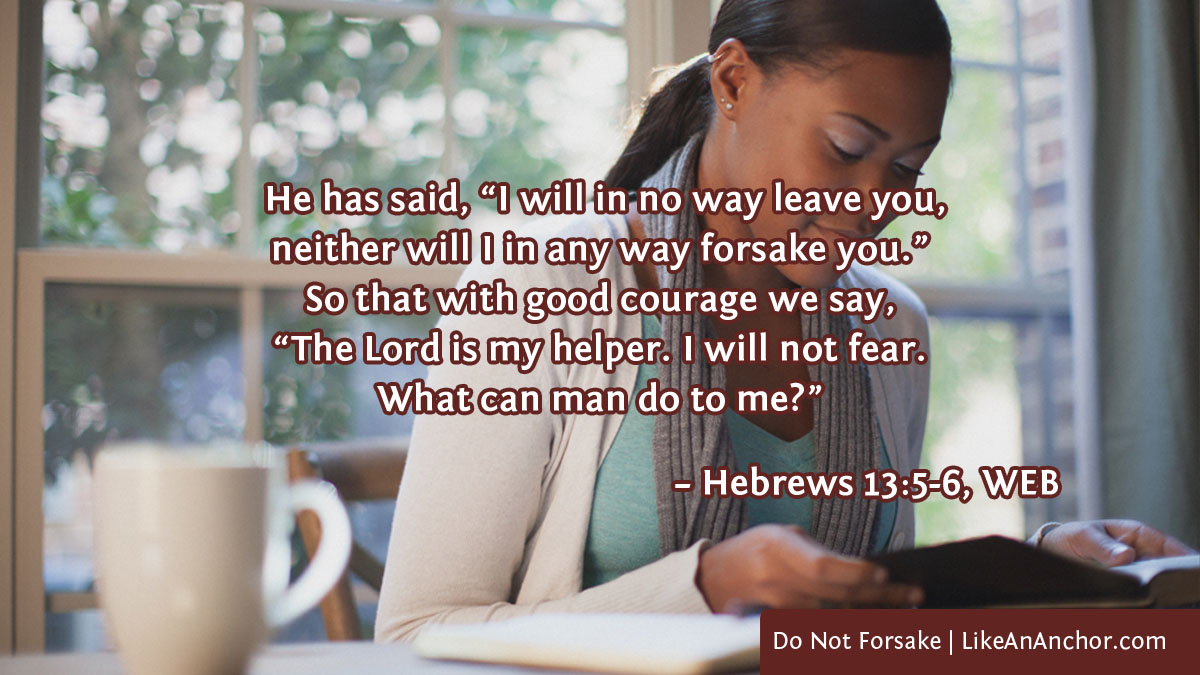
Yahweh is with you, while you are with him; and if you seek him, he will be found by you; but if you forsake him, he will forsake you.
2 Chronicles 15:2,WEB
For my people have committed two evils: they have forsaken me, the spring of living waters, and cut out cisterns for themselves: broken cisterns that can’t hold water.
Jeremiah 2:13, WEB
There are consequences for forsaking relationship with God, even including being forsaken by Him. That’s a sobering thought. We know sins can separate us from God (Isaiah 59:1-2), and unrepented sin on top of unrepented sin can even lead to God forsaking temporarily, the way He did with ancient Israel.
For Yahweh has called you as a wife forsaken and grieved in spirit,
Isaiah 54:6-8, WEB
even a wife of youth, when she is cast off,” says your God.
“For a small moment I have forsaken you,
but I will gather you with great mercies.
In overflowing wrath I hid my face from you for a moment,
but with everlasting loving kindness I will have mercy on you,” says Yahweh your Redeemer.
I don’t think of this so much as God abandoning the relationship (He is never the one who breaks covenants), but as us pulling away so far that He isn’t close to us anymore. And if we break covenant with Him, restoring the relationship requires something drastic (i.e. Jesus Christ’s sacrifice removing our sins). Thankfully, God in His mercy set things up so we can repent and turn back to Him, restoring relationship when we ask for forgiveness, change, and live in obedient harmony with Him.
Do Not Forsake Each Other
I heard an analogy once on a Christian radio station that has stuck with me for years. If your spouse said, “Darling, I love your head but I could do without your body,” would you feel loved? That’s essentially what we’re saying to God if we say, “Hey, I like Jesus but I could really do without all these Christians.”
And God put all things under Christ’s feet, and gave him to the church as head over all things. Now the church is his body, the fullness of him who fills all in all.
Ephesians 1:22-23, NET
We need to hold fast to the Head, Jesus Christ, but we do so as part of a collective body. The body/church is supposed to all hold on to Jesus Christ together and grow together (Eph. 2:20-23; 4:11-16). We have individual relationships with God and we work on our own salvation with His help, but it’s always in the context of the larger house, temple, or body (NT writers use various analogies) that God is building. It’s all of us together that make up the temple of God. We need each other.
Let’s consider how to provoke one another to love and good works, not forsaking our own assembling together, as the custom of some is, but exhorting one another, and so much the more as you see the Day approaching.
Hebrews 10:24-25, WEB
This is a direct instruction not to forsake each other. There are times when not assembling is unavoidable–health issues, lack of transportation, extreme distance, and persecutions can all make it impossible for some people to regularly gather with other believers. But if we don’t gather with others in the church–the body of Jesus Christ–it shouldn’t be by our own choice. We should never be the thing that stands in the way of fellowshipping with God’s people.
That said, I also want to acknowledge there are times when we need to discontinue fellowship with someone because they are sinful and toxic, and times when legitimate accusations must be brought against those in ministry (1 Cor. 5:9-13; 1 Tim. 5:19-20). I don’t want to downplay those serious issues, but I suspect they’re less common than situations where pride, selfishness, impatience, and miscommunication are getting in the way of godly conflict resolution and relationship restoration.
Love must be without hypocrisy. Abhor what is evil, cling to what is good. Be devoted to one another with mutual love, showing eagerness in honoring one another. Do not lag in zeal, be enthusiastic in spirit, serve the Lord. Rejoice in hope, endure in suffering, persist in prayer. Contribute to the needs of the saints, pursue hospitality. Bless those who persecute you, bless and do not curse. Rejoice with those who rejoice, weep with those who weep. Live in harmony with one another; do not be haughty but associate with the lowly. Do not be conceited. Do not repay anyone evil for evil; consider what is good before all people. If possible, so far as it depends on you, live peaceably with all people.
Romans 12:9-17, NET
As I read this, I feel convicted. There are several of these things that I neglect to do regularly and some instructions that I’ve even acted in opposition to (e.g. being reluctant to honor others instead of eager, or unwilling to bless those who’ve hurt me). But can you imagine how much different our lives, relationships, and churches would look if we all really followed Paul’s instructions here? It would be such a wonderful transformation, and getting to that point starts with each of us committing to living this out as far as depends on us.
God promises not to forsake us. He expects a similar commitment from us. He knows we’re not perfect, but we must do our best to remain faithfully committed to Him and fellowship with other believers if at all possible (and repent, ask for forgiveness, and change when we miss the mark). With God’s help, we can live securely in harmony with the Father, Jesus Christ, and the family they are building.
Featured image by Shaun Menary from Lightstock

Song Recommendation: “Come People of the Risen King” by Keith & Kristyn Getty

 Like An Anchor