
Do you remember the story of the Exodus? The people of Israel–the nation descended from Abraham, Isaac, and Jacob to whom God made great promises–were enslaved in Egypt. They cried out to God for help, and He sent a deliverer. Moses arrived and demanded that Pharaoh let the Israelites go. When Pharaoh refused, God sent 10 plagues that proved His absolute authority. After the final, devastating plague, Pharaoh and the Egyptians were happy to see the people of Israel go. After just a little while, though, Pharaoh angrily pursued them, intending to wipe them out. But God parted a sea for Israel to walk through, then after they’d escaped He used the sea to destroy the whole Egyptian army.
Imagine what it would have been like to see that. To witness all 10 plagues, especially the final ones where there was a clear distinction between God’s people and the Egyptians. Egypt was in darkness for three days, but the Israelites had normal light. All the Egyptian firstborn died, the children of Israel kept the Passover and God spared their lives. You’d have seen an entire sea split in half, walked through on dry land, and then watched as it destroyed the army trying to kill you (Ex. 14). Then, as your travels continued, you saw undrinkable water turn sweet and began gathering manna that appeared miraculously each morning to feed the entire company of people (Ex. 15:22-17:7). And then, your group of former slaves was attacked and you ended up winning the battle (Ex. 17:8-16). Finally, you came to Mount Sinai and literally heard the voice of God thunder down (Ex. 19-20). If you hadn’t been convinced of God’s reality before, you must have been by now!
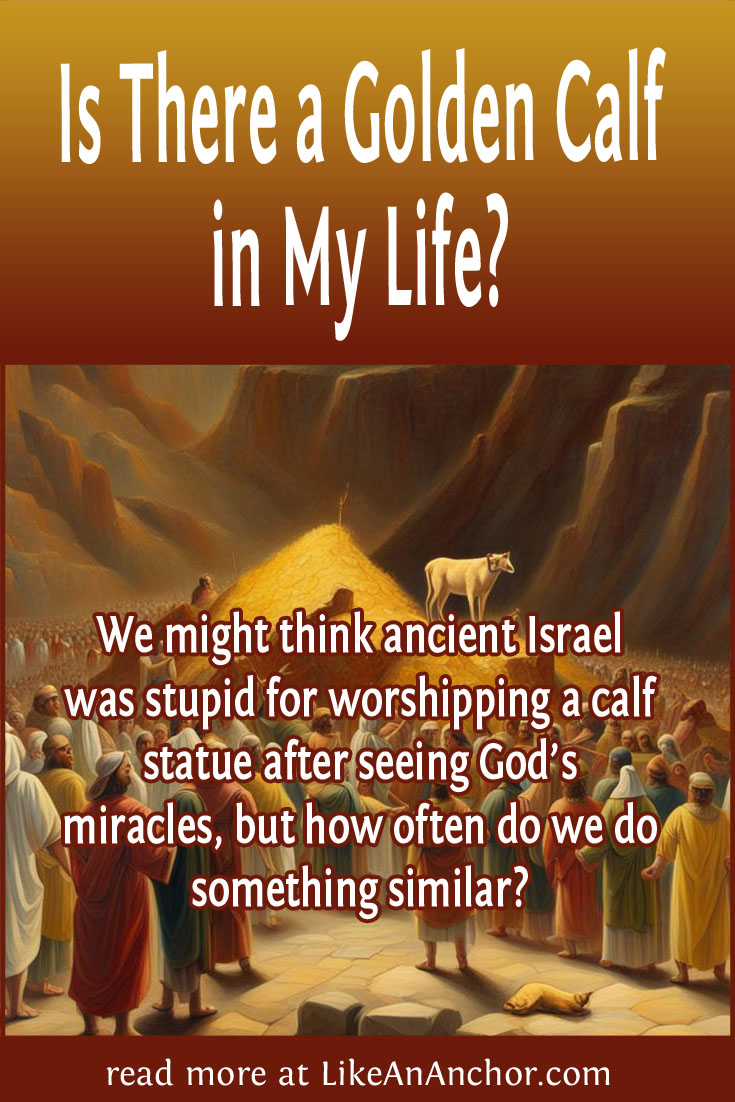
And yet, after God spoke the 10 Commandments and Moses went up to the mountain to speak with Him more, Israel made a golden calf and started worshipping it. As modern readers, we are often inclined to look back on people of the past and assume that we’re much better than them. How dumb do you have to be, we think, to have witnessed all God’s miracles and then decide a gold statue of a calf is the one you should worship?
Aaron’s Perspective
Let’s take a closer look at this story. After seeing “that Moses delayed coming down from the mountain, the people gathered themselves together to Aaron” and demanded that he “make us gods, which shall go before us” to replace Moses, “the man who brought us up out of the land of Egypt” (Ex. 32:1, WEB). The Hebrew word translated “gods” here is elohym, the same word used in Genesis 1:1 when it says, “God created the heavens and the earth.” It is a plural noun, used both generically of gods but also of the one true God (much like the English word today). The people are requesting a visible deity to take the place of Moses. Now, look at Aaron’s response.
All the people took off the golden rings which were in their ears, and brought them to Aaron. He received what they handed him, fashioned it with an engraving tool, and made it a molded calf. Then they said, “These are your gods, Israel, which brought you up out of the land of Egypt.”
When Aaron saw this, he built an altar before it; and Aaron made a proclamation, and said, “Tomorrow shall be a feast to Yahweh.”
Exodus 32:3-5, WEB (NET notes th
At first, Aaron echoes the people’s request for elohym (and the NET translation notes that “these are your gods” could be translated “this is your god”). But once the calf is built and the altar constructed, he proclaims “a feast to Yahweh.” In contrast to the more general elohym, Yahweh is a very specific name. Look how God revealed that name to Moses, when He first called him to go and deliver Israel.
God said to Moses, “I AM WHO I AM,” and he said, “You shall tell the children of Israel this: ‘I AM has sent me to you.’” 15 God said moreover to Moses, “You shall tell the children of Israel this, ‘Yahweh, the God of your fathers, the God of Abraham, the God of Isaac, and the God of Jacob, has sent me to you.’ This is my name forever, and this is my memorial to all generations
Exodus 3:14-15, WEB
Yahweh is God’s proper name, which He revealed to His people for them to use. God is a description of the type of being He is, Lord is a title, but Yahweh is His name. I think it’s significant that Aaron uses this name here, rather than the name of an Egyptian deity associated with cattle like Apis or Hathor. Aaron didn’t present this as a different god than Israel had followed out of Egypt; he caved to the people’s demands to make a visible representation of a god and then he said worshipping it was worshiping Yahweh.
God’s Perspective
Aaron’s description of the golden calf as the god who brought Israel out of Egypt is baffling to us. But how often do we do something similar, where we come up with an idea and decide we’re honoring God but in reality it has nothing to do with how He tells us to live and worship him?
Yahweh spoke to Moses, “Go, get down; for your people, who you brought up out of the land of Egypt, have corrupted themselves! They have turned away quickly out of the way which I commanded them. They have made themselves a molded calf, and have worshiped it, and have sacrificed to it, and said, ‘These are your gods, Israel, which brought you up out of the land of Egypt.’”
Yahweh said to Moses, “I have seen these people, and behold, they are a stiff-necked people. Now therefore leave me alone, that my wrath may burn hot against them, and that I may consume them; and I will make of you a great nation.”
Exodus 32:7-10, WEB
Whatever Aaron might have thought about what He was doing, Yahweh is very clear about how He viewed the golden calf incident. He was ready to kill everyone involved because they “corrupted themselves” and “turned away quickly out of the way which I commanded them.” Moses interceded on behalf of the people and God mercifully stayed His hand, but this was still a very serious offense. They had “sinned a great sin, and have made themselves gods of gold” (Ex 32:30-31, WEB). Even if some of them had thought they were in the right, it didn’t change the fact that what they did was wrong.

What about New Covenant Christians?
I wonder sometimes if there are areas where I’m just as stubborn as the ancient Israelites about doing something I think honors God but which He would tell me not to do (it’s a regular prayer of mine that He would show me if that is the case). We can say for certain that the New Covenant church is not immune to this issue, as demonstrated by Paul’s letters. He frequently corrects mistakes in people’s understanding of what is and is not pleasing in God’s eyes.
In 1 Corinthians, Paul chides the believers in Corinth for what the NET Bible describes as “immaturity and self-deception” (header for chapter 3). They’d broken into factions following different human teachers and they had an inflated opinion of their own wisdom. They’d even decided to allow sexual immorality within the congregation, and then boast about their tolerance! (1 Cor. 5). And there were other issues as well, which you can read the whole letter to learn more about. Eventually, Paul brings his readers back to the example of Israel at Mount Sinai.
For I do not want you to be unaware, brothers and sisters, that our fathers were all under the cloud and all passed through the sea, and all were baptized into Moses in the cloud and in the sea, and all ate the same spiritual food, and all drank the same spiritual drink. For they were all drinking from the spiritual rock that followed them, and the rock was Christ. But God was not pleased with most of them, for they were cut down in the wilderness. These things happened as examples for us, so that we will not crave evil things as they did. So do not be idolaters, as some of them were. As it is written, “The people sat down to eat and drink and rose up to play.” …
These things happened to them as examples and were written for our instruction, on whom the ends of the ages have come. So let the one who thinks he is standing be careful that he does not fall. No trial has overtaken you that is not faced by others. And God is faithful: He will not let you be tried beyond what you are able to bear, but with the trial will also provide a way out so that you may be able to endure it. So then, my dear friends, flee from idolatry.
1 Corinthians 10:1-7, 11-14, NET
One of the basic things that we need to accept when we commit to following God is that He’s the one who gets to determine how we ought to follow Him. It’s not a negotiation or something we come up with on our own. He gives us clear guidelines to follow. There are some things we can personalize–for example, we’re told to sing praises, but the style of music or the number of songs per church service isn’t specified. However, we aren’t given the option to change things completely–for example, eliminate music from worship or replace songs of praise in church services with songs that have nothing to do with God.
Examining Ourselves for Idolatry
Music is a relatively simple example. While it can generate sharp controversy and very definite opinions, most reasonable people will admit that music tastes are subjective and there isn’t anything wrong with different styles (i.e. traditional hymns vs. contemporary Christian) provided the lyrics are Biblically sound. Many of the other topics can get more controversial. For example, I think the question of Biblical holy days (e.g. Passover, Pentecost, Sukkot) vs. more recently “Christianized” holidays (e.g. Easter, Christmas) falls into this category. I struggle to wrap my head around why people would keep days God doesn’t tell them to while ignoring the ones that He does.
When we think of idolatry, we usually think of making statues and worshiping them instead of the true God. But it’s more insidious than that and it’s still dangerous today. Paul warned us to “flee from idolatry” (1 Cor. 7:15, NET). John’s final instruction in his first epistle is, “guard yourselves from idols” (1 John 5:21, NET). The ending of Revelation makes clear that idolaters will not be in God’s kingdom (Rev. 21:8; 22:15). It’s a very serious thing, and it’s something we all need to examine ourselves for and make sure we’re not replacing God with some other priority, or trying to worship Him in a way that seems okay to us but that He would say is not the way He commanded.
Now that we’ve started a new year on the Gregorian calendar, I start thinking about the new year that will start in the spring on God’s calendar. This year, the first day of the first month on the Hebrew calendar lines up with April 9th. That gives us about three months now before we’ll be keeping Passover. Traditionally, the time leading up to Passover is a season of self-examination because that’s what Paul tells the Corinthians to do shortly after he gives them the warnings from Israel’s past (1 Cor. 11:17-34). Now is an excellent time to start taking a look at ourselves, and prayerfully asking God to share His perspective on our choices. Personally, I like to pray Jeremiah’s prayer: “Yahweh, correct me, but gently” (Jer. 10:24, WEB). We need His correction, and we also need His mercy when we’re asking for His aid to identify and overcome idolatry or any other sin.
Featured image by ian kelsall from Pixabay

Song Recommendation: “Here I Am Anyway” by Josh Wilson

 Like An Anchor