Fictional MBTI – Thor (ESTP)

With Thor: Ragnarok now out, it seemed like a good time for another Fictional MBTI post, especially since Ragnarok is so good. Who would have thought a film about the destruction of Asgard and fall of the gods (that’s not a spoiler — it’s Norse mythology) could be so light-hearted and fun?

I’ve been typing Thor as an ESTP since the first film came out, which I think is pretty much the standard typing for him (please note: I’m only typing the MCU version of Thor, not his character in the comics or mythology). Still, just because there’s not much debate about his type doesn’t mean we can’t give him his own post. There are several different nicknames for this type, and for Thor I decided to go with “Adventurer” rather than the more commonly used David Keirsey nickname “Promoter.”

A Man of Action

Fictional MBTI - Thor (ESTP) | marissabaker.wordpress.com

ESTP types lead with a mental process called Extroverted Sensing (Se). Fittingly, this is the most visible aspect of Thor’s character in the films. SP types are doers. They thrive on taking action in the real world and they’re good at it. Really good. In fact, I’d venture a guess that most action heroes in fiction are SP types, especially STP types. It’s not that they can’t pause for reflection or plan ahead. It’s that they don’t really see the need since things usually work out so well for them.

ESTPs have a reputation for being thrill-seekers, and it’s not hard to see why. Their dominant Se seeks variety and physical stimulation. They like to take risks, yet they are so aware of their physical surroundings and their limits that they are probably the smartest physical risk-takers around. They have a natural awareness for what their body can or can’t do, paired with quick reflexes, and an ability to keep their wits in a crisis.” — Susan Storm, Understanding ESTP Sensing

This side of Thor’s character is at the forefront in the new film as well as his past appearances. In Ragnarok’s opening scene, he even comments that fighting against overwhelming odds without a real plan seems to always work out for him. And not only does it work out, he’s clearly enjoying himself. He thrives on challenge and risk-taking.

Thoughtlessly Charming

Fictional MBTI - Thor (ESTP) | marissabaker.wordpress.com

I’m going to skip over an ESTP’s co-pilot process for now and talk about their tertiary side. It’s tempting for any type to bypass their secondary function and spend more time in their less-developed tertiary side because that lets them stay in their preference for introversion or extroversion. For example, an ESTP’s primary and tertiary functions are both extroverted, while their secondary one is introverted.

Extroverted Feeling (Fe) isn’t all that well-developed or reliable for ESTPs. It can lead to bad decisions based on doing things that will make them look good to or fit in with the people around them (Fe is a process focused on harmony in relationships). Thor is clearly enjoying his social position in the opening scenes of the first film and I suspect that a large part of how he acts is because “reckless military leader” is the persona people expect (though I doubt he’s analyzed it that much). We also see him using his Fe to connect with people on earth as the charming gentleman Jane Foster falls in love with.

Learning After Doing

Fictional MBTI - Thor (ESTP) | marissabaker.wordpress.com

ESTPs learn best by doing. They’re not the sort to listen to lectures or spend a lot of time planing. They’d rather do something and see how it works out, then adjust future actions accordingly. Until something doesn’t work out there’s not much of a reason for them to spend time figuring out why. Which leads us to a discussion of an ESTP’s secondary function, Introverted Thinking (Ti).

Most people start to develop their secondary function in their teens, but it’s not a comfortable process for people to be in so we don’t always focus on growing it until we have to. For ESTPs, this “co-pilot” is a judging function that they use when making decisions. Ti is concerned with figuring out what makes sense, aligning to personal convictions, and impartially looking at facts. Thor starts doing this when his exile from Asgard in his first film forces him to look at the sort of decisions he’s been making and re-think his actions.

We do also get glimpses of an ESTP’s healthy thinking side in Thor’s character. People of this type can be incredibly clever and intelligent, though they’re often underestimated because so many outsiders just see their action-oriented side. An example from the first film is when he’s explaining the science behind Bifrost travel to Jane. He makes it look easy, but he’s managing to translate two completely different cultural way to framing the world (science and magic) in a way that makes perfect sense to an earth scientist. And in Ragnarok, we get a conversation between him and Bruce Banner where Thor effortlessly keeps up with and understands the scientific terminology used by a man with multiple PhDs.

Stress And The ESTP

Fictional MBTI - Thor (ESTP) | marissabaker.wordpress.com

Being cast out of Asgard in the first film, and especially learning that Mjölnir doesn’t see him as worthy anymore, pushes Thor into his least developed function. For ESTPs, that’s Introverted Intuition (Ni). When intuition is a type’s stress function, stressful situations tends to confuse their normally clear thought process and they may become angry, paranoid, or feel hopeless. It typically doesn’t take ESTPs long to bounce back, though, which helps explain why Thor’s despondency only lasts until he’s given a chance to take action and fight back.

What’s really interesting about Thor of the MCU films is that this version of his brother Loki is an INFJ type. Making Loki and Thor complete opposites in their personalities means they use the exact same mental functions in the opposite order. Thor’s weakest mental process is Loki’s strongest (INFJs lead with Ni), and vice-versa. No wonder they’re constantly butting heads and struggling to understand each other.


If you enjoyed this post, check out my other MCU typings:

Bucky Barns – ESTP

Loki – INFJ

Scott Lang -ISFP

Steve Rodgers – ISFJ

T’Challa – ISFP

Tony Stark – ENTP

Save

Save

Save

Save

Save

Save

Save

The Incredible Reasons God Gives Us For Not Being Afraid

It’s all well and good to say, “God doesn’t want you to be afraid,” like we did in last week’s post. But that doesn’t actually help much with getting rid of our fear. Even knowing He’s patient with our fearfulness doesn’t take the fear away.

Thankfully, God’s doesn’t just order, “Fear not,” and leave it at that. He offers specific promises that give us tangible reasons not to be afraid. And when we are fearful, those promises can help us overcome to act in faith despite our fears. This past week, I went through the Bible looking for all the reasons God gives for us not being afraid. There are many, but I’ve sorted them into four main categories:

The Incredible Reasons God Gives Us For Not Being Afraid Looking At Scriptural Mission Statements For People Following Jesus | marissabaker.wordpress.com
Photo credit: HarveyMade via Lightstock

God Is With You

Before Moses’s death, God inspired Him to share these words with Israel:

Be strong and courageous. Don’t be afraid or scared of them; for Yahweh your God himself is who goes with you. He will not fail you nor forsake you. (Deut. 31:6, WEB)

The number one reason we have for living without fear is that God Himself is with us. And not just as a church or a group of people. Individuals can also receive this promise, as did Isaac (Gen. 26:24), Joshua (Josh. 1:9), David (Ps. 23:4), Solomon (1 Chr. 28:20), and Jeremiah (Jer. 1:8).

Don’t you be afraid, for I am with you. Don’t be dismayed, for I am your God. I will strengthen you. Yes, I will help you. Yes, I will uphold you with the right hand of my righteousness. (Is. 41:10, WEB)

God promises not to let us down or leave us alone. That means the most powerful being in existence is at your side through everything. He doesn’t leave us to figure things out on our own nor abandon us in our struggles. Read more

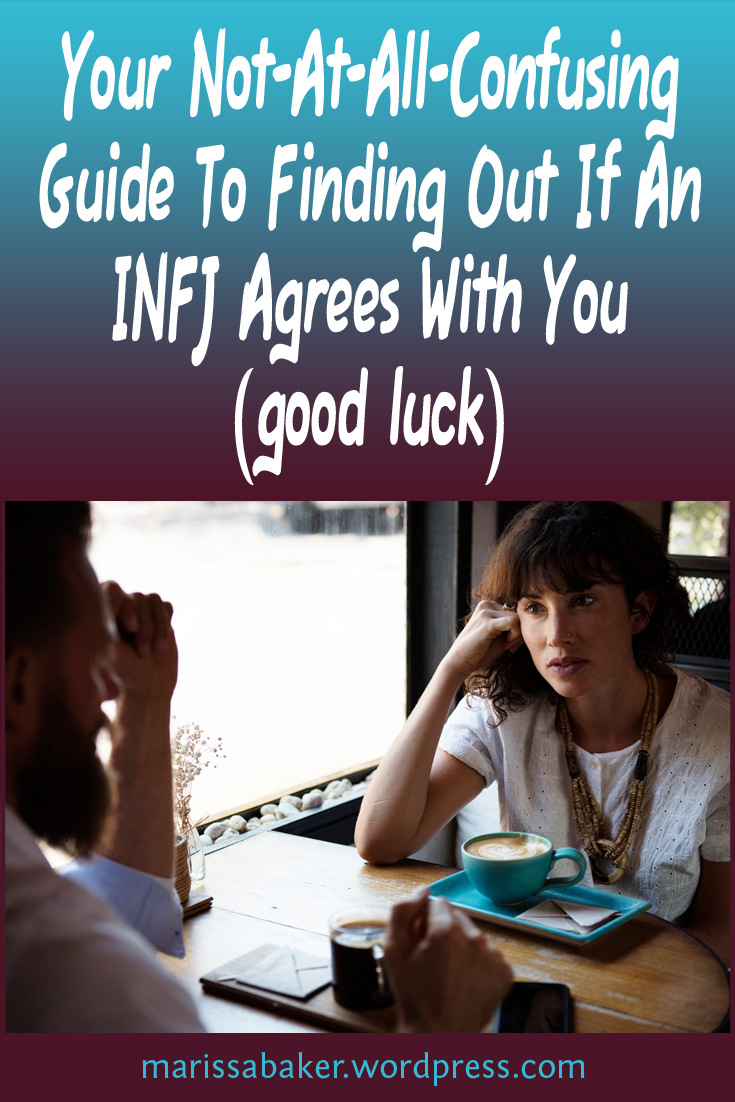
Your Not-At-All-Confusing Guide To Finding Out If An INFJ Agrees With You

Think INFJs are hard to figure out? Have you found yourself puzzled by an INFJ’s contradictory words and behavior? Well there’s no need to worry any more. I’ve got your quick, easy, and not-at-all-confusing guide to finding out if an INFJ agrees with you. No more will those mysterious unicorns of the personality type world confuse you in conversation. No longer will their confrontation-avoidance leave you wondering whether an INFJ actually agrees with what you’re saying or is simply making you think they do so you won’t get upset with them.

Your Not-At-All-Confusing Guide To Finding Out If An INFJ Agrees With You | marissabaker.wordpress.com
Photo credit: Rawpixel.com via Stocksnap

Head Nodding

Nodding mostly means we’re listening to you, so this could really go either way. Cross-check with other signs.

Eye Contact

Making eye contact typically means the INFJ agrees with you. Not making eye contact could mean one of three things: they disagree with you, they don’t care, or they agree with you but don’t want to admit it.

Non-Committal Sounds

An INFJ who’s making sounds like “um-hum” while glancing away looking for an escape doesn’t agree with you. But if they’re making the same sound with eye-contact while leaning toward you and smiling, then you’re good. Probably. Read more

What Does God Have To Say About Fear?

Is being afraid a sin? I think most of us, me included, would say it isn’t sinful in and of itself. Fear is often a natural gut reaction to things happening around us, and it serves a self-preservation role. It only becomes an issue if we act on it wrongly or let it paralyze us and prevent right action. But maybe I’m wrong. Maybe I’m letting my own fears cloud my perspective on this issue. Because it seems God takes our fearfulness more seriously.

He that overcometh shall inherit all things; and I will be his God, and he shall be my son. But the fearful, and unbelieving, and the abominable, and murderers, and whoremongers, and sorcerers, and idolaters, and all liars, shall have their part in the lake which burneth with fire and brimstone: which is the second death. (Rev. 21:7-8, KJV)

Some translations say “cowardly” instead of “fearful,” but the Greek deilos really does mean timid or afraid. Strong’s dictionary adds that it implies faithlessness. Hence Jesus’ question, “Why are you so afraid? How is it that you have no faith?” to the disciples in a storm (Mark 4:37-40, WEB). Is it really the case that God sees our fears and timidity as lack of faith?

What Does God Have To Say About Fear? | marissabaker.wordpress.com
Photo credit: HarveyMade via Lightstock

The Right Kinds of Fear

The Bible talks about fear in both positive and negative ways. The kind of fear that is connected with reverence and respect for God and His authority is good. In fact, it’s essential.

This is the end of the matter. All has been heard. Fear God, and keep his commandments; for this is the whole duty of man. For God will bring every work into judgment, with every hidden thing, whether it is good, or whether it is evil. (Ecc. 12:13-14, WEB)

Fear of God has long been a commanded part of following Him (Deut. 5:29; 6:2; 10:12). And in the New Testament, the apostles tell us to perfect “holiness in the fear of God” (2 Cor. 7:1, WEB), to “work out your own salvation with fear and trembling” (Phil. 2:12, WEB), and to live our lives on earth “in reverent fear” (1 Pet. 1:17, WEB). Read more

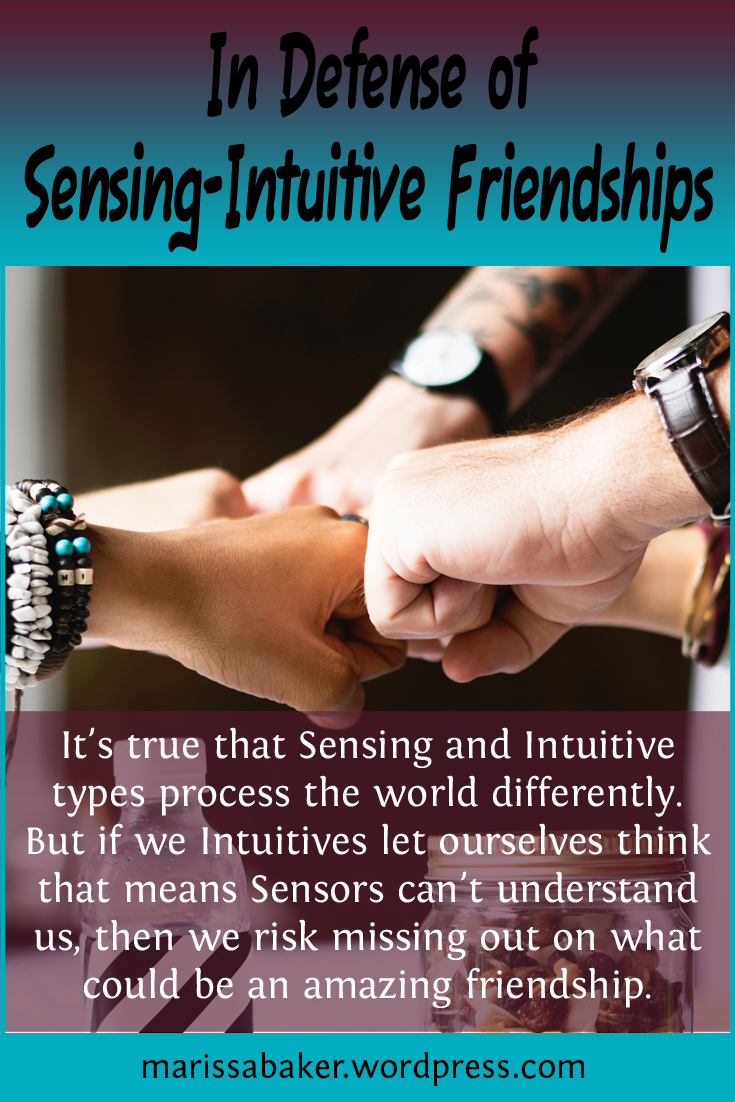
In Defense of Sensing-Intuitive Friendships

I talk with quite a few people who have Intuitive type personalities and grew up feeling misunderstood. They knew they were different from other people but didn’t know why and that led to feelings of loneliness and isolation. In some cases this feeling came from a lack of people they could truly connect with. But others encountered outright rejection or bullying.

As we grew up and started learning about our personality types, the feeling of being different started to make sense. Intuitive types do see the world differently from most other people — we only make up 30% of the world’s population. The other 70% of people are Sensing types. And becasue the Intuitive/Sensing side of our personalities describes how we perceive things and learn new information, it plays a huge role in how we frame our conceptions of the world. It’s no wonder that Intuitives feel different from the majority of the people they meet.

In Defense of Sensing-Intuitive Friendships | marissabaker.wordpress.com
Photo credit: Rawpixel.com via Stocksnap

The Amazing Intuitive Connection

There’s something incredible about learning you’re not alone. That there really are other people out there who process the world in much the same way you do. People whose eyes won’t glaze over when you dive deep into theoretical discussions, who won’t panic when you suggest a new perspective on traditional ideas, and who think talking about the future framed in all of human history is a great way to spend their afternoons.

I think Intuitives need other Intuitives around. I grew up with Intuitive siblings, eventually made several Intuitive friends, and now have the Intuitive Awakening group on Facebook. For close relationships, matching on your Intuition/Sensing preference is going to make it much easier to identify with and understand the other person. And I’m pretty sure any Intuitive with Intuitive friends or family is nodding their heads while reading this. We crave the opportunity to connect with other people who will understand us and validate our way of processing the world. It’s part of being human.

Inaccurate Sensing Stereotypes

But we can take our need for Intuitive connection to an unfortunate extreme and decide that other Intuitives are the only people worth talking with. People with this mindset say that Sensing types are too superficial, too selfish, too close-minded, and too judgemental for them to really connect with (a claim that is, when you think about it, an example of the mindset they’re accusing Sensors of having). Read more

What’s The Church Supposed To Do?

If you ask the church that I’ve spent most of my life in what their mission is they have a ready answer: preaching the gospel and preparing a people. I can’t speak for your churches, but I imagine many (perhaps even most) of them would also point to some version of what we call The Great Commission as their mission statement.

Jesus came to them and spoke to them, saying, “All authority has been given to me in heaven and on earth. Go, and make disciples of all nations, baptizing them in the name of the Father and of the Son and of the Holy Spirit, teaching them to observe all things that I commanded you. Behold, I am with you always, even to the end of the age. (Matt. 28:18-20, WEB)

Is this a commission? yes, it’s “an instruction, command, or duty given to … group of people.” Is it great? since it came from Jesus and involves a responsibility given His disciples, yes. But is it really meant as the defining mission statement for the entire church from Jesus’ resurrection to His return? I’m not so sure.

What's The Church Supposed To Do? Looking At Scriptural Mission Statements For People Following Jesus | marissabaker.wordpress.com
Photo credit: Pearl via Lightstock

A Sobering Warning

The religious leaders of Jesus’ day were the group He spent the most time criticizing and correcting. They professed to follow God’s highest standards but were in reality hypocrites. They did righteous looking things just to get attention (Matt. 23:5). They went to great lengths to convert people only to pervert their faith (Matt. 23:15). They placed too high an emphasis on money received as tithes and offerings (Matt. 23:16-19). They neglected the “weighty matters” of God’s law and instead followed their own traditions. They even turned the temple itself into a marketplace where they exploited people coming to worship God (John 2:14-16).

The scary thing is, these people honestly thought they were the most righteous God-followers out there. That serves as a warning today that church leaders and organizations have to be very careful where they place their focus. And so do we as individual members of Christ’s body.

A Greater “Commission”

We certainly shouldn’t ignore Christ’s instruction to go, disciple, baptize, and teach. But we need to make sure we’re thinking of that command from Matthew 28 in its proper context. Because there are two other commissions that Jesus plainly told us are His greatest commands. Read more