Learning From Others’ Spiritual Temperaments: Book Review of “Sacred Pathways” by Gary Thomas

A couple weeks ago, in an article titled “Psychology Isn’t Enough, but It Sure Helps: The Need for Personal, Spiritual Growth in Christianity” I talked about a book by Gary Thomas called Sacred Pathways: Discover Your Soul’s Path To God. I originally read it back in 2017 and I’d planned to write about it here on the blog but for some reason (which I don’t remember now) I never got around to it. So I reread it, and now I’d like to share some thoughts.

Book Overview

Thomas proposes nine “sacred pathways” — spiritual temperaments that describe how we’re most inclined to worship God. In the first chapter, he discusses that in the Christian churches we often expect everyone to worship God the same way. The example he uses is the “quiet time” that became a staple of church training and discipleship programs in the 1970s and ’80s. It involved spending 30 to 60 minutes each morning in prayer, personal worship, and Bible study, then having an accountability partner to check-in that you were keeping up with your routine. Prayer, worship, and study are all good things, but it’s not good if we reduce worship to “rote exercise” or assume everyone has to worship in the exact same way all the time (p. 14-15).

I’ve heard the idea that everyone else should worship “our way” voiced more or less directly by a variety of people in churches I’ve attended. Some think churches that don’t encourage dance are not worshiping Biblically; others worry about the people who aren’t committed enough to follow their example of reading the Bible through every year. I’ve voiced my own frustration with song services that have all the enthusiasm of a funeral dirge, saying we need more life in our worship to make it meaningful. Complaining about those who don’t  worship the way we think they ought is a common thing. But perhaps it betrays a wrong attitude. Read more
Mercies from Yahweh of Armies

Work, work your thoughts and therein see a king at war who holds those guilty that defy him. Behold him facing a besieged town, shouting out all the terrors that await those who persist in defiance, yet offering mercy if only they will yield to his authority. Note his relief when one chooses mercy, his gentleness with those who trust him and his swift vengeance on those who persist in rebellion.

I borrow this scene from my favorite Shakespeare play, Henry V (Act 3, prologue, Scene 2). But it’s also a Biblical image. We sometimes lose sight in the modern world that the KJV phrase “Lord of hosts” literally means “Yahweh of Armies.” One of the most often used titles of God is about Him personally going forth with a host of armies organized for war.

This is a comforting image when God is fighting against our enemies. But sometimes, “Yahweh’s anger burns against his people,” particularly when “they have rejected the law of Yahweh of Armies and despised the Holy One of Israel” (Is. 5:24-25). Even when that happens, though, God deeply desires to show mercy. His justice demands punishment for sin (Heb. 10:30-31), but His mercy offers a path to forgiveness and salvation (1 Pet. 2:24-25).

It’s common in modern churches to say that God was vengeful and frightening in the Old Testament but is gentle and loving in the New. Such a disconnect is not supported by scripture. Both the Father and the Word (who we now know as Jesus) have been active throughout history. They’re unchanging. In order to have a fuller, more accurate vision of who God is and what He is doing, we need to acknowledge that He is both wrathful justice and gentle mercies.

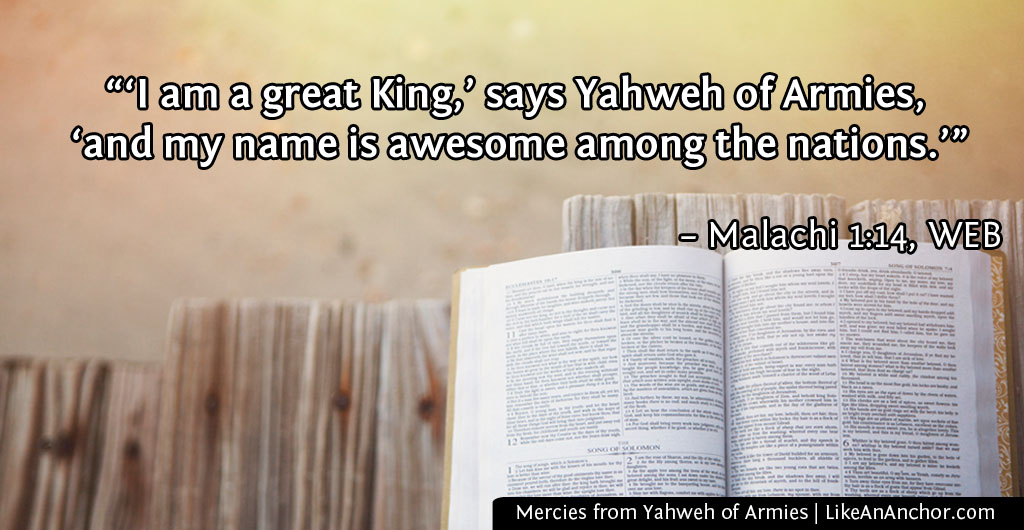
Mercies from Yahweh of Armies | LikeAnAnchor.com
Photo credit: Lamppost Collective via Lightstock

God’s Desire to Forgive

After the death of righteous Josiah, king of Judah, his son Jehohaz reigned for just 3 months before an Egyptian king dethroned him and set up his brother Jehoiakim in his place. This new king “did that which was evil in Yahweh his God’s sight” (2 Chr. 35:25-36:8). At this time, God was actively working through the prophet Jeremiah, and He sent him with a message.

In the fourth year of Jehoiakim the son of Josiah, king of Judah, this word came to Jeremiah from Yahweh, saying, “Take a scroll of a book, and write in it all the words that I have spoken to you against Israel, and against Judah, and against all the nations, from the day I spoke to you, from the days of Josiah, even to this day. It may be that the house of Judah will hear all the evil which I intend to do to them; that they may each return from his evil way; that I may forgive their iniquity and their sin.” (Jer. 36:1-3, all verses quoted from WEB translation unless otherwise noted)

Jeremiah’s prophecies contain warnings, corrections, lessons, and promises. From God’s words here in the passage I just quoted, it seems one of His main goals in sharing all those warnings was to save people from the consequences of their own disobedience.

Read more

Need Something New to Do? Here’s What Hobby You Should Try Based on Your Myers-Briggs® Type

The world is opening back up after quarantines and shelter-in-place orders. Most of us are now free to leave our homes, even though we’re being asked to social distance. Still, things aren’t entirely back to normal and many of us find we have some extra free time on our hands this summer. Large social events like concerts and festivals are canceled, we can’t go to movie theaters, and it might be hard to get together with friends.

Maybe now is a good time to try out a new hobby. I’ve been writing a series of posts for Psychology Junkie about 21 hobbies each Myers-Briggs® type loves. For this post here on my blog, though, I’m just going to suggest one for each type. I’ll skip the more common hobbies like reading, music, and art (which people of every personality type enjoy) and focus on some that are a bit more unique.

The hobby I chose for each type is one that I’ve seen at least one or two people of that type talk about enjoying, though it’s usually not common enough it would appear on a list of top 5 hobbies for that type. My hope is that you’ll find some suggestions you’re intrigued by but haven’t tried yet. Also, don’t hesitate to borrow a hobby suggestion from one of the other types. Who knows; you might find that hobbies other people love give you a fun new experience.

ENFJ — Local Exploration

Many ENFJs enjoy meeting new people, but something you might not have thought of is how much fun it could be to “meet” new places. Travel and exploration is a favorite hobby of some ENFJs, and you can even do that close to home. I’m pretty sure there are at least a few small towns, parks, tourist attractions, or other intriguing locations in your local area that you haven’t explored yet.

INFJ — Target Practice

This is the hobby that surprised me most when I was researching how other INFJs spend their free time. I came across several INFJs talking about how much they enjoyed archery, skeet shooting, and related hobbies. Most mentioned that they shoot at targets rather than going hunting. I guess I shouldn’t have been too surprised considering how intrigued I am by archery. So if you’re an INFJ looking for a new hobby, perhaps you’ll want to give this one a try. Read more

Titles of Jesus Christ: David’s Son

Over and over in the gospels, people cry out to Jesus, “Have mercy on us, you son of David!”

Why is the Messiah’s title as David’s son the one that blind men and a Canaanite woman latched on to as they asked for healing? (Matt. 9:27; 15:22; 20:30-31; Mark 10:46-48; Luke 18:35-39). Why did the people shout, “Hosanna to the son of David!” when Jesus entered Jerusalem, and why did that make the chief priests and the scribes so indignant? (Matt. 21:9, 15; Mark 11:10). What is the significance of this title?

It would be easy to gloss over Jesus’ title as David’s son, simply taking it as fulfillment of a few prophecies that said Messiah (the Hebrew equivalent to “Christ,” which means “anointed”) would come from King David’s descendants. But the Biblical writers treat this as a highly significant fact, and I think it’s worth looking into more closely.

Fulling A Covenant Promise

I’ve talked about the covenant aspect of Jesus being descended from David in several posts already, including “Inheriting Covenants.” The Lord made a covenant with David that He would establish his offspring’s kingdom forever, and that connected with the promise of Messiah (2 Sam. 7:12-15).

Yahweh has sworn to David in truth. He will not turn from it: “I will set the fruit of your body on your throne. If your children will keep my covenant, my testimony that I will teach them, their children also will sit on your throne forever more.” (Ps. 132:11-12, all verses from WEB translation)

David’s descendants eventually fell into disobedience and lost the physical kingdoms of Israel and Judah. But Jesus — a sinless, obedient son of David — inherited the covenant promise. According to Peter, David actually knew that would be the end result of God’s promises to him about his descendants. Read more

Psychology Isn’t Enough, but It Sure Helps: The Need for Personal, Spiritual Growth in Christianity

Someone once asked me if there are any aspects of Myers-Briggs® theory that I disagree with. I told them that my main issues have to do with ways it can be misused rather than with the actual theory. But as much as I like this type theory, I also acknowledge that it’s not a complete system for personal growth or even personality. Myers-Briggs® theory just describes how your mind works by talking about the psychological functions that you use most comfortably.

You can use type theory to help you develop those psychological functions, but they’re still not the whole story of your personality. There are other things we layer on top of that like personality traits, lived experiences, and personal beliefs. The functions are like a canvas we paint on; a foundation for building. They’re not the only things that make us who we are.

One of the dimensions that a system of psychological type does not cover is spirituality. That’s not to say that psychologists like Jung (whose work Myers-Briggs® theory is based on) would have denied there’s an essential spiritual component to humans. Far from it! It’s just that type psychology wasn’t designed to be a path in and of itself for spiritual growth. For that, we need something else.

A Connection Between Psychology and Spirituality

I had the idea to write this post last week, when I was listening to a podcast from Joel Mark Witt and Antonia Dodge of Personality Hacker. They’d recently attended an Enneagram workshop where one of the hosts, Uranio Pae, made the statement, “Spiritual work without psychological work is dangerous. Psychological work without spiritual work is incomplete.”

Read more

Titles of Jesus Christ: Our Peace

I think that when we hear Jesus talked about as “Prince of Peace” or “Our Peace,” we usually think of Him making strife cease. We picture Him setting up a world without war and fixing the strife between human beings and God. Those are definitely part of what’s going on, but there’s also a whole lot more. We can dive deeper into what “peace” means — and gain a deeper understanding of who Jesus is and what He is doing — by studying into the Hebrew word shalom.

Shalom is a key Biblical concept. It occurs over 250 timed in the Old Testament, and that’s not counting related words like shalem. It’s most often translated “peace,” though the King James Version uses about 30 different English words. Those include prosperity (Ps. 35:27), rest (Ps. 38:3), safety (Is. 41:3), using shalom as a salutation or greeting (Judg. 18:15; 1 Sam. 25:5), and in reference to someone’s welfare (Gen. 29:6; Ex. 18:7).

The Hebrew word shalom comes from the root verb shalem, which means “completeness, wholeness, harmony, fulfillment.” That’s all included in shalom as well, along with the English meaning of “peace” as an absence of strife. Also wrapped up in this concept is the implicit “idea of unimpaired relationships with others and fulfillment of one’s undertakings (Theological Wordbook of the Old Testament, by Harris, Archer, and Waltke, entry 2401a). It’s a much more nuanced word than we give it credit for in English translations.

Restitution and Healing

Shalom is wholeness — nothing missing, nothing broken. It is a state that humans don’t end up in naturally. God created us perfect, but we’re now fallen people living in a fallen world. Peace is an elusive thing.

There is no soundness in my flesh because of your indignation, neither is there any shalom in my bones because of my sin. (Ps. 38:3, Hebrew word added, all quotes from WEB translation)

Sin is something we’re all guilty of, and it’s something that causes brokenness. We’re not whole or complete, and the covenants that people of the past made with God are broken by humanity’s sin. If you want to fix something that’s broken, missing, or stolen, God requires restitution (shalem in Hebrew) in order to satisfy the requirements of law (Ex. 22:3, 5-6, 12, 14). In order to fix what is wrong with us, the process of restitution required something on a greater level than animal sacrifice or paying some money.

Read more