Are We “Too Picky”?

If you’re single (and you don’t want to be), you’ve probably asked yourself the question, “Am I being too picky?” There’s got to be a reason why you’re not in a relationship with someone, right? and you’re sure the reason has something to do with you. People of the opposite sex do exist, and if you’re not in a relationship with one of them you might think that 1) you’re not attractive and so they aren’t asking you out, or 2) you’re too picky and so you’re avoiding/turning down relationships with certain people.

As a 25-year-old single woman, I ask myself this question, too. And I’ve been encouraged to do so by much of the relationship advice I’ve read. You might have read some of this, too. I’m talking about those articles that tell girls to tear-up their “perfect man” list and give any decent guy a chance if he asks them out. Which sounds pretty good in theory, but that’s pretty much how two of the three dates I’ve been on were with guys literally old enough to be my father, and the third was with an atheist who obviously didn’t meet my first requirement that a guy I date have a strong, Christian faith.

Now, I’m not saying you should hang onto unrealistic expectations that will leave you like this skeleton over here –> but you do need to have some standards, and you don’t have to feel guilty for insisting people meet those standards. You are under no obligation to “pity date” anyone, or fling yourself at the first living breathing human who shows the slightest bit of interest in you.

“The One”

This weekend, I spent a good bit of time catching up on Boundless.org articles that I’d missed and checking out TrueLoveDates.com. What stood out to me on Boundless was two articles that offer step-by-step guides for men and for women on how to get married. They can both be summed up in the deceptively simple advice “be more attractive.”

Well, thank you Boundless-author. Previous to reading this article I was going for unattractive. I’ll change that now, and dates will magically appear.

Or not.

“What if I meet the one?”

These articles are part of a three-part relationship series. The first article was devoted to debunking the myth of “the one.” I actually agree with most of what he writes in this one — many Christian singles are too passive, waiting for God to drop their perfect match in their lap or hit them with a revelatory bolt of lightning when he or she shows up. But usually when people tell you to stop looking for “the one”/”your soulmate,” they are also telling you “you’re too picky” (also see my article “Why I Still Believe In Soul Mates“).  And I think it’s a little more complicated than this Boundless authors seems to think.

He says that if you’re a guy, there are only two reasons you’re not in a relationship: “1. You’re not asking. 2. No one’s saying yes.” The solutions are equally simple: “Man up” and “Be awesome.”

If you’re a girl, the reasons you’re single are “1. You’re saying “no” a lot” or “2. No one’s asking.” We’re given three things we can do to turn this around: “Demonstrate respect,” “Look good,” and “Be fun.”

Be (at least a little) Picky

Much as I love Boundless, TrueLoveDates.com had much more helpful tips this time. It’s a website run by Christian relationship counselor Debra Fileta. I’m really looking forward to reading more of her blog posts, and eventually her book. She has some great insight into the whole dating vs. courtship thing, but I won’t digress on that topic right now.

Her most recent articles have been 10 Guys You Should NEVER Date, 10 Girls You Should NEVER Date, and The Boyfriend Checklist: 10 Guys You SHOULD Date (I assume her next post will be a girlfriend checklist). They are focused on qualities you should either avoid or look for in a potential boyfriend or girlfriend, and eventually spouse. And they presuppose a certain level of picky-ness — that you won’t settle for Mr. On Again & Off Again, or Ms. Nothin’ In There But Air, or Mr. Sorta Spiritual, or Ms. One-Way-Street.

Even more helpful lists can be found in Fileta’s article What Women Really Want in a Man and What Men Really Want in a Woman. They are great, both for “this is what you should look for” and “this is the kind of person you need to be.” She says women want honesty, purity, strength, compassion, and humility. Men want realness, confidence, beauty, and passion. These aren’t impossible standards, and you really should be “picky” enough not to settle for less.

Love Languages and MBTI Types

Myers-Briggs types have much to tell us about ourselves and other people. Our MBTI type reflects our preferences for crowded parties or small gathering, describes how we connect with other people, shows us how we naturally respond to stress, and gives us a picture of our innate strengths and weaknesses. Another thing it’s often used for is trying to predict what type of person we’ll be attracted to, and most compatible with, in a romantic sense. Unfortunately, MBTI only gives part of the picture in this regard.

Types in Love

Disclaimer: some of the links in this post are affiliate links. This means that, at no additional cost to you, I will receive a commission if you click on the link and make a purchase on that website.

Use of the MBTI for romance is subject to much debate. Isabel Myer wrote in Gifts Differing*, chapter 11, that “it seems only reasonable that the greater mutual understanding between couples with more likeness than difference should lead, on the whole, to greater mutual attraction and esteem.” This was supported by her study of 375 married couples who were most frequently “alike on three of their four preferences rather than on only two, as would be expected by chance.” However, Isabel Myer was an INFP woman happily married to an ISTJ man. According to her own personality theory, they “shouldn’t” have gotten along, especially since she thought that shared S-N preferences were the most important for predicting a couple’s happiness together and understanding of each other. Obviously type isn’t the only important ingredient for happiness.

Elizabeth and Darcy from Pride and Prejudice, an NF – NT couple

David Keirsey’s book Please Understand Me II* agrees with Myers on the importance of S-N pairings, saying that his SP Artisan types are most compatible with SJ Guardians, and that NF Idealists are most compatible with NT rationals. His ideal pairing is someone who shares your S-N preference and is your opposite in the other three preferences. For example, he would pair an INFJ with an ENTP.

Continuing with INFJs as our example, these theories have influenced many INFJ profiles online. Jennifer Soldner’s Guide To INFJ Relationships lists ENFP, ENTP, INTJ and INFJ as the best matches for an INFJ. The worst matches are ESFP, ESTP, ESTJ, and ENTJ (note that this last one contradicts Keirsey’s rule for pairing NF and NT types). For the most part, these suggestions seem logical at first, much like Isabel Myer said when theorizing that people will get along best if they are similar. It doesn’t explain, however, why one study found that INFJs were most likely to marry either INFJs or ESTPs, or why Myers herself was happy married to someone so dissimilar in terms of type. Clearly there’s something else going on here.

The “Something Else”

Even with their generalizations about which types get along most easily together, both Isabel Myers and David Keirsey admit there are other very important ingredients to a lasting romantic relationship.

Individual relationships defy generalizations, and it should be stressed that two well-adjusted people of any two temperaments can find ways of making their marriage work for them.” (Keirsey)

“Understanding, appreciation, and respect make a lifelong marriage possible and good. Similarity of type is not important, except as it leads to these three. Without them, people fall in love and out of love again; with them, a man and woman will become increasingly valuable to each other and know that they are contributing to each other’s lives.” (Myers)

The 5 Love Languages by Gary Chapman

A mutual willingness to work together and actively build-up the relationships is more important than compatible MBTI types. One aspect of this is understanding the other person and learning how to love them. Becoming familiar with their Myers-Briggs type will help tremendously, but it’s not enough by itself. You also benefit from an understanding of Love Languages.

The five love languages theory was first published in 1995 by Gary Chapman, a relationship counselor and pastor. He says every person has a “language” that they use to communicate and receive love, either Words of Affirmation, Quality Time, Receiving Gifts, Acts of Service, or Physical Touch. Everyone has one primary love language, and you might have a secondary love language as well. If someone’s partner is not speaking their love language, they will not feel loved. There’s a test on Chapman’s website if you don’t know what your love language is and want to find out.

Layering Love Languages

In theory, any MBTI type can be combined with any one of the five love languages. I’m guessing, however, that there are some love languages that are more likely for certain MBTI types. Let’s take a quick look at the characteristics for the four type groups as related to different love languages.

SP types are typically concerned with outward, concrete ways of viewing the world, and focus on the here and now. Keirsey describes their preferred role in a romantic relationship as “playmate.” I could see SP types being particularly inclined toward Receiving Gifts, Quality Time, or Physical Touch as a primary love language. These all involve doing something for or with the loved one, which would appeal strongly to SP types.

Duty-fulfilling SJ types tend to play what Keirsey described as a “helpmate” role in relationships. They are stable, traditional, and thoroughly dependable people.  SJ types might be most in tune with Acts of Service, Quality Time or Words of Affirmation as a love language. These love languages visibly or verbally confirm that a SJ’s loved ones appreciate their constant reliability.

NF types are idealistic, enjoy abstract thought, and are natural romantics. Keirsey described their role in a romantic relationship as “soulmate.” They search for deep, genuine connections. Quality Time and Words of Affirmation seem like the most likely love languages, though Physical Touch and Acts of Service are also good possibilities. The key for NF types is genuine depth in a relationship, so they are inclined towards a language that increases emotional intimacy.

The NT types are highly intellectual, and Keirsey described their relationship role as “mindmate.” They are logical, abstract, and have little tolerance for the superficial. Words of Affirmation and Quality Time seem like the most likely love languages for an NT type, but after reading two different forum topics on MBTI types and love languages (one on Typology Central and one on Personality Cafe) I learned many NTs favor Physical Touch as well. My personal theory is that NT types view Service and/or Gifts with suspicion, wondering what the other person wants from them, while the others seem more genuine.

What about you? What are your Myers-Briggs type and love language(s)? Do you see a connection between the two? Share in the comments!

*indicates affiliate links

Why I Still Believe In Soul Mates

There seems to be a movement in some of the Christian relationship blogs I read to debunk the “myth” of soul mates. The argument can be summed up in this quote from Boundless.org’s article Myths About Soul Mates: “Believing that ‘the one’ is out there, waiting to ‘complete you,’ inevitably leads to discontentment and maybe even divorce.” Another of their articles, Hoping for a Soul Mate, quotes Atlanta psychiatrist Frank Pittman as saying, “Nothing has produced more unhappiness than the concept of a soul mate.” If you’re not familiar with these arguments, I encourage you to glance at one or both links before reading on.

click to read article, "Why I Still Believe In Soul Mates" | marissabaker.wordpress.com
Photo Credit: Anne Edgar via StockSnap

Defining “Soul Mate”

Just so we’re all starting out on the same page, here’s a composite definition of what the articles I referenced above seem to mean when they use the term “soul mate”:

A soul mate is your perfect match, who complements all your weaknesses and strengths and loves you unreservedly for who you are. There is only one soul mate for each person, and you’re on a search to find them so they can “complete you.”

These articles say this is an impossible ideal and it becomes dangerous when we start holding the person we’re in a relationship with to impossible and unrealistic expectations. And I do acknowledge this is a danger if we’re focused on the idea of finding one perfect mate (see this scene in Ever After for a humorous example of a few problems which can result).

Given these compelling arguments about the dangers of having an expectation like this in dating, you might be wondering why I’m writing a post about believing in soul mates. I have a slightly different take on the idea of soul mates, though.

My Idea of a Soul Mate

I imagine there are several people out there who have the potential to be our “soul mates.” For me, I think this would look like a relationship where I feel safe sharing my inner thoughts, feelings, and emotions. Someone who can understand, relate to, or at least appreciate the parts of my mind which I so rarely share, and with whom I can connect on a “kindred spirits” level. It almost goes without staying that this kind of connection must have a spiritual/religious component as well — I doubt I could be in this kind of relationship with someone who does not share my faith. I think there’s also a bit of truth in the idea of finding a mate who “completes” you, not in the way that most people might think of it but in the way that God meant when He created a husband and wife to be two parts of a whole.

As I mentioned, in this theory there are multiple people with whom the potential exists for forming a soul mate connection. You might meet several, but your goal should be that your relationships only reach a “soul mate level” with one of these people. I suspect that there’s a point in a good relationship where the other potential soul mates no longer matter because a “sole soul mate” relationship has been forged.

This is where the idea of commitment comes in. Once you choose to marry someone, you’re also choosing to cultivate  a soul mate relationship only with them (the first article I linked to actually touches on this point). This is also why can be dangerous to form deep emotional intimacies with someone of the opposite sex who you don’t intend to marry (or whom you’re not sure yet if you will marry) — sharing your heart without the promise of commitment to a sole soul mate relationship seems like a good way to get your heart broken.

click to read article, "Why I Still Believe In Soul Mates" | marissabaker.wordpress.com
Photo Credit: Andrew Welch via StockSnap

Personality Theory

I’m sure not everyone will agree with this idea, and really I don’t expect them to. There’s so much variation in our individual personalities, tastes and ideas that it seems ridiculous to expect everyone to want and expect the same thing from a romantic relationship.

Jane Eyre (INFJ) and Edward Rochester (ENTP or ENTJ)

When David Keirsey wrote his personality theories based on Myers-Briggs, he suggested that each of his four personality groups would be looking for, and be, a different kind of romantic partner. He describes the Artisans (Myers’ SP types) as Playmates, who are “exciting and fun” and usually end up married to Guardians (SJ types), who are looking to fill a Helpmate role. Rationals (NT types) want a Mindmate with whom they can have intellectual discussions and explore “abstract rather than concrete” ideas. They often marry the Idealists (NF types, like my INFJ personality), who are searching for Soulmates.

What Idealists wish for in their spouse is a Soulmate, a spouse who knows their feelings without being told of them, and who spontaneously expresses words of endearment, words that acknowledge their mate’s unique identity. Idealists want the marital relationship to be, as they put it, “deep and meaningful,” Other types will settle for much less than this.  … suffice it to say that Idealists are asking their spouses for something most of them do no understand and do not know how to give. (Please Understand Me II, p.146)

Well, that sounds depressingly unattainable. Honestly, when I was reading this book the first time the beginning of this paragraph had me nodding and thinking it sounded exactly just right, but that final sentence is really discouraging. Still, I don’t think I have such unrealistic expectations as Keirsey describes Idealists as having in other parts of his book (though it does sound idyllic). Maybe he’s right and 80-85% of the population will tell me I’m crazy to hope for a “soul mate.” But hopefully someday I’ll be able to say, like the bride in Song of Songs, “I found him whom my soul loves” (Song. 3:4, WEB).


Click here to check out my e-book, The INFJ Handbook, for more information and insight into the INFJ personality type
Available in the Amazon Kindle Store

Save

Save

Save

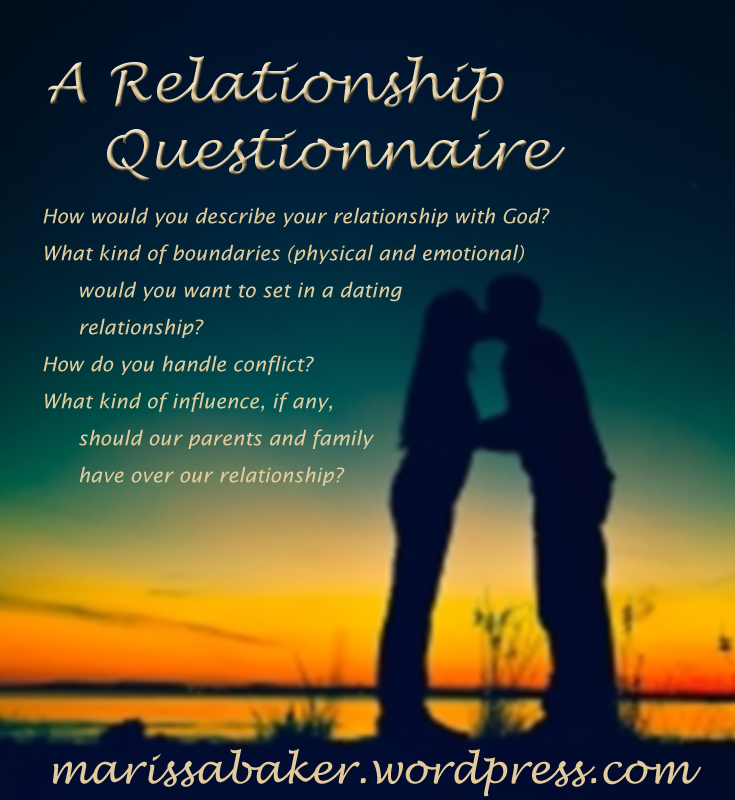
A Relationship Questionnaire

A Relationship "Questionnaire" by marissabaker.wordpress.com

I was talking with a friend some weekends ago about items we have on our “future husband” and “potential boyfriend” lists. We were saying how it would be nice if we could find out more easily whether or not a guy was someone we would like to date before we agreed to go out with him, and I suggested (half-jokingly) “I say we prepare a detailed questionnaire for potential boyfriends and ask for at least 3 character references.” The more we talked about it, the better the idea sounded. After all, when you apply for a job, you have to answer a whole series of questions and you’re expected to provide references that can attest to your good character. Relationships are more important, and hopefully more permanent, so why wouldn’t we give as much consideration to finding out whether or not someone is right for you and you are right for them?

On the other hand, I’ve talked to more than one girl who was approached by a guy who was clearly working his way through a list of questions as they talked. They felt like they could see him putting mental check-marks down as he covered each topic. Ew … that’s creepy! We certainly don’t want to end up like that.

Non-creepy Questions

As I continued to think about this idea, I realized it would be less helpful to run people through a “prefect person checklist” than to have some kind of guideline for clarifying what we need in a relationship. There are certain things I think of as non-negotiable, such as a having a relationship with God. If I don’t clarify what that means to me before I meet someone, though, I might find myself making excuses for a guy because I like him, even if his beliefs differ from mine on significant points.

Before our conversation about surveying boyfriends, I came across something titled “My Little Book of Whether Or Not He’s Worth It” by Brittany Baily. There is much to like about her points, particularly her emphasis on not settling for a guy who treats you with disrespect. But I feel this kind of guide misses two very important things: 1) it ignores the importance faith plays in a relationship, and 2) it focuses entirely on what I need/want in a relationship. For my list, I wanted to address the need to have God as the center of your relationship, as well as the fact that a relationship can’t be all about what you want — you also have to think of the other person’s needs and be the kind of person they are looking for.

I’ve presented my list in a questionnaire form, mostly because of the conversation which prompted this post. I would advise against actually passing them out to potential boyfriends or girlfriends (but if you do, be sure to let me know how it goes!). Think of it as a guide to learning important things about the person you are considering, or in, a relationship with. You might want to fill one out with the answers you think you would like a potential dating partner to fill-in, and then answer one for yourself. Would your ideal match like the way you filled out your survey? If you meet someone who would answer one of these questions differently than you think you would like, will you be irritated by that or learn to live with it?

Relationship Questionnaire

Spiritual

  • How would you describe your relationship with God? (you can’t expect someone to love you the way you deserve/need/want to be loved if they do not love God even more than they love you)
  • What do you consider a good amount of time to spend in prayer and study on a daily basis? (how much time they give to God is an indication of whether or not they are worth your time)
  • How important is fellowship with other believers to you? What influences your decisions about which church group(s) to attend?

Relational

  • What kind of boundaries (physical and emotional) would you want to set in a dating relationship?
  • How much time do you envision spending together in person, online, or on the phone while dating? Will you write letters and/or emails?
  • What would make you mistrust someone you were dating?
  • Why didn’t your previous relationships work out?
  • How do you handle money? Are you a spender? a saver? some other money personality?

Personal

  • Are you typically introverted or extroverted? would you be comfortable spending time with someone who is more introverted/extroverted than you are?
  • How do you express anger?
  • How do you handle conflict?
  • Do you know what your primary love language is?
  • Is there anything in your past that you wouldn’t want to tell someone you just started dating, but probably should before you get married?
  • What do you consider your positive characteristics?
  • What do you consider your negative characteristics?

Family

  • Do you want kids? How many? Would you consider adoption, and if so under what circumstances?
  • If you want kids, how would you like to educate them? Home school? Public school? Private school?
  • Would kids be encouraged to pursue higher education, if that’s what they want?
  • What do you consider appropriate discipline for young children? for teenagers?
  • Is it important to live near the extended family? Why or why not?
  • What kind of influence, if any, should our parents and family have over our relationship?
  • Are you closer to your mother or to your father? Why?

One Last Note

I hope you find these helpful. Feel free to add suggestions — I can continue to edit this based on feedback.

I also want to add that I talked about these questions with the friend who first gave me the idea, and requested feedback from a couple who has been happily married for almost 27 years — my parents. I’ve also been reading  about psychology, love, and relationships for years, and drew upon that information for some of these points.