Sometimes, we see something in scripture that we really like. A specific word or phrase in a specific translation speaks to us, and we get excited about that phrase. For example, in the KJV Proverbs 29:18 says, “Where there is no vision the people perish.” I’ve heard quite a few people use that to say that if we can’t visualize our end goal, we’ll fail. But more modern translations often say something like “prophecy” (LEB), “prophetic vision” (NET), or “revelation” (WEB) because those are closer to the meaning of the Hebrew word chazon (H2377). “Vision” was a perfectly good translation of chazon in 1611 (in the sense of “I’ve seen a vision”), but English meanings have shifted enough that it’s no longer the best word to use and can lead to misinterpretation.
I recently came across another verse where something similar happened. In Amos 7, English translations typically talk about a “plumb line” that God placed in the midst of His people Israel. It’s an analogy that many like. A plumb line is “a line (as of cord) that has at one end a weight (such as a plumb bob) and is used especially to determine verticality” (Merriam-Webster). People have taken this analogy and run with it, and you can find dozens of articles and sermons talking about God’s plumb line and wondering if we measure up. But when I read this passage in the New English Translation, they used the word “tin” instead. It’s such a dramatically different translation that I dug into it more to see how that happened and to try and figure out what Amos 7 means.
How Did We Get to “Pumb Line?”
First, let’s take a look at the Bible verses in question. Here is how it reads in a translation that uses plumb line:
Thus he showed me and behold, the Lord stood beside a wall made by a plumb line, with a plumb line in his hand. Yahweh said to me, “Amos, what do you see?”
I said, “A plumb line.”
Then the Lord said, “Behold, I will set a plumb line in the middle of my people Israel. I will not again pass by them any more. The high places of Isaac will be desolate, the sanctuaries of Israel will be laid waste; and I will rise against the house of Jeroboam with the sword.”
Amos 7:7-9, WEB
And here it is in the New English Translation:
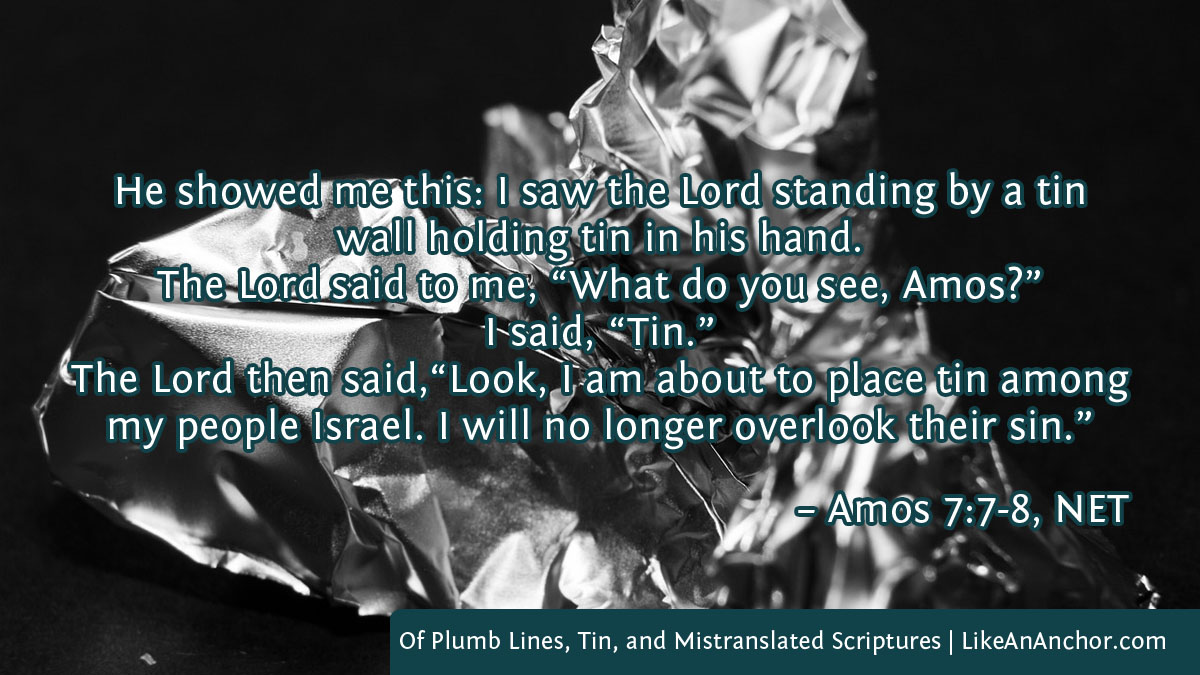
He showed me this: I saw the Lord standing by a tin wall holding tin in his hand. The Lord said to me, “What do you see, Amos?” I said, “Tin.” The Lord then said,
“Look, I am about to place tin among my people Israel.
Amos 7:7-9, NET
I will no longer overlook their sin.
Isaac’s centers of worship will become desolate;
Israel’s holy places will be in ruins.
I will attack Jeroboam’s dynasty with the sword.”
Obviously, these are two very different translations that lead to very different interpretations of this verse. Thankfully, the NET is very good about documenting the translators’ choices and sharing the reasoning behind them in footnotes. Here’s part of what they say about the tin vs. plumb line translation:
The Hebrew word אֲנָךְ (ʾanakh), “tin,” occurs only in this passage (twice in verse 7 and twice in verse 8). The meaning “tin” is based on its Akkadian cognate annaku. The traditional interpretation of these verses (reflected in many English versions) assumed that אֲנָךְ meant “lead.” Since lead might be used for a plumb line, and a plumb line might be used when building wall, the “lead” wall was assumed to be a wall built “true to plumb” while God holds a “lead” weighted plumb line in his hand. In this view the plumb line represents a standard of evaluation. This understanding developed before Akkadian was deciphered and the type of metal clearly identified for annaku. (In Hebrew “lead” is עֹפֶרֶת; ʿoferet.)
NET footnote on Amos 7:7
One of my go-to Hebrew dictionaries confirms that the “plumb line” translation is based on the assumption that anak means “plummet, plumb, lead-weight” (BDB; H594). It still seems like quite a leap to go from a word that you think means “lead” to translating it as “plumb line.” I guess translators didn’t think lead on its own made sense, so they tried to think of what lead might be used for in the context of a wall. Since lead weights could be used on plumb lines, and plumb lines would be used to make a wall vertical, we ended up with the plumb line translation in Amos 7. But then scholars did more work with the Akkadian language and learned the Hebrew anak most likely means “tin” instead of “lead.” Now we’re back to the problem of figuring out why God would give a prophet a vision of God holding a relatively soft type of metal while standing next to a wall made of the same metal, then say He’s going to put that metal in the midst of His people.
What Might “Tin” Mean?
If “plumb line” changes to “tin,” then the traditional interpretations of this scripture don’t make sense anymore. Assuming that “tin” is the correct translation, what could it mean? The NET footnote suggests a few possibilities:
Some view the tin wall and piece of tin as symbolic. If the tin wall of the vision symbolizes Israel, it may suggest weakness and vulnerability to judgment. … Their citadels, of which the nation was so proud and confident, are nothing more than tin fortresses. Various proposals depend on selecting some quality about tin and suggesting a role for that in this context. However, it is more likely that this is a case of a sound play like the next vision in Amos 8:1-2 (see also Jer 1:11-14). With the presentation technique of a sound play, the vision is not the prophecy, only the occasion for the prophecy. God gets the prophet to say a certain sound and then spins the prophecy off that. See the note at 7:8.
NET footnote on Amos 7:7
The sound play isn’t something you can easily translate, so it’s hard to see it when we read Amos in English. The NET translators hint at it by rhyming “tin” with “sin” (“Look, I am about to place tin among my people Israel. I will no longer overlook their sin” [Amos 7:8, NET]), but it’s still not obvious unless you either read Hebrew or have resources like the NET Bible to point out what’s happening in the original language.
While the sound play does sound like a reasonable explanation, the possible interpretation linked to characteristics of tin also makes sense in context. Amos 7:7-9 is just one of three visions that the Lord shows Amos in sequence. The first two both involve Yahweh revealing a judgement against Israel, first a plague of locusts and then one of consuming fire. Both times, Amos begs for a reprieve because Israel is too “small” or “weak” to withstand such punishment. Both times, Yahweh decides not to use that punishment (Amos 7:1-6). It could be that the weakness of tin is linked with the weakness that Amos identifies in Israel. Though Israel is weak, the Lord “will no longer overlook their sin” and eventually the holy places and kings will be destroyed (Amos 7:7-9).
Are There Any “Plumb Line” Scriptures?
If you really liked the “plum line” analogy, you might find it disappointing to learn about the “tin” translation. But there is one other verse where “plumb line” is a good translation.
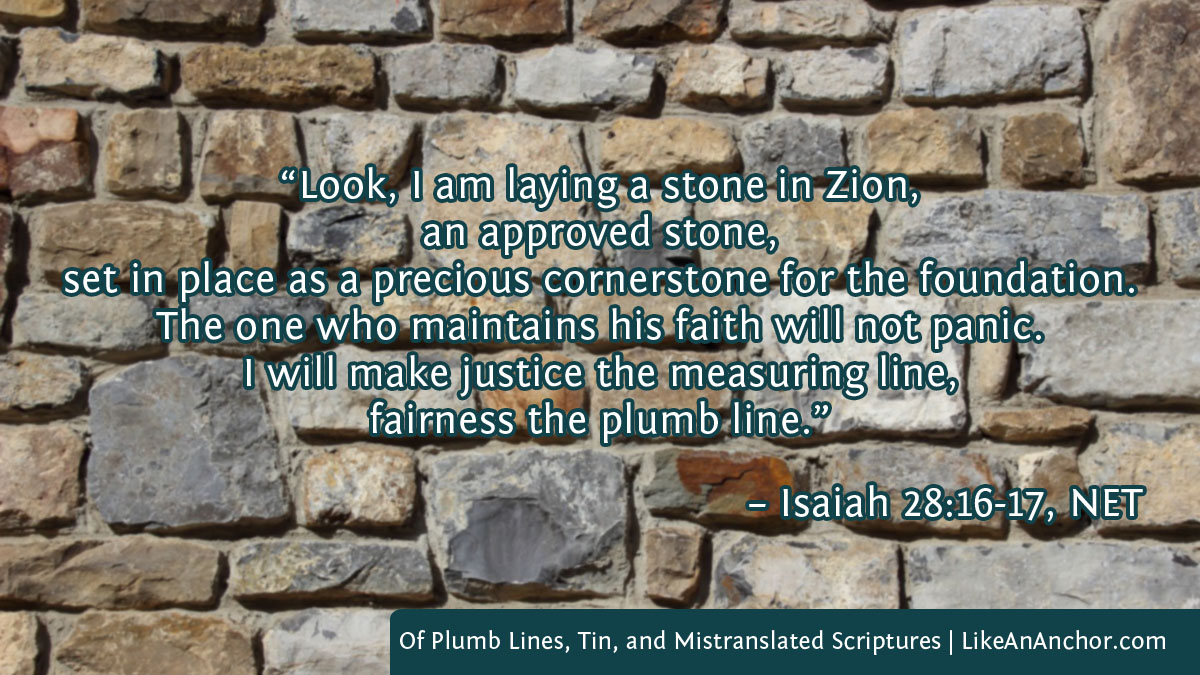
Therefore the Lord Yahweh says, “Behold, I lay in Zion for a foundation a stone, a tried stone, a precious cornerstone of a sure foundation. He who believes shall not act hastily. I will make justice the measuring line, and righteousness the plumb line. The hail will sweep away the refuge of lies, and the waters will overflow the hiding place.”
Isaiah 28:16-17, WEB
Here, “plumb line” is translated from mishqeleth. It means “level, leveling tool or instrument, plummet” (BDB; H4949). It’s a tool used in building, which makes sense because the context is Yahweh laying the Messiah as the foundation stone for the house He planned to build with the New Covenant church (Eph. 2:20; 1 Pet. 2:5-7).
Yahweh measures the house He’s building using instruments of justice and righteousness. We can still say that He places a plumb line in His people and expects us to measure up to His standards; we just shouldn’t use Amos 7 as the scriptural support for that idea.
As we discussed last week, all scripture is God-breathed. Sometimes, though, the involvement of fallible human beings–or even just the natural evolution of language–can muddy the meaning, especially in translation. If we learn that there’s a more accurate translation of a scripture that’s closer to the original intent, then that’s the one we should go with. We shouldn’t just accept any new interpretation blindly, but with careful investigation and prayer it’s usually possible to discern which translation(s) are more accurate when there’s a significant difference between them.
Featured image by Cloé Gérard from Pixabay

Song Recommendation: “Word of God Speak” by MercyMe



 Like An Anchor