Fictional MBTI – Steve Rogers (ISFJ)

This was requested in the comments on Fictional MBTI – Loki, and since I went to see Captain America: The Winter Soldier on Friday it seemed a good time to write a post about Steve Rogers/Captain America. Incidentally, I will reference Winter Soldier in this post but will try to keep it spoiler-free. If you don’t want to know anything about the plot, though, go watch the film and then come back 🙂

In support of typing Steve as an ISFJ, I’ll be citing quotes from Captain America, The Winter Soldier, Gifts Differing* by Isabel Myers, and Was That Really Me?* by Naomi L. Quenk.

  • Disclaimer: links marked with an * are affiliate links. This means that, at no additional cost to you, I will receive a commission if you click on the link and make a purchase on that website.

Introverted Sensing

Isabel Myers describes the Introverted Sensing (Si) types – both ISFJ and ISTJ — as “remarkably dependable … they base their ideas on a deep, solid accumulation of stored impressions, which gives them some almost unshakable ideas” (102). For Steve Rogers, this resulted in the attitude that earned him consideration in Dr. Abraham Erskine’s experiment — “I don’t want to kill anyone. I don’t like bullies; I don’t care where they’re from” (Captain America). The same deeply rooted ideas that form his character also gave Steve the conviction to stand-up to Nick Fury when asked to compromise his values to create a “safe” world — “This isn’t freedom; it’s fear” (Winter Soldier).

In the right person, the traits of Si are perfect for military command. Si types are extremely stable, not entering “into things impulsively” and, “once in, they are very hard to distract, discourage, or stop” (Myers 102). When convinced he is in the right, Captain America is an unstoppable force, whether he is performing a one-man rescue mission in WWII or leading a team against Hydra.

Since Si is an introverted function, there are aspects of their private reactions that ISFJs usually keep to themselves. Only when they feel “off duty” and are around people they trust will they share insights into their unique way of viewing the world. These impressions “may be absurd, irreverent, touching, or hilarious, but never predictable, because their way of sensing life is intensely individual” (Myers 103). Steve tends to joke before going on missions, such as his dialog with Peggy Carter before he parachutes behind enemy lines in Captain America, and that scene from the beginning of Winter Soldier (which is also in the trailer) when he says he doesn’t anything to do on Saturday night because his barbershop quartet is dead.

Extroverted Feeling

Fictional MBTI - Steve Rogers. Captain America is an ISFJ. marissabaker.wordpress.com

Though an auxilary function, Extroverted Feeling (Fe) is the most easily visible aspect of an ISFJ. Heavily informed by dominant Si, this manifests in ISFJs as an emphasis on “loyalty, consideration, and the common welfare” (Myers 104). Myers also says that a well-balanced ISFJ will be very hard working and more practical than a typical introvert. They also “carry responsibility well,” though they do not necessarily enjoy leadership (102).

Fe is a social function, to the point that some introverts who use Fe may be mistaken for extroverts (this explains why you’ll sometimes see Steve typed as an ESFJ). It adapts to situations and strives to act in a way that is acceptable to as many people as possible. An ISTJ probably wouldn’t have agreed to become the “star-spangled man with a plan,” but ISFJ Steve was convinced that was how he could best serve his country. He stuck with that role up until it conflicted with his deeply held Si convictions. In this aspect, ISFJs resemble INFJS, in that both will try to please others for as long as possible without compromising their ideas.

Thinking

Psychologists disagree about whether or not the tertiary function should be described as “introverted” or “extroverted” (so it’s opposite of the auxiliary function), or simply listed by itself. Whichever the case, Jung says that this third function is under conscious control to some degree as it supports the auxiliary function (Quenk 33, 51). For an ISFJ, tertiary thinking helps with clarity in crisis situations, strategy and logic, and suspending feeling to evaluate other people’s actions. We can see this any time Captain America is planning something strategic, as he sorts through sensing data and comes up with a plan.

Extroverted Intuition

Fictional MBTI - Steve Rogers. Captain America is an ISFJ. marissabaker.wordpress.com

All dominant sensing type are uncomfortable with intuition, and highly skeptical of unverified facts. They can’t consciously access their inferior, or shadow, function of Extroverted Intuition (Ne) and are made uneasy by it. In every day life, this comes out as a general sense of worry and a skepticism about new ideas. This can be useful for detecting flaws in new proposals and warning about negative possibilities, which Steve does quite often in The Avengers. For ISFJs to become comfortable with something new and unexpected, they need time alone to process, such as Steve hiding from the world in The Avengers until he feel needed again and has had time to come to terms with his time displacement.

Anger is a typical response for ISFJs, particularly ISFJ men, when stressed. Stress can also cause ISFJs to become more outspoken, “irritable, and pessimistic” (Quenk 220). They are likely to feel a “loss of control over facts and data,” become more impulsive, and focus on worst-case scenarios (Quenk 221).

Stress triggers for inferior Ne include people whose types use intuition as a dominant function (such as Tony Stark/Iron Man), noisy and disorganized environments, unsubstantiated statements from authority figures, “not having sufficient information to do a good job,” and delays in goal achievement (Quenk 219). These last three triggers play a major role in the opening events of Winter Soldier, when Steve becomes angry that Nick Fury didn’t give him all the information about a rescue mission.


If you enjoyed this post, check out my other MCU typings:

Bucky Barns – ESTP

Loki – INFJ

Scott Lang -ISFP

T’Challa – ISFP

Thor – ESTP

Tony Stark – ENTP

Save

Save

Save

Save

Fictional MBTI — Neal Caffrey (ESTP)

Season 4 of White Collar is now on DVD, which means it’s on Netflix, which means I’m finally catching up on episodes. White Collar is probably my favorite crime drama (the only other candidates are NCIS: LA and Castle, and I haven’t liked them as well lately), and I’m fascinated by the characters.

When I first read David Keirsey’s Please Understand Me II chapter on Artisans, I was thinking of Neal Caffrey from White Collar even before Keirsey mentioned that most con-men were extroverted SP types (though of course most SP types [about 30-35% of the population] are not con-men). A hunch like that isn’t enough to type a fictional character, but it’s a good place to start.

Why SP?

Like Loki, typing Neal is complicated by his criminal behavior and possible psychopathy. I have not seen his Myers-Briggs type discussed often, and most of the ones I have seen type him an ENTJ or an ENFP. Since my decision to place him as a sensor instead of intuitive is apparently unpopular, I’d like to address why. While he does go with his “gut feeling” sometimes and rely on intuition, he does not display classic NF qualities like valuing personal authenticity, a focus on lasting emotional connections, and preoccupation with personal journeys. I could almost see him as an NT, but his problem solving abilities seem more focused on real-world results (a Sensing attribute) than on the abstract ideas behind the problems (an Intuitive trait).

The core characteristics Keirsey uses to describe Artisans are these (quoted from his website):

  • Artisans tend to be fun-loving, optimistic, realistic, and focused on the here and now.
  • Artisans pride themselves on being unconventional, bold, and spontaneous.
  • Artisans make playful mates, creative parents, and troubleshooting leaders.
  • Artisans are excitable, trust their impulses, want to make a splash, seek stimulation, prize freedom, and dream of mastering action skills.

Extroverted Sensing

Fictional MBTI: Neal Caffrey -- marissabaker.wordpress.comNow that I’ve narrowed Neal down to one of four types (ESFP, ISFP, ESTP, or ISTP), I want to switch from Keirsey’s approach to cognitive functions (which is too elaborate a subject to go into here. If you want background info, see this article).  I’ve settled on ESTP for Neal, which gives him this function stack:

  • Dominant: Extraverted Sensing (Se)
  • Auxiliary: Introverted Thinking (Ti)
  • Tertiary: Extraverted Feeling (Fe)
  • Inferior: Introverted Intuition (Ni)

Note: For the remainder of this post, I rely heavily on Keirsey’s Portrait of The Promoter, and Dr. A.J. Drenth’s ESTP Personality Profile.

Extroverted Sensing types (ESxPs) are life-of-the-party people. They enjoy presenting themselves well (for example, Neal’s expensive taste in clothing), and are generally seen as charming (that Neal fits this description goes without saying if you’ve watched the show). Se types are easily bored by routine, and actively seek out new sensory experiences (such as fine dining, romance, and [in Neal’s case] running a con). They like to take action, accomplish tasks, and experience the world. Keirsey describes them as a risk-taking type.

Introverted Thinking

Fictional MBTI: Neal Caffrey -- marissabaker.wordpress.comI’ve settled on Introverted Thinking instead of Feeling for Neal’s auxiliary function because of his gift for planning and how serious he becomes when he has to stop and think instead of just being free to act. It is one reason he is such a successful criminal, and why he is so valuable to the FBI. Dr. Drenth phrases it this way:

The fluid nature of their Ti, combined with the keen observational powers of their Se, contributes to ESTPs’ acumen as practical problem solvers. ESTPs can analyze a situation, diagnose the problem, and then determine how to fix it.

You can see examples of Neal’s thinking function in most episodes, as he responds to problems that arise by thinking and planning. Primarily, he approaches problem-solving from a perspective of getting things done efficiently (as opposed to worrying about how each option will affect people involved).

Relationships

Farther down the function stack, and less conciously available, is Extroverted Feeling. The typical ESTP does not like to share their judgments or true feelings. Keirsey says, “While they live in the moment and lend excitement – and unpredictability – to all their relationships, they rarely let anyone get really close to them.” Even when Neal does open up to people and form bonds with them (like his friendship with Peter), he is still able to run off to a tropical island and smoothly settle into a new life (though it only lasted for one episode in the fourth season).

So, what do you think? Does Neal fit the profile of an ESTP? Is there another type you think fits him better (maybe you have an argument for him as an iNtuitive)?

Fictional MBTI — Loki

Update: Click here for a newer post about Loki with a more complete type analysis.

Over the past couple weeks, without even looking for them, I’ve stumbled upon two blogs talking about Myers-Briggs types for fictional characters. One is a Tumbler called MBTI in Fiction. The other is a blog titled A Little Bit of Personality, with a series of posts analyzing heroic archetypes.

I’ve been intrigued by the characters each of these writers choose to type as INFJs. Neither of these writer’s are INFJs themselves (the writer from “MBTI in Fiction” is an ENTJ and the writer of “A Little Bit of Personality” is an ENTP), and it’s interesting to see who non-INFJs think are INFJs. I don’t always agree with them, but it’s interesting.

Loki

Fictional INFJs -- Loki. marissabaker.wordpress.comThis was the first post I saw from MBTI in Fiction. My initial reaction was, “There’s no way Loki and I have the same personality type.” But I agree that he’s an introvert, and I don’t think he’s logical or grounded enough to be either an S or a T type, so that leaves us with INFJ or INFP. (Some people type him as an INTJ Mastermind, but he seems to rely on Extroverted Feeling more than Extroverted Thinking as a function).

Both INFJs and INFPs feel everything very deeply and trust their intuition. However, INFPs tend to keep their emotions to themselves, though feelings will inform all their actions. Outwardly, they appear “receptive and non-judgmental.” INFJs prefer to approach the world through Introverted Intuition (Ni), followed by Extroverted Feeling (Fe). They are the rarest type, often question their sanity,  rely strongly on their intuitions about people, and tend to talk about their feelings. Dr. A.J. Drenth’s profile includes this descriptions, which I think sounds a lot like Loki (as played by Tom Hiddleston in The Avengers):

INFJs are far less serious inwardly than they may appear outwardly. Their inner world is well described as playful, imaginative, colorful, mischievous, and daring. Characterized by Perceiving rather than Judging, it is far less controlled and regulated than that of INFPs. INFJs love playing with ideas, perspectives, theories, images, symbols, and metaphors.

Another reason I’ve been won-over to typing Loki as an INFJ is because of the description of INFJ villains on A Little Bit of Personality’s page. It really does sound like Loki, and the last line hits a little too close to home for me to brush this analysis off as written by someone who just doesn’t understand INFJs.

When turned to villainy, the INFJ is *creepy*! There isn’t really any other word for it. Dark Paladins are the best of manipulators because they are incredibly intuitive about people and can apply their mild-manneredness to going under the radar as long as they need to, manipulating others who would never suspect them. Because they are so good at this and *know* it, pure-hearted INFJ’s often wonder if they are secretly evil and manipulative at heart, like one day they’ll wake up and realize they were bad all along.

Future Posts?

I was planning on covering several characters, but after I started writing Loki I decided one would be enough for a single post. Maybe I’ll write more at some other time, if anyone is interested. Are there any characters you’ve been thinking are INFJs? Would you be interested in me typing non-INFJ characters?

Save

Writing Heroines

Last week, I wrote a post about the eight hero archetypes listed in The Complete Writer’s Guide to Heroes and Heroines: Sixteen Master ArchetypesI’ve used this book extensively since I discovered it in the library, and I’ve found it a great help in crafting dynamic characters. Characters I wrote before reading it even fit in the archetypes, which I’m taking as a sign that I was on the right track with character development. For these characters, the descriptions have helped me edit them to be stronger and more consistent.

If you’re a writer and you can find a copy of the book, I highly recommend using it. If not, here’s a brief overview of each description for the eight female archetypes. All the quotes below are from the descriptions in the book.

Heroine Archetypes

Heroine ArchetypesThe Boss

This is a strong, tough character who wants to win at all costs. Typically, such a character always got her own way growing up and wants that to continue. “She will shade the truth in order to gain her objective and she is not above manipulating circumstances to make things go her way.”

The Seductress

Assertive, strong, and clever, this type of character learned at a young age she could charm people into doing what she wanted. She is cynical, driven, manipulative. “Her true desires and motives are carefully concealed behind a sensual smile. Knowledge is power, so she makes sure no one knows her” and instinctively distrusts people.

The Spunky Kid

This is the “heroine underdog.” She has a sense of humor and is reliable, supportive, unassuming, and skeptical. Sometimes, she “hides behind her sarcastic wit, and her lack of confidence may make her play down her best attributes, but she is spirited, cheerful and the most loyal of friends.”

The Free Spirit

Sincere, upbeat, and imaginative, this type of character can also be impulsive, meddling, and undisciplined. They have a strong sense of individuality and never plan anything, but always seem to land on their feet.  She is a natural entertainer, and “may be a handful for anyone who has to deal with her, but she makes the experience worthwhile in her zany, high-spirited way.”

The Waif

This character is trusting, easily influenced, kind, and insecure. She inspires others to want to save her, and is generally content to let herself be rescued. “Her delicate fragility makes her an easy target … [and] she adapts to any situation she falls into without complaint.” You’re far less likely to see her in fiction of today than the other archetypes, but that does not mean she should be avoided.

There is something refreshing about a heroine who does not talk back or fight every battle, but rather, allows a man to be a man and believes that if left well enough alone, situations will resolve themselves.

The Librarian

This type of character likes to organize everything. She is efficient, serious, dependable, rigid, repressed, and a perfectionist. She assumes she has all the answers and, “more often than not, she is right, but she can be a bit stubborn about considering other opinions.” She is also portrayed as having a passionate side when she “lets her hair down.”

The Crusader

“This is a heroine in the truest sense — deeds of valor are right up her alley.” She is courageous, resolute, and persuasive. Her flaws include obstinacy, rashness, and being outspokenly opinionated. She wants to set the word straight and “has no faith in the intrinsic merit of human nature; no belief that all will end well if left alone.”

The Nurturer

A character of this type needs to be needed. She is optimistic, capable, idealistic, self-sacrificing, and willing to compromise so she won’t hurt anyone’s feelings. Before thinking of herself, “she makes sure that all her loved ones are happy and content … Her serene, capable and patient manner invariably soothes troubled souls or hurting hearts.”

Writing Characters

There are three approaches to using these archetypes to create characters. A character could be a “core archetype,” fitting into a singe archetype and remaining consistent through the course of the story. Characters can also evolve, changing from one archetype to another because of the events of the story. Layered characters have elements of two archetypes, which may take turns being dominant but will not change over the course of the story.

An example of evolving archetypes is the Beast in Beauty and the Beast, who changes from a Lost Soul into a Chief as a result of Belle’s nurturing character. Layered characters include MacGyver (Warrior and Professor), Eliza Doolittle in My Fair Lady (Waif and Spunky Kid), and Princess Leia (Boss and Crusader).

I hope you’ve enjoyed reading about these character types, and that it sparks an idea for your own writing (or at least provided some interesting reading while procrastinating from writing 😉 ).

Still No Oven / Hero Archetypes

Since I am still without an oven, I’m going to depart from my schedule and post something other than a recipe today. The repairman is supposed to come this afternoon so, in lieu of writing about food, I’m going to write about writing.

Over on MarisMcKay.com, I’ve been working on a series of blog posts about character archetypes. I’ve spent too much time on the accompanying images not to try and broaden the audience, so this post will be devoted to heroes and I’ll dedicate Monday’s post to heroines. While collecting the examples of each type, I noticed sci-fi/fantasy may be overrepresented, but that’s what I’m most familiar with and I’ve decided not to apologize for it.

This theory of character development is contained in a book titled The Complete Writer’s Guide to Heroes and Heroines: Sixteen Master Archetypes. The ideas are based on Jung’s theory of collective unconscious. He identified major archetypes that arise from memories of shared human experience and serve as models for personalities.  For this book, the authors suppose that

 At the very core of a character, every hero can be traced back to one of eight major archetypes, as can every heroine. The core archetype tells the writer the most basic instincts of heroes or heroines — how they think and feel, what drives them and how they reach their goals.

Hero Archetypes
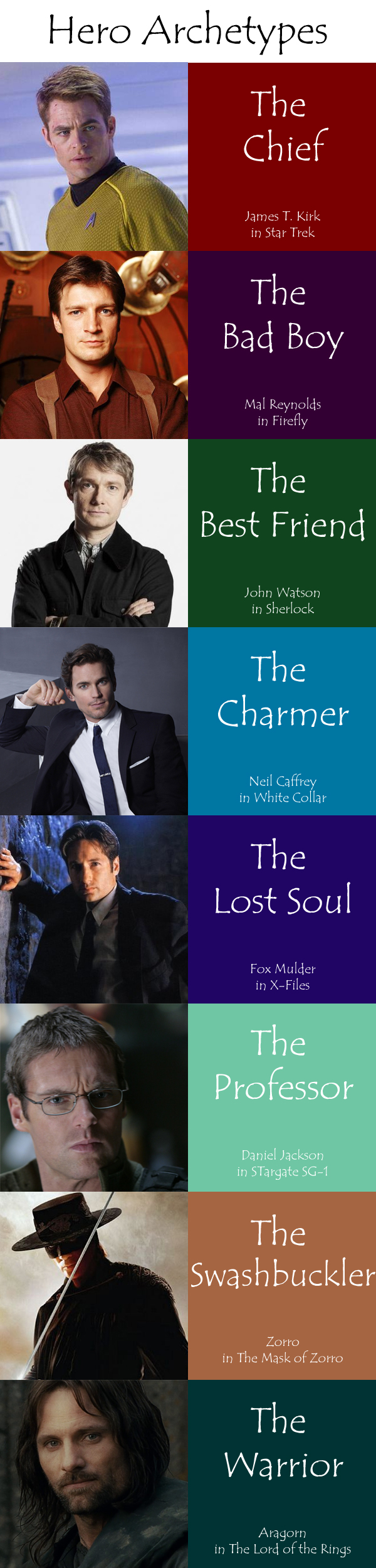
Eight hero archetypesThe Chief His major virtues are that he is goal-oriented, decisive, and responsible. He can also be stubborn, unsympathetic, and dominating. “He is a man who seizes control whenever possible. Active, dynamic, and strong-willed, he urgently needs to fix problems and produce results.” This type of character is not discouraged by challenge, and is typically a born leader or a conqueror type of character.

The Bad Boy This type is succinctly described as “every schoolgirl’s fantasy and every father’s nightmare.” He is typically charismatic, street smart, and intuitive, but is also pessimistic, bitter, and volatile. This character “struts into every room, daring one and all to knock the chip from his shoulder. … All his life, he has been pointed out as a bad example, so he does his best to maintain that reputation.”

The Best Friend “Decent, kind and responsible … He fits in everywhere and is universally liked. Whether he operates out of a sense of duty or genuinely enjoys giving of himself, he is always there.” His main virtues are stability, a supportive nature, and tolerance. His flaws are that he can be complacent, myopic, and unassertive.

The Charmer This is the likable rogue type who can “make you believe in fairy tales” but “is not always there in the ever-after”. He is creative, witty, and smooth, but also manipulative, irresponsible, and elusive.  “Exuding enormous charisma, he showers the people in his life with gifts of laughter and happiness. He is always fun, often irresistible, and frequently unreliable.”

The Lost Soul This character is devoted, vulnerable, discerning, brooding, unforgiving, and fatalistic. He is defined by an isolating event from his past. He “drifts through life with a heavy heart and a wounded spirit. He is dramatic, intriguing, and secretive. … This man has a poet’s voice, an artist’s creative genius, and a writer’s grasp on emotions.”

The Professor Some of my favorite characters — Daniel Jackson, Spock, Sherlock Holmes — share this type. They are “used to being the smartest man in the room,” are experts in their field, and can be absent minded or highly organized. They are analytical and genuine, but also insular, inhibited, and inflexible.

The Swashbuckler This character is an explorer or a daredevil,  fearless and foolhardy. He is exciting but unreliable, capable of finding a solution to any problem, but selfish in pursing his goals. “He loves to leave his mark on every exploit, so he chooses the most rash and flamboyant method of achieving his aim. Impulsive and creative, this man lives for the next adventure.”

The Warrior Tenacious, principled, and noble, this character type is compelled to see justice done. They can be self righteous, relentless, and merciless with their enemies. A character of this type “believes evil cannot go unpunished. He cannot allow the bad guys to walk away, so trouble seems to follow him wherever he goes.” He defends the weak and is the perfect protector.

Writing With Archetypes

I’ve found this book helpful in coming up with ideas for strong characters. For one character, who was disappearing into the background of my finished novel, it’s helped me flesh him out so much that the sequel will be his story. He is a Warrior, and I’m going to layer on some Lost Soul characteristics to make him even more unique.

There is a wide variety within each type, so even if you don’t combine them there is plenty of room for character development. As the writers of this book said, Henry Higgins from My Fair Lady is a chief, like Captain Kirk, but you wouldn’t want him commanding a Starship. If you’re a writer and you can find a copy (the book is out of print, so I use one from the library), I highly recommend this resource.