Psalm 25: A Friendship Covenant With God

I love reading through Psalms, as I’m sure many of you do. They’re among the most beloved passages of scripture. You probably have several at least partly memorized. Many are set to music, and people of God have been singing them for thousands of years. As familiar as they are, there’s still more to learn from them. As we read the Psalms, we might notice something we hadn’t thought of before or the Lord might grant us a deeper understanding of truths we’ve read over and over.

Today, I want to look at one of David’s psalms. We don’t know when he wrote Psalm 25, but there is a note that tells us he was the author. From the psalm itself, we can assume that David was facing some sort of trouble when he wrote it because he asks God for help. It’s not one of the more desperate sounding psalms, though; David seems to have peace in this trouble and confidence that God will hear His prayer and respond.

To you, Yahweh, I lift up my soul.
My God, I have trusted in you.
    Don’t let me be shamed.
    Don’t let my enemies triumph over me.
Yes, no one who waits for you will be shamed.
    They will be shamed who deal treacherously without cause.

Psalm 25:1-3, WEB

In these opening lines, we see David coming to Yahweh (God’s proper name, see Ex. 3:14-15) in prayer. In a respectful, conversational poem, David states his trust, makes a request, and says that he knows Yahweh responds to these types of prayers from His people. David was confident that God can be counted upon to keep His promises, and he also knew that God wants us to ask Him for things. Prayer keeps lines of communication open and builds relationship, even though God already knows exactly what we need.

Forgiveness and Faithfulness

I find it interesting that even though David opens the prayer with a specific request (“Don’t let me be shamed. Don’t let my enemies triumph over me”), he immediately shifts from asking for deliverance to asking for instruction. He wants God to teach him because he’s confident in the God of his salvation.

Show me your ways, Yahweh.
    Teach me your paths.
Guide me in your truth, and teach me,
    For you are the God of my salvation,
    I wait for you all day long.

Psalm 25:4-5, WEB

David doesn’t spend the whole prayer asking for God to rescue him from a physical situation. The bulk of the psalm is spent on discussing relationship. There’s teaching, and covenant-keeping, and claiming the Lord as “my God.” David also discusses his sin, likely because that damages relationship with God. Jesus hadn’t died for our sins yet when this psalm was written, but David knew about the promised Messiah (Acts 2:22-31) and he knew that God is merciful and gracious to forgive. Then, as now, God deeply desires a relationship with His people and He is eager to forgive sins and mend broken relationships if only we’ll turn to Him.

Yahweh, remember your tender mercies and your loving kindness,
    for they are from old times.
Don’t remember the sins of my youth, nor my transgressions.
    Remember me according to your loving kindness,
    for your goodness’ sake, Yahweh.
Good and upright is Yahweh,
    therefore he will instruct sinners in the way.
He will guide the humble in justice.
    He will teach the humble his way.
All the paths of Yahweh are loving kindness and truth
    to such as keep his covenant and his testimonies.
For your name’s sake, Yahweh,
    pardon my iniquity, for it is great.

Psalm 25:6-11, WEB

If you read my new Armor of God study guide or a blog post that mentioned battle prayers of Biblical kings, you might remember that these types of prayers acknowledge God’s power to help, make a request for help, and claim the Lord as their God (2 Chr. 14:9-12; 20:5-12; Is. 37:14-20). The praying person may also remind God of His previous faithfulness, asking that He will continue to guard the people He made a covenant with. We see those elements in David’s battle prayer as well, alongside his request for instruction and restored relationship.

Image of a man reading the Bible, overlaid with text from Psalm 25:12-14, NET version: "The Lord shows his faithful followers the way they should live. They experience his favor; their descendants inherit the land. The Lord’s loyal followers receive his guidance, and he reveals his covenantal demands to them."
Image by Matt Vasquez from Lightstock

Covenant Kindness

Earlier in the psalm, when David prays, “Yahweh, remember your tender mercies and your loving kindness,” the phrase “loving kindnesses” is translated from the Hebrew word chêsêd (H2617). It’s challenging to translate this into English. Often translators choose words like “kindness” or “mercy,” but those miss the word’s deep connection with covenants. There is scholarly argument over whether chesed is faithfulness to covenant obligations, or mercy/kindness as a character trait of God that underlies His covenants, but either way this word is inextricably linked in scripture to the formal relationships God makes with people (Theological Wordbook of the Old Testament entry 698).

What man is he who fears Yahweh?
    He shall instruct him in the way that he shall choose.
His soul will dwell at ease.
    His offspring will inherit the land.
The friendship of Yahweh is with those who fear him.
    He will show them his covenant.

Psalm 25:12-14, WEB

In this psalm, David delights in God’s goodness and faithfulness to the covenant, and also asks for God’s gracious forgiveness so David could be counted as one who keeps covenant with God. Even the most faithful human beings–David himself being called a man after God’s own heart–miss the mark. We sin, which damages relationship and breaks covenant agreements with God. That’s one reason He planned on a New Covenant through Jesus Christ; He knew the Old Covenant wasn’t enough on its own to fix humanity’s rebellion and establish eternal relationships (Heb. 8:6-12). It is His grace that makes it possible for us to keep covenant with Him, and Jesus’s sacrifice that makes it possible for us to be considered righteous.

Verse 14–the one about friendship and covenants–is the one that made me want to look at this psalm more closely. When we receive grace, we have a responsibility to live faithfully with God as His loyal friends. In this psalm, David connects friendship with God to hearing Him and heeding His instructions. Friends of God like Abraham, David, and Jesus’s disciples share a special relationship with God (Isa. 41:8; James 2:23; John 15:14). There’s something precious about loving God in this way, and sharing a covenant relationship with Him.

Emotional Plea for Aid

As David wraps up this psalm, he returns to his plea to God for deliverance from enemies. He’s still confidently looking to God, but he admits to being “desolate and afflicted” with a troubled heart. I like these sorts of psalms, because they reassure me that God wants us to express our honest emotions in our prayers.

My eyes are ever on Yahweh,
    for he will pluck my feet out of the net.
Turn to me, and have mercy on me,
    for I am desolate and afflicted.
The troubles of my heart are enlarged.
    Oh bring me out of my distresses.
Consider my affliction and my travail.
    Forgive all my sins.
Consider my enemies, for they are many.
    They hate me with cruel hatred.
Oh keep my soul, and deliver me.
    Let me not be disappointed, for I take refuge in you.
Let integrity and uprightness preserve me,
    for I wait for you.
God, redeem Israel
    out of all his troubles.

Psalm 25:15-22, WEB

As I write this blog post, there’s war in Israel following recent terrorist attacks. Around the world, “More than 360m Christians suffer high levels of persecution and discrimination for their faith” and 5,621 were killed for their faith last year (Open Doors World Watch List 2023). Even those of us not facing physical persecution fight spiritual battles that take many forms. We can think of many reasons we might want to pray this prayer alongside David today.

While we pray for deliverance for ourselves and God’s people, we can also follow David’s example of focusing not only on our immediate physical needs but also our spiritual ones. We can pray for rescue from enemies and from our own sins. We can pray for God’s friendship, express respect for His covenant and His teachings, and praise Him for the deliverance we confidently expect.


Featured image by Pexels from Pixabay

Keeping The Feast As God’s Covenant Community

If you’re reading this when it posts, then today (Sept. 30, 2023), is the first day of the Feast of Tabernacles (Sukkot). As we made preparations to keep this Feast, I’ve been thinking about a book of the Bible that, at first glance, you might think doesn’t have much to do with the holy days. Usually when talking about God’s holy times, we turn to some place like Leviticus 23, which outlines all the days God says are holy to Him. This year, though, I’ve been thinking about Romans.

I’m sure I’ve mentioned before that Paul’s letter to the Romans is one of my favorite books in the Bible. There’s so much depth to it; I think I could spend a lifetime studying it and not fully understand everything. While reading Romans 10 and 11 a few weeks ago, I sketched out some notes trying to visualize the olive tree grafting analogy that Paul uses when discussing how New Covenant Christians and Gentile believers (those who were not ethnically part of Israel) become part of God’s community of faith, and what happened to the Jewish people who did not accept Jesus as the Messiah. Earlier, I also sketched out a chart trying to illustrate the different ways that Paul speaks to Jewish and Gentile converts about God’s law. I turned one into an infographic and one into a sort of flowchart. These visualizations helped me, and I’m sharing them in hope they might be useful to others as well.

Two Paths to Get to Christ

Often, I think Christians make the mistake of thinking that Christianity was a new religion started by Jesus and that the Jews today are still keeping the faith described in the Old Testament. What we ought to realize is that Jesus came as the next step in God’s plan for His people. He was the promised Messiah, and those who accepted Him continued along the path God laid out for His people from Genesis onward. Assuming you believe that Jesus is the Messiah, then those who didn’t believe in Him are the ones who broke off and went a different direction. That’s what Paul is addressing in this section of Romans. 

Brothers and sisters, my heart’s desire and prayer to God on behalf of my fellow Israelites is for their salvation.  For I can testify that they are zealous for God, but their zeal is not in line with the truth.  For ignoring the righteousness that comes from God, and seeking instead to establish their own righteousness, they did not submit to God’s righteousness. For Christ is the end of the law, with the result that there is righteousness for everyone who believes. 

Romans 10:1-4, NET

Paul was a Jewish man who had zeal for God that originally didn’t line up with the truth. He persecuted Christians at first, but when Jesus dramatically revealed Himself to Paul as the Messiah, Paul aligned His zeal with God’s truth. After that, he wanted all of his fellow Israelites to have a similar awakening. At this point, rather than aligning themselves with God’s truth, the way that they were trying to follow His law involved doing things their own way. Christ brings an end to trying to keep the law as a way to establish your own righteousness.

The Greek word for “end” here can mean the end or completion point, but it also means “the end to which all things relate, the aim, purpose” (Thayer, G5056, 1d). Now, remember that when we’re interpreting Paul we need to keep in mind that, as a faithful apostle, he would not contradict one of Jesus’s teachings. Jesus said, “Do not think that I have come to abolish the law or the prophets. I have not come to abolish these things but to fulfill them” (Matt. 5:17, NET). Here, He’s saying that He came “to fulfil, i.e. to cause God’s will (as made known in the law) to be obeyed as it should be, and God’s promises (given through the prophets) to receive fulfilment” (Thayer, G4137, 2c3). Therefore, Paul is not saying that Jesus got rid of the law. He’s pointing out that we don’t become righteous by keeping the law.

Paul taught both Jewish and Gentile Christians. These two groups had different relationships to the law of God as they came into the church. For Jewish Christians, “the law was our schoolmaster to bring us unto Christ, that we might be justified by faith” (Gal. 3:24, KJV). For Gentile Christians (particularly those who weren’t already “God fearers” who’d aligned themselves with the Jewish faith), they came to Jesus by faith first and learned about God’s laws afterwards. You’ll often see Paul telling his Jewish readers that it’s important to keep God’s law on a heart level now and to understand they can’t make themselves righteous, and teaching his Gentile readers to obey God but not accept extra Jewish traditions they’d added on top of the law.

Chart illustrating the ways Paul outlines for Jewish and Gentile Christians to both enter the New Covenant community with God.
Image by Marissa Martin, created with Canva

For Moses writes about the righteousness that is by the law: “The one who does these things will live by them.” But the righteousness that is by faith says … “The word is near you, in your mouth and in your heart” (that is, the word of faith that we preach), because if you confess with your mouth that Jesus is Lord and believe in your heart that God raised him from the dead, you will be saved. For with the heart one believes and thus has righteousness and with the mouth one confesses and thus has salvation. For the scripture says, “Everyone who believes in him will not be put to shame.” For there is no distinction between the Jew and the Greek, for the same Lord is Lord of all, who richly blesses all who call on him. For everyone who calls on the name of the Lord will be saved.

Romans 10:5-6, 8-13 (bold italics in original to mark OT quotes)

Paul uses quotes from the Old Testament to support his thesis that Jewish and Gentle Christians are part of the same spiritual family. God wants all His people in community together, joined into one covenant relationship with Him. For many of the Gentiles, this is the first time they’ve been in covenant with God. For the Jewish believers, the New Covenant was a promise contained in the Old Covenant. Whichever way they came into the family, they’re now both part of that New Covenant with God.

Grown or Grafted into One Tree

So I ask, God has not rejected his people, has he? Absolutely not! For I too am an Israelite, a descendant of Abraham, from the tribe of Benjamin. God has not rejected his people whom he foreknew! Do you not know what the scripture says about Elijah, how he pleads with God against Israel? “Lord, they have killed your prophets, they have demolished your altars; I alone am left and they are seeking my life!” 

But what was the divine response to him? “I have kept for myself seven thousand people who have not bent the knee to Baal.” So in the same way at the present time there is a remnant chosen by grace. And if it is by grace, it is no longer by works, otherwise grace would no longer be grace. What then? Israel failed to obtain what it was diligently seeking, but the elect obtained it. …

I ask then, they did not stumble into an irrevocable fall, did they? Absolutely not! But by their transgression salvation has come to the Gentiles, to make Israel jealous …  Now I am speaking to you Gentiles. Seeing that I am an apostle to the Gentiles, I magnify my ministry, if somehow I could provoke my people to jealousy and save some of them. For if their rejection is the reconciliation of the world, what will their acceptance be but life from the dead?

Romans 11:1-7, 11, 13-15, NET (bold italics in original to mark OT quotes)

Through His prophets, God revealed that He always intended to open up salvation to all nations after the Messiah came. Even before that, He allowed people from non-Israelite nations to join the covenant community if they really wanted. As Paul was writing, though, this broad preaching of the good news to all the nations was a new and exciting thing.

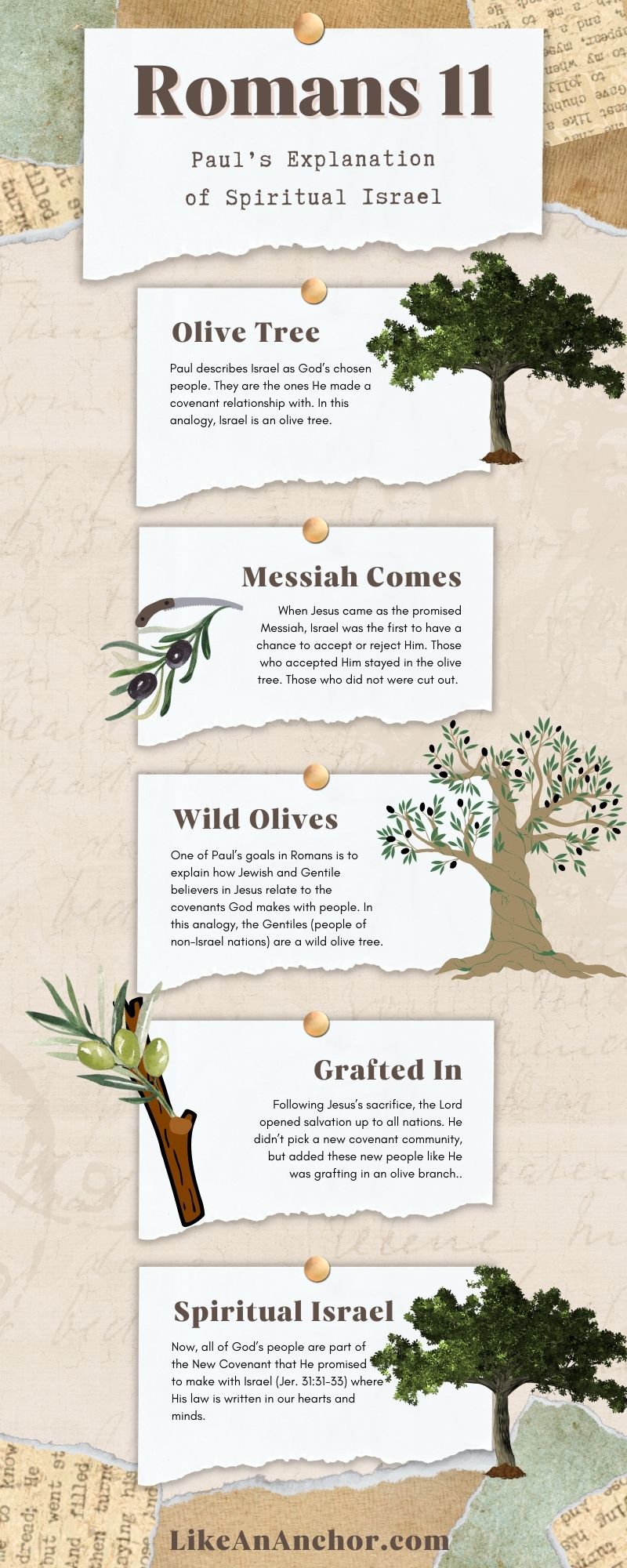
This doesn’t mean God started a brand new family/community, though. He transitioned His family to a new and better covenant, and welcomed new members in. Those who didn’t want to come with Him into the New Covenant got cut out of the community (at least for a little while). I find this easier to wrap my head around with a visualization. If you’re subscribed to my newsletter, you’ve already seen this infographic. I sent it out on Wednesday to give newsletter readers a sneak peak and to ask for feedback on the design.

Infographic illustrating the "grafted in" analogy Paul uses for how Jewish and Gentile Christians enter the New Covenant community with God.
Image by Marissa Martin, created with Canva

The Things We Do In God’s Family

Image of ___ with the blog's title text and the words "By celebrating God's Feasts, we're honoring Him as His covenant-keeping people."
Image created with Canva

One of the things that stood out to me when I was reading Misreading Scripture with Individualist Eyes by E. Randolph Richards and Richard James was the way they described Paul’s letters discussing Jewish and Gentile believers. One of the things Paul is doing when writing to believers, including in his Romans letter, is telling them they are part of a new community. In collectivist cultures, people get their identity from a group. Before conversion, Jews and Gentiles were part of different communities with different expectations, beliefs, and codes of conduct. Now, though, they are part of God’s covenant community.

When we’re in God’s community as part of His family, there are certain expectations that come with that. For example, we’re expected to treat God’s name with respect and honor Him with our words and conduct. He expects us to come to Him when we need help rather than turn to something else first. We’re to love the Father and Jesus, and Jesus said if we love Him then we will keep His commandments. Most Christians today already know that this includes the 10 Commandments, but those aren’t the only aspects of God’s law that transfer to the New Covenant. They’re more of a summary.

As already mentioned, Jesus said He came to fill the law and the prophets to their fullest extent, not to abolish them (Matt. 5:17) In some ways, more is expected of us in the New Covenant rather than less. We don’t need to do all the sacrifices since “by one offering he [Jesus] has perfected forever those who are being sanctified” (Heb. 10:14, WEB), but we are expected to obey the law on a heart level and not just a letter level (Matt. 5:17-48). God’s laws and commands describe the things that we do as part of God’s family; the things that He expects from people who have a covenant relationship with Him. His Sabbaths and Holy Days are a key part of that for Spiritual Israel today. They are times when He calls for His children to come together, rejoice with each other and with Him, and learn more about Him. That’s what we’ll be doing for the seven days of the Feast of Tabernacles and the Eight Day that follows, just as Jesus did when He kept this Feast (John 7).


Featured image by Claudine Chaussé

Relational Faith: A Book Review and Theological Reflection

I was so happy to receive a comment from Brent Schmidt on my blog post about his book Relational Grace: The Reciprocal and Binding Covenant of Charis (2015) offering me the opportunity to read his new book Relational Faith: The Transformation and Restoration of Pistis as Knowledge, Trust, Confidence, and Covenantal Faithfulness (2023). I really enjoyed the book on grace, and I was eager to read this follow-up work on faith.

You could read Relational Faith on its own, but it builds on Relational Grace and is best read as a continuation of that study. The basic argument of this new book is, “A universal doctrinal apostasy regarding faith occurred, necessitating a restoration of relational, covenantal faith” (p. 233). Much like Schmidt explained with charis/grace, the original meaning of pistis is vastly different from most mainstream Christian ideas of faith. Studying the context for how these Greek words were used when the New Testament was written helps us understand how grace and faith work today. God’s character is unchanging and the way He relates to us–including what He expects of those in relationship with Him–also didn’t change just because theologians over the years came up with different interpretations and ideas.

I don’t remember if I’ve mentioned this here before, but if I could have constructed a perfect-for-me class to take as part of my Masters in Rhetoric and Writing program, it would have focused on the Apostle Paul’s use of classical and Jewish rhetorical strategies. Schmidt holds a PhD in classics, and reading this book I felt like I was getting much of what I’d want from that hypothetical class. Schmidt opens the introduction with the words, “Context is key if we are to understand the essential Christian doctrine of faith as taught by the Apostle Paul” (p. 1). Amen, sir. Also, pistis is the same word used for “persuasion” in Aristotle’s rhetoric, and Schmidt spends a good deal of time on classical rhetoricians’ use of the word.

In short, this book could have been written for me even though Schmidt and I have some significantly different theological views/backgrounds (a bit more on that at the end). Overall, I found this an excellent scholarly work situating pistis firmly in its ancient context for both Jewish and Gentile Christians in the first-century. It also contains a detailed history of the changes in doctrinal understandings of faith over the years, with comparisons between different interpretations of faith from a variety of theologians. I didn’t find this book quite as engaging as Relational Grace, but it was well worth reading.

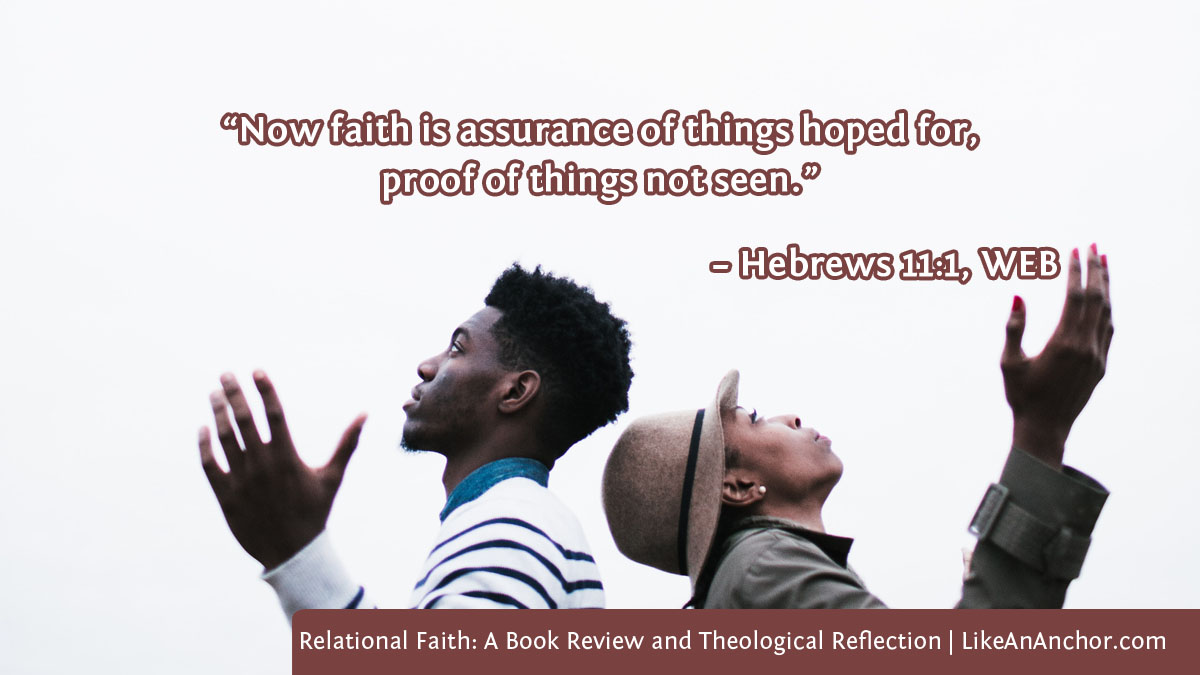
Image of two people with hands lifted in worship overlaid with text from Hebrews 11:1, WEB version:  “Now faith is assurance of things hoped for, proof of things not seen.”
Image by Temi Coker from Lightstock

Contextualizing Pistis

One of Schmidt’s basic premises is that we can better understand how Biblical writers use a Greek word by looking at how Classical writers earlier and around the same time used that word. This may seem an odd idea to us who live in a world where it’s considered normal and proper to separate religion from things like philosophy and science. There wasn’t such a separation in ancient times, though (Schmidt, p. 3). And while Biblical writers did give some words new/deeper Christian spiritual meanings, extrabiblical writings provide invaluable clues for understanding how people used these words at the time Paul and others were writing.

Schmidt’s etymological history of pistis and related words reveals that they can mean “faithfulness, steadfastness, and trustworthiness because of the underlying expressions of loyalty between parties in covenant relationships” (p. 11). He also places the word’s use in the context of classical Greek writers and Roman writers using the equivalent Latin word fides. He even looked into how pagan conceptions of the Pistis and Fides as goddesses influenced contemporary uses of the word. It’s a thorough scholarly investigation.

Additionally, Schmidt writes, “in the first century, pistis implied active loyalty, trust, hope, knowledge, and persuasion in the patron-client relationship or within the new covenant brought about through Christ’s Atonement” (p. 11). Faith in this sense is an active thing that’s connected with reciprocal relationships. When we’re in covenant with God, He is faithful to us and we must be faithful to Him. This is a concept that would have been very familiar to both Greek and Jewish audiences (Schmidt, p. 12-16). Also, Greek and Roman audiences were very familiar with the patron-client relationships that had pistis at the center. Whatever their religious background, first-century audiences would have thought of faith in a reciprocal relational context.

Jewish audiences in particular knew that faithfulness was key to covenants with God. In Hebrew, the basic root word for faith is aman (H539 in Strong’s). At the core, it means “firmness or certainty” (Theological Wordbook of the Old Testament, entry 116). Related words in this family include amen (verily, truly), emun (faithfulness, trusting), emuna (firmness, fidelity), and emet (truth). Schmidt points out that, like the Greek pistis, these Hebrew concepts were “knowledge-based, relational, and covenantal” (p. 37). And when Jewish writers wrote in Greek, they translated aman words into Greek as pistis (Schmidt 38). For example, when Paul quotes Habackuck 2:4, “the righteous will live by his faith (emunah),” he says, “the righteous shall live by faith (pistis)” (Rom. 1:17, WEB).

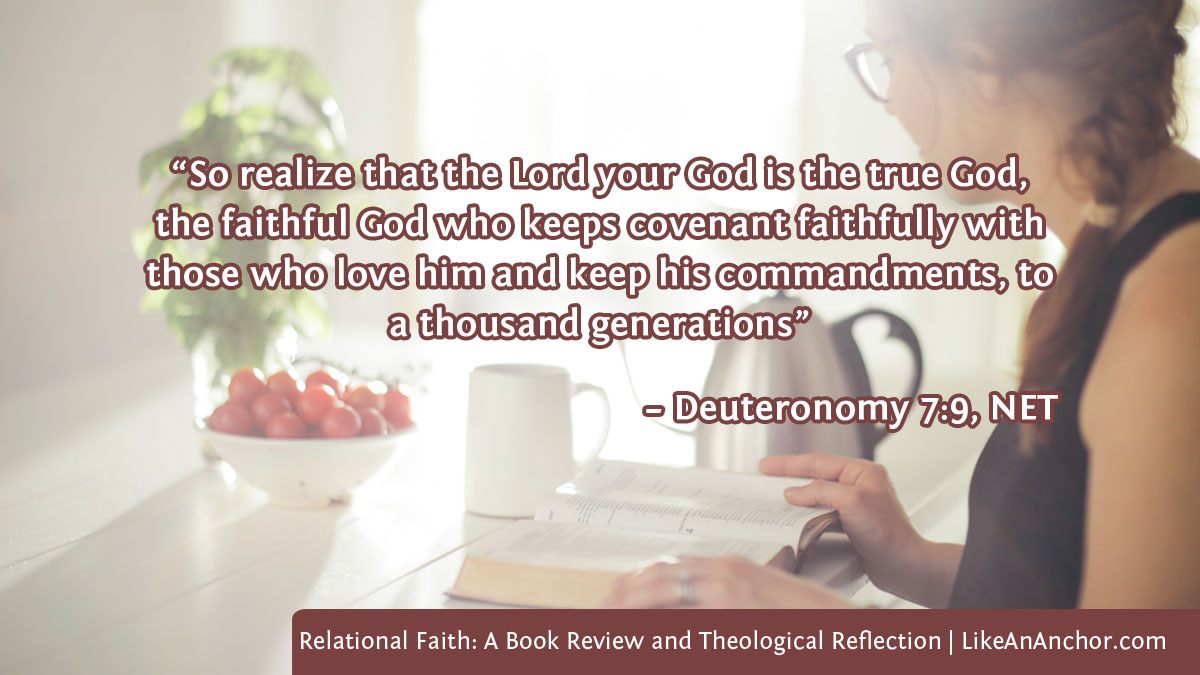
Image of a woman studying the Bible, overlaid with text from Deuteronomy 7:9, NET version:  “So realize that the Lord your God is the true God, the faithful God who keeps covenant faithfully with those who love him and keep his commandments, to a thousand generations”
Image by MarrCreative from Lightstock

Tracking Changes in Descriptions of Faith

Neoplatonists and Augustine

Have I talked on this blog before about the Neoplatonists? I don’t think I have, but they keep coming up in books I read that trace how Christianity changed after the first century. This school of thought (along with other trends, including anti-Jewish sentiments) heavily influenced shifts such as the change from keeping the Sabbath on Saturday to gathering on Sunday and adding the idea of an immortal soul (whereas in the Bible, God ” alone possesses immortality” until He grants it to people in His family [1 Tim. 6:16; 1 John 3:1-3]). And apparently, it’s also connected to the change from thinking of faith as intimately connected to covenant to an expression of belief in accepted Christian doctrines.

  • Side note: if you’re interested in exploring this idea more, I recommend Plato’s Shadow: The Hellenizing of Christianity by Gary Petty. It’s a good introduction/overview of the topic. (Please note this is an affiliate link, which means I’ll receive a small commission if you click on the link and make a purchase.)

While tracing the ways Christian conceptions of faith changed after the first century, Schmidt writes, “Neoplatonist faith (pistis) embraced the intelligible and pure through contemplation and also embraced emotional assurances that the soul was immortal by identifying with an abstract divine” (p. 116). Here’s where we start getting the idea of faith as something abstract, mystical, or requiring only passive acknowledgement. This is happening during the late Classical period (starting around 200 AD), and heavily influences Christianity of the Middle Ages. In contrast, “Ancient readers understood that faith obligated them to demonstrate their faithfulness actively” (p. 130).

The major shifts in conceptions of faith solidified around the 5th century. Schmidt comes down hard on Augustine for that, and rightly so I think based on other examinations I’ve read of Augustine’s work and the readings I’ve done of excerpts from his own texts (we covered him in my classical rhetoric class). Augustine introduced doctrinal concepts such as original sin and predestination, and defined faith as something God gave those He determined would be His people. Though an influential theologian, Augustine contradicted long-established Christian teachings in some of his doctrines, including the way he spoke about faith as something passively received from God, an emotion, and/or acknowledgment of a belief system (Schmidt, Chapter 9). In short, “Augustine’s model of faith fit very poorly with any Hellenistic notions of pistis because first-century pistis was ‘neither a body of beliefs nor a function of the heart or mind, but a relationship which creates community” (Schmidt, p. 167, quoting scholar Teresa Morgan).

I find it very interesting that the shift to seeing faith as a mystical thing granted to you by God, which helps you accept mysteries unknowable, coincides with the shift in popularly accepted Christian doctrine toward describing God’s nature as a Trinity (the Council of Nicae and the Council of Constantinople both happened in the 4th century). If you’re going to describe God as an unknowable three-in-one deity rather than as a family where the Father and Son make covenants with and know people individually, then it’s hard to define faith as a patron-client relationship that believers have with the Father modeled after the relationship the Father has with the Son. (For more on why I don’t think “trinity” is the best way to describe the nature of God, see my post “What Does It Mean For Each of Us That God Is A Family?“)

Medieval to Modern Theologians

Schmidt spends the next few chapters tracing Catholic and then Protestant teachings about faith through the Medieval, Renaissance, Enlightenment, and early Modern periods. William Tyndale stands out as a theologian working to balance the ideas of “salvation by faith alone” and the clear Biblical instructions for faith to result in good works (Schmidt, pp. 185-88). Heinrich Bullinger, John Locke, and Dietrich Bonhoeffer are also highlighted as rare examples of theologians hearkening back to the active, covenantal context of pistis. Overall, though, the meaning of faith shifted away from ancient conceptions of pistis as faithfulness in covenant and focused more on passive, mystical experiences. Debates at this time often centered on how/if good works were linked with faith and whether or not there was any human free will involved.

There still isn’t a clear consensus in modern Christianity about how to define faith. There are, however, influential theological movements hearkening back toward an ancient understanding of pistis. In Chapter 13, Schmidt explores one of the reasons why I wasn’t all that surprised by what I read in this book about covenants and faith. C.S. Lewis (my favorite Christian writer) taught that faith necessarily involves action. The modern theological movement known as The New Perspective on Paul (including authors I’ve read and enjoyed like N. T. Wright and others I’m familiar with including E.P. Sanders and James Dunn) teach that Paul must be read through a first-century Jewish lens. They also point out that mistakes in reading Paul’s writings and over-reliance on Medieval theologians have led to distorted ideas of faith.

A Few Last Thoughts

Image of the Relational Faith book cover overlaid with the blog post's title text.
Features cover image for Relational Faith

As someone who’s been part of a 7th-day Sabbath-keeping Church of God group her whole life and who also has a Messianic Jewish background, the core arguments of Relational Faith weren’t surprising to me. Similarly, when I first came across the New Perspective on Paul, it didn’t seem revolutionary to read Paul as a Jewish writer who sees covenants as central to Christianity. That’s simply how I think of Christianity.

I will admit, though, that reading Relational Faith challenged me to think more deeply about how I talk about faith. For example, I will use the phrase “my faith” to mean “the doctrines I believe in and the experience of feeling sure that God exists.” A first-century Christian, though, saw faith more as something you do than something you have. If they talked about “my faith,” they’d likely mean “my faithfulness to the covenant God makes with me, as well as the obedient actions associated with honoring that covenant.” Reading this book made me want to be more intentional and careful about how I conceptualize and speak of my relationship with God to ensure it aligns with His word.

Even with confusion about what faith really means and ongoing theological debates, I would argue that the original meaning of faith has not been entirely lost even in “mainstream” Christianity. Yes, there are plenty of songs and teachings that reduce faith to some internal sensation or belief, but there’s also Josh Wilson singing, “Faith is Not a Feeling,” Christianity.com pointing out that faith is often synonymous with obedience, and Baker’s Evangelical Dictionary of Biblical Theology connecting faith with covenants that bridge Old and New Testaments. There isn’t a simple “this group is all wrong, while this group is all right” answer.

Finally, as I mentioned in the beginning, Schmidt and I have some different theological views. I try to practice the first-century version of Christianity I read about in the New Testament as closely as possible (if you want to label me, “Messianic” or “Sabbath-keeper” works pretty well). Schmidt is a member of the Church of Jesus Christ of Latter Day Saints. Most of the focus of his book is on areas where he overlaps with other Christians (i.e. interpreting the New Testament in light of the writers’ use of classical Greek language), but the last two chapters are devoted to the concept of “faith” in the Book of Mormon and other Latter Day Saints’ writings. While I find this aspect of his beliefs rather puzzling, please read this more as an observation than a criticism–those chapters didn’t interest me much, but readers are free to do with them as they will.


Relational Faith was published on March 21, 2023. It is available on Amazon as a Kindle ebook or paperback book (please note this is an affiliate link, which means I’ll receive a small commission if you click on the link and make a purchase).


Featured image by Claudine Chaussé

Relational Investment In The New Covenant

It’s amazing how much you notice the reciprocal nature of God’s relationships with people once you start looking for it. I noticed this when I first read Brent Schmidt’s book Relational Grace, and I’m noticing it even more now that I’m reading his follow-up book, Relational Faith. In both these books, Schmidt explains the context for the Greek words charis (grace) and pistis (faith) are relational and reciprocal; they were connected to patron-client relationships, where a more powerful patron creates a covenant relationship with a client who owes them ongoing loyalty in response to their faithfulness and gracious gifts.

Schmidt writes, “in the first century, pistis implied active loyalty, trust, hope, knowledge, and persuasion in the patron-client relationship or within the new covenant brought about through Christ’s Atonement” (Relational Faith, p. 11). Similarly, everyone knew “receiving charis implied entering into reciprocal covenantal relationships” (Relational Grace, p. 63).

So, I’ve been thinking about faith as active trust and the centrality of reciprocal relationship as we went into the Passover this past week. I also took my Tree of Life translation as the Bible I’d be following along with during the Passover service. And I noticed some interesting things. For one, this Messianic translation uses “trust” instead of the more typical “belief” when translating John 14:1. Second (and this is what we’ll focus on today), the words of the New Covenant in John 13-17 have a lot of reciprocal language.

The Importance of Doing Loyal Things

For purposes of this discussion, I’m using “reciprocal” in the sense of “reciprocity.” Merriam-Webster’s dictionary defines it as “mutual dependence, action, or influence” and ” a mutual exchange of privileges” (Reciprocity). This dictionary also points out that “Reciprocal and mutual share a good deal of meaning; the former may be defined as ‘shared, felt, or shown by both sides,’ and the latter as ‘shared in common'” (Reciprocal). So when we look at this idea in the Bible, we’re looking at places where God says, “Because I do ___, you respond like ___” or where His followers say something like, “It is right for us to do ___, because the Lord has graciously done ___.”

At Jesus’s last Passover on earth with His disciples, He instituted New Covenant symbols and traditions, including the foot washing. During the evening meal, Jesus got up and washed His disciples feet. Then, He told them to reciprocate by doing the same thing for other people.

 If I then, your Lord and Teacher, have washed your feet, you too ought to wash one another’s feet.  For I have given you an example—you should do just as I have done for you. I tell you the solemn truth, the slave is not greater than his master, nor is the one who is sent as a messenger greater than the one who sent him. If you understand these things, you will be blessed if you do them.

John 13:14-17, NET

The proper response to Jesus serving you is to go out and serve others. Then, when you understand and do the things He teaches, you’ll receive blessings. In sharp contrast stands Judas, who responded to His Master’s selfless service with betrayal. You might remember I’ve also been reading The Heliand, a Saxon retelling of the gospel account in the style of epic poetry like Beowulf. In this version, the disciples are cast as warrior-companions who owe fealty to their thane, the great king Jesus the Healer. Though we feel Judas’s betrayal deeply in modern translations, I think the Saxons might have understood even more deeply what it meant to a first-century Jewish, Greek, and Roman audience to break faith with someone who you’d bound yourself to in a covenant that should have been faithful and reciprocal.

Image of Bibles on a table overlaid with text from John 14:21, 23,  NET version:  “One who has my commandments and keeps them, that person is one who loves me. One who loves me will be loved by my Father, and I will love him, and will reveal myself to him. ... If a man loves me, he will keep my word. My Father will love him, and we will come to him, and make our home with him.”
Image by Inbetween from Lightstock

More Reciprocal Instructions

In my church we often refer to the passage of scripture in John 13-17 as the words of the New Covenant. I encourage you to read through that section of scripture and look at how many times the “if you do this, I will do this” or “because I do this, you should do this” pattern repeats. I’ll just quote one of those passages here:

“You are clean already because of the word that I have spoken to you. Remain in me, and I will remain in you. Just as the branch cannot bear fruit by itself, unless it remains in the vine, so neither can you unless you remain in me.

“I am the vine; you are the branches. The one who remains in me—and I in him—bears much fruit, because apart from me you can accomplish nothing. If anyone does not remain in me, he is thrown out like a branch, and dries up; and such branches are gathered up and thrown into the fire, and are burned up. If you remain in me and my words remain in you, ask whatever you want, and it will be done for you. My Father is honored by this, that you bear much fruit and show that you are my disciples.

 “Just as the Father has loved me, I have also loved you; remain in my love. If you obey my commandments, you will remain in my love, just as I have obeyed my Father’s commandments and remain in his love. I have told you these things so that my joy may be in you, and your joy may be complete.  My commandment is this—to love one another just as I have loved you. No one has greater love than this—that one lays down his life for his friends. You are my friends if you do what I command you.

John 15:3-14, NET

If we live in Jesus, He and His Father will live in us. Because they live in us, we’ll bear much fruit. When we bear fruit, it honors God. And so on. The New Covenant is a reciprocal relationship. Like any healthy relationship, there’s trust and reliance on each other to do things that build up the relationship. And as the far more powerful party in the covenant, God gives far more than we do. In John 13-17, Jesus promises to send the gift of the Holy Spirit. He assures those who are loyal to Him that His Father will hear and respond to their prayers. And the main thing He asks from us in return is love, loyalty and obedience. Over and over we read, “if you love me, keep my commandments,” including the one to love each other (John 13:34-35; 14:15, 21, 23; 15:17).

It’s really amazing to think about. God wants to have a real relationship with us. And not one that’s easily ended when someone decides it’s hard or not what they expected or they don’t “feel like it” anymore. He’s invested in us for the longest-term possible–eternity. He wants us to grow and thrive in this relationship, learning to be like Him since we’re becoming part of His family.

A Real, Mutually Invested Relationship

Image of two people holding hands with the blog's title text and the words  "God wants a real, lasting covenant relationship with us where the trust and investment go both ways."
Image by Jantanee from Lightstock

Now this is eternal life—that they know you, the only true God, and Jesus Christ whom you sent.

John 17:3, NET

Our eternal potential hinges on a meaningful, real, covenantal relationship with God the Father and Jesus the Messiah. We can learn more about the type of relationship they want to have with us by looking at the relationship they share.

Everything I have belongs to you, and everything you have belongs to me, and I have been glorified by them. I am no longer in the world, but they are in the world, and I am coming to you. Holy Father, keep them safe in your name that you have given me, so that they may be one just as we are one.

John 17:10-11, NET

We belong to God, and He gives us to Jesus, and Jesus leaves us safe with God, and they work together so we can be one as they are one. There’s a beautiful, seamless unity in their relationship and they want to welcome us into that oneness as well (John 17). It’s such an astonishing proposition that the apostle John was still marveling at it decades later.

See how glorious a love the Father has given us, that we should be called God’s children—and so we are! The reason the world does not know us is that it did not know Him. Loved ones, now we are God’s children; and it has not yet been revealed what we will be. But we do know that when it’s revealed, we shall be like Him, because we will see Him just as He is. Everyone who has this hope in Him purifies himself, just as He is pure.

1 John 3:1-3, TLV

There are expectations connected to this covenant relationship, but they’re expectations that naturally flow from the type of connection we share with God our Father and Jesus our adopted elder brother and betrothed Husband. For example, I expect that my parents will continue loving me as their daughter; they expect I won’t do things to dishonor them or purposefully disgrace the family. My fiancé and I each expect the other to remain faithful to and invest in our relationship now and after we’re married. It’s very similar in our relationship with God–the trust and investment go both ways.

We know God the Father and Jesus Christ are invested in their relationships with people. They’ve “got skin in the game”–they made us in their own image, poured their time and energy into us, and Jesus even died for us. He talked about that at Passover, too: “No one has greater love than this—that one lays down his life for his friends. You are my friends if you do what I command you” (John 15:13-14, NET). John brings this up again in his epistles as well, saying, “We have come to know love by this: that Jesus laid down his life for us; thus we ought to lay down our lives for our fellow Christians” (1 John 3:16, NET). There’s even a reciprocal aspect to Jesus’s sacrifice; we can’t pay Him back for such a gift, but there is a proper response we’re supposed to have when we recognize the love that motivated His sacrifice.


Featured image by Claudine Chaussé from Lightstock

Spiritual Tenacity

The word “tenacity” comes into English “from Latin tenacitas ‘an act of holding fast,’ from tenax (genitive tenacis) ‘holding fast, gripping, clingy; firm, steadfast'” (Online Etymology Dictionary). It’s not a word that’s used in any of the Bible translations I frequently read (WEB, NET, TLV, KJV), but the same concept is expressed with terms such as “hold fast” or the related idea of endurance.

When we hold fast to something on a physical level, it’s either because we love it so much (e.g. hugging your child tight) or because we need something to keep us from falling or getting pulled away (e.g. clinging to a rope when climbing a cliff or holding onto a tree branch to keep from being swept away in a flash flood). Something similar is happening on a spiritual level.

When we’re living in covenant with God and have a relationship with Him, He wants a close and loving relationship with us. He also expects an exclusive relationship, but there are other things pulling at our time and attention that could draw us away from Him if we don’t hold on tight. Putting something before Him, making covenant relationships with conflicting things, or holding tight to something other than God would mean that we’re being unfaithful to Him (Ex. 34:12-14). In contrast, holding fast to God involves having a faithful, love-filled relationship with Him.

What are you Holding Onto?

In the Old Testament, Joshua warned ancient Israel about the importance of staying faithful to God. With God’s guidance, Joshua led them into the promised land, fought and conquered the land under God’s leadership, and saw the people settled in their promised inheritance. The surrounding nations weren’t completely gone, though, and neither were the influences from Israel’s past. So when Joshua was old, he called Israel together to give them instructions and warnings.

Therefore be very courageous to keep and to do all that is written in the book of the law of Moses, that you not turn away from it to the right hand or to the left; that you not come among these nations, these that remain among you; neither make mention of the name of their gods, nor cause to swear by them, neither serve them, nor bow down yourselves to them; but hold fast to Yahweh your God, as you have done to this day. …

“But if you do at all go back, and hold fast to the remnant of these nations, even these who remain among you, and make marriages with them, and go in to them, and they to you; know for a certainty that Yahweh your God will no longer drive these nations from out of your sight; but they shall be a snare and a trap to you, a scourge in your sides, and thorns in your eyes, until you perish from off this good land which Yahweh your God has given you.”

Joshua 23:6-8, 12-13, WEB (emphasis added)

Here, Joshua presents the people with two options. They can “hold fast to Yahweh your God” or they could “hold fast” to the ungodly nations around them. Similarly, we see other people in the Bible holding fast to either good or bad things. A psalmist tells the Lord, “I hold fast to your rules” (Ps. 119:31, NET). Yahweh promises good things to those who “hold fast to my covenant” and keep the Sabbath (Is. 56:1-7, WEB). God praised Job to Satan as an example of “a pure and upright man,” saying, “he still holds firmly to his integrity” (Job 2:3, NET).

In contrast, there are others who “hold fast to their deception” (Jer. 8:5, NET). Proverbs says, “The evil deeds of the wicked ensnare him. The cords of his sin hold him firmly” (Prov. 5:22, WEB). Jesus chided people who rejected God’s law to “hold fast to human tradition” (Mark 7:1-8, NET). Clearly, we need to be careful what we’re clinging to. Are we holding on to God, or to things that are trying to tug us away from Him? Trying to do both isn’t going to work. “No man can serve two masters,” Jesus said, “for either he will hate the one, and love the other; or else he will hold to the one, and despise the other” (Matt. 6:24, KJV). We need to make sure the one we “hold to” is God.

Holding on to Hope

There are strict warnings about who or what we choose to hold onto in this life. We can’t have divided loyalties when we come to God. He’ll work with us through our doubts, but He expects us to choose Him when it comes down to it. The admonition to us today is still the same as the one Joshua gave Israel: “hold fast to Yahweh your God.”

God also told people in the Old Testament to hold onto His covenant, including the Sabbaths (which are a sign of being in covenant with God). That continues today. For example, Paul told the Corinthian church to “hold firm the traditions” and “hold firmly the word which I preached to you” in an epistle contextualized by his discussion of the Feast of Unleavened Bread (1 Cor. 11:2; 15:2, WEB). Paul also gave similar instructions in three other letters (2 Thes. 2:15; 1 Tim. 1:18-19; Tit. 1:8-9). We need to carefully hold on to the truth God gives us and obey his instructions. And when we do that, we’re holding on to some amazing things.

Christ is faithful as a Son over his house. We are his house, if we hold fast our confidence and the glorying of our hope firm to the end. … we have become partakers of Christ, if we hold the beginning of our confidence firm to the end.

Hebrews 3:6-7, 13 WEB (emphasis added)

Therefore since we have a great high priest who has passed through the heavens, Jesus the Son of God, let us hold fast to our confession. …

And let us hold unwaveringly to the hope that we confess, for the one who made the promise is trustworthy.

Hebrews 4:14; 10:23 NET (emphasis added)

 God wanted to demonstrate more clearly to the heirs of the promise that his purpose was unchangeable, and so he intervened with an oath, so that we who have found refuge in him may find strong encouragement to hold fast to the hope set before us through two unchangeable things, since it is impossible for God to lie. We have this hope as an anchor for the soul, sure and steadfast

Hebrews 6:17-19, NET (emphasis added)

Look how positive this wording is. We’re to “hold fast” to our confidence in Christ and the glory of hope, the confession of our faith and hope, and the hope of joy set before us in the future. Holding onto God, His word, righteousness, and goodness also means holding onto hope and joy. It makes me think back to part of our Isaiah study from earlier this year about the joy found in keeping covenant with God (see “Isaiah Study: Joy in the Sabbath Covenant With God“). In a close relationship with God, obedience flows naturally from love and honoring God brings joy while strengthening hope.

“Hold on to What You Have”

We can sum up the Bible’s “hold fast” instructions with this verse: “hold fast to what is good. Stay away from every form of evil” (1 Thes. 5:21-22, NET). Our spiritual walk requires tenacity–a conviction to hold tight to God and the goodness associated with Him while rejecting the things which would want to pull us away or present alternative things to cling to.

Something that helps us greatly in our quest to hold fast to good is that Jesus holds fast to us. He says that He and the Father hold Their people in Their hands (John 10:27-29). He also holds the keys to death, the spirits of God, the angels of the churches, and the keys to David’s kingdom–wonderous things we can only begin to understand (Rev. 1:16-18; 2:1; 3:1, 7). It’s in the letters to the churches in Revelation that Jesus describes Himself as holding these things, and it’s also here that He counsels us to keep holding on.

I am coming soon. Hold on to what you have so that no one can take away your crown. …  The one who has an ear had better hear what the Spirit says to the churches.

Revelation 3:11, 13, NET

The “crown” here “refers to a wreath … worn as a symbol of honor, victory, or as a badge of high office” (NET footnote on Rev. 3:11). It’s not so much a symbol of ruling as it is of victory. Think of the laurel crowns in ancient Rome and Greece that still influence our language today; we use the word “laurels” for “a tangible symbol signifying approval or distinction” (Vocabulary.com).

We’re part of a spiritual war. We’ve joined up on God’s side–the one guaranteed victory in the end. Until the time when we receive our crowns of victory, we’re called to be soldiers in a war that mostly takes place on a spiritual plane but also bleeds into the physical realm. I have a book about this called Like An Anchor Study Guide: The Armor of God coming out early next year, but for now I’ll direct you to my series of blog posts on Spiritual Warfare if you want to read more about this.

You will be hated by everyone because of my name. Yet not a hair of your head will perish. By your endurance you will gain your lives.

Luke 21:17-19, NET

Jesus Christ and God the Father are the ones who make victory possible. We get to play a role, too. It’s our job to hang on to them and endure. That’s how we win. Spiritual tenacity is a vital component to living a victorious, godly life.


Featured image by S. Hermann / F. Richter from Pixabay

Humility To Keep Covenant With God

Have you ever noticed there are things God cannot do? For example, “it is impossible for God to lie” (Heb. 6:18, NET). When we talk about serving a God who can do anything, what we really mean is that He has the power to accomplish anything He promises and to work things out which seem impossible to us.

The fact that there are some things God simply can’t do is reassuring when we look at what those things are. It isn’t just that God chooses not to lie–He can’t do it. Deception simply isn’t in His character. That means we can trust Him completely. When He makes a promise He’s going to keep it. He might adjust His plans in response to something we do (the way He delayed Nineveh’s destruction when the people repented) but He will never go back on His promises. One of the promises that He’ll never break involves the covenant relationships He establishes with people.

No Chance of God Forgetting

I’ve been writing about covenants again recently. I hadn’t planned to stay on this topic, but one verse read in a sermon last Sabbath caught my ear and got me digging deeper again. To get some context, this verse comes from Deuteronomy when Moses spoke to Israel before they entered the promised land. He recapped their journey so far, reminded them of times they’d disobeyed God, recalled military encounters, and spoke of Joshua taking over after his death. Then, he says, “Now, Israel, pay attention to the statutes and ordinances I am about to teach you, so that you might live and go on to enter and take possession of the land that the Lord, the God of your ancestors, is giving you” (Deut. 4:1, NET). Now, he starts to remind them of the covenant promise they made.

Again, however, pay very careful attention, lest you forget the things you have seen and disregard them for the rest of your life; instead teach them to your children and grandchildren. … You approached and stood at the foot of the mountain, a mountain ablaze to the sky above it and yet dark with a thick cloud. Then the Lord spoke to you from the middle of the fire … he revealed to you the covenant he has commanded you to keep, the Ten Commandments, writing them on two stone tablets.

Deuteronomy 4:9, 11-13, NET

Moses will recap this covenant as the book goes on, but first He talks about what will happen if Israel forsakes this covenant. If they break their relationship with God “and do other evil things before the Lord your God that enrage him, I invoke heaven and earth as witnesses against you today that you will surely and swiftly be removed … you will surely be annihilated” (Deut. 4:25-26, NET). That’s a serious consequence, but it’s also not God’s final say in the matter.

In your distress when all these things happen to you in future days, if you return to the Lord your God and obey him (for he is a merciful God), he will not let you down or destroy you, for he cannot forget the covenant with your ancestors that he confirmed by oath to them.

Deuteronomy 4:30-31, NET

Notice the wording here: God “cannot forget the covenant.” Many translations say “will not” here, but the NET translators understand the Hebrew’s “imperfect verbal form to have an added nuance of capability here.” Brown-Driver-Briggs Hebrew Lexicon say this Hebrew word lo means “no” or “not” in a way that’s an “absolute prohibition.” In other words, there’s no chance–not in a billion years or under any circumstances–that God could possibly forget His covenant.

Image of a woman holding a baby with text from Isaiah 49:14-16, NET version: “Zion said, ‘The Lord has abandoned me, the Lord has forgotten me.’ Can a woman forget her baby who nurses at her breast? Can she withhold compassion from the child she has borne? Even if mothers were to forget, I could never forget you! Look, I have inscribed your name on my palms"
Image by Pearl from Lightstock

What About Us?

That covers one side of the covenant. God’s not going to back out, break His promises, forget He’s in a relationship with us, or decide we’re not worth it. But we’re in this covenant, too. What about us?

You people of this generation,
listen to the Lord’s message:
“Have I been like a wilderness to you, Israel?
Have I been like a dark and dangerous land to you?
Why then do you say, ‘We are free to wander.
We will not come to you anymore?’
Does a young woman forget to put on her jewels?
Does a bride forget to put on her bridal attire?
But my people have forgotten me
for more days than can even be counted.”

Jeremiah 2:31-32, NET

God knows we’re not perfect. We are capable of breaking covenants, going back on our word, forgetting Him, or letting our relationships slip down on our priority list. Forgetting God is an insane thing to do–like a bride forgetting to put on her wedding dress and not even noticing. But people still forget Him over and over. That’s why, in His mercy, God built in a way for us to come back into covenant with Him.

Let’s read Moses’s words one more time: “if you return to the Lord your God and obey him (for he is a merciful God), he will not let you down or destroy you, for he cannot forget the covenant with your ancestors that he confirmed by oath to them” (Deut. 4:31, NET). Remember that, through Jesus, we inherit the covenants God made with Israel’s ancestors. This promise includes us today, and we can come back to covenant with Him if/when we stray by following the same steps: return and obey. When we do that, He covers up our covenant breaking with His abundant love, faithfulness, and grace. He’s incapable of abandoning His covenant, and He makes it so that we can be counted faithful too.

Keeping Covenant With God

Image of a man sitting on a beach at sunset with the blog's title text and the words "When we realize our ability to keep covenant with God is a result of His mercy, it results in humility coupled with a sense of security. His faithfulness enables our 
faithfulness."
Image by Aaron Kitzo from Lightstock

Did you notice the sharp contrast between us and God here? He’s incapable of breaking covenant; humans have never been 100% faithful to Him. He’s committed to never walking away from us; people walk away from Him all the time. He’s holy and perfect; we’re fleshy and flawed.

A proper understanding of this contrast leads to an attitude we need in order to return to God and obey Him. We need humility. When we realize that our ability to keep covenant with God is a result of His mercy, there’s no room for feeling puffed up about ourselves. It’s His faithfulness that enables our faithfulness. When we have an understanding of how much we owe to Him and how highly He values us, it results in humility coupled with a sense of security.

For the high and lofty One who inhabits eternity,
whose name is Holy, says:
“I dwell in the high and holy place, with him also who is of a contrite and humble spirit,
to revive the spirit of the humble,
and to revive the heart of the contrite.”

Isaiah 57:15, WEB

While we do have obligations as participants in this covenant, we don’t have to be afraid that God will cut us off if we make a mistake. We just need to humbly recognize that we can’t do this on our own and accept the same thing God told Paul: “My grace is enough for you, for my power is made perfect in weakness” (2 Cor. 12:9, NET). We’re all weak compared to God, and when we acknowledge that weakness it opens up opportunities for Him to work in us powerfully.

God highly values His covenant with us. He promises to live with us when we’re humble and trust Him. He doesn’t hold our weakness against us. Rather, He loves us so much that He died to take away the death penalty humans earned for covenant-breaking and welcomes us into His family with open arms. We can trust Him. We can love Him without fear. And we can keep covenant with Him even though we’re flawed knowing that, with Jesus, “whenever I am weak, then I am strong” (2 Cor. 12:10, NET).

Featured image by WhoisliketheLord Studio from Lightstock