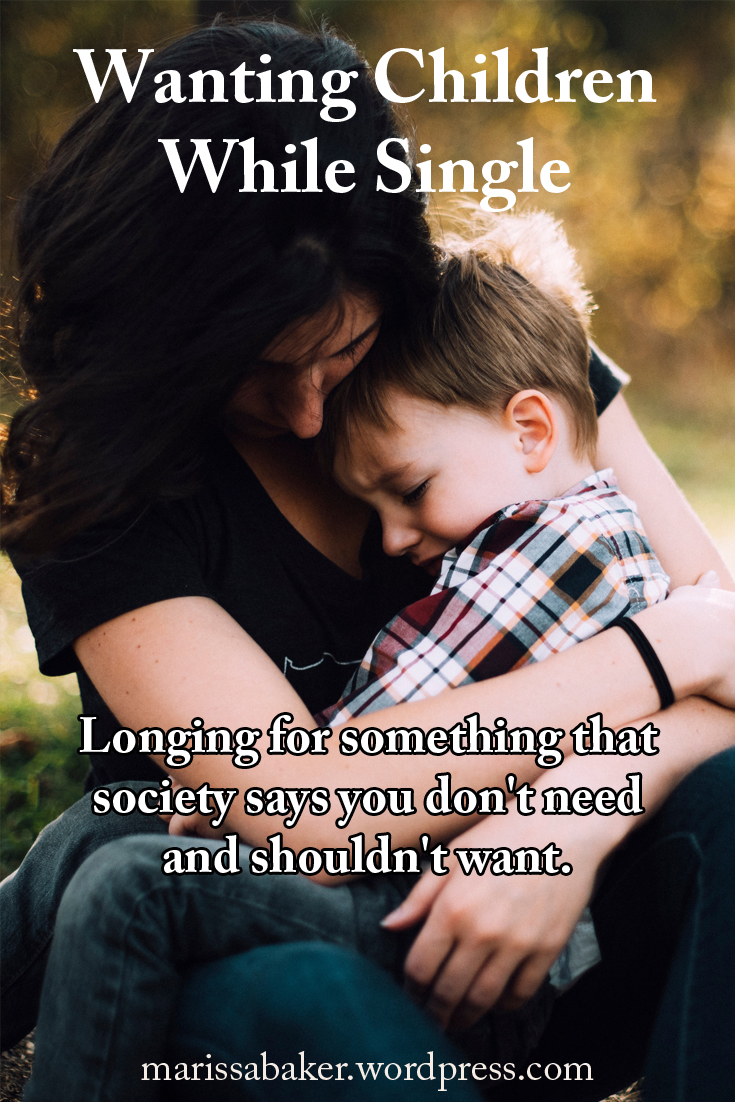
You snuggle babies every chance you get, longing for the day when you might hold your own child. Or perhaps you don’t hold babies any more because the ache of wishing they were yours is just too much. That’s the kind of grief and longing we associate with women in relationships who want to have a child and can’t get pregnant. Yet this desire isn’t confined to women with a man in their lives whom they love.
I’ve always felt guilty for how much I sympathize with the barren women of the Bible. As far as I know, I could have children if I found the right guy to marry and it seems rude to compare myself with women who are physically unable to have children. It also seems out-of-order to long for children before meeting the man I’d want to be their father.
I’m not alone, though. A woman I met through this blog while working on The INFJ Handbook shared her desire for children by asking why so many children are born into broken families while we, who would make good moms, are left barren. Since then, I’ve come across other women who feel the same way. If you’re committed to not having sex before marriage and/or not having children without a man in your life, then single women can know the pain of empty arms that long to hold a child.
Cultural Back-lash
Longing for children is unpopular in today’s society. We’ve become so obsessed with the fact that women are more than “baby producing machines” that the notion of being a mother has becomes synonymous with female oppression. Instead of seeing motherhood as a beautiful thing that many women desire, we’re told kids should take a back-seat to your career, your other desires, and your empowerment as a woman. And if having kids is actually one of your top life goals? well, clearly you’re still living in the pre-feminism dark ages. Read more →
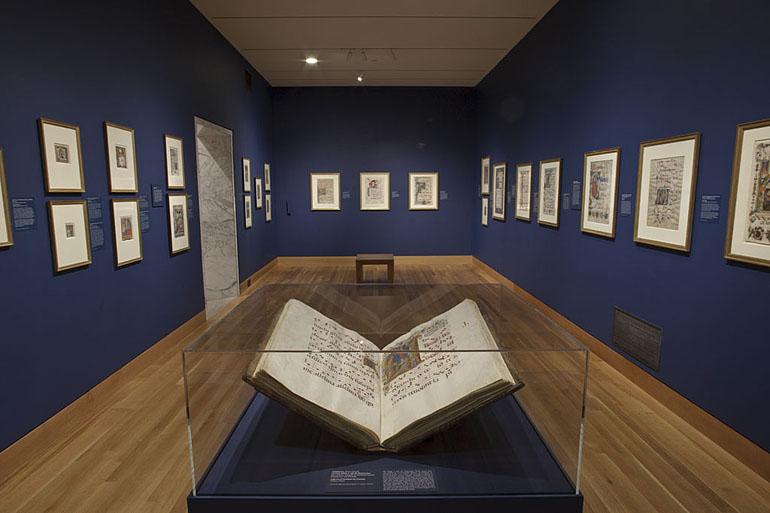
A few years ago when I was in college, one of my professors organized a small group of interested students and took us up to the Cleveland art museum. The purpose of our visit, a touring exhibit of religious artifacts from medieval Europe, was interesting, but that wasn’t what lured me there. It was the museum’s permanent collection of illuminated manuscripts.
These manuscripts date from the Middle Ages. Every page was carefully copied by hand, and they didn’t just stop there. Illuminating a manuscript with (real) gold, silver, and bright colors in illustrations and elaborate first letters turned them into works of art. The sort of books you took the time to create like this were held in high value (many are religious texts).
It’s no secret I love books. But most of the books on my shelves are, in the strictest sense, disposable and replaceable. They were impersonally mass-printed in a factory. Any meaning that particular copy has is unique to me. But for the handwritten manuscripts each copy is unique. They’re irreplaceable. And they were created with love.
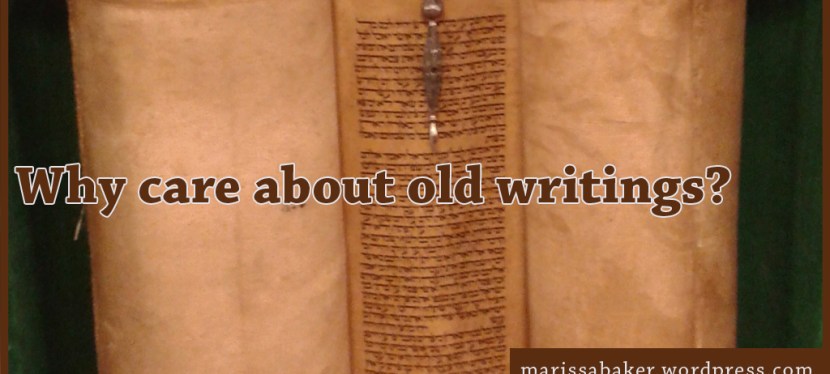
That’s also true of the ancient writings I saw yesterday. The Ancient Hebrew Scroll Project is one of only 2 or 3 complete sets of the Tanakh (Old Testament), and it’s the only one you’ll ever have a chance to see. It tours in public and there’s never any admission fee. The oldest scroll is a 600 year old Torah. Others are around 250 years old, with the exception of some scrolls too rare to obtain old copies (those are newly commissioned). Several survived the Holocaust, including a Haftorah that was bayoneted six times by Nazis.
The beginning of Psalm 119 on a scroll written in 2009. Notice you can see the lines are written in sets of 8, each starting with the same Hebrew letter (that’s why it’s divided alphabetically in your English Bibles; because of the type of poem/song it is)
Every single Bible scroll, the new and the old, was created the same way. Two Levites stand holding a completed scroll open before a scribe. The scribe reads one word aloud, then writes it using a pen made from a turkey feather dipped in ink made from gall nuts, gum-Arabic, and ash. He does this for every single word with the exception of the YHWH name of God. For this word, he will not speak it aloud and before writing it he washes his hands and takes up a pen only used to write the Name.
Once the scroll is finished, the scribe counts every letter to make sure it adds up to the correct number for that scroll. If it passes that test, he gives it to another scribe for re-counting, spell-checking, and format inspection. If that scribe gives it the go-ahead, it’s given to another scribe. Only after two scribes double-check the first scribe’s work is the scroll kosher.
Latter (aka “Minor”) Prophets. Scroll written the late 17th Century
“So what?” some people ask. Who cares about hand-writing things like this in the age of computers? And yet this is how the Bible was preserved intact and unchanged for thousands of years. It’s the only way any writing from pre-1440 got passed down to us. There’s something about the process itself that lends meaning to the books and scrolls created with such careful attention.
New, fast, and disposable isn’t always better. There’s value in taking time to pour love and great care into something that will last. That’s one of the lessons the old writings teach us. They give us a chance to stop and ponder what we value. Something preserved in this way has to matter or it’s not worth taking the time.
If there were no computers or printing presses any more, which writings would you value highly enough to copy by hand letter by letter so nothing was lost?
There’s something magical about meeting a person who “gets” you. It’s like your minds work on the same wavelength and you’re instantly talking as if you’re old friends. The two of you think so much alike that there’s no struggle to explain yourself.
This sort of connection often has to do with personality type. Our Myers-Briggs types describe the way our minds work (click here for tips on finding your true Myers-Briggs type). When we meet someone else whose brain processes the word in a similar way, we’re likely to experience a connection with them, especially if we have overlapping interests.
In contrast, when we seem to clash with someone for no reason it often has to do with differences in how we process the world. To use a fictional example from the Marvel Cinematic Universe, Steve Rogers and Tony Stark don’t just conflict ideologically. Their ISFJ and ENTP types are exact opposites, which means the mental process Steve is most comfortable using is the one Tony finds most stressful (and vice versa).
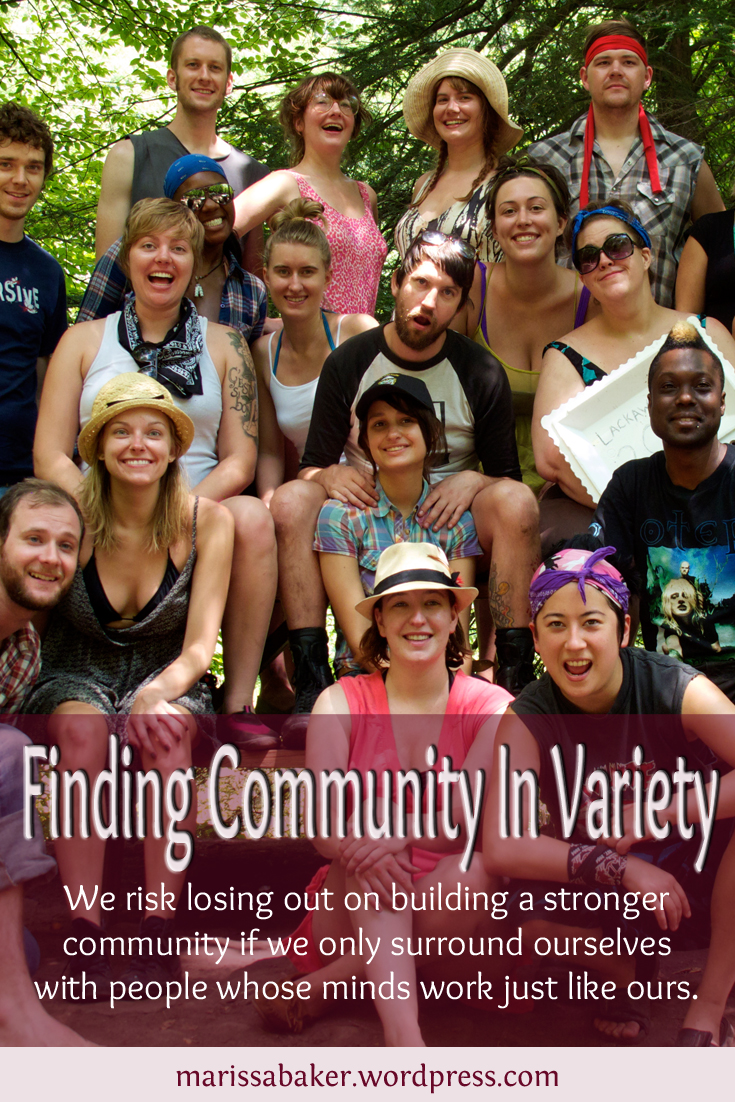
Many of us seek to surround ourselves with people who think like us. They’re the people we’re most comfortable with, the ones who identify with us, the ones with similar priorities and goals. Often this type of community is based around interests, such as spending time with people in your church, joining a bird watching club, or hanging out with friends at a ballgame. Personality similarities in these groups are typically accidental.
For those with rare personality types, though, it’s hard to find communities of like-minded people. Only about 30% of the population is made up of Intuitive types, and among those INTJ and INFJ are the rarest. How do you find community when only 1-4% of the world’s population thinks like you? Read more →
I’m sitting here thinking, “What does one write on Independence Day when one is rather disappointed in the direction one’s country is headed?” Thousands of babies are being slaughtered, we just had the largest mass shooting in US history, there’s a systematized rejection of gender and acceptance of child abuse … the list goes on and on, and our presidential candidates aren’t making things look any better. I wonder if this is something like how Hamilton felt facing the election of 1800.
Except I’m not sure which of our current candidates is Burr in this analogy and which is Jefferson. I’m probably just going to not vote at all (side note: for some reason I’ve always felt uncomfortable with/guilty for voting, even though my church doesn’t teach against it. Weird, huh?).
Anyway, this isn’t going to be a depressing post! We’re celebrating Independence Day, and I’m quite certain the best way to do that this year is listening to the Hamilton Original Broadway Cast Recording. It’s on Amazon Prime, Spotify, YouTube — you have no excuse not to listen. Nor any excuse not to think about what you’re listening to.
Hamilton didn’t win 11 out of the record-breaking 16 Tony nominations just because it’s a run-away hit with a unique musical approach. The catchiest music couldn’t have sustained this level of success without a story that resonates deeply with fans. One of the many fantastic things about Hamilton is that it presents the founding father’s as real people. They’re not glorified by rose-eyed historical glasses or torn to shreds by an opposing historical perspective trying to vilify them. They’re just real men with a vision for the future and the necessary skills and commitment to found a country that is now celebrating its 240th birthday. Not too shabby a legacy. So what does that mean for us, real people today who have the chance to influence the course of history?
A More Accurate Picture of America’s Ethnic Landscape
The only reason I would ever advocate casting with race in mind is for the purpose of historical or cultural accuracy. Now I’m re-thinking even that. A racially diverse cast works perfectly for Hamilton — America of today telling the story of America’s founding. And even though the individual characters’ casting doesn’t match the race of their historical counterparts, a racially diverse group working together to found our country is more accurate than most people think. Peter Salem (hero of the Battle of Bunker Hill), Prince Whipple (who fought alongside Washington), James Armistead (the double-spy who may have “won the revolutionary war”), Wentworth Cheswell (who rode to say “the British are coming” at the same time as Paul Revere) — they were all black, along with many other key figures in America’s founding.
Leslie Odom Jr. (Aaron Burr), Christopher Jackson (George Washington), Daveed Diggs (Marquis de Lafayette/Thomas Jefferson), Phillipa Soo (Eliza Hamilton), Renée Elise Goldsberry (Angelica Schuyler)
Renee Elise Goldsberry, who plays Angelica Schuyler, says that the most beautiful thing about Hamilton is that “it’s told by such a diverse cast with a such diverse styles of music. … We have the opportunity to reclaim a history that some of us don’t necessarily think is our own” (quote from Times article “Why History Has Its Eyes on Hamilton’s Diversity“).
One of the lines in Hamilton is “history has its eyes on me/you.” The founders knew what they were doing was going to make a mark on history, but this phrase can also be true of us today. Every generation has the potential to make its mark on history. Will future Americans look back on us and see a group of people who wouldn’t stand for white-washing of their history any more? or will they see us as complicit in maintaining the accepted historic narrative that all blacks were slaves and all whites were oppressors, even if that means marginalizing blacks who held influential positions at key points in American history?
Redefining The Moral Climate of Our Nation
One of the things Alexander Hamilton is known for is being involved in our country’s first political sex scandal. Perhaps this is one reason he was so often overlooked — he didn’t fit the squeaky-clean mold of a founding father that was popular in history books until very recently (now we seem to be going the other direction, trying to dig up as much dirt as possible on everyone. No one’s ever accused the human race of being balanced, have they?).
In a post-Clinton age it seems strange to us that when Hamilton’s affair came out the immediate reaction was “Well, he’s never gon’ be President now” (though I’m sure in more historically accurate language). The idea of someone who cheated on his wife and openly confessed it becoming president was unimaginable. Hamilton himself down-played the seriousness of the affair, concentrating on proving he was a virtuous man innocent of the financial crimes he was accused of. Or, as he says in the play, “I have not committed treason, and sullied my good name.” He even wrote that he believed his wife “will approve, that even at so great an expence, I should effectually wipe away a more serious stain from a name, which it cherishes with no less elevation than tenderness. The public too will I trust excuse the confession” (read the full text of Hamilton’s Reynold’s Pamphlet here).
Committed treason he did not, but sully his good name Hamilton certainly did. “Hamilton’s reputation was in tatters,” an article from the Smithsonian says, “Talk of further political office effectively ceased.” Now, 219 years later, can you even imagine living in nation that expects moral behavior from its politicians? Or where the politicians themselves take responsibility for their own behavior? Hamilton was so worried about the possibility of a stain on his reputation that he confessed to an affair. And even though he did down-play its severity in light of the other charges, he still said of the affair, “I bow to the just censure which it merits. I have paid pretty severely for the folly and can never recollect it without disgust and self condemnation.”
It is one of my favorite things about the play Hamilton that Hamilton takes responsibility for the affair, acknowledging that he should have said “no to this.” It doesn’t absolve Maria Reynolds of her role in seducing a married man, but there’s “No Slut Shaming in Hamilton” either (<- that blog post is what prompted me to listen to Hamilton for the first time). Today, we don’t expect people in the public eye to even take responsibility, much less to hold themselves to a certain standard of morality. We’re scandal-hungry and ready to offer judgement on celebrity short-comings, but we don’t expect anything better. Perhaps this trend will continue until there’s no longer any such thing as a socially accepted moral standard, but I hope not. And when history turns its eyes back on us, will they see a generation sliding farther into cultural decay, or one that took a stand and said, “We expect better things of our role-models and leaders”?
There are plenty of other moral, social, and political issues we could discuss. If history’s eyes really are on America today, what would you like to see change for the better in our generation? financial disparity between rich and poor? the foster care system? environmental issues? whether or not to forfeit our second amendment rights? Please share your thoughts in the comments (bonus points for using Hamilton quotes)!
I was only planning to read female authors from my Classics Club list this year (since they’re having their Women’s Classic Literature event), but a recent film trailer took me back to Tarzan of the Apes (1912) by Edgar Rice Burroughs. When I first read Tarzan as a young teen, “with the noble poise of his handsome head upon those broad shoulders, and the fire of life and intelligence in those fine, clear eyes” he became one of my (many) literary crushes (Chapter XIII).
While he was “muscled as the best of the ancient Roman gladiators … yet with the soft and sinuous curves of a Greek god,” what impressed me most was that Tarzan taught himself to read from books he found in his human parents’ cabin. He could read and write fluent English by the age of 18, even though the only other language he had any experience with was the limited vocabulary of the fictive “anthropoid apes” who raised him. By the end of the book, he speaks fluent French as well. I consider myself reasonably intelligent, had the advantage of not being raised by apes, and I haven’t even managed to become bi-lingual.
Yet shadowed by these descriptions of a super human Tarzan is a disturbing form of racism. Racism is evident from the moment the first black characters appear in the story, yet it goes far deeper than a matter of antiquated ideas about race popping up in the way a Classics author writes descriptions. Burroughs’ racism in Tarzan represents a mindset heavily influenced by evolutionary ideas about biology and race. Read more →
A couple days ago, we finally got a new trailer for Star Trek: Beyond that felt a bit more like “real Star Trek.” Now, there are Trekkies who will say none of the new films are “real Trek,” but I’m not one of them. Though parts of Star Trek (2009) and Star Trek: Into Darkness (2013) irritated me as a life-long Trekkie, overall I thought they were good stories and I’m nothing but pleased with the cast’s performances of my favorite characters (especially Karl Urban as Doctor McCoy).
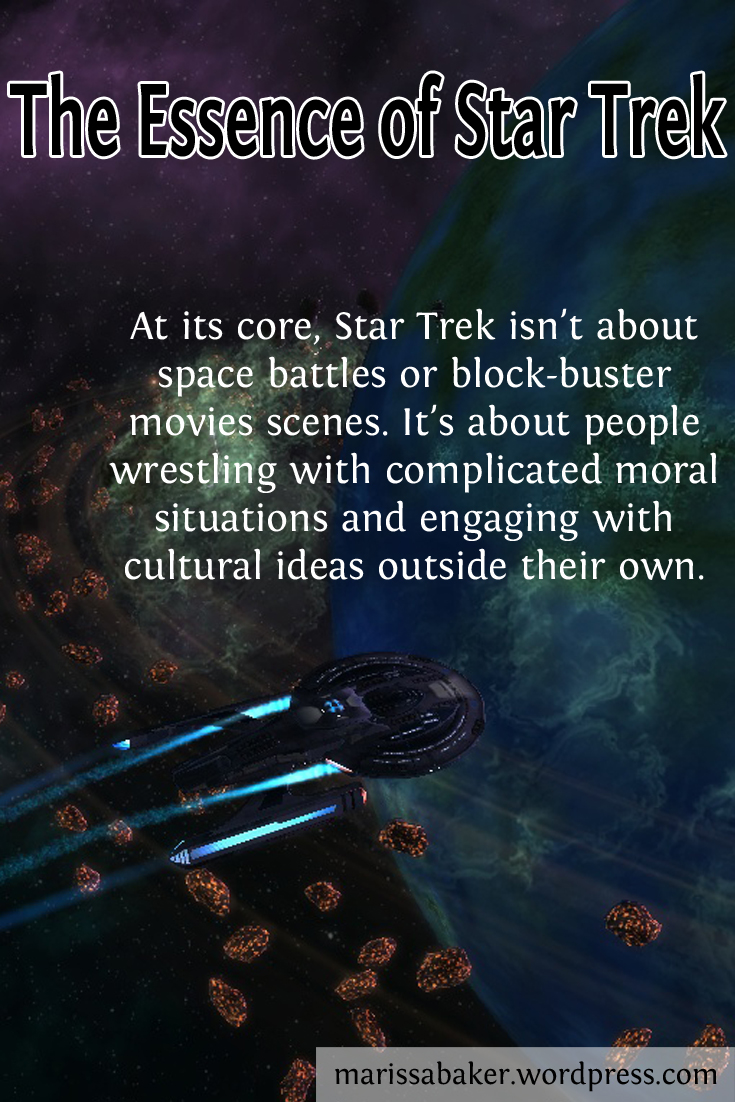
I did, however, feel these films were missing a focus that has always been core to the idea of Star Trek. Star Trek’s mission is about exploration, science, new cultures, and ideas. It’s not a space-battle heavy type of science fiction nor was it a “crisis of the week” type of show. It’s much more thoughtful than that. The new movies engaged with ideas of this nature to a certain extent, but they were also fast-paced, explosion-heavy, and largely earth-centric blockbuster films. The first trailer for Star Trek: Beyond made it look like the new film took that to an extreme. It was so bad that Simon Peg admitted he “didn’t love it” and told Trek fans “hang in there, be patient.”
In this new trailer we get discussion about Kirk’s motivation and character. We finally see hints of exploring new worlds, engaging with different cultures, and wrestling with tough ideas. This makes me happy because, at its core, Star Trek is about people trying to do the right thing in complicated situations. Trek should engage with current cultural topics in a unique way. It should support the idea that “good” and “right” are a real things rather than abstract concepts while also acknowledging it’s not always easy to know what’s the good and right thing to do.
Here’s some examples of what I’m talking about. I could list many others (the TNG episode “Measure of a Man,” for one), but for the sake of space I limited it to three episodes. *Spoilers for all episodes below*
TOS: City on the Edge of Forever
Written by science fiction legend Harlan Ellison, “City on the Edge of Forever” is regarded by many as hands-down the finest episode in the Original Series and perhaps all of Star Trek. After Doctor McCoy inadvertently alters earth’s history, Kirk and Spock travel back to the 1930s to repair the time-line, at which point Kirk (predictably) falls for a woman who needs to die for history to play-out as it should. Edith Keeler is a social-worker who runs a soup kitchen and seeks peace for the entire planet. In the correct timeline, she dies in a car accident. If Doctor McCoy saves her life, her peace movement delays U.S. involvement in World War II.
Kirk is the product of a society with the type of peaceful, one-world government Edith dreams of and fights for. He agrees with her ideologically, but he also knows that if she lives Germany’s victory prevents the formation of his unified future-earth. The whole episode grapples with the ideas of responsibility and accountability. Letting someone die is wrong, but letting a planet’s future die would also be wrong. Which is the lesser evil? Can we allow one personal tragedy in order to prevent a global catastrophe? Those are questions we’re still wrestling with today.
DS9: In The Pale Moonlight
While not one of my favorite episodes, “In the Pale Moonlight” is a good example of what we’re talking about today. The story is set during the Dominion War, and the Federation is losing. To borrow from Memory Alpha’s description, “Captain Sisko enlists Garak’s help to ‘persuade’ the Romulans to join the Federation/Klingon alliance to win the war. Sisko unwittingly learns that to save the Federation, he may have to sell his soul and the values Starfleet stands for.” Sisko, and the audience, wrestle with the question of how far the “good guys” can or should go to win a war. He begins with “good intentions,” but they’re the sort that proverbially pave a road to hell.
As the plan becomes ever more complex, he moves from spying, to fabricating false evidence, to paying off dangerous criminals with the ingredients for biogenic weapons, and finally he becomes complicit in an assassination. But Sisko hasn’t gone off the deep end — he simply came up with a plan, received approval, and kept moving forward with sanction from the Federation. Though the assassination wasn’t part of the original plan, there aren’t any repercussions for it. Romulus declares war and the Alpha quadrant is saved. Mission accomplished. But not without great moral wrestling. The episode ends with Sisko staring into the camera ending his personal log with the words, “So I will learn to live with it…Because I can live with it…I can live with it.”
STC: Lolani
Star Trek Continues really feels like a 4th season of the Original Series, and it continues Star Trek’s rich history of dealing with complicated ethical questions and current cultural issues. In this episode (click to watch), the Enterprise rescues a frightened Orion slave girl from a damaged ship. Having been taken from her family and enslaved, Lolani’s situation is very much akin to trafficked victims here on earth. You might think freeing her is the obvious, moral thing to do, but Star Trek is never simple. The episode wrestles with other issues as well, such as whether or not Lolani’s victimization can excuse her crimes and to what extent Kirk and his people can legally help her.
Since the Orion system isn’t part of the Federation and their law demands any slaves found revert to Orion control, the Federation insists Kirk return Lolani rather than risk an international incident. Kirk initially complies, then chooses to rescue her in violation of Starfleet orders. Before he can, Lolani kills herself and her master by destroying the ship. It’s too late for his change of heart to help; for his moral core to over-ride his nation’s law. That saves the Federation from war with the Orions, but what does it do to Kirk’s soul?
I’m hoping Star Trek: Beyond and the new series coming next year continue Trek’s history of tackling complex ideas, pushing us outside our cultural comfort zones, and looking at issues and ideas from multiple angles. I want more stories that make us think while they’re entertaining us.









 Like An Anchor