What Role Does The Tertiary Function Play In Myers-Briggs® Personality Types?

When we talk about psychological functions in Myers-Briggs® types, the tertiary function often gets over looked. Usually, we talk about the two that we use most often or about the inferior function that usually shows up under stress. These three functions are hugely important. Our dominant and co-pilot processes need to work together for us to have healthy, balanced personalities. And we need to understand the inferior function so we’re better equipped to recognize and deal with how we react to stressful situations. But the tertiary function is also important.

To learn more about how your inferior function works, check out my article “What Does Each Myers-Briggs® Type Look Like When They Get Stressed-Out?” And if you need a refresher on cognitive functions, or if this part of Myers-Briggs® is new to you, read “The Simplest Guide to Myers-Briggs® Functions Ever

The tertiary function is also called the “relief function.” In Personality Hacker’s car model (affiliate link), they call it the 10-year-old because that’s the level of maturity this function typically has. Psychologist John Beebe named it the “Eternal Child” after one of Carl Jung’s archetypes. Though we don’t talk about this function nearly as much as some of the others, it’s also a key part of our personality. Understanding the tertiary function, and how it relates to the other functions, can really help us understand ourselves.

Growth And The Functions

In terms of typology, personal growth happens when we’re using both our introverted and our extroverted sides, as well as our judging and perceiving sides. Working to find a balance between our dominant and co-pilot processes leads to growth and change because we’re exercising all these aspects of our personality. Read more
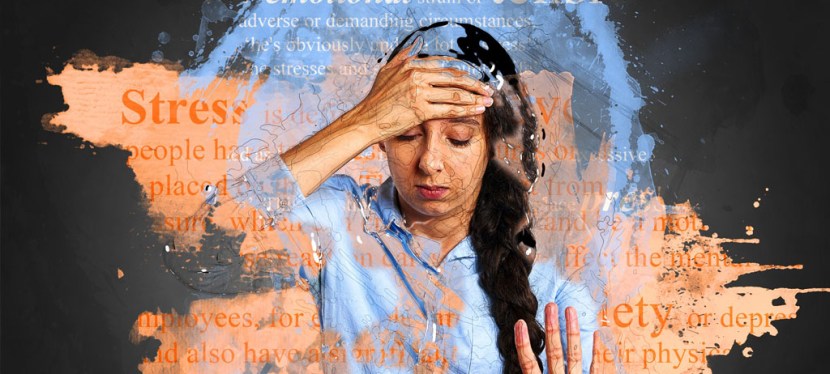
What Does Each Myers-Briggs® Type Look Like When They Get Stressed-Out?

Stress is something we all have to deal with. It’s part of being human. But how we each react to stress is, at least partly, determined by our personality types.

Each personality type has four mental processes called “cognitive functions” that they use when living their day-to-day lives. These functions describe how our minds work. For example, an ESTJ type is most comfortable using Extroverted Thinking to make decisions in the outer world. That’s supported by their co-pilot Introverted Sensing, which is their preferred way to learn and process information. Then they have a tertiary process called Extroverted Intuition, which they’re not quite as comfortable with. The fourth function, in this case Introverted Feeling, is called the inferior process and it’s not well developed at all.

For more information on how cognitive functions work, read “The Simplest Guide to Myers-Briggs® Functions Ever

When we’re stressed-out our minds typically go to our inferior process. (We can also “loop” between our dominant and tertiary, but that’s a topic for another post). This explains why we start acting out of character when under stress. Stress throws off the familiar, comfortable balance of our mental processes and changes how we deal with things. And because we each use a different combination of these mental functions, a stress-response is going to look a little different for each type.

Why Study Stress-Responses?

Recognizing what a stress-reaction looks like for different types can help us in several ways. If you’re in any kind of relationship with someone, knowing what happens when they’re stressed can give you a different perspective on them when they start to act out a character. Instead of being puzzled by their behavior, you can recognize it as the way they respond to stress.

In terms of our relationship with ourselves, knowing our own stress reactions can help us recognize when we need to practice some self-care. If you’re starting to go into your inferior function, then it’s time to take a look at your life and figure out what’s the cause of your stress and how you can get yourself back into balance. Read more

Why Is It So Hard For Certain Personality Types To “Just Get Over It”?

You know when you’re struggling with something bad that happened to you and someone says, “Just get over it,” but you know it’s not that simple? For some reason, this particular hurt lodged deep inside and letting go seems well-nigh impossible.

For this post, I’m not talking about a hurt like grief over losing someone you love. We know why things like that are hard to “get over,” and in many cases it wouldn’t be appropriate to move on quickly. Most people recognize that hurts of that sort require time to heal and grieve. I’m talking about interpersonal hurts that might seem “little,” but have a big impact anyway. For example…

  • You express an authentic part of yourself (like your happy, fun-loving side), then people assume that’s all there is to your personality.
  • You receive 99% positive feedback about a project, but that 1% haunts you anyway.
  • You help someone out of the goodness of your heart, but others misinterpret your motives.
  • You decide to open up to someone, then lie awake at night worrying about their reaction.

Hurts like this touch on the core of who we are and/or our relationships with other people. These hurts are often deeply individual, and others might not understand them. If you don’t care what other people think of you, then you’re not going to understand why someone else is so upset about the one person in their life who’s a critic. If you find it easy to adapt to different social situations, you might not understand why someone’s so upset about not being able to express their true self all the time.

The reason why things like this can hurt us so deeply is often nuanced and complicated, but it has a lot to do with how we use the Feeling sides of our personalities. Everyone has a Feeling side (whether or not there’s an F in your four-letter Myers-Briggs® type), and we each use this part of our personality a little differently. Read more

Dating Your Mirror: ENFP and INFJ Relationships

Once upon a time, I told my sister, “I don’t think I’d ever date an ENFP.” Even though I’d seen lots of people describing ENFP-INFJ as a “perfect” pairing it just didn’t sound like a good fit for me. I loved having ENFP friends, but the ones I knew were either so intense they made me feel anxious, or so extroverted they wore me out, or too scattered for me to think I wouldn’t eventually get irritated with them in a closer relationship (or all of the above).

Then a few years after making this statement, I started actually getting to know one of my ENFP acquaintances. And now we’re dating (doesn’t that sound like just the sort of coincidence that would happen in a romance  story?). He does have an intense personality but I’ve done enough work overcoming my social anxiety that doesn’t scare me any more (actually, it’s rather exciting). He’s the most extroverted person I know but I’ve discovered it’s not a problem for us. And he’s not scattered or flaky (which, it turns out, is another of those unfair/too widely applied stereotypes bouncing around Myers-Briggs circles).

Now, I could spend the next 1,000+ words telling you about how wonderful my boyfriend is but that’s probably not what you clicked on this post for (if it was I’m afraid you’re going to be disappointed). Instead, we’re going to talk about why ENFPs and INFJs have a reputation in Myers-Briggs circles for getting along so well. Read more

Disney Villains Myers-Briggs Chart – Part Two

Last week I posted my chart with Disney villains Myers-Briggs types. It turned into such a big post that I finally split it in half — Sensing types in Part One and Intuitive types today in part two (some of you probably saw the whole post last week. It was live for a few hours before I decided splitting it up would be more manageable). To re-cap, here’s my criteria for which villains are included in this chart:

  • All Primary Members of the Disney Villains franchise show up here, except Chernabog.
  • I then added a few other popular villains, paying special attention to the villains from films where I’ve already typed a Disney heroine.
  • To keep the number of villains manageable, I decided not to type any of their side-kicks or secondary villains.
  • I’m only typing the animated versions. This is mostly to maintain consistency, since sometimes the type changes in live-action reboots (such as Maleficent becoming more INFJ when she got her own film).

Disney Villains Myers-Briggs Chart | marissabaker.wordpress.com

As I mentioned last week, if you compare this chart to the ones I made for Disney Princesses, you’ll see they’re almost opposite each other. The spots on the chart that stood empty for the Princesses (ENFJ, INTJ, INTP) now have at least one occupant and some of the spots bursting with princesses don’t have any villains at all. The biggest trend seems to be Feeling types equal “good” and Thinking types equal “evil” (which really bugs me, but that’s a rant for another time).

There’s not much to go on for typing some of the villains. They’re often caricatures of personality types rather than fully-fleshed out characters. By necessity, associating a villain with a certain types means looking at the most negative stereotypes of that type. But Disney typing is fun, so even when we don’t have much to work, I’m going to take a guess at the character. You’re welcome to shout-out in the comments about what you do and don’t like! Have fun 🙂

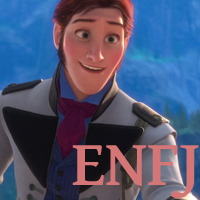
Hans — ENFJ

Hans - ENFJ. Visit marissabaker.wordpress.com for more Disney villain typesI love NF type villains. They’re not the typical choice for a fictional bad guy and their motives aren’t always immediately understandable, which is part of makes them an unexpected and unpredictable character.

  • Fe: Types that lead with Fe often have the easiest time connecting with people. Which means they can be the most charming, manipulative villains you’ll ever see. Hans’ entire plan is based on charming one of the sisters into marrying him (which he does easily by creating an instant connection with Anna). He’s also writing a narrative that makes him “the hero that’s going to save Arandel” as he manipulates all Elsa’s advisors until they’re begging him to be king.
  • Ni: This shows up in his long-term thinking. As the youngest of 13 brothers, he decided that taking over a different kingdom was better than the life he could see continuing on in the future at home.
  • Se: Typically a fun-loving and risk-taking aspect of personality, which helps him charm Anna initially and also shows up in his physical skills like dancing and swordfighting.
  • Ti: Logic is not an ENFJ’s strongest suit. Hans’ entire plan rests on getting people to feel the way he wants them to rather than not on something concrete and he doesn’t have a backup plan.

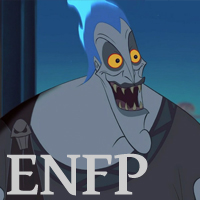
Hades — ENFP

Hades - ENFP. Visit marissabaker.wordpress.com for more Disney villain typesThere’s little disagreement that Disney’s Hades is an NP type and none at all that he’s an extrovert. People just can’t agree on Thinking or Feeling. Both ENxP types lead with Ne, so it comes down to whether he uses Fi/Te (ENFP) or Ti/Fe (ENTP) to make decisions. Read more

Disney Villains Myers-Briggs Chart – Part One

It’s finally here! The baddest evildoers to ever oppose animated Disney heroism — now with Myers-Briggs types. There are a lot of villains that show up in Disney stories so I had to whittle it down to a fairly short list. Here’s my criteria:

  • All Primary Members of the Disney Villains franchise show up here, except Chernabog.
  • I then added a few other popular villains, paying special attention to the villains from films where I’ve already typed a Disney heroine.
  • To keep the number of villains manageable, I decided not to type any of their side-kicks or secondary villains.
  • I’m only typing the animated versions. This is mostly to maintain consistency, since sometimes the type changes in live-action reboots (such as Maleficent becoming more INFJ when she got her own film).

Disney Villains Myers-Briggs Chart | marissabaker.wordpress.com

If you compare this chart to the ones I made for Disney Princesses, you’ll see they’re almost opposite each other. The spots on the chart that stood empty for the Princesses (ENFJ, INTJ, INTP) now have at least one occupant and some of the spots bursting with princesses don’t have any villains at all. The biggest trend seems to be Feeling types equal “good” and Thinking types equal “evil” (which really bugs me, but that’s a rant for another time).

There’s not much to go on for typing some of the villains. They’re often caricatures of personality types rather than fully-fleshed out characters. By necessity, associating a villain with a certain types means looking at the most negative stereotypes of that type. But Disney typing is fun, so even when we don’t have much to work, I’m going to take a guess at the character. You’re welcome to shout-out in the comments about what you do and don’t like! Have fun 🙂

  • Please note: there were so many villains to type that I split them up into two blog posts. Part One covers the Sensing Type villains and Part Two will cover the Intuitive types.
  • One more note: I mostly type by function stacks, so if you’re not familiar with that part of Myers-Briggs theory you can click here to read The Simplest Guide To Myers-Briggs Functions Ever.

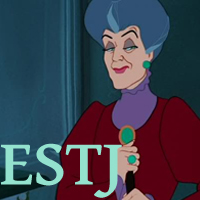
Lady Tremaine — ESTJ

Lady Tremaine - ESTJ. Visit marissabaker.wordpress.com for more Disney villain typesMost people type her as a TJ type (at least in the animated version), but beyond that there isn’t any agreement about her I/E or S/N preference. I’m pretty sure she’s a Sensor, but I’ve gone back and forth between introvert and extrovert. I’ve gone with extrovert because she’s very inclined to take-charge in the outer world and we don’t really see her spending any time alone.

  • Te: The opening narration describes her as “cold, cruel, and bitterly jealous of Cinderella’s charm and beauty.” While not a fair representation of TJ types, “heartless” is an accusation stereotypically leveled against them, especially women. She’s very outwardly judgemental and her communication consists of authoritative orders.
  • Si: My guess is that Lady Tremaine married Cinderella’s father for security. She already had a “good family” so she wasn’t social climbing. While we do see her trying to forward her daughters’ interests, it’s not really as part of a N-type’s long-term planning. She’s working within traditional roles to control and manipulate people.
  • Ne: A pattern-recognition function, Extroverted Intuition helps Lady Tremain put the pieces together and realize Cinderella was the mystery woman at the ball.
  • Fi: As an inferior function, Introverted Feeling can show up as outbursts of emotion and a fear of feeling. Lady Tremain is a very detached character, never showing her feelings for the people around her unless it’s in an angry outburst.

Queen of Hearts — ESTJ

Queen of Hearts - ESTJ. Visit marissabaker.wordpress.com for more Disney villain typesThe Queen of Hearts is one of the more exaggerated Disney villains. ESTJ nicknames include Supervisor, Executive, Overseer, and Enforcer. Take that to a villainous extreme and you just might get someone who lops off subordinates’ heads when things don’t go as they ordered. Read more