Keep Planting, Even If You’re Weeping

Last week, I’d stayed up later than usual and instead of reading a chapter in Acts before bed, I turned to the Psalms to find a short passage to read. I just happened to open the Bible (a Tree of Life Version that I keep in my nightstand) to Psalm 126. Something about this translation caught my eye, and it prompted today’s post. Here’s the full psalm to start us off:

When Adonai restored the captives of Zion,
it was as if we were dreaming.
Then our mouth was filled with laughter,
and our tongue with a song of joy.
Then they said among the nations,
Adonai has done great things for them.”
Adonai has done great things for us
    —we are joyful!
Restore us from captivity, Adonai,
like streams in the Negev.
Those who sow in tears
will reap with a song of joy.
Whoever keeps going out weeping,
    carrying his bag of seed,
will surely come back with a song of joy,
    carrying his sheaves.

Psalm 126, TLV

It’s that last verse that captured my attention: “Whoever keeps going out weeping, carrying his bag of seed, will surely come back with a song of joy, carrying his sheaves.” It might (if you’re at all familiar with American gospel songs and Protestant hymns) make you think of the 1874 hymn “Bringing in the Sheaves.” For me, the part that captured my attention is this “keeps going out” line.
Keeping Going Out

In Psalm 126:6, some translations simply say, “He who goes out weeping” (WEB) but the TLV and others like the NKJV include this sense of continuing to go out while you’re weeping. The setting for this psalm is restoration from captivity. Israel had gone into captivity, and now God delivered them and brought them back to the land. The psalmist is looking back on this and making an agricultural analogy.

Suppose you’re in the spring, ready to plant, but something happens. It’s a set back, a tragedy, a calamity, a grief-inducing event. It’s the sort of thing that would make you weep. At that point, you have a choice. You can “keep going out” and sowing into the future, or you could give up. But you know that if you want to reap a harvest, you need to plant seed. Similarly, the metaphorical future “harvest” that we get in our own lives is determined (at least in part) by what we “sow” now.

Do not be deceived. God will not be made a fool. For a person will reap what he sows, because the person who sows to his own flesh will reap corruption from the flesh, but the one who sows to the Spirit will reap eternal life from the Spirit. So we must not grow weary in doing good, for in due time we will reap, if we do not give up.

Galatians 6:7-9, NET

If the agricultural metaphor isn’t working for you, we can relate it to other things with a cause and effect. If you put a steady diet of unhealthy food into your body, you’ll get an unhealthy body; if you eat healthy foods, you’ll have a healthier body. Sowing (like how we eat and whether we exercise) is an investment in the future, for better or worse.

Notice that Paul says “we must not grow weary in doing good” and that we should “not give up.” Sowing is a long-term investment. It takes time for the seed to sprout, grow, and bear fruit. We might not see the results of it for quite some time. As Psalm 126 says we need to “keep going out” to sow, trusting that God will give us a good harvest.
Planting In Hope

The word “hope” isn’t used in the psalm that we’re looking at today, but it’s an essential ingredient for what we’re talking about here.

 For it is written in the law of Moses, “Do not muzzle an ox while it is treading out the grain.” God is not concerned here about oxen, is he? Or is he not surely speaking for our benefit? It was written for us, because the one plowing and threshing ought to work in hope of enjoying the harvest. 

1 Corinthians 9:9-10, NET (bold italics mark a quotation from Deut. 25:4)

Here, Paul is saying that teachers of the word have the right to make their living by preaching the gospel (1 Cor. 9). The basic principle is that if you put the work into something, you have a right to expect to enjoy the results of that labor. Hope in the Bible isn’t something nebulous. When hope is related to God, there’s a level of certainty to it. God provides a solid anchorage for our hope (Heb. 6:19), giving us good reason to confidently expect that if we keep going out sowing, we will eventually bring in a harvest with joy.

 Not only this, but we ourselves also, who have the firstfruits of the Spirit, groan inwardly as we eagerly await our adoption, the redemption of our bodies. For in hope we were saved. Now hope that is seen is not hope, because who hopes for what he sees? But if we hope for what we do not see, we eagerly wait for it with endurance.

Romans 8:23-25, NET

Come Back Rejoicing
One of the things that we humans can find frustrating is that God is a long-term thinker. When He promises to give us the desires of our heart, for example (Ps. 37:6), we want that to happen immediately. I didn’t expect it to take 15+ years and a healthy dose of heartache before He answered my prayers to be a wife and mother, but then I found myself marrying a wonderful man and just over a year later having a beautiful daughter with him. I don’t think I’d be so blessed now if I hadn’t continued “sowing into” my life and my relationship with God during the season of weeping.

When we read, “all things work together for good for those who love God, who are called according to his purpose” (Rom. 8:28, NET), we often forget that Paul is talking on a cosmic timescale. Before the statement about all things working together for good, he says, “I consider that our present sufferings cannot even be compared to the coming glory that will be revealed to us” (Rom. 8:18, NET; see Rom. 8:18-30). Sometimes–even often–a harvest of joy happens now, in our human lives. But even if it doesn’t happen now, it will certainly happen at the end if we don’t give up.

My aim is to know him [Jesus Christ], to experience the power of his resurrection, to share in his sufferings, and to be like him in his death, and so, somehow, to attain to the resurrection from the dead.

Not that I have already attained this—that is, I have not already been perfected—but I strive to lay hold of that for which Christ Jesus also laid hold of me. Brothers and sisters, I do not consider myself to have attained this. Instead I am single-minded: Forgetting the things that are behind and reaching out for the things that are ahead, with this goal in mind, I strive toward the prize of the upward call of God in Christ Jesus. Therefore let those of us who are “perfect” embrace this point of view. If you think otherwise, God will reveal to you the error of your ways.

Philippians 3:10-15, NET

Scripture encourages us to look beyond our immediate circumstances with hope, trusting in the glorious future that God has planned for us. Long-term, if we’re going to “reap” the future God promises to His firstfruits, we need to keep pressing on toward the goal of eternal life. It’s this perspective that lets us “consider it nothing but joy when you fall into all sorts of trials, because you know that the testing of your faith produces endurance” and endurance helps bring us to perfection (James 1:2-3, NET). You’ll reap blessings in this life as well (especially if you have a mindset that looks for and recognizes them), but the biggest blessings we have are the opportunity to become God’s children and the promise of eternal life forever with Him after He “harvests” us with great joy.


Featured image by vargazs from Pixabay

Song Recommendation: “Bringing In The Sheaves”

What Will God’s People Do In The Future?

I just got home from celebrating the Feast of Tabernacles (Sukkot) with my family and many other believers around the world. My family was in Tennessee this year for the Feast, and the fall colors on the trees made for a beautiful backdrop to this joyful festival season. If you’re not familiar with this Feast as one of God’s holy days, check out my post “Understanding the Days that God Calls Holy To Him.” If you are familiar with this day, then you probably know that we believe it pictures the Millennial reign of Jesus Christ after His second coming.

In the future, Jesus will return to earth again. Faithful believers who died will be resurrected and those still alive will rise up along with them to meet Jesus. We’ll be changed, then, to spirit beings like God (1 Cor. 15:52; 1 John 3:2) as the Father completes the process of birthing/adopting us into His family as children and then marrying us to His Son Jesus. The adversary, Satan, will be locked away, and a 1,000-year time period we call the Millennium will begin where Jesus reigns over the earth (Rev. 20).

Then what happens? What are we going to be doing during the Millennium in God’s kingdom, and even into the future after that?

Reign With Him

The main thing we know about our role in the Millennium is that we’ll be working alongside Jesus Christ. We’re told in Revelation that the faithful believers who died (i.e. “fell asleep” in Jesus) and rise again in the first resurrection “will be priests of God and of Christ, and they will reign with him for a thousand years” (Rev. 20:6, NET). We know from other passages this will be a resurrection to spiritual life (1 Cor. 15). If we’re in this group, we’ll be like God and death will no longer have power over us (1 John 3:2; Rev. 20:6).

 So I endure all things for the sake of those chosen by God, that they too may obtain salvation in Christ Jesus and its eternal glory. This saying is trustworthy:

If we died with him, we will also live with him.
If we endure, we will also reign with him.

2 Timothy 2:10-12, NET

Salvation is a process that culminates in our change to spirit beings as part of God’s family. As God-family members, we’ll reign alongside Jesus Christ, seated with Him on His throne (Rev. 3:21-22). Most of the other things that we know we’ll be doing are part of this role.

Image of a man sitting on a beach at sunset overlaid with text from Rev. 20:6, NET version: "Blessed and holy is the one who takes part in the first resurrection. The second death has no power over them, but they will be priests of God and of Christ, and they will reign with him for a thousand years.
Image by Aaron Kitzo from Lightstock

Serve as Priests

We already read the verse that says, “they will be priests of God and of Christ, and they will reign with him for a thousand years” (Rev. 20:6, NET). This is actually a role that God’s people were supposed to start filling all the way back in the time of Exodus. When ancient Israel arrived at Mount Sinai, Yahweh told Moses to tell the people, “Now therefore, if you will indeed obey my voice and keep my covenant, then you shall be my own possession from among all peoples; for all the earth is mine; and you shall be to me a kingdom of priests and a holy nation” (Ex. 19:5-6, WEB). Israel never lived up to that goal, but that’s still something God wants from His people.

 you yourselves, as living stones, are built up as a spiritual house to be a holy priesthood and to offer spiritual sacrifices that are acceptable to God through Jesus Christ. … you are a chosen racea royal priesthooda holy nationa people of his own, so that you may proclaim the virtues of the one who called you out of darkness into his marvelous light. 

1 Peter 2:5, 9, NET (italics mark allusions to and quotations from Ex. 19:5-6; Is. 43:20-21; Mal. 3:17)

In the introduction to Revelation, John says Jesus Christ “loves us and has set us free from our sins at the cost of his own blood and has appointed us as a kingdom, as priests serving his God and Father” (Rev. 1:5-6, NET). Note that there is a slight discrepancy in the Greek here: some manuscripts use the word basileia (kingdom) and some use basileus (king). That’s why you’ll see “kings and priests” or “kingdom of priests” or “priestly kingdom” depending on the translation. Either way, we’ll have a duty to serve within God’s kingdom as priests.

Rule as Judges

Though it’s unclear whether anyone in the resurrection will be called a “king” other than David (Ezk. 37:24), we will be filling a ruling role as we reign alongside Jesus. It seems that this role is closely linked with that of having authority to judge.

Then Peter said to him, “Look, we have left everything to follow you! What then will there be for us?” Jesus said to them, “I tell you the truth: In the age when all things are renewed, when the Son of Man sits on his glorious throne, you who have followed me will also sit on twelve thrones, judging the twelve tribes of Israel.”

Matthew 19:27-28, NET

This verse is specifically about the 12 Apostles, but Paul tells us “that the saints will judge the world” and even that “we will judge angels” (1 Cor. 6:2-3, NET). How to judge righteously is one of the things we should be learning now, in this life (1 Cor. 6:1-11), partly because it’s an aspect of God’s character that we need to develop to be more like Him and partly because it’s a skill we’ll need in the future.

“And to the one who conquers and who continues in my deeds until the end, I will give him authority over the nations—

he will rule them with an iron rod
and like clay jars he will break them to pieces,

just as I have received the right to rule from my Father—and I will give him the morning star. The one who has an ear had better hear what the Spirit says to the churches.”

Revelation 2:26-29, NET (bold italics mark a quotation from Ps. 2:9)

God places a high value on righteousness and justice. He prioritizes those things when He uses His authority as judge, and we will be following that pattern of judging righteous judgement (John 7:24) with the authority He’ll give us in the Millennium. Sometimes, righteousness and justice demand punishment as consequences for wrongdoing, but we’ll also get the chance to exercise godly mercy.

Image of a Bible lying open on a wood platform with sunlight shining on the pages overlaid with text from Isaiah 32:1, WEB version: "Behold, a king shall reign in righteousness, and princes shall rule in justice."
Image by Lamppost Collective from Lightstock

Serve As Jesus Does

It’s vital that we remember God’s idea of a reigning, ruling, authority figure is very different than what the world typically thinks of. When humans have a lot of power, they almost universally abuse it. God will not tolerate such a thing from His people, now or in the Millennium.

But Jesus called them and said, “You know that the rulers of the Gentiles lord it over them, and those in high positions use their authority over them. It must not be this way among you! Instead whoever wants to be great among you must be your servant, and whoever wants to be first among you must be your slave—just as the Son of Man did not come to be served but to serve, and to give his life as a ransom for many.”

Matthew 20:25-28, NET

We’ll rule the same way that Jesus does–by serving the people under our authority. Pride, arrogance, and lording it over others has no place in a godly ruler. In fact, treating other people like that now can disqualify us from being in God’s kingdom (Matt. 24:45-51). This brings us to an important point. God is watching us today and making a judgement as to whether we can be trusted with the roles He plans to give His people in the future (1 Peter 4:17). If we can’t show Him now that we can become humble, service-oriented, teachable people who will faithfully follow His will, then He’s not going to entrust us with the true riches (Luke 16:10-11).

Teach People

We’ve been talking about how we’ll be ruling, but who will we be ruling? When you read through Revelation, you’ll notice that there are people who aren’t included in the first resurrection and who aren’t killed during the tribulation. There will be human beings alive in the Millennium who survive the end times leading up to Jesus’s return and live on into the Millennium. By the time Satan is released at the end of the 1,000 years, there are whole nations on earth for him to attempt to deceive (Rev. 20:7-8). Coupling that information with Old Testament prophecies (for example, Is. 11:1-9; 65:17-25), we can piece together that when the saints are ruling with Jesus as spirit beings who are part of God’s family, there will also be physical human beings on the earth.

For the people will dwell in Zion at Jerusalem. You will weep no more. He will surely be gracious to you at the voice of your cry. When he hears you, he will answer you. Though the Lord may give you the bread of adversity and the water of affliction, yet your teachers won’t be hidden any more, but your eyes will see your teachers; and when you turn to the right hand, and when you turn to the left, your ears will hear a voice behind you, saying, “This is the way. Walk in it.”

Isaiah30:19-21, WEB

If we’re worthy to be in the first resurrection and rule with Jesus as kingly priests, it’s very likely that we’ll be the teachers saying, “This is the way” and showing people how to walk with God. God wants His people to “obey my statutes and carefully observe my regulations” now and there’s no indication that will change in the future (Ezk. 36:27, NET). We will continue to serve Him and keep His commands and we’ll teach others to do so, including the command to keep His Sabbaths and holy days like the Feast of Tabernacles (Zech. 14:16-19).

Live Forever With God

Image of a woman with her arms raised in worship silhouetted by a sunset, overlaid with blog's title text and the words, "God has a glorious future planned for His people, which includes ruling alongside Jesus and doing the things that godly rulers do."
Image by Brittney BorowskiL from Lightstock

Once God transforms us into spirit beings, death has no more power over us . We’ll be immortal (1 Cor. 15:50-54; 1 Thes. 4:16-17). For those in the first resurrection and those who are written in the Book of Life following the end of the Millennium and the second resurrection, life continues on after the Millennium. We don’t know much about what we’ll be doing as we live forever with God, but we know that there will be a profound change in the earth and that humanity will live more closely with God than ever before.

 Then I saw a new heaven and a new earth, for the first heaven and earth had ceased to exist, and the sea existed no more. And I saw the holy city—the new Jerusalem—descending out of heaven from God, made ready like a bride adorned for her husband. And I heard a loud voice from the throne saying: “Look! The residence of God is among human beings. He will live among them, and they will be his people, and God himself will be with them. He will wipe away every tear from their eyes, and death will not exist any more—or mourning, or crying, or pain, for the former things have ceased to exist.”

Revelation 21:1-4, NET

It can be fun to speculate about the details of what we might be doing in this incredible future, but God evidently didn’t want to tell us too much. I suspect the long-term future He has planned is so wonderful we couldn’t wrap our minds around it. We just need enough of a glimpse to know that we want to be there, and to motivate us to keep growing toward the goal of spending forever with God.

God’s plan is so beautiful, and at the end of the story told in the Bible He promises a “happily ever after” greater than we could possibly imagine. Satan and his influence will be done away with. Peace will fill the whole earth. And, assuming we are among the faithful holy people of God during our human lives, we’ll be transformed into spirit beings who are part of God’s family. As God-family members, we’ll be ruling with Jesus Christ and doing the things that Godly rulers do: serving humbly, judging righteously, and teaching truthfully.


Featured image by Lamppost Collective from Lightstock

When God Does (and Doesn’t) Share His Glory

Almost two weeks ago, I was reading my devotional for this year when the author, Chris Tiegreen, made a point that I’d never thought about before. He pointed out that God once said He doesn’t share His glory with others, but He does share His glory with His children (The One Year Hearing His Voice Devotional, June 17). In the first case, God is being zealous for His reputation and relationship with His people, refusing to share the glory due to Him as Yahweh with idols or anything else. But in the second case, He’s inviting people to become part of His family and share in the glory that belongs to Him.

It’s really an amazing thought. Our God is great and powerful, almighty and sovereign. He has absolute and ultimate authority that no one else can check. He’s truly glorious and inherently holy. It’s incredible that He pays attention to us at all, let alone that He invites us to become part of His family and wants to make us like Him.

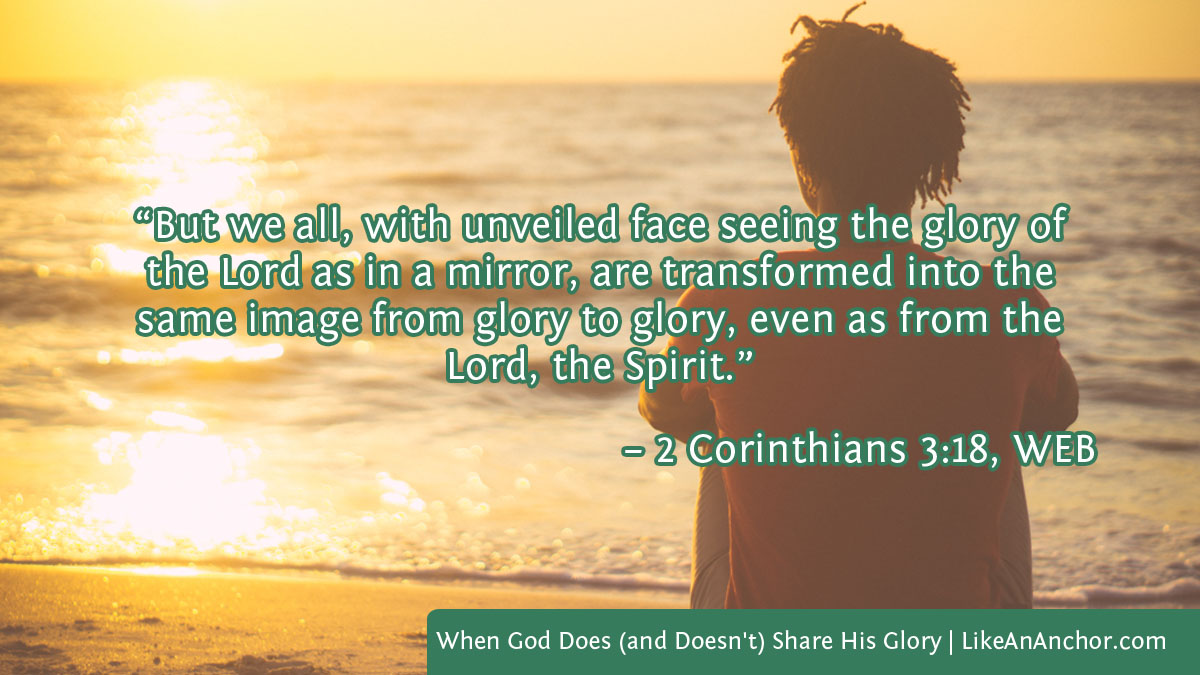
Image of a man sitting on a beach watching the sunset overlaid with text from 2 Cor. 3:18 version: “But we all, with unveiled face seeing the glory of the Lord as in a mirror, are transformed into the same image from glory to glory, even as from the Lord, the Spirit.”
Image by Aaron Kitzo from Lightstock

Our Jealous God

There are two places, both in Isaiah, where God specifically says “I will not share my glory” or “I will not give my glory to” anyone else (phrasing depends on translation). Let’s take a look at those; they’re both part of the final section of Isaiah, which we studied extensively here on this blog a couple years ago.

“I am Yahweh.
    That is my name.
    I will not give my glory to another,
    nor my praise to engraved images.

Isaiah 42:8, WEB

For my sake alone I will act,
for how can I allow my name to be defiled?
I will not share my glory with anyone else!

Isaiah 48:11, NET

Notice the emphasis God places on His name. In Hebrew thought, names are linked with reputation. God cares about how people see His name; it should be regarded as holy. He won’t allow people to defile His name, and He doesn’t share His glory with anyone else. I think this links back to some of God’s warnings in Exodus. When He made a covenant with ancient Israel, He made sure to let them know that He would not tolerate them worshiping other gods. It’s right there at the beginning of the 10 commandments.

 God spoke all these words, saying, “I am Yahweh your God, who brought you out of the land of Egypt, out of the house of bondage.

“You shall have no other gods before me.

“You shall not make for yourselves an idol, nor any image of anything that is in the heavens above, or that is in the earth beneath, or that is in the water under the earth: you shall not bow yourself down to them, nor serve them, for I, Yahweh your God, am a jealous God

Exodus 20:1-5, WEB

Later in Exodus, God reinforces this command. He warns Israel not to make covenant relationships with the other nations in the promised land and to destroy all their altars, places of worship, and idols because “you shall worship no other god; for Yahweh, whose name is Jealous, is a jealous God” (Ex. 34:14, WEB). We often think of jealousy as bad, but God feels it as a right and proper emotion. His jealousy is “zeal for one’s own property” or spouse (Theological Wordbook of the Old Testament, entry 2038). Just like a husband or wife doesn’t want to share their spouse with someone else, God doesn’t want to share His people with another god or anything else they might prioritize above Him.

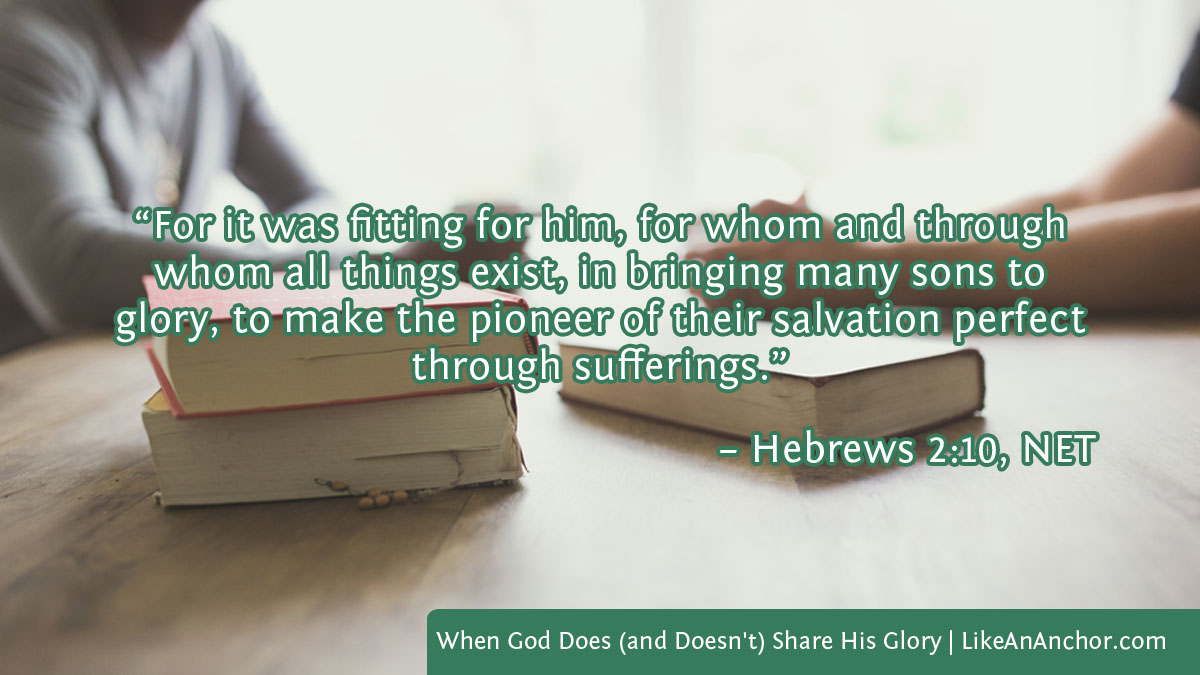
Image of two men sitting across a table from each other with books on the table overlaid with text from Heb. 2:10, NET version: “For it was fitting for him, for whom and through whom all things exist, in bringing many sons to glory, to make the pioneer of their salvation perfect through sufferings.”
Image by Claudine Chaussé from Lightstock

Shared, Familial Glory

In the New Testament, most of the time when “glory” is mentioned, it’s in the context of glorifying God or acknowledging the glory of Jesus Christ. That’s no surprise–they’re the ones who deserve glory, and if we see them correctly we’ll know to glorify Them rather than something or someone else. What’s surprising is that there are moments when God chooses to share His glory.

“I am not praying only on their behalf, but also on behalf of those who believe in me through their testimony, that they will all be one, just as you, Father, are in me and I am in you. I pray that they will be in us, so that the world will believe that you sent me. The glory you gave to me I have given to them, that they may be one just as we are one—I in them and you in me—that they may be completely one, so that the world will know that you sent me, and you have loved them just as you have loved me.”

John 17:20-23, NET

There’s so much just in this little section of Jesus’s prayer before His death that should make our jaws drop. He prayed for us, looking ahead to think of all the people who would believe in Him because of what His disciples would teach. He prayed for oneness between us and Him and the Father–that we’d actually get to share in the same relationship They have with each other. He says He gives glory to them–all those who believe in Him–just like the Father gave Him glory. He even says that the Father loves us the same way He loves Jesus.

This should blow our minds. Our jealous God, zealous to guard the glory of His name and keep an exclusive relationship with His people, decided to share His glory in a very specific way. Even though all human beings “have sinned and fall short of the glory of God” (Rom. 3:23, NET), He’s inviting people to join Him in His family and thereby receive His glory. It’s not like we’re earning glory on our own; we get to have glory because He is glorious and He’s making us like Him.

Called To A Glorious Future

Image of two girls studying a Bible, overlaid with blog's title text and the words, "God doesn't share His glory with just anyone, but He wants to share it with us. He won't tolerate rival deities, but He's making us part of His family."
Image by Ryan Klintworth from Lightstock

God called us for a purpose. He wants to grow His family. That’s been His plan from the beginning: to make more god-beings who will be the Father’s children, Jesus’s younger (adopted) brothers and sisters, and who will make up Jesus’s bride. In other words, He wants to share His glory by making us like Him (2 Thess. 2:13-14; Heb. 2:9-10; 1 Pet. 5:10-11).

As you know, we treated each one of you as a father treats his own children, exhorting and encouraging you and insisting that you live in a way worthy of God who calls you to his own kingdom and his glory.

1 Thessalonians 2:11-12, NET

We’ve been called to glory now, but it’s not fully shared with us yet. That’s happening in the future, just like we are already the children of God but we’re still waiting to see exactly what it means that we will be like God (1 John 3:1-2).

But our citizenship is in heaven—and we also eagerly await a savior from there, the Lord Jesus Christ, who will transform these humble bodies of ours into the likeness of his glorious body by means of that power by which he is able to subject all things to himself.

Philippians 3:20-21, NET

In the future, after Jesus’s return, we’ll be transformed into glory (Rom. 8:18-21; 1 Cor. 15:41-43; 2 Cor. 3:18). It’s one of the blessings associated with the promise of eternal life. God doesn’t share His glory with just anyone, but He wants to share it with us. He won’t tolerate rival deities, but He’s making us like Him as part of His family.

Reading that God won’t share His glory with others, but that He does share His glory with us, reinforces the high value God places on His people. It also helps us understand our relationship to Him. It’s not just that He likes us the way we like our pets. He’s literally making us part of His family, meaning we get to share in the things that are part of His family including His glory.


Featured image by Pearl from Lightstock

Song Recommendation: “Glorious” by Ted Pearce

Isaiah Study: Doing A New Thing

Today’s article is the fifth blog post since I started studying Isaiah 40-66. In the first post, I made a list of key themes that I want to study more extensively in this section of scripture. The list included (among other things) the message that God is doing and making something new. This theme is very closely connected to the one we discussed in last week’s post about looking toward the Messiah. It’s also connected with another point we touched on a few weeks ago; that one way God proves He is God is by revealing His new plans to the prophets before they happen.

I can only imagine how awed Isaiah must have been to receive this revelation. How encouraging it must have been to learn that God has such an amazing plan to set things right; to realize that a Messiah would soon come to usher in the salvation of the world! I wonder how much of the timing he understood. Did Isaiah know we’d still be reading these words thousands of years later, joining him in marveling at all that God has done in the past and will do in the future? Peter seems to think he did.

Concerning this salvation, the prophets sought and searched diligently. They prophesied of the grace that would come to you, searching for who or what kind of time the Spirit of Christ, which was in them, pointed to, when he predicted the sufferings of Christ, and the glories that would follow them. To them it was revealed, that they served not themselves, but you, in these things, which now have been announced to you through those who preached the Good News to you by the Holy Spirit sent out from heaven; which things angels desire to look into.

1 Peter 1:10-12, WEB

Here, Peter tells us that people like Isaiah did know they were speaking to us–we who know the Messiah and have received His salvation. Peter was also among those to whom Jesus said “many prophets and kings desired to see the things which you see, and didn’t see them, and to hear the things which you hear, and didn’t hear them” (Luke 10:24, WEB; see also Matthew 13:14-17). The prophets didn’t see everything as clearly as we do know. God has revealed to us things so glorious that the angels desire to look into them. We see His future plan for “glories that would follow” more clearly, particularly as we look back on the prophets’ words about the new things God still has in store for us.

Declaring a New Way to Save

At the end of the first Servant Song prophecy, God says, “Behold, the former things have happened and I declare new things. I tell you about them before they come up” (Is. 42:9, WEB). That’s one of the main things that God is doing in this section of Isaiah. There’s so much emphasis on the Messiah and on the new things God will do through Him. Jesus’s coming changed things dramatically for God’s people. Once we were sinners condemned to death, now we’re redeemed from that penalty. Once we were under the Law as a “guardian” of our conduct; now we keep the Law from the heart on a spiritual level (Gal. 3:23-25; Rom. 8:1-14). Once we saw God’s plan only dimly, now He’s revealed it to His people more clearly (Matt. 13:10-11; 1 Cor. 2:9-10; Eph. 3:4-6; 1 Pet 1:10-12).

When Isaiah’s original readers heard God “declare new things” about the Messiah, Jesus’s first coming was still in the future. At this time, God told Israel “from this point on I am announcing to you new events” (Isa. 48:6, NET). Knowing there’s a Messiah bringing a new way to save isn’t news for us anymore–from our perspective, He arrived here on earth nearly 2,000 years ago. However, we can still get excited for what His coming meant for us and for other new things that God is planning.

Look, I am about to do something new.
Now it begins to happen! Do you not recognize it?
Yes, I will make a road in the wilderness
and paths in the wastelands.
The wild animals honor me,
the jackals and ostriches,
because I put water in the wilderness
and streams in the wastelands,
to quench the thirst of my chosen people,
the people whom I formed for myself,
so they might praise me.

Isaiah 43:19-21, NET

The context for this passage is redemption. God is revealing that He will rescue Israel from the Babylonians, but then the language shifts to declaring a future redemption as well. The “road in the wilderness” and God’s work with the wild animals foreshadows Millennial imagery in Isaiah 65 (which we’ll get to later in this post). God began His new work of bringing peace to earth with Jesus’s first coming, and He’s still working on that exciting project today as we–and all of creation–await Jesus’s second coming.

For I consider that our present sufferings cannot even be compared to the coming glory that will be revealed to us. For the creation eagerly waits for the revelation of the sons of God. For the creation was subjected to futility—not willingly but because of God who subjected it—in hope that the creation itself will also be set free from the bondage of decay into the glorious freedom of God’s children.

Romans 8:19-21, NET

Something New For Us

In addition to God’s new revelations about how He plans to save and transform the world, He also revealed something new that’s happening in each of us. He promises He’ll give His people new names as He does the part of His new work that takes place inside each of them.

For the sake of Zion I will not be silent;
for the sake of Jerusalem I will not be quiet,
until her vindication shines brightly
and her deliverance burns like a torch.
Nations will see your vindication,
and all kings your splendor.
You will be called by a new name
that the Lord himself will give you.
You will be a majestic crown in the hand of the Lord,
a royal turban in the hand of your God.
You will no longer be called, “Abandoned,”
and your land will no longer be called “Desolate.”
Indeed, you will be called “My Delight is in Her,”
and your land “Married.”
For the Lord will take delight in you,
and your land will be married to him.

Isaiah 62:1-4, NET

Here, we’re told two of the new names God gives to the people He’s working with. We’re also told “you will be called by a new name that the Lord himself will give you.” If we were just looking at this verse on its own, we might think that refers to the new names Hephzibah (“My Delight is in Her”) and Beulah (“Married”). However, we also learn more about other new names in the book of Revelation. Jesus mentions two of His letters to the seven churches.

To the angel of the church in Pergamum write the following: … The one who has an ear had better hear what the Spirit says to the churches. To the one who conquers, I will give him some of the hidden manna, and I will give him a white stone, and on that stone will be written a new name that no one can understand except the one who receives it.’

Revelation 2:12, 17, NET

To the angel of the church in Philadelphia write the following: … The one who conquers I will make a pillar in the temple of my God, and he will never depart from it. I will write on him the name of my God and the name of the city of my God (the new Jerusalem that comes down out of heaven from my God), and my new name as well.

Revelation 3:7, 12, NET

The first new name mentioned is highly individual; only the person who receives the name even knows what it is. The second new name is one that we’ll share with Jesus Christ. I don’t want to get too off-track from today’s topic, so we’ll keep this discussion about names brief. For now, let’s remember that names in Hebrew thought are closely tied to a person’s reputation and character. When God puts His name on us, He’s trusting us with His family’s reputation and claiming us as people who are like Him.

God also has a long history of giving new names to people He works closely with, including Abraham, Sarah, Israel, Peter, James, John, and Paul (Genesis 17:4-5, 15-16; 32:28; Mark 3:16-17; Acts 13:9). There’s something very special about getting a new name from God, and it seems that it has to do with receiving a new position in life. New names come with a new way of living or a new attainment of something that God is working on in us. It’s fitting, then, that we’re told we’ll get new names when God is handing out rewards to faithful people after Jesus returns to this earth. That’s also when we’ll be revealed as the glorious children of God (Rom. 8:18-24).

New Heavens and New Earth

Isaiah has a lot to say about the Millennial reign of Jesus Christ and the new earth which will follow. In Revelation 20, we’re told that after Jesus’s second coming Satan will be locked away for a thousand years, the faithful will rise from the dead, and they’ll “be priests of God and of Christ, and will reign with him one thousand years” (Rev. 20:6, WEB). Then in Revelation 21-22, we learn of “a new heaven and a new earth” that will come after that. We don’t get many details about what the Millennium or the world after that will look like here in Revelation, but we learn more through God’s descriptions through Isaiah of His future holy mountain (Isaiah 2:1-4; 11:1-10).

“For, behold, I create new heavens and a new earth;
    and the former things will not be remembered,
    nor come into mind.
But be glad and rejoice forever in that which I create;
    for, behold, I create Jerusalem to be a delight,
    and her people a joy.
I will rejoice in Jerusalem,
    and delight in my people;
and the voice of weeping and the voice of crying
    will be heard in her no more.
    “No more will there be an infant who only lives a few days,
    nor an old man who has not filled his days;
for the child will die one hundred years old,
    and the sinner being one hundred years old will be accursed.
They will build houses and inhabit them.
    They will plant vineyards and eat their fruit.
They will not build and another inhabit.
    They will not plant and another eat:
for the days of my people will be like the days of a tree,
    and my chosen will long enjoy the work of their hands.
They will not labor in vain
    nor give birth for calamity;
for they are the offspring of Yahweh’s blessed
    and their descendants with them.
It will happen that before they call, I will answer;
    and while they are yet speaking, I will hear.
The wolf and the lamb will feed together.
    The lion will eat straw like the ox.
    Dust will be the serpent’s food.
They will not hurt nor destroy in all my holy mountain,”
    says Yahweh.

Isaiah 65:17-25, WEB

Isn’t this an incredible picture of the future? This is what we have to look forward to after Jesus returns to earth. It’s this future that we’ll be picturing when we observe Sukkot (the Feast of Tabernacles) in just a few months. Given the connection between Sukkot and the Millennial reign of Jesus Christ, it’s fitting that the last thing the Lord says in Isaiah about His new heavens and new earth relates to God’s holy calendar and His Sabbath days. This verse also connects to our post about Sabbath-keeping in Isaiah 40-66.

“For just as the new heavens and the new earth I am about to make will remain standing before me,” says the Lord, “so your descendants and your name will remain. From one month to the next and from one Sabbath to the next, all people will come to worship me,” says the Lord.

Isaiah 66:22-23, NET

These verses promise that in the midst of all this newness, there will also be a reliable stability. God is still on His throne. His character and the way He wants to do things are not going to change. We’ll still have patterns of worship to follow. We’ll still have relationships with Him, though they will then be closer than ever before.

We know Jesus is coming back, but it’s easy to let that slip our minds as we go through our day-to-day lives. But if we hold onto the vision in Isaiah and other future-pointing passages of scripture, we can also hold onto the excitement of being part of the “new thing” God is doing. And that can help us stay encouraged and joyful as we move forward into the future.

Featured image by Inbetween from Lightstock

Song Recommendation: “The Holy City” by Stanford Olsen and The Tabernacle Choir

Bonus song I found while searching for a different “New Heaven, New Earth” song: “Новое небо” by Simon Khorolskiy

What Potential Does God See In You?

We know God’s mind works differently than human minds do. He knows more fully, sees the big picture, and understands motives in a way that we can’t. His thoughts aren’t like our thoughts nor His ways like our ways (Is. 55:8). This means that when He looks at human beings, He often sees something different than others see, or even something different than the person sees about themselves.

Yahweh, you have searched me,
and you know me.
You know my sitting down and my rising up.
You perceive my thoughts from afar.
You search out my path and my lying down,
and are acquainted with all my ways.
For there is not a word on my tongue,
but, behold, Yahweh, you know it altogether.

Psalm 139:1-4, WEB

There’s a comfort as well as a nervousness that can go along with being known this well. We may long for someone to really know the truest version of us, but the idea of being fully seen can also be frightening. It’s reassuring, then, to look at what God shares in His word about how He sees the people He works with. In many cases, He has a higher opinion of us than others do and a greater belief in our potential than we do ourselves.

Gideon

In the book of Judges we see a pattern emerge in Israel’s history. After the death of Joshua, the people would rebel against God, God would punish them using their enemies, they’d turn back to God, and He’d raise up a judge to deliver them and guide them back toward righteousness. This went on for many years. At one point, “The children of Israel did that which was evil in Yahweh’s sight, so Yahweh delivered them into the hand of Midian seven years” (Judges 6:1, WEB). When they cried out to God for help, God called Gideon as the next judge.

Yahweh’s angel came and sat under the oak which was in Ophrah, that belonged to Joash the Abiezrite. His son Gideon was beating out wheat in the wine press, to hide it from the Midianites. Yahweh’s angel appeared to him, and said to him, “Yahweh is with you, you mighty man of valor!”

Judges 6:11-12, WEB

Gideon is hiding in a winepress trying to thresh wheat when the angel shows up with this greeting. Then a little later, when Yahweh tells Gideon to tear down the altar to Baal that Gideon’s father had created, Gideon “did as Yahweh had spoken to him. Because he feared his father’s household and the men of the city, he could not do it by day, but he did it by night” (Jug. 6:27, WEB). Again, he hid what he was doing because he was afraid. Gideon is also the one who famously asked Yahweh for a sign twice before he could muster the courage to go and do as Yahweh commanded in order to drive out the Midianites (Jug. 6:36-40).

That doesn’t sound much like a “mighty man of valor” to us. It sounds like someone with low self-confidence and a lot of fears and worries to overcome. But God saw something different, and He used Gideon in mighty ways (Judges 6-7). Gideon’s fear, second-guessing, and his statement that “my family is the poorest in Manasseh, and I am the least in my father’s house” (Jug. 6:15) didn’t stop God from doing something mighty with him.

David

King David is the most well-known example of God looking past the outward appearance. In this story, God sent Samuel to Jesse’s house with instructions to anoint one of his sons as the next king of Israel. When Samuel sees the first son he’s so impressed he says, “Surely Yahweh’s anointed is before him.” God has a different perspective (1 Samuel 16).

But Yahweh said to Samuel, “Don’t look on his face, or on the height of his stature, because I have rejected him; for I don’t see as man sees. For man looks at the outward appearance, but Yahweh looks at the heart.”

1 Samuel 16:7, WEB

They go through seven sons before finally running out of the ones that are close at hand. Brining in David is an afterthought; he’s just the youngest boy, out tending the sheep. He wasn’t important enough for his dad to call him to the sacrifice earlier in this narrative and he certainly wasn’t one of the options for being the next king of Israel. God turns that expectation up-side-down. David becomes the greatest king of Israel. God even calls him “a man after my heart” (Acts 13:22, WEB). Once again, God sees potential for greatness in someone others overlooked.

Hannah

At the beginning of 1 Samuel we’re introduced to Hannah. She was one of two wives of an Ephramite named Elkanah. Her husband loved her, but she had no children and the other wife teased her mercilessly for it, especially when her family went to Shiloh to worship at Yahweh’s temple. One year, grieving Hannah goes off alone to beg Yahweh for a son. She was “in bitterness of soul, and prayed to Yahweh, weeping bitterly.”

Now Eli the priest was sitting on his seat by the doorpost of Yahweh’s temple. … As she continued praying before Yahweh, Eli saw her mouth. Now Hannah spoke in her heart. Only her lips moved, but her voice was not heard. Therefore Eli thought she was drunk. Eli said to her, “How long will you be drunk? Get rid of your wine!”

1 Sam. 1:9, 12-14 WEB

The priest thought she was drunk and accused her without knowing all the facts. Eli softened toward her when he heard her story, but God already saw her heart and heard the prayer she spoke in His temple. The next time “Elkanah knew Hannah his wife,” we’re told “Yahweh remembered her. When the time had come, Hannah conceived, and bore a son; and she named him Samuel” (1 Sam. 1:19-20, WEB). It’s not just the kings and great leaders that God sees with compassion and clarity. It’s also those longing for specific blessings and desiring good things in line with His will.

Moses

Moses grew up as a prince of Egypt, then fled after murdering an Egyptian. He spent 40 years as a shepherd before God showed up in the burning bush and told Moses that he’d be the one God used to deliver Egypt (Exodus 3-4). Moses was understandably shocked by this.

Moses said to God, “Who am I, that I should go to Pharaoh, and that I should bring the children of Israel out of Egypt?” …

Moses answered, “But, behold, they will not believe me, nor listen to my voice; for they will say, ‘Yahweh has not appeared to you.’” …

Moses said to Yahweh, “O Lord, I am not eloquent, neither before now, nor since you have spoken to your servant; for I am slow of speech, and of a slow tongue.” …

Moses said, “Oh, Lord, please send someone else.”

Exodus 3: 11; 4: 1, 10, 13

Moses saw himself as unable to speak, utterly unqualified, and unwilling to do something so dangerous and so great. God had an answer for each of these protests, promising Moses could do what needed to be done because God would be there providing guidance and power. They finally reach a sort of compromise, with God letting Moses’s bother Aaron act as spokesman. Despite this rocky start, God helped Moses live up to the potential He saw in him. Moses even became one of God’s closest friends (Ex. 33:11; Num. 12:6-8).

What About Us?

Those are just four of many examples in the Bible of God seeing something in people that no one else did. Gideon was hiding and uncertain, David was overlooked by his family, Hannah was misinterpreted and rebuked by a priest, and Moses was convinced he couldn’t do the things God called him to do. But God looked at those situations and saw great potential for valor, kingship, motherhood, and leadership.

“For I know the thoughts that I think toward you,” says Yahweh, “thoughts of peace, and not of evil, to give you hope and a future.”

Jeremiah 29:11, WEB

I’ve written before about how God defines our identities in Him. God sees you as someone worth dying for (Rom. 5:8). He says you belong to Him (1 Cor. 6:19-21). He sees you as salt and light in this earth (Matt. 5:13-14). He says you are called, holy, and chosen (1 Pet. 2:9). You are friends and siblings of Jesus Christ (John 15:14, Rom. 8:16-17). You are greatly loved and highly valued by both the Father and the Son (John 3:16; 15:13-14). We’re precious to God and He sees a glorious future for us where we’re part of His family, partaking in His divine nature. In Him, we can be courageous overcomers, recipients of abundant blessings, and eventually kings and priests in His kingdom (1 Pet. 2:9; Rev. 5:7-10). That’s the potential God sees in each of us.

Featured image by Manfred Richter from Pixabay

Song Recommendation: “You Say” by Lauren Daigle

Eternity Has Begun

“Eternity has begun for us.”

That phrase was used in a message on the First Day of the Feast of Tabernacles this year, and it kept cropping up in conversations and sermons throughout the rest of the week where I was keeping the Feast.

In my churches, we teach that people who are not called today will get a chance at salvation after the second resurrection. The books will be opened, giving them understanding of the Bible, and then after an unspecified period of time they’ll be “judged according to their works” (Rev. 20:11-13). For those in God’s household today, though, judgement has already begun. This is our chance at eternal life.

Eternity Has Begun | marissabaker.wordpress.com

Great Responsibility

Those of us who’ve responded to God’s call and entered a covenant with Him have been given great gifts of understanding. After we receive an invitation to become firstfruits, God teaches us “things which angels desire to look into” (1 Pet. 1:12). The kingdom of God is a mystery that isn’t shared with just anyone yet, and for a very good reason.

And that servant who knew his master’s will, and did not prepare himself or do according to his will, shall be beaten with many stripes. But he who did not know, yet committed things deserving of stripes, shall be beaten with few. For everyone to whom much is given, from him much will be required; and to whom much has been committed, of him they will ask the more. (Luke 12:47-48)

The more someone knows, the more they’re accountable for. Today, God is working with a select few — people He knows can make it if they will truly follow Him and love with all their hearts, minds, and souls. Even so, we’re warned quite clearly that there will be people in the churches who think they’re serving God but still don’t “get it.”

Not everyone who says to Me, ‘Lord, Lord,’ shall enter the kingdom of heaven, but he who does the will of My Father in heaven. Many will say to Me in that day, ‘Lord, Lord, have we not prophesied in Your name, cast out demons in Your name, and done many wonders in Your name?’ And then I will declare to them, ‘I never knew you; depart from Me, you who practice lawlessness!’ (Matt. 7:21-23)

We can’t follow God however we want, even if it looks good from the outside, and expect to make it into His kingdom. We have to follow God the way He commands, and cultivate a relationship with Jesus Christ.

Run To Obtain

As God gets to know us on our walk with Him, He’s purifying and molding us into a “new creation” in Jesus Christ (2 Cor. 5:17). At the same time, we’re being judged to see how we measure up. Are we growing? Do we desire a relationship with Him? Will we submit to His headship in our lives?

In Matthew 25, Jesus says that when He “comes in His glory” He will gather people before Him and divide them into two groups. By this time, the judgement is already made — He knows who is a sheep and who is a goat (Matt. 25:31-46). When we stand before Christ, it will be too late to try and convince Him you really were a sheep who just acted like a goat sometimes. We have to commit ourselves to His way of life now.

Do you not know that those who run in a race all run, but one receives the prize? Run in such a way that you may obtain it. And everyone who competes for the prize is temperate in all things. Now they do it to obtain a perishable crown, but we for an imperishable crown. Therefore I run thus: not with uncertainty. Thus I fight: not as one who beats the air. But I discipline my body and bring it into subjection, lest, when I have preached to others, I myself should become disqualified. (1 Cor. 9:24-27)

God isn’t going to make you or me a firstfruit just because we showed up for church. There isn’t a participation prize. Not everyone who runs a race wins, and not everyone who claims to follow Jesus will be in His kingdom. We have to discipline ourselves to run in a way that qualifies us to receive the ultimate prize.

God wants people in His family who are teachable and humble — who respond to His work in their lives and take an active role. Only God can transform us, but we can chose whether or not to let Him. We can choose to strive for “an imperishable crown.”

Judgement Today

 For if we would judge ourselves, we would not be judged. But when we are judged, we are chastened by the Lord, that we may not be condemned with the world. (1 Cor. 11:31-32)

The uses of “judge” in 1 Corinthians 11:31 come from two different Greek words. “If we would judge” — diakrino, to discern (G1252) — “ourselves, we would not be judged” — krino, tried in a solemn judicial manner (G2919). If we would exercise discernment and take a good look at ourselves, we would behave in such a way that there was no need for a divine judicial ruling to correct and motivate us.

There’s still cause for hope even when we don’t exercise perfect discernment in judging ourselves. God’s first response when judging someone is to give them a chance to change, not destroy them. He judges and chastens us as a Father does His children (Heb. 12:5-11). It’s for our correction and growth.

For the time has come for judgment to begin at the house of God; and if it begins with us first, what will be the end of those who do not obey the gospel of God? Now, “If the righteous one is scarcely saved, where will the ungodly and the sinner appear?” (1 Pet. 4:17-18)

“The time has come,” Peter said, and that was almost 2,000 years ago. The house of God is still going through “a solemn judgement, a judicial trial” (Zodhiates, G2917, krima). God is looking at us right now, refining us and correcting us to make certain of our character. He wants us to fill important roles in His family, and He won’t give us those roles if we aren’t a good fit — it wouldn’t be fair to the people God’s family is serving and teaching in the Millennium.

Becoming like Christ is the key to our transformation from someone who would be judged as a goat to someone who will hear, “Well done, good and faithful servant.” We have to follow His example completely, develop a close relationship with Him, and learn to obey God’s commands. Hebrews tells us that even Jesus, “learned obedience by the things which He suffered” (Heb. 5:8). If God in the flesh had to learn and suffer, it follows that we will as well. Indeed, the context of 1 Peter 4:17-18 is suffering “according to the will of God” without being ashamed (1 Pet. 4:16, 19).

In a proper Christian context, trials are seen as a good thing because they are a tool God uses to bring us closer to Him. Suffering, chastisement, and judgement are part of the refining, discipline process of turning us into firstfruits. It’s meant as a stepping stone — not a stumbling block — on the way to eternity.