Glory Shared With Us

One of the oft-repeated words in Christ’s prayer recorded in John 17 is “glorify” or “glory.” The very first words He says  are, “Father, the hour has come. Glorify Your Son, that Your Son also may glorify You” (John 17:1).  A few verses later, He adds,

I have glorified You on the earth. I have finished the work which You have given Me to do. And now, O Father, glorify Me together with Yourself, with the glory which I had with You before the world was. (John 17:4-5)

The subject of glorification starts becoming more personal to us a bit later, when Jesus says of His people, “I am glorified in them” (John 17:10). If having Christ glorified in you sounds spectacular, just wait until we read verse 22:

And the glory which You gave Me I have given them, that they may be one just as We are one (John 17:22)

At this point, we’re starting to see something incredible, something glorious, is being discussed here in John 17. We see Jesus and the Father glorifying each other, and Jesus sharing His glory with us. That last part is the one which most intrigues me. What does it mean?

δόξα

The word used for “glorify” is doxazo (G1392), which is derived from the word translated “glory.” That word is doxa (G1391). Zodhiates says it “can mean appearance, reputation, glory. It basically refers to the recognition belonging to a person, honor, renown.” It can also denote the “appearance, form, aspect” of someone, as in “God’s image and character. … It comprises all that God will appear to be in His final revelation to us.”

As Zodhates shifts his discussion to a Christian’s future glory, he says that doxa does not refer only to an outwardly glorious appearance, but to a glory within that makes the outside splendid. Doxa‘s derivative, doxazo, means “to glorify, recognize, honor, praise.” Most of Zodniates’ definition for this word in my study Bible is devoted to it’s use in John’s writings.

In the writings of John, the doxa of God is the revelation and manifestation of all that He has and is. It is His revelation in which He manifests all the goodness that He is (John 12:28). Since Christ made this manifest, He is said to glorify the Father (John 17:1, 4); or the Father is glorified in Him (John 13:31; 14:13). When Christ is said to be glorified, it means simply that His innate glory is brought to light, made manifest (John 7:39; 11:4; 12:16, 23; 13:31; 17:1, 5).

This definition explains several verses we quoted in John 17. Jesus glorified His Father by teaching people about the Father’s glory and revealing His character. God the Father glorified His Son by exalting Him and making His glory manifest in roles like High Priest, Good Shepherd, and Head of All Things to the Church. Their mutual glorification is about revealing Who and what They are to people.

Glory and God’s People

John 17:10, where Christ says, “all Mine are Yours, and Yours are Mine, and I am glorified in them,” shows we are to play a role in manifesting Christ’s glory to the world. If Jesus is being glorified in us, then our lives will be testaments to the honor and praise that belong to Him.

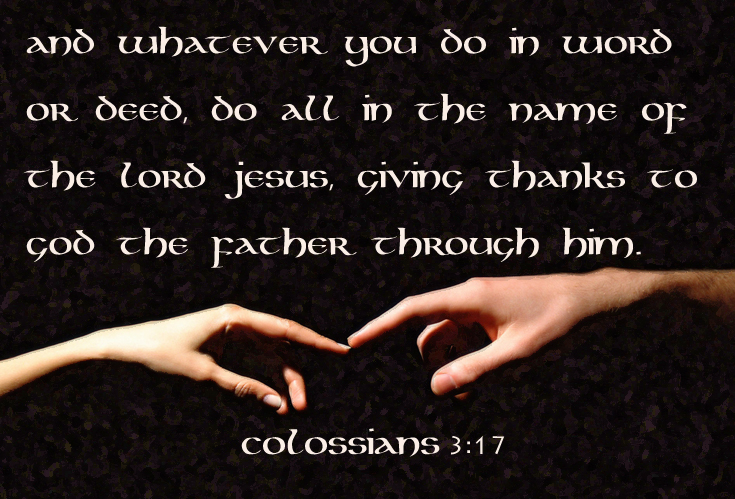
And whatever you do in word or deed, do all in the name of the Lord Jesus, giving thanks to God the Father through Him. (Col. 3:17)

Glory Shared With Us | marissabaker.wordpress.comWe talked about this idea two weeks ago, in the context of “whatever you do, do all to the glory of God” (1 Cor. 10:31). Our inside character, which comes out in our words and actions, should be proclaiming God’s glory, and attracting honor to Him.

The most intriguing verse, however, (to me at least) is when Christ says He’s given us His glory in verse 22. Let’s read some of the verses leading up to that.

I do not pray for these alone, but also for those who will believe in Me through their word; that they all may be one, as You, Father, are in Me, and I in You; that they also may be one in Us, that the world may believe that You sent Me. (John 17:20-21)

Jesus makes it clear that He’s talking about future believers — including us — as well as His disciples then. He emphasizes unity among the believers, and between us and God.

I, therefore, the prisoner of the Lord, beseech you to walk worthy of the calling with which you were called, with all lowliness and gentleness, with longsuffering, bearing with one another in love, endeavoring to keep the unity of the Spirit in the bond of peace. (Eph. 4:1-3)

Paul connects unity with walking in way that properly fits with our calling from God, and Jesus connects it with showing the world that He was sent by the Father. Much the same way, having love shows that we’re Christ’s disciples (John 13:35). It’s starting to sound like the ideas of manifesting, recognizing and showing forth that are carried with the word “glorify” are connected to this idea as well. And now we come to verse 22:

And the glory which You gave Me I have given them, that they may be one just as We are one: I in them, and You in Me; that they may be made perfect in one, and that the world may know that You have sent Me, and have loved them as You have loved Me. Father, I desire that they also whom You gave Me may be with Me where I am, that they may behold My glory which You have given Me; for You loved Me before the foundation of the world. (John 17:22-24)

Christ’s Glory

Jesus Christ has given us His glory? It seems astonishing, but that’s what He says. based on the definition of glory, this tells us that Jesus is giving us His form and appearance, His honor, reputation and character. (Just to clarify, I mean “give” in the sense of “share” rather than passing it along).

This just boggles my mind. To quote King David, “What is man that You are mindful of him?” (Ps 8:4). We don’t deserve God’s attention, let along a share in His Son’s glory. Yet that is what He is doing in, for, and to us.

Let this mind be in you which was also in Christ Jesus (Phil. 2:5)

And He said to me, “My grace is sufficient for you, for My strength is made perfect in weakness.” (1 Cor. 12:)

My little children, for whom I labor in birth again until Christ is formed in you (Gal. 4:19)

Christ’s mind in us … His strength in our weakness … His character formed in us … could these be other ways to express the same thing that’s going on when He says, “the glory which You gave Me I have given them”?

the mystery which has been hidden from ages and from generations, but now has been revealed to His saints. To them God willed to make known what are the riches of the glory of this mystery among the Gentiles: which is Christ in you, the hope of glory. (Col. 1:26-27)

Christ in us gives us present glory by association with His glory, and He is our hope of future glory where “we shall be like Him, for we shall see Him as He is” (1 John 3:2). I said earlier that glorification in John 17 is connected with revealing Who and what the Father and Jesus Christ are to the world. Their work to glorify us is connected with this same goal.

We are called “the light of the world,” and told “Let your light so shine before men, that they may see your good works and glorify your Father in heaven” (Matt. 5:14-16). As we press on toward future glory, let’s also be mindful of the glory we’ve been given now as Christ’s own special people, to glorify Him and the Father by how we live.

Glory Shared With Us | marissabaker.wordpress.com

Choosing For His Glory

Last week, we talked about living our whole lives in the context of praising God. This study is directly related to that, and I want to begin by quoting a scripture that I almost referenced in that post but decided to save until today.

Therefore, whether you eat or drink, or whatever you do, do all to the glory of God. (1 Cor. 10:31)

I don’t know about you, but I know that right now my life isn’t at the point where I can say that every single thing I do is done with the intention of bringing God glory. But that is part of our goal while we are here on this earth. Every aspect of our lives should be contextualized by our relationships with God and Jesus.blog post "Choosing God's Glory" by marissabaker.wordpress.com

Every Single Thing

The idea of every part of our lives being lived for God’s glory can be a daunting prospect, as this level of self-control seems almost impossible to attain. That overwhelmed feeling is usually how I react to reading this verse:

Casting down arguments and every high thing that exalts itself against the knowledge of God, bringing every thought into captivity to the obedience of Christ (2 Cor. 10:5)

“Every thought”? That’s a tall order. It’s a bit less daunting, though, when we remember Jesus Christ’s words to the disciples in Matthew 19:26 — “With men this is impossible, but with God all things are possible.” Self-control is also one of the fruits of the Holy Spirit, so we know that it is attainable with God’s help (Gal. 5:22).

I also suspect that, while there may be some days when we literally have to battle every thought, that it gets easier. The closer we grow to God, the more automatic it will be to think and act like Him. Christ Himself is being formed in us (Gal. 4:19), along with His mind and thought processes (Phil. 2:5). Letting, inviting, asking Him to dwell in us is a step toward living all our lives for God’s glory (John 15:4, 8).

Let the word of Christ dwell in you richly in all wisdom, teaching and admonishing one another in psalms and hymns and spiritual songs, singing with grace in your hearts to the Lord. And whatever you do in word or deed, do all in the name of the Lord Jesus, giving thanks to God the Father through Him. (Col. 3:16-17)

You Are Dead

If we go back to the beginning of Colossians 3 to get context for the verse we just quoted, we find an interesting introduction to a passage that talks about putting to death our sins (verse 5) and putting on the new man who looks like Christ (verse 10).

If then you were raised with Christ, seek those things which are above, where Christ is, sitting at the right hand of God. Set your mind on things above, not on things on the earth. For you died, and your life is hidden with Christ in God. (Col. 3:1-3)

If we really are living as if we are dead to the world and our only life is wrapped up in Christ, of course we’ll be living for His glory.

How shall we who died to sin live any longer in it? Or do you not know that as many of us as were baptized into Christ Jesus were baptized into His death? Therefore we were buried with Him through baptism into death, that just as Christ was raised from the dead by the glory of the Father, even so we also should walk in newness of life. (Rom. 6:2-4)

Earlier, I suggested that we should be growing to the point where reacting in the same way that Christ would respond is automatic. If we struggle with anger, for example, it might still be our first impulse but we should be becoming more practiced at replacing it with love. C.S. Lewis had this to say about what first impulses can tell us about ourselves.

Surely what a man does when he is taken off his guard is the best evidence for what sort of a man he is? Surely what pops out before the man has time to put on a disguise is the truth? If there are rats in a cellar you are most likely to see them if you go in very suddenly. But the suddenness does not create the rats: it only prevents them from hiding. In the same way the suddenness of the provocation does not make me an ill-tempered man; it only shows me what an ill-tempered man I am. (C.S. Lewis, Mere Christianity)

As we mature as Christians we should be quicker to recognize our tendencies to sin, and with Christ in us we now have the power to resist temptation before it becomes sin. It is imperative that we be aware of and active in this process. We cannot passively overcome sin.

Therefore do not let sin reign in your mortal body, that you should obey it in its lusts. And do not present your members as instruments of unrighteousness to sin, but present yourselves to God as being alive from the dead, and your members as instruments of righteousness to God. (Rom. 6:12-13)

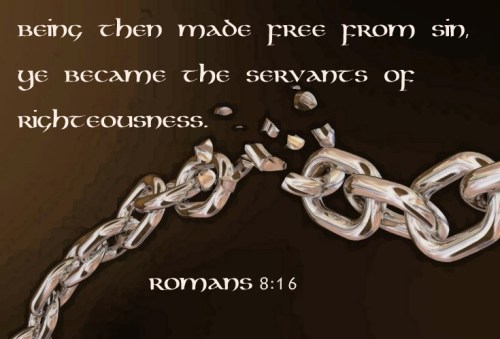
As human beings, we can’t be without a “master” — we’re either serving sin, or we’re serving God (Rom. 6:16-23). If we’re serving God in “obedience leading to righteousness,” then we’re also making conscious choices to not obey, or yield to, sin.

Bought and Redeemed

When Jesus Christ died for us, He ransomed us free from servitude to sin. We belong to Him, not to ourselves. Acts 20:28 describes the Church as “purchased with His own blood.” Peter says that false teachers who spread “destructive heresies” are “even denying the Lord who bought them” (2 Pet. 2:1). It is important that we recognize, rather than deny, this fact. blog post "Choosing God's Glory" by marissabaker.wordpress.com

Jesus’ incredible sacrifice cleansed us so that we could “serve the living God” (Heb. 9:14). He made a relationship possible between us and our creator. He established a new covenant “on better promises” that offers us eternal life as part of God’s family (Heb. 8:6). We don’t belong to this world or to Satan or to ourselves any more — we have been ransomed away from slavery to sin and to our own individual weaknesses. We now belong to the One who ransomed us, as His servants, His friends, His bride, His family, His body, His church, and His temple.

Do you not know that your bodies are members of Christ? … Or do you not know that your body is the temple of the Holy Spirit who is in you, whom you have from God, and you are not your own? For you were bought at a price; therefore glorify God in your body and in your spirit, which are God’s. (1 Cor. 6:15, 19-20)

Our physical bodies and our spirits — the intangible part of that makes me “me” and can communicate with God’s Spirit — belong to God. This fact does not, however, mean that we don’t have free will. Even within the choice to follow God (and it is a choice), there are many other choices we’ll have to make. I’ve been talking about this in relation to careers with a new friend I met through this blog. Our latest e-mails brought up the idea that God doesn’t care so much what you do to earn a living (with, you know, the obvious exceptions of earning money in a way contrary to the laws of God and man) as He cares how you conduct yourself in your work and whether or not you’re growing close to Him.

We Give You Glory

Returning to 1 Corinthians 10:31, which opened this post, the context is whether or not Christians could eat meat that was sacrificed to idols. That’s not really an issue for us today, but there’s still a lesson we can learn. Paul says it’s okay to eat or not eat this kind of meat, so long as the way you conduct yourself glorifies God.

Whatsoever is sold in the shambles, that eat, asking no question for conscience sake: for the earth is the Lord’s, and the fulness thereof. If any of them that believe not bid you to a feast, and ye be disposed to go; whatsoever is set before you, eat, asking no question for conscience sake. But if anyone says to you, “This was offered to idols,” do not eat it for the sake of the one who told you, and for conscience’ sake; for “the earth is the Lord’s, and all its fullness.” “Conscience,” I say, not your own, but that of the other. For why is my liberty judged by another man’s conscience? But if I partake with thanks, why am I evil spoken of for the food over which I give thanks? Therefore, whether you eat or drink, or whatever you do, do all to the glory of God. Give no offense, either to the Jews or to the Greeks or to the church of God, just as I also please all men in all things, not seeking my own profit, but the profit of many, that they may be saved. (1 Cor. 10:25-33)

Either choice was morally and legally acceptable before God on its own. But because we belong to God, Paul says that our choices need to be examined in the light of “will it bring God glory?” and “will it profit my brethren?” In the same way, once we answer the question, “can I, or can I not” do something legally in God’s eyes, we should then ask, “should I , or shouldn’t I?” It’s a matter of where our hearts are, and what is our motivation. This same topic is also discussed a few chapters earlier in 1 Corinthians, and that passage adds an even stronger warning.

But food does not commend us to God; for neither if we eat are we the better, nor if we do not eat are we the worse. But beware lest somehow this liberty of yours become a stumbling block to those who are weak. For if anyone sees you who have knowledge eating in an idol’s temple, will not the conscience of him who is weak be emboldened to eat those things offered to idols? And because of your knowledge shall the weak brother perish, for whom Christ died? But when you thus sin against the brethren, and wound their weak conscience, you sin against Christ. (1 Cor. 8:8-12)

That is serious. When our choices, even if they are perfectly acceptable based on our own knowledge, hurt our brethren, it is a sin against Christ. It’s the seam idea expressed in Matthew 25 — “inasmuch as you did not do it to one of the least of these, you did not do it to Me” (Matt. 25:41-46). It’s not enough to act based on knowledge of God’s laws, though that is certainly important. We must also be acting based on love, which builds up our brethren, and for the glory of god (1 Cor. 8:1-7).

In conclusion, the song “Glory” by Casting Crowns has been running through my head for two weeks, so I’m going to share it here: