Recently, I realized that The Bible Project, which I follow on YouTube, also has a podcast hosted by co-founders Tim Mackie and Jon Collins. I started listening to their Deuteronomy series, which is the end of their walk through the Torah (first five books of the Bible) that spanned all of 2022. It’s been fascinating. I’ve never sat down with the Torah and meditated on it the way they describe doing, though I have read those five books of the Bible several times over the years.
Today, I want to talk about something mentioned in “Deuteronomy Scroll Episode 6: Jesus, Marriage, and the Law.” In this episode, they compare Deuteronomy 24:1-4 with Matthew 19:1-12 and take that as an example of how Jesus read and used the Law. This is a section of the Torah dealing with divorce and remarriage.
Then some Pharisees came to him in order to test him. They asked, “Is it lawful to divorce a wife for any cause?” He answered, “Have you not read that from the beginning the Creator made them male and female, and said, ‘For this reason a man will leave his father and mother and will be united with his wife, and the two will become one flesh’? So they are no longer two, but one flesh. Therefore what God has joined together, let no one separate.”
They said to him, “Why then did Moses command us to give a certificate of dismissal and to divorce her?” Jesus said to them, “Moses permitted you to divorce your wives because of your hard hearts, but from the beginning it was not this way. Now I say to you that whoever divorces his wife, except for immorality, and marries another commits adultery.”
Matthew 19:3-9, NET (bold italics mark OT quotes)
In this podcast episode, Tim and Jon point out that Jesus went back to Genesis to reveal God’s original ideal for marriage. In this particular situation, the Law (given through Moses) isn’t representative of what God wanted from the beginning. It is God’s concession for hard-hearted people living in a fallen world. In other words, God intended marriage to be permanent but in a world where that doesn’t always happen He gave guidelines for divorce. Here, Jesus says infidelity is a justifiable reason for divorce. Later, Paul says that if a believer has an unbelieving spouse who wants a divorce the believer isn’t “bound” to stay married (1 Cor. 7:15). As the Bible Project points out, this hints that Jesus’s statement in Matthew 19 wasn’t taken as a full expression of His views on divorce and remarriage, but rather as the proper way to interpret the specific law in question from Deuteronomy.
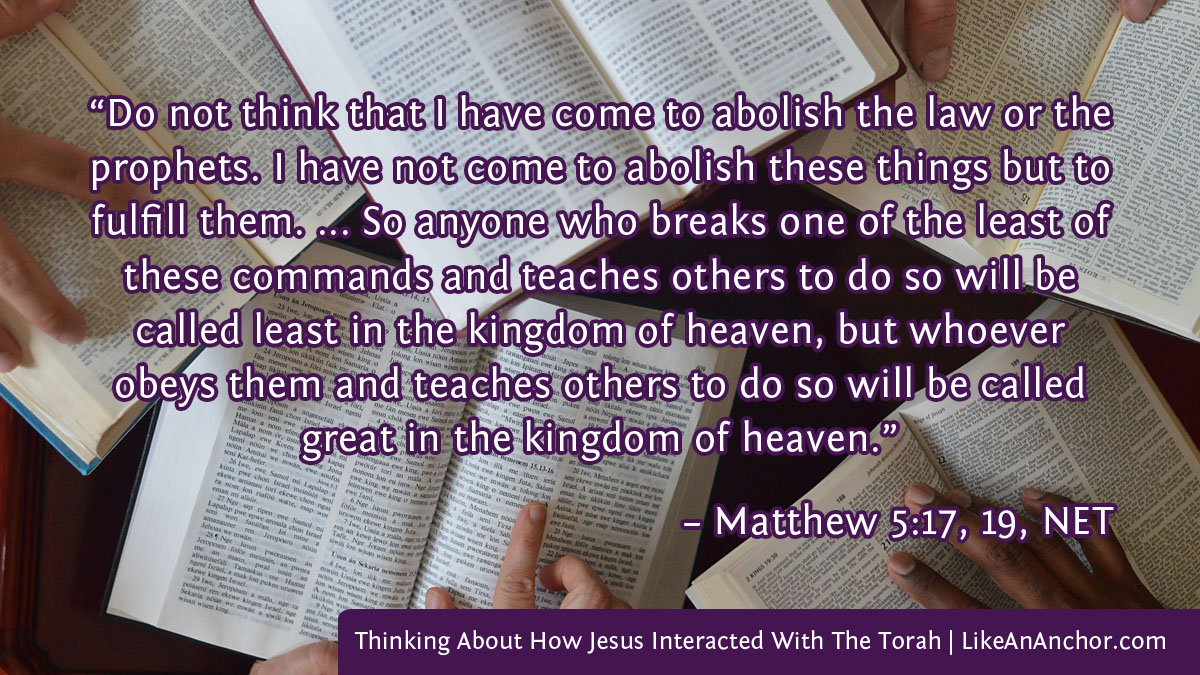
My purpose today isn’t to examine divorce and remarriage as a topic, but to use this as a jumping off point for meditating on Jesus’s relationship with the Law. I did something similar in my post “What Happens When God Takes Justice to the Next Level?” In that post, we went through the Sermon on the Mount, where Jesus reveals that He came to fill up the Law to a spiritual level, not destroy it. For example, He said it’s not enough for His followers to obey the command “thou shalt not murder;” He also expects us not to despise or condemn other people (Matt. 5:21-22). That’s very similar to what He does in Matthew 19. It’s not enough to follow the instructions for divorce; Jesus said that, ideally, God doesn’t want divorce to happen at all (though there are some times it can/will).
If you read a Bible that calls attention to Old Testament quotes in the New Testament (NET, for example, puts direct OT quotes in bold italics and allusions to OT passages in italics) then you’ll see that Jesus quoted from the Old Testament extensively. The Blue Letter Bible’s website has a list of quotes and allusions, which you can click here to view. They list 258 quotes or allusions to the Hebrew scriptures in the four gospel accounts, including many from Psalms, Isaiah, and the Torah (especially Deuteronomy and Leviticus). To make things more manageable for today’s post, we’ll just focus on Matthew. This book contains 102 of the quotes and allusions noted by Blue Letter Bible, though not all are quotes from Jesus; many are Matthew linking Jesus’s life to Old Testament prophecies (which is a different, though fascinating, topic).
Useful for Everyday Living
The first time Matthew records Jesus quoting the Old Testament is during the temptation in the wilderness. Here, Jesus goes into the wilderness for 40 days and nights after His baptism. Then, Satan shows up and tries three times to tempt Jesus into sin. Jesus counters each of these temptations with a quote from Deuteronomy (Matt. 4:1-11).
This account highlights and reveals a couple interesting things. First, Jesus had these verses memorized. There’s a good chance, given what we know of first-century Jewish education, he could have had the whole Torah memorized. Second, Jesus’s main counter for an attack by Satan was to quote God’s law. Clearly, He found value in memorizing and living by these verses.
Similarly, Jesus quoted Deuteronomy when He gave practical instructions for resolving a disagreement between brothers in the faith, and may also have been alluding to Leviticus (Matt. 18:15-20; Lev. 19:15-17; Deut. 19:15). He uses principles from the Laws God gave for interacting with other people and upholding justice to show how we should resolve disagreements as His followers.
Additionally, Jesus told a young man who asked Him about eternal life, “‘if you want to enter into life, keep the commandments.’ ‘Which ones?’”’ he asked. Jesus replied, ‘“’Do not murder, do not commit adultery, do not steal, do not give false testimony, honor your father and mother, and love your neighbor as yourself‘” (Matt. 19:17-19, NET). There’s more to that story (Matt. 19:16-26), but for the topic we’re studying the main thing I want to point out is that Jesus taught familiar commandments from Exodus, Leviticus, and Deuteronomy as guides for heading toward eternal life. In short, He treated God’s laws from the Old Testament as something we should still follow that are useful for everyday life.
Back To God’s Intent
As I mentioned in the intro, Jesus quotes several Old Testament laws in the Sermon on the Mount. He does not say these laws are wrong or that we shouldn’t obey them. Rather, He counsels His listeners to pay attention to God’s intent behind the law and obey at a higher level. He expects more of us than simply keeping the Law. He expects us to become like God, who gave the law, and “be perfect, as your heavenly Father is perfect” (Matt. 5:48, NET). Later, He boils the Law down to the most important points.
And one of them, an expert in religious law, asked him a question to test him: “Teacher, which commandment in the law is the greatest?” Jesus said to him, “‘Love the Lord your God with all your heart, with all your soul, and with all your mind.’ This is the first and greatest commandment. The second is like it: ‘Love your neighbor as yourself.’ All the law and the prophets depend on these two commandments.”
Matthew 22:35-40, NET
Here, Jesus quotes from Deuteronomy 6:5 and Leviticus 19:18. Love is the essence, or fulfillment, of God’s law (Rom. 13:8-10; Gal. 5:14). The other commandments in the Law are details; instructions on how to love God and love your neighbor. And based on Jesus’s conversations about the Law, we really should be doing even better than simply obeying the letter of the law. We need to obey God in the spirit and intent behind the law.
Be Wary of Human Ideas

Now, thinking humanly, we might conclude that if Jesus wants us to keep the law even better, maybe we should put some extra guards around it. That’s a mistake people in Jesus’s day made, too, and He condemns the practice. People do not have the right to elevate human traditions to the level of doctrine, and they especially don’t have the right to replace something God commanded with anything else (Matt. 15:1-20).
Another error that Jesus pointed out was misinterpreting scriptures. One day the “Sadducees (who say there is no resurrection) came to him and asked him” about the levirate marriage law of Deuteronomy. He knew they really wanted to ask about the resurrection rather than that law, and He replied, “You are deceived, because you don’t know the scriptures or the power of God” and He quoted from Exodus to backup the truth of the resurrection (Matt. 22:23-33). In this case, human reasoning got in the way and these people tried to use one of the laws recorded by Moses to prove a point that law had nothing to do with.
When we read the psalms, especially Psalm 119, we see people meditating on God’s Law, loving His commandments, and praying for deeper understanding. We need to continue following that example. In many ways, obeying God is very simple: love Him and love your neighbor. But we’re not yet perfect; we aren’t yet fully “grown up” to be like Jesus Christ (Eph. 4:14-16). We are, however, being conformed to His image and having His mind formed in us (Rom. 8:28-29; 1 Cor. 2:15-16). We can study God’s law–and Jesus’s example of interacting with God’s law–to learn more about Him and our role as His followers.
Featured image by Matt Vasquez

Song Recommendation: “Thy Word” by Amy Grant

 Like An Anchor