Wrapping Our Minds Around Biblical Hebrew

The more I study the Bible, its historic context, and the languages it was originally written in, the more I realize that native English speakers are not well equipped to wrap our minds around Hebrew. I’ve been writing quite a bit about this recently as I look at specific topics like “Waiting in Hope” and “Putting ‘Spare the Rod’ In Context.”

I’ve heard a lot of people, especially those who love the KJV Bible translation, express that they want as close as possible to a 1-to-1 translation of the Bible. They think it’s most accurate if there’s a Hebrew or Greek word directly translated to an English word without anything taken away or added in the number of words. I lean that way with most of my translation preferences, too, but I’m starting to think that while that might be a fairly good way to translate Greek, it’s not all that helpful for Hebrew.

Painting With Words

If you don’t count proper names, Biblical Hebrew has about 7,000 distinct words. Modern Hebrew has about 33,000 words, which is a much expanded vocabulary pool but still significantly smaller than English. Webster’s dictionary currently includes about 470,000 entries for English words and some estimates place the number of English words close to 1 million. That doesn’t mean that Hebrew is a more limited language, though. One of the things that it means is there are a lot of Hebrew words where one word represents concepts that English splits up into multiple words (e.g. “wait” and “hope” are distinct in English, but they’re both valid translations of a single Hebrew word).

Hebrew is full of desert browns and burnt umbers of a nomadic, earthy people who trekked through parched deserts and slung stones at their enemies. Overall its palette only contains a small set of colors … Because of its small vocabulary, each word has a broader possible meaning.

The Hebrew of the Bible … expresses truth by splashing on rich colors with a thick brush, like Van Gogh. … even though the details are quite rough, you mentally fill them in, inferring them from the context. Your mind is used to doing this – figuring out meaning from context. Even when you communicate in English, you rely on common experience to fill in the gaps. You sketch out a scene with a few word-strokes, and let people figure out the rest. Hebrew simply relies on this much more than we do.

Lois Tverberg, “Speaking is Painting: Why No Translation Can Be ‘Perfect’”

I really like Lois Tverberg’s comparison of languages to painting styles. Hebrew uses broader brush strokes and a more limited color pallet while English uses a fine-tipped brush, different colors, and more colors. No English translation will ever be perfect because Hebrew and English are so different; that’s one reason it’s helpful to look at multiple translations when studying. It’s also helpful to learn at least a few important Hebrew words even if you can’t devote the time needed to learn the whole language.

Image of a man studying the Bible overlaid with text from Ex. 20:7, AMP version: “You shall not take the name of the Lord your God in vain [that is, irreverently, in false affirmations or in ways that impugn the character of God]; for the Lord will not hold guiltless nor leave unpunished the one who takes His name in vain [disregarding its 
reverence and its power]."
Image by Matt Vasquez from Lightstock

An AI-Assisted Case Study on Exodus 20:7

As I’ve been pondering this topic again recently, I keep mulling over a specific question: If there isn’t a 1-to-1 correlation for most Hebrew-to-English translations, would it be helpful to think of key Hebrew words as multiple English words. For example, in English we have “You shall not take the name of the Lord your God in vain” for Exodus 20:7 (NET). But would it be more accurate to say “You shall not take/carry/use the name/reputation of Yahweh your Elohim in [a] vain/empty/worthless [way]”?

I thought I was on the right track, but I wasn’t sure who to ask about it. I don’t have access to a Biblical Hebrew scholar that I’m aware of, or the time to devote years to really learning the language. Then I remembered I’d been reading about and listening to podcasts on Artificial Intelligence (AI) recently, and one of the things people agree it’s a good tool for is research (some saying it’s a better search engine than Google now). I had been in the “I’m a real writer; I don’t use AI!” camp but the more I read about it, the more I’m convinced of two things: 1) ignoring it won’t make AI go away, and 2) there are some situations where it can be a helpful tool. In this particular case, an AI model can process vast amounts of information on Biblical Hebrew in a matter of seconds that would take me months or even years to work through.

Now, there is something we need to keep in mind as we look at the AI response. AI models like ChatGPT (the one that I used) can “hallucinate,” or make up information. That’s why I asked it about Exodus 20:7 and Proverbs 29:15. These are two verses that I’ve already studied quite a bit, so I’d be more likely to recognize if there was something wrong with the AI response. The AI response matched everything I’ve found in my own studies, so I’m reasonably confident that the additional information it provided is also accurate. Here is the link to my full chat if you want to check it out for yourself, and here are some highlights from the AI response:

Biblical Hebrew is a compact, context-dependent language with far fewer words than English. A single Hebrew word often holds multiple layers of meaning, depending on context, syntax, and cultural backdrop. English, by contrast, tends to slice meanings more finely, distributing them across many distinct words. So, when translating Hebrew to English, it’s not just about replacing words — it’s about reconstructing meaning.

This is why your suggestion — to think of Hebrew words as mapping onto multiple English possibilities — is both linguistically sound and theologically wise.

Image of a woman reading the Bible, overlaid with blog's title text and the words, "Biblical Hebrew is a very different type of language than modern English. It’s often helpful to think of multiple English words representing key Hebrew words rather than try for a 1-to-1 translation."
Image by Pearl from Lightstock

After unpacking my specific example, the AI model suggested two possible expanded translations of Exodus 20:7.

A Fuller Rendering: “You shall not lift up or invoke the name/reputation of Yahweh your Elohim in a false, empty, or worthless manner.” …

This approach does not clutter the meaning — it actually recovers the ethical and relational weight of the command. It’s not just about speech. It’s about how we represent God’s character in our lives, words, oaths, and actions.

I was honestly surprised that ChatGPT gave me such a nuanced, thorough response to my question. It was eerily similar to talking with a knowledgeable, personable professor or scholar who genuinely takes pleasure in helping other people broaden their understanding. It didn’t really tell me something brand new, but it was nice to get confirmation that I’m on the right track as I try to wrap my head around Biblical Hebrew. I hope it gave you some food for thought too.


Featured image by Inbetween from Lightstock

Waiting In Hope

In the lady’s scripture writing group that I’m part of in our local church congregation, the theme for January is “Wait on the Lord.” When I was writing a scripture earlier this month, I noticed that some translations of Psalm 31:24 used the word “hope” and others used the word “wait.” Those are two very different words in English, so I wondered how they could be so connected in Hebrew that “hope” is just as good of a translation for the word as “wait.”

I’ve heard quite a few native English speakers describe Hebrew as weird and frustrating. How can you have words that mean completely opposite things depending on the context? It makes no sense! But the more I study the Bible and read about Hebrew language and thought, the more I appreciate that Hebrew isn’t a more limited language than English. It’s just a very different kind of language. Lois Tverberg compares languages to painting styles–Hebrew uses broader brush strokes and a more limited color pallet (i.e. number of words; about 8,000 for Hebrew) while English uses a fine-tipped brush, different colors, and more colors (there are about 100,000 English words). Language shapes so much of how we think, so if we want to understand the thought process of the people God used to write the Bible, it helps to learn more about the languages they used.

A Look At Hebrew Language

Be strong, and let your heart take courage,
    all you who hope in Yahweh.

Psalm 31:24, WEB

Be strong and confident,
all you who wait on the Lord.

Psalm 31:24, NET

In English, these different translations make it seem like the verse could mean two completely different things. For English speakers, hoping in Yahweh isn’t at all the same thing as waiting on the Lord. We think of hope as a feeling of expectation, desire, or trust (Oxford Languages via Google). Waiting is something we do until something else happens, a staying in place or delaying action (Oxford Languages via Google). If you’re excited about the thing you’re waiting on or trust that it could happen you might feel hope, but they’re not necessarily connected.

The Hebrew word translated either “hope in” or “wait on” is yachel/yahal (יָחַל, H3176). It’s a verb (action word) that is primarily translated “hope” in the KJV, but also “wait,” “trust,” and “tarry.” The Theological Wordbook of the Old Testament (TWOT) states that the word carries “the idea of ‘tarrying’ and ‘confident expectation, trust'” as well as “hope” (TWOT entry 859). They explain the hope-wait connection like this:

yahal is used of ‘expectation, hope’ which for the believer is closely linked with ‘faith, trust’ and results in ‘patient waiting.’ … This yahal ‘hope’ is not a pacifying wish of the imagination which drowns out troubles, nor is it uncertain (as in the Greek concept), but rather yahal ‘hope’ is the solid ground of expectation for the righteous.”

TWOT entry 859

Yahal “is a close synonym to batah ‘trust’ and qawa ‘wait for, hope for'” (TWOT 859). We won’t look at batah in this post, but most of the other verses I’ve been writing this month translate “wait” from the word qavah or qawa (קָוָה, H6960). This word “means to wait or to look for with eager expectation” (TWOT 1994). Qavah has to do with waiting in faith, trusting in God, hope for the future. The root verb qawa is most often translated “wait” and “look for” in the KJV. It’s the derivative noun tiqvah that’s usually translated “hope” or “expectation.” There are also several other words that can be translated “wait.” Some of these are also translated “hope,” including sabar/shabar (H7663: “to inspect, examine, wait, hope, wait upon [BDB]) and others without the hope connotation, such as chakah (H2442: “wait, wait for, await” [BDB]). We won’t dive into all these different words in this post, but I wanted to bring them up to demonstrate the wait/hope connection is woven throughout the language.

Image of a man reading the Bible overlaid with text from Psalm 71:14-15, WEB version: "As for me, I will wait continually, and will continue to praise you. I will tell about your justice, and all day long proclaim your salvation, though I cannot fathom its full extent."
Image by Matt Vasquez from Lightstock

Confident Expectation

Once I started thinking about “wait” and “hope” as being connected, it’s almost impossible not to see it. The first time the word yahal appears in the Bible is in Genesis 8:12. This is after the flood, while Noah, his family, and all the animals are still on the ark.

At the end of forty days, Noah opened the window of the ship which he had made, and he sent out a raven. It went back and forth, until the waters were dried up from the earth. He himself sent out a dove to see if the waters were abated from the surface of the ground, but the dove found no place to rest her foot, and she returned into the ship to him, for the waters were on the surface of the whole earth. He put out his hand, and took her, and brought her to him into the ship. He waited yet another seven days; and again he sent the dove out of the ship. The dove came back to him at evening and, behold, in her mouth was a freshly plucked olive leaf. So Noah knew that the waters were abated from the earth. He waited yet another seven days, and sent out the dove; and she didn’t return to him any more.

Genesis 8:6-14, WEB

There are two times in this passage where an English translation says, “He waited.” The first time, the Hebrew word is chûl/chı̂yl (H2342): “to twist, whirl, dance, writhe, fear, tremble, travail, be in anguish, be pained” (BDB definition). Clearly, this is not a hopeful sort of waiting. It’s an anxious waiting. But then, after the dove comes back with “a freshly plucked olive leaf” so that Noah knew the waters were starting to dry up, the type of waiting changes. This time, “he yahal yet another seven days.” Now, Noah had a reason to hope and the way that he waited changed.

Unfortunately, there isn’t an English word that would capture wait/hope as a dual meaning. Translators either have to pick one or the other, or replace the single word with a whole phrase that means something similar. The Amplified Bible translation (AMP) does this for yahal sometimes (though not in Genesis 8). AMP renders Psalm 31:24 as “Be strong and let your hearts take courage, All you who wait for and confidently expect the Lord.” That’s what Noah was doing, at least once he’d seen evidence that the earth was growing back after the flood.

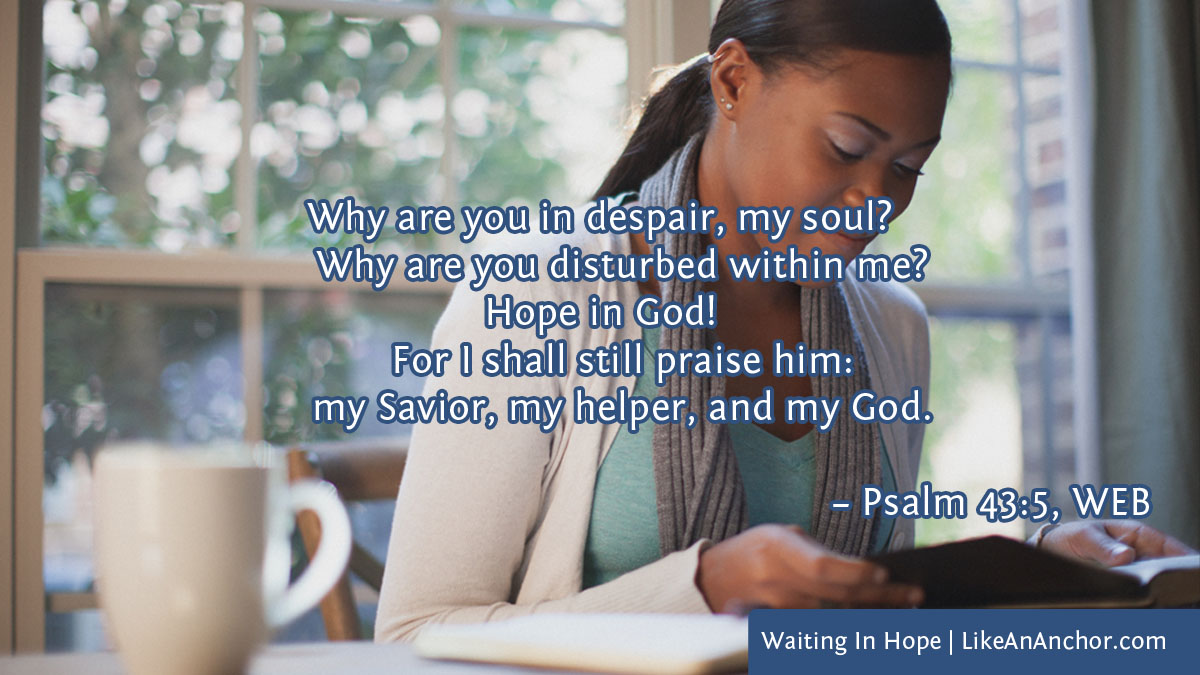
Image of a woman reading the Bible overlaid with text from Psalm 43:5, WEB version: "Why are you in despair, my soul? Why are you disturbed within me? Hope in God! For I shall still praise him: my Savior, my helper, and my God."
Image by Pearl from Lightstock

God Shows Up

When studying a Hebrew word, I often like to focus on how the word is used in Psalms because those songs are so much about the relationship between people and God. Relationships lie at the heart of Christianity, and I find it particularly insightful to look at how people of faith used certain words when recording their feelings, thoughts, and worship.

We see yahal in 19 verses in Psalms, including some that describe a situation where it doesn’t seem like “hope” is the expected response. While “hope” is the traditional default translation, the NET translators maintain that “to wait” is the “base meaning” of yahal and whether “the person waiting is hopeful or expectant” depends on context (footnote on Ps. 42:5). I wonder, though, if the authors meant there to be some hints of hope even in the ones where it doesn’t seem (to us) to fit the context. After all, there are other words the authors could have used for “wait.”

Behold, Yahweh’s eye is on those who fear him,
    on those who hope in his loving kindness,
    to deliver their soul from death,
    to keep them alive in famine.
Our soul has waited for Yahweh.
    He is our help and our shield.
For our heart rejoices in him,
    because we have trusted in his holy name.
Let your loving kindness be on us, Yahweh,
    since we have hoped in you.

Psalm 33:18-22, WEB

Here, “hope” is translated from yahal and “waited” from chakah (the NET translates all of them “wait”). Now, this one (Psalm 33) is a psalm of praise, and it makes sense to our minds that we’d see “hope” in this context. But we also see “I hope in you, Yahweh” (Ps. 38:15) in a psalm that begins with God’s indignation and wrath (Psalm 38) and the instruction “hope in” or “wait for” God (Ps. 42:5, 11; 43:5) when suffering despair and persecution (Psalms 42; 43). Those are the times when we need hope the most. And one of the reasons that we can have hope that’s a “confident expectation” rather than something uncertain is because God has showed up so many other times when we (and other people of faith) waited for Him.

A Sure, Certain Hope

Image of a woman looking up at the sky, overlaid with blog's title text and the words, "Several Hebrew words can be translated either "wait" or "hope." Learning about the wait-hope connection that Bible writers saw can help us hold on to hope today when we're waiting on God."
Image by Brightside Creative from Lightstock

One of God’s promises that we’re still waiting on is that He will resurrect all His faithful followers from the dead. That’s not something that’s happened yet. Like so many of God’s promises, some people (even in the 1st century, right after Jesus’s life, death, and resurrection) say that it won’t happen. But, as Paul points out, God’s track record proves that He can follow-through on His promises.

Now if Christ is being preached as raised from the dead, how can some of you say there is no resurrection of the dead? But if there is no resurrection of the dead, then not even Christ has been raised. And if Christ has not been raised, then our preaching is futile and your faith is empty. … And if Christ has not been raised, your faith is useless; you are still in your sins. Furthermore, those who have fallen asleep in Christ have also perished. For if only in this life we have hope in Christ, we should be pitied more than anyone. But now Christ has been raised from the dead, the firstfruits of those who have fallen asleep. 

1 Corinthians 15:12-14, 17-20, NET

For Paul, the fact that God the Father raised Jesus Christ from the dead proves that He will raise “those who have fallen asleep in Christ” as well. Our hope in the resurrection is a confident expectation because there’s already proof that God can do it, just like Noah’s hope that the water would recede became confident when he saw evidence of plant life on the earth.

You are my hiding place and my shield.
    I hope (yachal) in your word. …
Uphold me according to your word, that I may live.
    Let me not be ashamed of my hope (seber).

Psalm 119:114, 116, WEB

God’s word contains many promises that we can read about. They’re backed up by His proven character, and because He is trustworthy we know that when we wait hopefully, He’s not going to disappoint us or make it so that we’d be ashamed of following Him.

Being therefore justified by faith, we have peace with God through our Lord Jesus Christ; through whom we also have our access by faith into this grace in which we stand. We rejoice in hope of the glory of God. Not only this, but we also rejoice in our sufferings, knowing that suffering produces perseverance; and perseverance, proven character; and proven character, hope: and hope doesn’t disappoint us, because God’s love has been poured into our hearts through the Holy Spirit who was given to us. For while we were yet weak, at the right time Christ died for the ungodly. 

Romans 5:1-6, WEB

Just reading through the Bible and observing how people talk about hope, we can see that it’s connected with confident expectation and it’s something that Biblical writers treat as certain as long as it’s pointed towards God. Studying the Hebrew language a little bit more and learning that wait and hope are so closely connected in that language can help us understand on a deeper level how the Biblical writers understood hope and waiting on God. It can teach us about both the Old Testament, which was written in Hebrew, and the New Testament, which was written by Jewish people who were deeply influenced by their linguistic history. And that can help us hold on to hope today when we’re waiting on God to do something in our lives or fulfill His promises.


Featured image by Ben White

Revive Me, Lord

Two Sabbaths ago, my dad gave a message in our church group about personal revival, specifically on the topic of rekindling a waning interest in Bible study. I was feeling a bit down emotionally at the start of that following week, and I remembered he mentioned a Hebrew word often translated “revive” that I thought it might be encouraging to look at more closely. It turned into such an interesting study that I didn’t get this post finished for last week and skipped posting so I could spend two weeks studying and writing.

The Hebrew word in question is chayah or haya (depending on how you want to transliterate it into the English alphabet). It’s Strong’s number H2421 and entry 644 in the Theological Wordbook of the Old Testament (TWOT), where the authors devote nearly three full pages to haya and its derivatives. It’s a very important word in the Old Testament writings, with the root word appearing 270 times, and it’s translated as “live,” “alive,” “quicken,” “nourish,” “recover,” and “revive” (along with a few other less frequent phrases) in the King James Version. The closely related derivative chay (H2416) appears 498 times, and it’s most often translated “life” or something that is alive, e.g. “a living thing.” Today, let’s take a closer look at these words and see what we can learn.

“Life” In Hebrew

The TWOT says the root verb haya means “to live or have life” (in the simple Qal stem) or “giving or restoring life” (in the word’s two other verb stems) (p. 279). The “range of meaning” also includes “‘to preserve or sustain life’ or ‘to nourish’ … ‘or to restore to health, to heal, recover'” (p. 280). Key to understanding this word is that it is usually very concrete rather than an abstract idea.

“The OT speaks of life as the experience of life rather than as an abstract principle of vitality which may be distinguished from the body. This is because the OT view of the nature of man is holistic, that is, his function as body, mind, spirit is a unified whole spoken of in very concrete terms. Life is the ability to exercise all one’s vital power to the fullest; death is the opposite.”

R. Laird Harris, Gleason L. Archer, Jr., and Bruce K. Waltke; TWOT entry 644, p. 279

We might think this is a very different viewpoint from the New Testament, but that’s because we’ve been influenced by modern ideas about people being bodies with spirits or souls rather than unified wholes. The idea that humans have a soul that’s separate and immortal came into Christianity from Neoplatonic philosophy about 200-300 years after Christ’s human life (see “Rethinking Heaven: Capturing A Vision Of The Resurrection” and “Relational Faith: A Book Review and Theological Reflection“). We’re “spirit, soul, and body” (1 Thes. 5:23, WEB) as a unified whole, living our lives as human beings made in God’s image.

While chayah can have slightly “less concrete” meanings, such as living “by the words of God ‘not by bread alone’ (Deut 8:3; Ps 119:50, 93)” even these uses are grounded in “the biblical unity of man’s nature” and seem to refer to both physical “prosperity as the gift of obedience” and “the spiritual quality of life” (TWOT, p. 280). There are also hints in the Old Testament that chayah refers to the eternal, spiritual life God offers after death, not just the physical life that He gives us (Ps. 49:9; Prov. 12:28; 15:24; Dan. 12:2). The concreteness of the word ties in well with the Biblical teaching that there will be a bodily resurrection (i.e. we’ll be resurrected as spirit beings with spirit bodies, not something ghostly or disembodied).

Walking with God for Life

Since chayah is used so many times in the Bible, I thought I’d focus today’s study on the ways that it’s used in the Psalms (just to make things a little more manageable). I did this by looking up chayah (H2421) and chay (H2416) with the program eSword, which yielded 82 matches in the psalms (31 chayah, 51 chay). This includes several categories of verses, including ones describing God as “the living God” (Ps. 42:2; 84:2) and talking about us being in the “land of the living” (Ps. 27:13; 56:13; 142:5). I want to focus, though, on the ones that speak of how God impacts our lives (click for examples).

Surely goodness and loving kindness shall follow me all the days of my life,
    and I will dwell in Yahweh’s house forever.

Psalm 23:6, WEB

The much beloved Psalm 23 shows Yahweh’s involvement with David’s whole life (and ours as well). God is the shepherd who provides all our needs, restores our souls, guides us, guards us, and comforts us. Chay appears in the last verse, providing a conclusion to the short psalm. When we remember that the life represented by chay can involve nuances of preserving, sustaining, nourishing, and reviving, it deepens our understanding of the quality of life that God wants to give us.

In another section of scripture, Jesus said, “I have come so that they may have life, and may have it abundantly. I am the good shepherd” (John 10:10-11, NET). Obviously, the word chay doesn’t appear here because the New Testament was written in Greek rather than Hebrew, but I think we can see how the meaning is connected. God wants our lives to be good, not just abstractly but in a real, tangible way.

 I have set Yahweh always before me.
    Because he is at my right hand, I shall not be moved.
Therefore my heart is glad, and my tongue rejoices.
    My body shall also dwell in safety.
For you will not leave my soul in Sheol,
    neither will you allow your holy one to see corruption.
You will show me the path of life.
    In your presence is fullness of joy.
In your right hand there are pleasures forever more.

Psalm 16:8-11, WEB (footnote on v. 10: “Sheol is the place of the dead”)

As with Psalm 23, chay appears in the conclusion of Psalm 16 (also a psalm of David). Long after David’s death, the apostle Peter said that this Psalm is really “about the resurrection of the Christ, that he was neither abandoned to Hades, nor did his body experience decay” (Acts 2:31, NET [italics mark allusions to Psalm 16]). David was a prophet, and he knew he was writing about one of his descendants who would be the Messiah/Christ (Acts 2:22-33). A lot of this psalm also feels personal, though, and I suspect that we can read it on both levels: a messianic prophecy and an expression of David’s assurance that God will take care of him.

I’m not sure how much David understood about God’s ultimate plan to bring human beings into His family, but it is accurate that God won’t leave us in the grave forever. It’s also accurate to say that he shows us “the path of life” in multiple senses: the path to walk in order to have a good life here on this earth, and the path to eternal life with God forever.

Revival from God

I find it ironic that I’ve been struggling to focus on and finish this study, which was inspired by a message about reviving a waning interest in Bible study. For some reason, I’ve just had a very hard time for this post with going from reading Bible scriptures to knowing how to put them together and what to say about them.

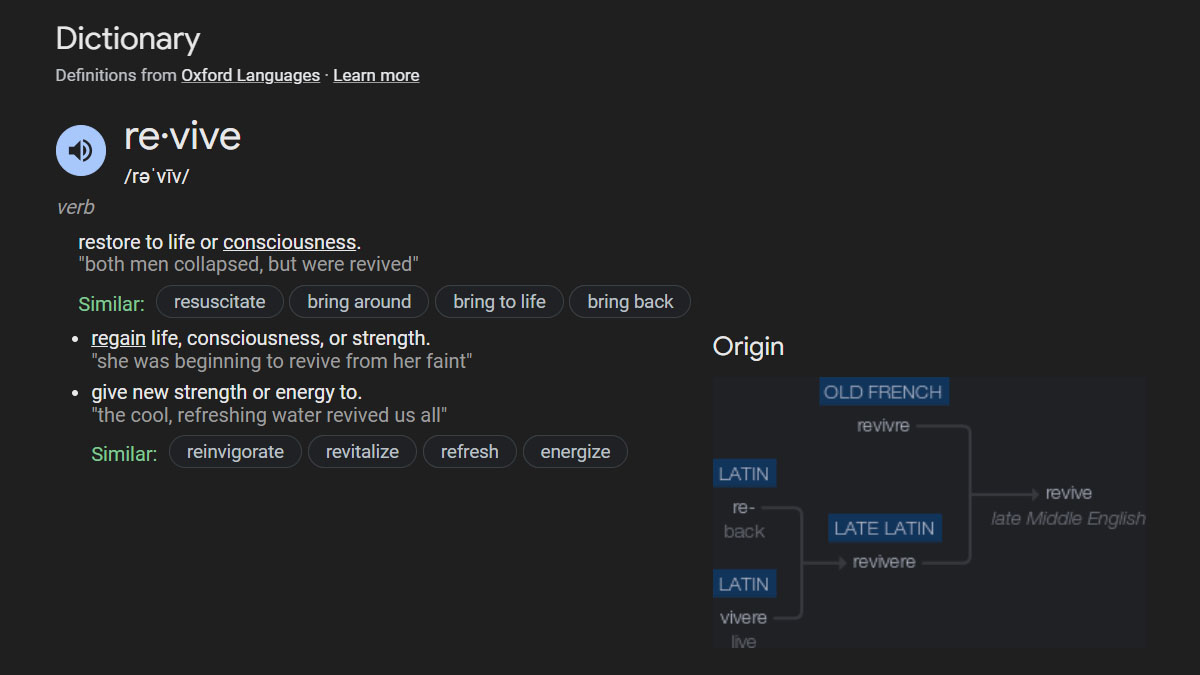
In the Psalms, there are several times where chay or chayah are translated “revive” (as well as the more common “life” or “live”). It shows up a lot in Psalm 119. This whole psalm is like a love letter to God’s word; every single verse talks about God’s law, ordinances, statues, precepts, way, etc. Here, we learn that revival (chayah) is found in the words of God.

My soul is laid low in the dust.
    Revive me according to your word!

Psalm 119:25, WEB

I will never forget your precepts,
    for with them, you have revived me.

Psalm 119:93, WEB

Hear my voice according to your loving kindness.
    Revive me, Yahweh, according to your ordinances.

Psalm 119:149, WEB

It seems that the solution to my problem focusing on study is to persistently come back to God and His word even if it takes a while for things to come together and make sense. In fact, that’s the solution to all of our problems. It’s not like there’s anywhere else to go for answers. As Peter said when Jesus asked if the twelve wanted to go away after several other disciples decided not to listen to Him anymore, “Lord, to whom would we go? You have the words of eternal life” (John 6:68, NET).

We can physically survive without having a relationship with God, but we can’t have full, abundant, and eventually eternal life apart from Him. He doesn’t promise that we’ll never have tough times or difficult feelings, but He does promise life-giving revival in Him and His word if we come to Him during those challenges.


Featured image by Sasin Tipchai from Pixabay

Song Recommendation: “Mayim Chaim” by Zemer Levav

Our Roles As Keepers

Two weeks ago, we examined God’s role as our keeper, focusing on Psalm 121. Part of that examination included looking at the definition for the Hebrew word shamar, which is translated “keep” or “keeper” in this Psalm. As with many Hebrew words, shamar includes a range of meanings depending on the context. The Complete Theological Wordbook of the Old Testament states, “The basic idea of the root is ‘to exercise great care over'” (TWOT entry 2414). As we looked at in the previous post, the TWOT breaks the nuances of meaning into these broad categories:

Today, I want to look at our roles as keepers. We are told to keep covenant with God, to keep ourselves in the right way, and to keep care of other people.

Image of a woman reading the Bible overlaid with text from Psalms 103:17-18, WEB version: But Yahweh’s loving kindness is from everlasting to 
everlasting with those who fear him, his righteousness to children’s children; to those who keep his covenant, to those who remember to obey his precepts. 
Image by Pearl from Lightstock

Keeping Covenant

God faithfully keeps covenant with us. We don’t have to worry that He’ll change His mind, forget about us, or decide His commitments aren’t worth honoring. He’s absolutely faithful and reliable. The same can’t be said about human beings, but with God’s help we can commit to covenant keeping and keep coming back and recommitting when we miss the mark.

You shall do my ordinances. You shall keep my statutes and walk in them. I am Yahweh your God. You shall therefore keep my statutes and my ordinances, which if a man does, he shall live in them. I am Yahweh.

Leviticus 18:4-5, WEB

The obligation to keep God’s laws as part of our covenant relationship with Him isn’t just an Old Testament thing. It’s also part of the New Covenant. It’s actually even more important in the New Covenant because now, keeping covenant with God sinks in at a heart level. God wanted this sort of heart connection under the Old Covenant, but didn’t get it (Deut. 5:29). Now, with His holy spirit inside us and Jesus’s sacrifice to reconcile us to God, we can more fully obey the command to love God with all our hearts, minds, and souls and to keep His commandments because of that love (Matt. 22:36-40; John 14:15, 21; 15:10-12).

I will give them one heart, and I will put a new spirit within you. I will take the stony heart out of their flesh, and will give them a heart of flesh; that they may walk in my statutes, and keep my ordinances, and do them. They will be my people, and I will be their God. 

Ezekiel 11:19-20, WEB

When we think of shamar as “to exercise great care over,” we might then ask how we can do that to the covenant we have with God. For one thing, it involves knowing what the covenant obligations are. At the most basic level, it’s to fully love God and to love our neighbors. All the other commands hinge on those two (Mark 12:28-34). That doesn’t mean the other commandments aren’t important–it just means that our keeping of the other commandments happens because we love God and others. Sabbath keeping, for example, it something that God instituted at creation, that Jesus did, and which God describes as “a perpetual covenant” for His people to keep (Ex. 31:13-16).

Image of a man reading the Bible overlaid with text from Ecclesiastes 12:13, WEB version: This is the end of the matter. All has been heard. Fear God and keep his commandments; for this is the whole duty of man.
Image by Matt Vasquez from Lightstock

Keeping Ourselves

As people in covenant with God, we have a responsibility to “exercise great care” over our own conduct. We see one example of this in Deuteronomy, when Moses warns the people of ancient Israel to “keep the commandments of Yahweh your God which I command you” then to “be careful, and keep your soul diligently, lest you forget the things which your eyes saw, and lest they depart from your heart all the days of your life; but make them known to your children and your children’s children” (Deut. 4:2, 9, WEB). This involves carefully guarding our conduct, soul, and words (Prov. 13:3; 21:23) to make sure we’re following God the way He tells us to.

I said, “I will watch (shamar) my ways, so that I don’t sin with my tongue.
    I will keep (shamar) my mouth with a bridle while the wicked is before me.”

Psalm 39:1, WEB

Doing things according to God’s instructions is key to this: we must be careful to keep ourselves from breaking covenant with Him or following other Gods (Deut. 4:23; 11:16). It’s actually a matter of life and death. On a broad scale, our choice between living in covenant with God (which involves obedience, righteousness, and repentance when we miss the mark) or walking contrary to Him is a choice between life and death (Deut. 30:19).

We can see the seriousness of keeping ourselves in God’s instructions in phrases like, “Be very careful (shamar) if you value your lives! Do not carry any loads in through the gates of Jerusalem on the Sabbath day” (Jer. 17:21, NET). The NET footnote on this verse notes that the Hebrew phrase used here could also be translated, “Be careful at the risk of your lives.” In the context leading up to this, God talks about the grave sins of His people, the curse associated with trusting your human heart verses the blessing associated with trusting Him, and the healing available in Yahweh (Jer. 17:1-18). Then, He goes into Sabbath keeping as a key example of the commandments His people broke and that they must begin keeping again if they value their lives and their relationship with Him (Jer. 17:19-27).

The Hebrew word shamar obviously doesn’t appear in the Greek New Testament, but how people “conduct themselves in the household of God” (1 Tim. 3:15, NET) still matters. For example, Jesus told people, “Keep yourselves from covetousness” (Luke 12:15, WEB), the apostles wrote to new Christians that they should “keep themselves from” things like eating blood and committing sexual immorality (Acts 15:28-29), and Paul told Timothy, “Keep yourself pure” (1 Tim. 5:22, NET). When we enter a covenant relationship with God, we’re also committing to keeping ourselves by a certain standard of conduct that He expects from His people.

Keeping Others

Image of a woman sitting at a table reading the Bible, overlaid with blog's title text and the words, "The Hebrew word shamar is often translated “keeper,” and it means “to exercise great care over.” The Bible tells us to keep covenant with God, keep ourselves in the right way, and to keep caring for other people."
Image by MarrCreative from Lightstock

The final application of shamar that we’re going to look at today involves heeding, guarding, or attending to something important. The word can also be used to refer to the person who is guarding or keeping watch (Josh. 10:18; 2 Kings 11:5-9; Est. 2:21; Is. 21:11-12). The most famous use of shamar in this sense is a negative example.

The man knew Eve his wife. She conceived, and gave birth to Cain, and said, “I have gotten a man with Yahweh’s help.” Again she gave birth, to Cain’s brother Abel. Abel was a keeper of sheep, but Cain was a tiller of the ground. …

Cain said to Abel, his brother, “Let’s go into the field.” While they were in the field, Cain rose up against Abel, his brother, and killed him.

 Yahweh said to Cain, “Where is Abel, your brother?”

He said, “I don’t know. Am I my brother’s keeper?”

Genesis 4:1-3, 8-9, WEB

Yahweh warned Cain before all this that sin was crouching at his door like a predatory animal ready to pounce if he didn’t subdue it (Gen. 4:6-7). Cain knew he failed in that task, yet when Yahweh asked him where his brother is, he shot back this question: “Am I my brother’s keeper?” Perhaps it’s to hearken back to Abel’s profession, i.e. “Am I responsible for keeping my brother the way he’s responsible for keeping his flocks of sheep?”

The obvious answer should be yes, you are responsible to take care of the people around you. I find it very interesting that Cain, who “was a tiller of the ground” was no longer allowed to “cultivate and keep” the earth after he killed his brother (Gen. 2:15; 4:10-12). Failing in his familial duty, he was not entrusted with other shamar duties.

God makes it even more clear in the New Testament that He expects us “to exercise great care over” other people, especially those who are our brothers and sisters in Christ (Gal. 6:10) but also our neighbors (i.e. anyone we’re aware of and able to help [Luke 10:25-37]). Caring for each other and loving each other is the responsibility of every Christian (John 13:35; Phil. 2:1-5). There’s a particular responsibility, though, laid on those who are leaders in the churches to “keep watch” over people’s souls (Heb. 13:17).

As those who follow the God who keeps covenant with and keeps watch over His people, we should follow His example. That includes keeping covenant with Him, keeping ourselves held to His standards, and acting as “keepers” for the people around us. These three things are aspects of our lives that deserve our careful attention and the effort that it takes to exercise great care over them.


Featured image by Jantanee from Lightstock

Of Plumb Lines, Tin, and Mistranslated Scriptures

Sometimes, we see something in scripture that we really like. A specific word or phrase in a specific translation speaks to us, and we get excited about that phrase. For example, in the KJV Proverbs 29:18 says, “Where there is no vision the people perish.” I’ve heard quite a few people use that to say that if we can’t visualize our end goal, we’ll fail. But more modern translations often say something like “prophecy” (LEB), “prophetic vision” (NET), or “revelation” (WEB) because those are closer to the meaning of the Hebrew word chazon (H2377). “Vision” was a perfectly good translation of chazon in 1611 (in the sense of “I’ve seen a vision”), but English meanings have shifted enough that it’s no longer the best word to use and can lead to misinterpretation.

I recently came across another verse where something similar happened. In Amos 7, English translations typically talk about a “plumb line” that God placed in the midst of His people Israel. It’s an analogy that many like. A plumb line is “a line (as of cord) that has at one end a weight (such as a plumb bob) and is used especially to determine verticality” (Merriam-Webster). People have taken this analogy and run with it, and you can find dozens of articles and sermons talking about God’s plumb line and wondering if we measure up. But when I read this passage in the New English Translation, they used the word “tin” instead. It’s such a dramatically different translation that I dug into it more to see how that happened and to try and figure out what Amos 7 means.

How Did We Get to “Pumb Line?”

First, let’s take a look at the Bible verses in question. Here is how it reads in a translation that uses plumb line:

Thus he showed me and behold, the Lord stood beside a wall made by a plumb line, with a plumb line in his hand. Yahweh said to me, “Amos, what do you see?”

I said, “A plumb line.”

Then the Lord said, “Behold, I will set a plumb line in the middle of my people Israel. I will not again pass by them any more. The high places of Isaac will be desolate, the sanctuaries of Israel will be laid waste; and I will rise against the house of Jeroboam with the sword.”

Amos 7:7-9, WEB

And here it is in the New English Translation:

He showed me this: I saw the Lord standing by a tin wall holding tin in his hand.  The Lord said to me, “What do you see, Amos?” I said, “Tin.” The Lord then said,

“Look, I am about to place tin among my people Israel.
I will no longer overlook their sin.
Isaac’s centers of worship will become desolate;
Israel’s holy places will be in ruins.
I will attack Jeroboam’s dynasty with the sword.”

Amos 7:7-9, NET

Obviously, these are two very different translations that lead to very different interpretations of this verse. Thankfully, the NET is very good about documenting the translators’ choices and sharing the reasoning behind them in footnotes. Here’s part of what they say about the tin vs. plumb line translation:

The Hebrew word אֲנָךְ (ʾanakh), “tin,” occurs only in this passage (twice in verse 7 and twice in verse 8). The meaning “tin” is based on its Akkadian cognate annaku. The traditional interpretation of these verses (reflected in many English versions) assumed that אֲנָךְ meant “lead.” Since lead might be used for a plumb line, and a plumb line might be used when building wall, the “lead” wall was assumed to be a wall built “true to plumb” while God holds a “lead” weighted plumb line in his hand. In this view the plumb line represents a standard of evaluation. This understanding developed before Akkadian was deciphered and the type of metal clearly identified for annaku. (In Hebrew “lead” is עֹפֶרֶת; ʿoferet.) 

NET footnote on Amos 7:7

One of my go-to Hebrew dictionaries confirms that the “plumb line” translation is based on the assumption that anak means “plummet, plumb, lead-weight” (BDB; H594). It still seems like quite a leap to go from a word that you think means “lead” to translating it as “plumb line.” I guess translators didn’t think lead on its own made sense, so they tried to think of what lead might be used for in the context of a wall. Since lead weights could be used on plumb lines, and plumb lines would be used to make a wall vertical, we ended up with the plumb line translation in Amos 7. But then scholars did more work with the Akkadian language and learned the Hebrew anak most likely means “tin” instead of “lead.” Now we’re back to the problem of figuring out why God would give a prophet a vision of God holding a relatively soft type of metal while standing next to a wall made of the same metal, then say He’s going to put that metal in the midst of His people.

What Might “Tin” Mean?

If “plumb line” changes to “tin,” then the traditional interpretations of this scripture don’t make sense anymore. Assuming that “tin” is the correct translation, what could it mean? The NET footnote suggests a few possibilities:

Some view the tin wall and piece of tin as symbolic. If the tin wall of the vision symbolizes Israel, it may suggest weakness and vulnerability to judgment. … Their citadels, of which the nation was so proud and confident, are nothing more than tin fortresses. Various proposals depend on selecting some quality about tin and suggesting a role for that in this context. However, it is more likely that this is a case of a sound play like the next vision in Amos 8:1-2 (see also Jer 1:11-14). With the presentation technique of a sound play, the vision is not the prophecy, only the occasion for the prophecy. God gets the prophet to say a certain sound and then spins the prophecy off that. See the note at 7:8.

NET footnote on Amos 7:7

The sound play isn’t something you can easily translate, so it’s hard to see it when we read Amos in English. The NET translators hint at it by rhyming “tin” with “sin” (“Look, I am about to place tin among my people Israel. I will no longer overlook their sin” [Amos 7:8, NET]), but it’s still not obvious unless you either read Hebrew or have resources like the NET Bible to point out what’s happening in the original language.

While the sound play does sound like a reasonable explanation, the possible interpretation linked to characteristics of tin also makes sense in context. Amos 7:7-9 is just one of three visions that the Lord shows Amos in sequence. The first two both involve Yahweh revealing a judgement against Israel, first a plague of locusts and then one of consuming fire. Both times, Amos begs for a reprieve because Israel is too “small” or “weak” to withstand such punishment. Both times, Yahweh decides not to use that punishment (Amos 7:1-6). It could be that the weakness of tin is linked with the weakness that Amos identifies in Israel. Though Israel is weak, the Lord “will no longer overlook their sin” and eventually the holy places and kings will be destroyed (Amos 7:7-9).

Are There Any “Plumb Line” Scriptures?

If you really liked the “plum line” analogy, you might find it disappointing to learn about the “tin” translation. But there is one other verse where “plumb line” is a good translation.

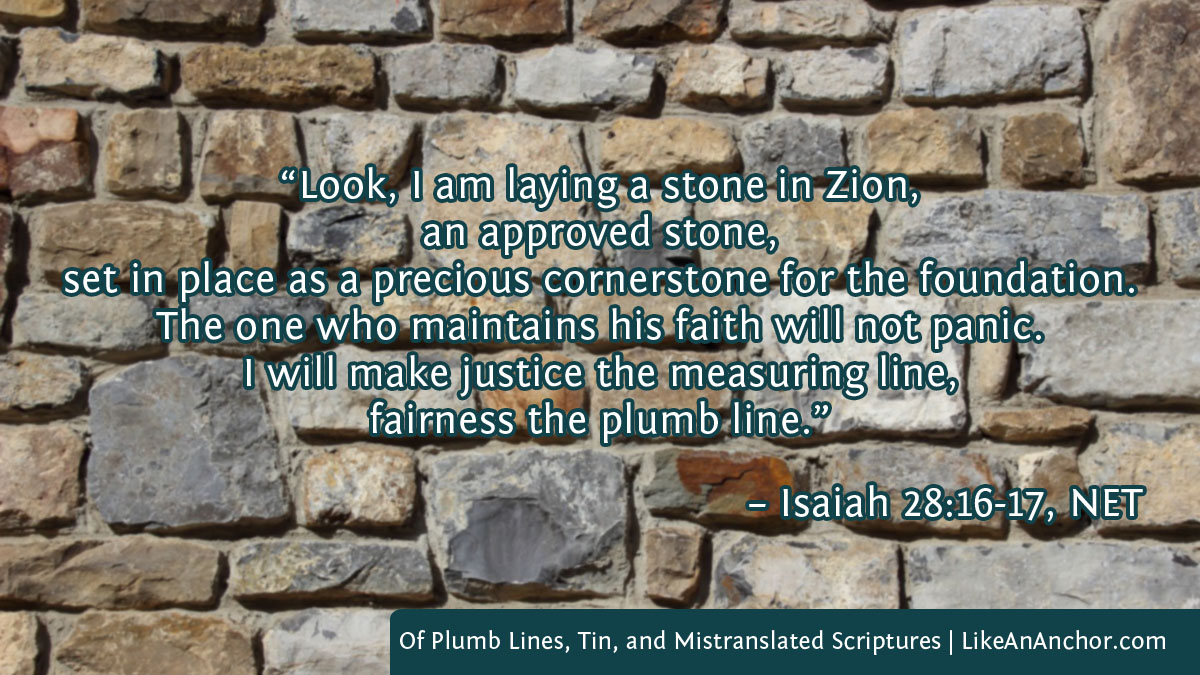
 Therefore the Lord Yahweh says, “Behold, I lay in Zion for a foundation a stone, a tried stone, a precious cornerstone of a sure foundation. He who believes shall not act hastily. I will make justice the measuring line, and righteousness the plumb line. The hail will sweep away the refuge of lies, and the waters will overflow the hiding place.”

Isaiah 28:16-17, WEB

Here, “plumb line” is translated from mishqeleth. It means “level, leveling tool or instrument, plummet” (BDB; H4949). It’s a tool used in building, which makes sense because the context is Yahweh laying the Messiah as the foundation stone for the house He planned to build with the New Covenant church (Eph. 2:20; 1 Pet. 2:5-7).

Yahweh measures the house He’s building using instruments of justice and righteousness. We can still say that He places a plumb line in His people and expects us to measure up to His standards; we just shouldn’t use Amos 7 as the scriptural support for that idea.

As we discussed last week, all scripture is God-breathed. Sometimes, though, the involvement of fallible human beings–or even just the natural evolution of language–can muddy the meaning, especially in translation. If we learn that there’s a more accurate translation of a scripture that’s closer to the original intent, then that’s the one we should go with. We shouldn’t just accept any new interpretation blindly, but with careful investigation and prayer it’s usually possible to discern which translation(s) are more accurate when there’s a significant difference between them.


Featured image by Cloé Gérard from Pixabay

Song Recommendation: “Word of God Speak” by MercyMe

What Does It Mean to Worship God?

Years ago when I first studied the topic of “praise,” I remember I immediately wanted to do a follow-up study on “worship.” That’s what I’m doing again this week. We often use “praise and worship” as a connected idea, almost as if they’re the same thing or they’re simply the label for the time during church services when we sing songs to God. But I remember from my last studies on worship that worship in the Bible is a different thing from praise. They can be connected, but they’re distinct ideas.

Praise, as we saw in last week’s post, involves acknowledgement of something God is or does. It includes the ideas of glorifying God, confessing His greatness, blessing and thanking Him, and lifting up His greatness and mighty deeds. In many cases, praise is public, communal, and enthusiastic. It often involves music and singing. Worship, on the other hand, involves bowing before God with humility, respect, and reverence as you offer service to Him. Praise and worship may occur together, but not necessarily.

Worship Words

As usual here on this blog, I like to start topical studies by looking at the Hebrew and Greek words used in the Bible. We’ll also compare them to the English definition, to see where there might be differences that could affect our understanding.

In English, “worship” as a noun means “the feeling or expression of reverence and adoration for a deity.” As a verb (action), it means “show reverence and adoration for (a deity); honor with religious rites” (Google and Oxford Languages). That matches the Hebrew and Greek meanings pretty well, but it’s missing a few points about how we show that reverence, adoration, and honor. We don’t really bow much anymore (at least in modern Western culture), but that sign of humble recognition that we’re entering the presence of someone far superior to us is key to understanding worship in the scriptures.

In Hebrew, “worship” is usually translated from sachah (H7812). This word appears 172 times in the Hebrew Bible, and you can translate it “bow down” or “worship.” Occasionally, English translators may use words like “obeisance” or “reverence” as well. Basically, the word means “to bow down, prostrate oneself” as “before a superior in homage” and “before God in worship” (Brown, Driver, Briggs [BDB]). Strangely (considering how much time they devote to words translated “praise”), the Theological Wordbook of the Old Testament (TWOT) has little to say about sachah. They simply say that the word can mean to “depress” or “weigh down” someone or something, as well as “‘to prostrate oneself’ or ‘to worship'” (TWOT 2360). The meaning seems to be fairly straightforward. There’s also a similar Chaldean word used in the book of Daniel that means to prostrate or “fall down” in worship (H5657; segid).

In the modern NET Bible, the translators sometimes render the Hebrew words abad (H5647; “serve” in KJV) and yare (H3372; “fear” in KJV) as “worship.” They’ll also translate whole phrases like “set their hearts to seek” or “call on the name” as “worship.” The NET isn’t my preferred translation for the Old Testament (I think they sometimes lose the important, poetic word pictures of Hebrew by reducing them to a single English word), but abad is an important word to look at when we’re studying worship. It blends the meanings of several roots, including “to do or make” and “to worship, obey” (TWOT 1553). It involves service offered to someone, often a king or deity. In a proper sense, it includes the “joyous and liberating experience” of serving the one true God (TWOT). Our worship can include obedient service as well as humble and reverent bowing before God.

In Greek, “worship” can be translated from a wide variety of different words. In the KJV, translators chose “worship” to represent all of these words: proskuneo (G4352; prostrate/worship), sebomai (G4576; revere/adore/worship), doxa (G1391; glory), latreuo (G3000; minister/serve), eusebeo (G2151; be pious toward/respect), therapeuo (G2323; wait upon, worship), threskeia (G2356] ceremonial observance/religion), and also a few single-use derivatives of those words (note: worship is not the only translation for most of these words [e.g. doxa is typically translated “glory”]). Most often (54 out of 73 verses), “worship” comes from proskuneo. The NET also translates these words as “worship,” and they translate latreuo as worship more often than the KJV does (which typically uses “service”).

Taking the Hebrew and Greek together, the ideas that come into the English language as “worship” typically involves either 1) prostration and bowing down before God, and/or 2) service given to God. It also includes nuances of respect, adoration, and reverence. With that background, let’s look at how these words (particularly the Hebrew sachah and abad and the Greek proskuneo and latreuo) are used by Bible writers.

Image of a man sitting at a table with his head bowed over an open Bible, overlaid with text from Psalm 95:6, WEB version: "Oh come, let’s worship and bow down. Let’s kneel before Yahweh, our Maker"
Image by WhoisliketheLord Studio from Lightstock

Kneeling in Worship

The earliest record we have of worship comes from Abraham, the Friend of God (Isa. 41:8; Jam. 2:23). When “Yahweh appeared to” Abraham before the destruction of Sodom and Gomorrah, Abraham “ran to meet them from the tent door, and bowed himself to the earth” (Gen. 18:1-2, WEB). Here, “bowed himself” is translated from sachah. Abraham also used this word when God commanded him to sacrifice Isaac, explaining to his servants, “We will worship, and come back to you” (Gen. 22:5, WEB). Just in these examples, we see that worship involves humility, respect, and actions that serve God obediently. Sachah may involve literal bowing, but not always.

Oh come, let’s worship (sacha) and bow down (kara).
    Let’s kneel (barak) before Yahweh, our Maker,
    for he is our God.
We are the people of his pasture,
    and the sheep in his care.

Psalm 95:6-7

Here, “worship” is translated from sachah. It’s paired with kara (H3766) and barak (H1288). Kara specifies literal bending and bowing. It’s used 36 times in scripture, and at least 13 are for bowing to the knees and bending the back in worship (TWOT 1044). Barak is one of the words that we looked at last week; it is more typically translated “bless” and can be translated “praise” in some contexts. The use of these three words together makes it clear sachah isn’t always synonymous with kneeling (there wouldn’t be need for another word to clarify it if that was the case). Worship always involves the attitude of humbly prostrating oneself before God, but doesn’t always mean literally falling to your knees (though it can and often does include that).

Like Hebrew, Greek also has separate words for “bow/kneel” than the word for “bow/worship.” One of them is kampto (G2578), which Paul uses to talk about one of his prayers (Eph. 3:14-19) and to express the proper reaction people should have–and eventually all will have–to Jesus the Messiah.

As a result God highly exalted him
and gave him the name
that is above every name,
so that at the name of Jesus
every knee will bow (kampto)
—in heaven and on earth and under the earth—
and every tongue confess
that Jesus Christ is Lord
to the glory (doxa) of God the Father.

Philippians 2:9-11, NET

You’ll see something similar in the gospels, too, where people “bow down” and “worship” Jesus. The same thing is happening before God’s throne in heaven (Matt. 2:11; Rev. 5:14; 19:4). In these verses, the words are pipto (G4098; literally “fall down”) and proskuneo (G4352; worship). Zodhiates says that proskuneo comes from a root meaning to kiss, which references an “ancient oriental mode of salutation … when one was much inferior, he fell upon his knees and touched his forehead to the ground or prostrated himself, throwing kisses at the same time toward the superior” (The Complete Wordstudy Dictionary: New Testament, entry 4352). This isn’t necessarily literally happening in the New Testament (though, as we’ve seen, people do fall down or bow before God as well as worship), but it’s a custom underlying the action of showing reverence, adoration, and worship to a deity.

Image of hands clasped on an open Bible overlaid with text from Joshua 23:16, NET version:  “If you violate the covenantal laws of the Lord your God which he commanded you to keep, and follow, worship, and bow down to other gods, then the Lord will be very angry with you”
Image by Jantanee from Lightstock

Service As Worship

31 times in the Old Testament, you’ll find sachah and abad in the same verse. Over and over again, God’s people are warned not to bow down to, worship, or serve any other gods (Ex. 20:5; Deut. 11:16; 2 Kings 17:34-35). Doing so violates the covenant ancient Israel made with Yahweh (Josh. 23:16; Jer 22:9). Jesus reiterated the importance of worshiping and serving God alone during His confrontation with Satan following His baptism.

Again, the devil took him to a very high mountain, and showed him all the kingdoms of the world and their grandeur. And he said to him, “I will give you all these things if you throw yourself to the ground and worship me.” Then Jesus said to him, “Go away, Satan! For it is written: ‘You are to worship the Lord your God and serve only him.’”

Matthew 4:8-10, with a quotation from Deut 6:13

Here, because Jesus is quoting from the Old Testament, we can see how he aligned the Hebrew and Greek words for worship. We’re to worship (Greek proskuneo; Hebrew yare) God and serve (Greek latreuo; Hebrew abad) Him. Like the Hebrew abad, the Greek verb latreuo (noun form latreia) involves serving someone greater than you. The root word means “one hired,” indicating this service is voluntary and involves some kind of reward. When worshipping God, it’s not a transactional hiring process, but there are great rewards for those who faithfully serve Him.

Therefore I exhort you, brothers and sisters, by the mercies of God, to present your bodies as a sacrifice—alive, holy, and pleasing to God—which is your reasonable service (latreia).

Romans 12:1, NET

Presenting our entire lives to God as if we’re serving in His temple offering ourselves as a sacrifice to Him is a reasonable service. Reading Hebrews can provide a fascinating study of latreuo. It’s used of temple service under the Old Covenant, which was commanded as part of worshiping God but couldn’t make the worshippers perfect the way that Jesus’s sacrifice does (Heb. 9:1, 6, 9; 10:2). Because of what Jesus did, “the blood of Christ” cleans “your conscience from dead works to serve the living God” (Heb. 9:14, WEB). I said earlier this service isn’t a transactional hiring process, but it is a reciprocal relationship. When we accept Jesus’s sacrifice, we’re supposed to respond with worship and service.

So since we are receiving an unshakable kingdom, let us give thanks, and through this let us offer worship (latreuo) pleasing to God in devotion and awe. For our God is indeed a devouring fire.

Hebrews 12:28-29, with a quotation from Deut 4:249:3.

The Bible gives us a few concrete examples of what this service looks like. Anna the prophetess served God by staying in the temple, fasting, and praying (Luke 2:36-37). Paul served God by following Jesus, believing in the law and the prophets, worshiping in the spirit, and preaching the gospel (Acts 24:10-14; Rom. 1:9; Phil. 3:3). Serving God voluntarily and wholeheartedly is a key aspect of how we worship Him.

Spirit and Truth

Image of a man sitting in a church pew with his head bowed, overlaid with blog's title text and the words, "Worship involves bowing before God (literally or figuratively) with humility, respect, and reverence and serving Him in spirit and in truth."
Image by Shaun Menary from Lightstock

Returning to the Greek word most often translated worship, proskuneo (G4352), we can fill in a little more of our picture of what it means to worship. In the gospels, people worshiped when they learned that Jesus is the Messiah (Matt. 2:1-2, 11; 14:33; John 9:38). People also worshiped when they ask Jesus for something (Matt. 8:2; 9:18; 15:25). We can continue both these practices today, worshiping Jesus and the Father as we recognize who they are and what they do, and also approaching them with our requests in a humble, worshipful way.

“But a time is coming—and now is here—when the true worshipers will worship the Father in spirit and truth, for the Father seeks such people to be his worshipers. God is spirit, and the people who worship him must worship in spirit and truth.”

John 4:23-24, NET

This conversation that Jesus has with a Samaritan woman is probably the most direct discussion anyone in the Bible has about how we’re supposed to worship. Most of the time, we see examples of people worshipping or instruction to worship God without a specific explanation of how to do that. Here, Jesus gives us a “must” statement for how we need to worship God.

Thoroughly examining what it means to do something in spirit and truth could fill at least one more whole blog post. But I think the easiest way to understand it is to think about Paul’s letters that contrast walking in the flesh to walking in the spirit (e.g. Romans 8). Lives transformed by God are spirit-led, and that should affect our worship as well. For the “truth” aspect, I think of the letter where Paul said we should be “practicing the truth in love” (Eph. 4:15, NET). In this passage, truth is a verb. We don’t think of “truthing” as an action in English, but it is here. The NET notes that we can think of it as “being real or truthful in both conduct and speech” (footnote on Eph. 4:15).

Worship involves bowing before God (literally or figuratively) with humility, respect, and reverence. It also involves the service that you offer to Him. All of this must be done in spirit and in truth for it to qualify as true worship in our New Covenant relationship with God the Father and Jesus the Son.


Featured image by Pearl from Lightstock