
Putting God in a Clay Pot: How Much Does the Lord Understand You?

Do you ever feel like God doesn’t really know what you’re going through? That He doesn’t get how hard it is to be human or that He expects too much of us?

I think this is an easy thought pattern to fall into. “My problem is something different,” we think. “Other people don’t understand, and maybe God doesn’t either. Sure Jesus was human but that was 2,000 years ago. Things have changed.”

Truth is, though, things haven’t changed that much. “There is no new thing under the sun” because human nature stays the same (Ecc. 1:9). And even if things have changed so much that being human is fundamentally different than it once was, God has still taken steps to make sure He understands us. Evidently connecting with us is very important to Him, because He’s done some pretty incredible things in order to get inside our perspectives and also to share His mind with us. Firstly, He made us. Secondly, He experienced human life by Jesus living as a human. Finally, He indwells His people today through His spirit.

Made

If you make something you understand it. You know all the ingredients in the cookies, you know the hours put into shaping clay into an urn, you know the measurements and materials required to machine that part. God understands us even better than that, for He created all the materials we’re formed from and then fashioned us in His own image.

Like a father has compassion on his children, so Yahweh has compassion on those who fear him. For he knows how we are made. He remembers that we are dust. (Psalm 103:13-14, WEB)

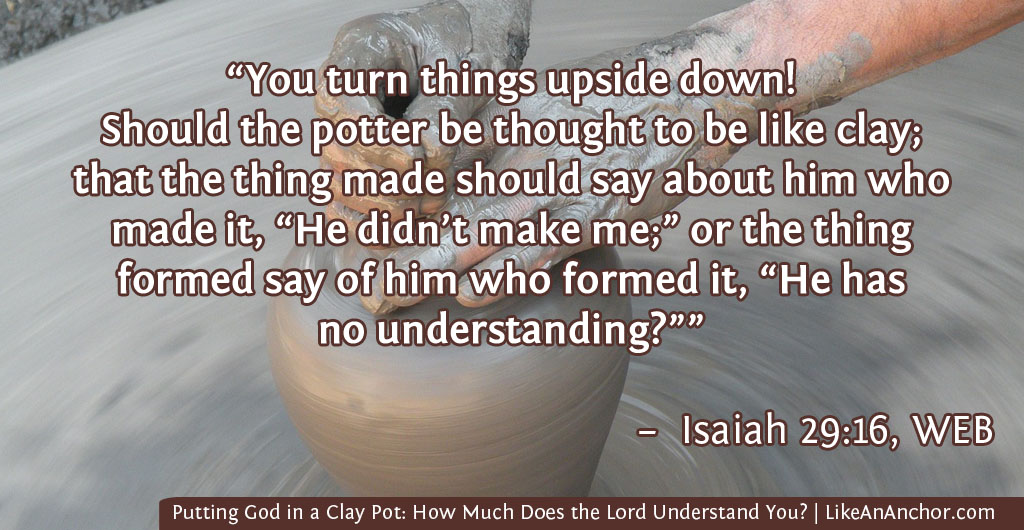
Other translations use the phrase “He knows our frame” (Hebrew word yetser, meaning form, framing, or purpose). God made us and knows all about us. We are something formed by him as if we were clay in the hands of a master potter (Is. 29:16 also uses the word yetser).

However, knowing how to make a clay pot isn’t the same as knowing what it’s like to be a clay pot. He could search us and know us more intimately than anyone else (see my favorite Psalm, number 139 for an example), but God in the Old Testament hadn’t yet lived as one of us.
Lived

They say if you want to understand someone you should walk a mile in their shoes. God did much more than that when the Son came to this earth as a man. He walked 33 years in our human form.

Who, existing in the form of God, didn’t consider equality with God a thing to be grasped, but emptied himself, taking the form of a servant, being made in the likeness of men. And being found in human form, he humbled himself, becoming obedient to the point of death, yes, the death of the cross. (Phil. 2:6-8, WEB)

Having created the form of man, God now inhabited it as the Word who took on the same form He created (John 1:1-4, 14). Both Father and Son were involved in creation (Eph. 3:9) and both were involved in the decision to send Jesus as the Messiah (John 5:36-37; 10:17-18). The God-family was in perfect agreement about how important it was for one of them to live and die as a human.

Since then the children have shared in flesh and blood, he also himself in the same way partook of the same, that through death he might bring to nothing him who had the power of death, that is, the devil … Therefore he was obligated in all things to be made like his brothers, that he might become a merciful and faithful high priest in things pertaining to God, to make atonement for the sins of the people. For in that he himself has suffered being tempted, he is able to help those who are tempted. (Heb. 2:14, 17-18, WEB)

This tells us that one of Jesus’ reasons for coming to this earth was to experience human life and so know first-hand what we are going through. This is an incredible sacrifice for God to make in order to understand you! It’s mind-boggling that one of the two all-powerful beings in the universe would choose to live like one of the clay pots He made all so He could save our lives and understand how to help each of us.

Indwelt

What Jesus did in coming to earth, living as human, and dying for us is amazing in itself. But He doesn’t stop there. He made us, then He lived like us, and now He lives inside us.

For we don’t preach ourselves, but Christ Jesus as Lord, and ourselves as your servants for Jesus’ sake, seeing it is God who said, “Light will shine out of darkness,” who has shone in our hearts to give the light of the knowledge of the glory of God in the face of Jesus Christ. But we have this treasure in clay vessels, that the exceeding greatness of the power may be of God, and not from ourselves. (2 Cor. 4:5-7, WEB)

Today, God is still putting His presence in clay pots (us) through His spirit. He has said, “I will dwell in them and walk in them. I will be their God and they will be my people” (2 Cor. 6:16, WEB). This is an intimate level of knowing that goes beyond how we are made or even what it’s like to be human (John 15:4; 17:22-23). Through the indwelling of His spirit, He knows what it is like to be us in the fullest way we could ever imagine.

So if you ever feel like maybe God doesn’t understand you, remember all the ways that He knows you. He made human kind, lived as a human, and now lives in each of us. No one (including yourself) will ever understand you as well as God does. And there’s a great comfort in that, “for we don’t have a high priest who can’t be touched with the feeling of our infirmities.” Our Lord and Savior knows what it’s like to be human and has deep sympathy for all of us (Heb. 4:14-16). Beyond that, He deeply sympathizes with each individual He’s in a relationship with because we dwell in Him and He in us through His spirit.

I know how hard it is when you’re struggling with loneliness, but when we have a relationship with God we never have to feel fundamentally alone or misunderstood. He’s gone to incredible lengths to have a deep, personal relationship with us. All we have to do is recognize that He’s there.

Featured image credit: JamesDeMers via Pixabay

The Joy Of The Lord

I think most of us have learned there are multiple words for love in the Greek language. With seven words devoted to this concept, we assume it must be important. But did you know something similar is going on with the word “joy”?

In the New Testament the primary Greek word for joy is chara or its root chario. The Greek parts of the Bible also use agalliao, euphrosure, and (more rarely) skirtao and apolausis. Hebrew has even more words for joy. The primary one is samach and its close relatives simcha and sameach. Other words for joy include chadah, sus, alats, giyl, and alaz. The words for “shout” like ranan and rua also carry a joyful meaning in certain contexts. That adds up to more than a dozen words in the Bible to describe joy!

Clearly, joy is an important concept for Biblical writers and for the cultures they lived in. This type of joy isn’t just a happy feeling, though. It’s a state of being that we can have as a result of being in relationship with God. As a fruit of the spirit, joy is present in all spirit-led Christians. This joy can be bubbly, enthusiastic, and happy (and often is), but it can also be a quiet, enduring outlook that flourishes inside us even when we don’t feel outwardly merry.

Joy Is More Than Happiness

To those in less than pleasant circumstances, commands to rejoice (like Deut. 26:11: 1 Thes 5:16) often feel insensitive. “If you knew what I was going through,” we might say, “you wouldn’t tell me to feel happy.” Nevertheless, joy is something God expects and commands from His people.

It’s a similar situation as what happens with love. God is love, and He commands us to love others even when it doesn’t make sense from a human perspective. Biblical love is also something more than our modern concept of warm feelings toward someone. It’s much deeper. In much the same way, joy goes deeper than feelings of happiness. Read more

How To Find Peace With What God Expects: Learning From Moses’ Five Questions

Have you ever heard someone say that if you’re doing what God wants you to do you’ll know because you’ll have peace with it? This is one of those Christian-ish sayings that sounds good at first, but doesn’t always hold up to more rigorous scrutiny.

Take Moses for example. When God called him to lead the children of Israel out of Egypt Moses did not feel peace with this mission. In fact, he tried to talk God out of picking him five times in this conversation. I find it interesting that God wasn’t angry with the fact that Moses didn’t have a peace with his calling at first. The Lord only got angry when Moses begged Him to send someone else.

God doesn’t need us to feel like we can handle what He asks us to do (He’ll help us out with that). He just needs us to be willing to trust where He’s leading and walk forward with Him. That’s part of what His responses to Moses’ five questions can teach us.

First Question

Moses said to God, “Who am I, that I should go to Pharaoh, and that I should bring the children of Israel out of Egypt?” (Ex. 3:11, WEB)

It’s a reasonable question, one we would expect from the man later described as “very humble, more than all the men who were on the surface of the earth” (Num. 12:3, WEB). In fact, if Moses was the sort of person who thought he was perfectly qualified and able to do this God probably wouldn’t have chosen Him. Our Lord has a practice of choosing “the lowly things of the world … that no flesh should glory before God” (1 Cor. 1:28, 29, WEB).

He said, “Certainly I will be with you. This will be the token to you, that I have sent you: when you have brought the people out of Egypt, you shall serve God on this mountain.” (Ex. 3:12, WEB)

God’s answer to the human question, “Who am I?” is “I will be with you.” It’s not about who we are when we’re called to do something for God. It’s about who He is and His power to work in and through humble, teachable people. Read more

Fighting For Truth Within God’s House

Dear friends, although I was making every effort to write to you concerning our common salvation, I considered it a necessity to write to you to encourage you to contend for the faith delivered once and for all to the saints. (Jude 1:3, LEB)

Way back in the first century, Jude had planned to write fellow believers concerning their common salvation. However, he had to change the topic because “certain men have slipped in stealthily” (v. 4) to spread destructive heresies.

When we read an instruction to “contend for the faith,” we typically think of preaching to the world and fighting for God’s truth in an ungodly society. But Jude is talking about the need to do this inside the church. And if they were dealing with problems like this back in the first century, you can be sure we’ll be facing them today as well.

A List of Wickedness

Jude said that we need to fight for the faith even inside the church because of ungodly people who sneaked in. As the letter unfolds, he explains in detail what sort of things these people were doing. It’s a long list, but I think it’s an important one to look at in detail. Read more

What Can Following The Lord Do For You?

We don’t follow God primarily because we want to get something from Him, or at least we shouldn’t. We follow Him because we love Him, He is our savior, and nothing on earth can compare to having a relationship with Him. But we also shouldn’t ignore the fact that following God does mean we’ll receive good gifts from Him.

Following God gives us hope for eternal life. He promises that all who believe in Him shall never see death. Even if that were the only gift, it would be more than enough. However, the good things we receive from God don’t all wait until after you die. He also does wonderful things in our lives right now.

We can’t expect all (or even most) of God’s blessings will be physical ones, though. While He does promise to provide for our needs and even blesses some with physical prosperity, none of us escape trials and hardships in this life. In fact, Christians are promised they will suffer in following Christ’s footsteps. If we only expect God to do things for us in the physical realm then we’ll miss a lot of the blessings He pours out on us. So today, let’s take look at one Psalm that describes some of the incredible things that following the Lord can do for us.

Psalm 19 begins by saying, “the heavens declare the glory of God.” After waxing eloquent about how the universe reveals the Creator, David begins to speak of other ways the Lord, Yahweh, reveals Himself to us. Then David explains how those revelations affect those who believe. Read more

The Value of Being Slow To Anger

The Old Testament often describes God as “slow to anger.” A more literal translation of the Hebrew is actually “long-nosed,” which makes no sense in English. But it’s a picture of a person who takes a long time to reach the point where they’re so angry that their nostrils flare and the air whooshes through their nose like a bull about to charge.

The phrases “slow to anger” and“long-suffering,” are both translated from two Hebrew words — “long” and “breath/passion/heat/anger.” The Greek equivalent is typically translated “patience” or “long-suffering.” It’s not about never getting angry, but about having control over when that happens and not flying off into a rage.

Anger is not inherently sinful. God gets angry, and Paul also tells us we can be angry without sinning (Eph. 4:26). But God doesn’t get angry quickly or without good cause, and we shouldn’t either. So how can we become “slower to anger” and “longer suffering”?

Quick Anger Fuels Strife

I think the dividing line between anger that is and is not sinful can be found in the effect that it has. Jesus throwing those who were exploiting believers out of the temple? Righteous anger. Me getting so upset at someone that I say something nasty which leads to conflict? Sinful anger.

God hates arrogance, wicked schemes, and discord. So if your anger is causing these (or anything else He hates), then it is leading to sin. There are several Proverbs addressing this. Here are a few: Read more