Inheriting Covenants: Revisited

I’ve been thinking about covenants a lot lately, especially the topic of which covenants transfer to us today and how that happens. I think of this as the topic of “inheriting covenants,” the title of a blog post I wrote way back in 2016. When I realized how long ago I wrote that post, I wanted to revisit the topic. As we grow in our walk with God, we should gain a deeper appreciation and understanding of His word. It’s good to go back sometimes and revisit topics we thought we understood well. As Paul said, “If someone thinks he knows something, he does not yet know to the degree that he needs to know” (1 Cor. 8:2, NET). There’s so much depth to God’s word; so much to learn as we grow.

Defining Covenants

Let’s start with the basics. In Hebrew, the word for “covenant” is berith (H1285). In Greek, for the New Testament, the word is diatheke (G1242). These words don’t mean exactly the same thing, and so it can be challenging for us today to figure out what the Biblical writers meant by covenants and how they worked. Also, most of our lives aren’t based on covenants today; in the U.S., I’ve rarely heard that word used outside of a religious context. We need to do some linguistic and historical research to understand covenants, which are so important to the Biblical world and God’s ongoing relationships with humanity.

The Theological Wordbook of the Old Testament (TWOT) notes that “Apart from blood ties the covenant was the way people of the ancient world formed wider relationships with each other” (entry 282a). Covenants have to do with establishing relationship. They were binding agreements between two parties that people in the ancient world took very seriously; “There is no firmer guarantee of legal security peace or personal loyalty than the covenant” (Behm, qtd. in TWOT). When God made a covenant with His people, we was binding Himself in relationship to them in the most reliable way possible. Like other covenants, the ones between God and humanity include both expectations and promises. Covenant documents between people survive to the present day, and the format of them has many similarities with God’s Ten Commandments and the book of Deuteronomy (Klein, ref. in TWOT).

In Greek, diatheke means testament, as in “the last disposition which one makes of his earthly possessions after his death,” or a covenant agreement (Thayer). According to Spiros Zodhiates, dispensation/testament is always the usage in classical Greek (The Complete WordStudy Dictionary of the New Testament, entry 1242). New Testament writers picked this word to use for covenants. That might seem odd at first, but Zodhiates proposes a definition of covenant that covers both the unilateral enactment of diatheke and the established relationship of berith. He writes that what we describe as a covenant “is a divine order or agreement which is established without any human cooperation and springing from the choice of God Himself whose will and determination account for both its origin and its character” (entry G1242, section IV).

Indeed, we always see God as the initiator of covenants and, by necessity, the relationship established by a covenant with God is always one where He is the superior party. God calls us His friends, but that is a gracious choice on His part; we are by no means His equals nor can we make demands of Him. We either choose to accept the covenants He offers, or we reject relationship with Him. We don’t get the chance to insert our own demands into the covenant; we trust that we’re more than adequately protected and provided for by His promises.

Image of a woman reading the Bible overlaid with text from Jeremiah 31:31, 33, NET version: "Indeed, a time is coming," says the Lord, "when I will make a new covenant with the people of Israel and Judah. ... I will put my law within them and write it on their hearts and minds. I will be their God and they will be my people."
Image by Matt Vasquez from Lightstock

Key Covenants

There are four main covenants that God made with human beings that are recorded in the Old Testament writings: the Noahic Covenant, the Abrahamic Covenant, the Sinai Covenant, and the Davidic Covenant. There are other covenants mentioned, but those are the big ones. The BibleProject has a great summary of these on YouTube:

With the exception of the Noahic Covenant, the covenants God made with people included expectations for God’s human covenant partners. God kept up His covenant promises, but people broke the covenants with God. That put us under a death-penalty; a curse (Rom. 3:23; 5:12; Gal. 3:10). Then Jesus came along. As a human being, He was a physical descendant of Abraham, an Israelite heir of the covenants with God, and a man in the lineage of David (Acts 2:29-31). He was born into the physical position of an heir to all these key covenants. He also came as God in the flesh, so He can see covenants from both sides and keep covenant perfectly both as God and human.

Prior to Jesus Christ coming to this earth, all except the Noahic Covenant were linked to Abraham’s descendants. The Sinai Covenant was with all of physical Israel and included a fuller revelation of God’s law and expectations. The Davidic covenant was more specific, applying to one line of the tribe of Judah. It was possible for a stranger to join themselves to Israel and become part of the Abrahamic and Sinai Covenants with God, as Rahab and Ruth did, but it was apparently quite rare and more often than not was discussed in a prophetic context (Is. 56:6-7).

That also changed with Jesus’s coming. In the New Testament, Paul writes to Gentile believers that they were “alienated from the citizenship of Israel and strangers to the covenants of promise, having no hope and without God in the world” until the time of their conversion. They were not previously heirs to the covenants, “But now in Christ Jesus you who used to be far away have been brought near by the blood of Christ” (Eph. 2:12-13, NET). This is a fulfillment of a promise that God delivered through His prophets; a promise to make a better New Covenant with the people of Israel and the spiritual descendants of Abraham.

A Question of Inheritance

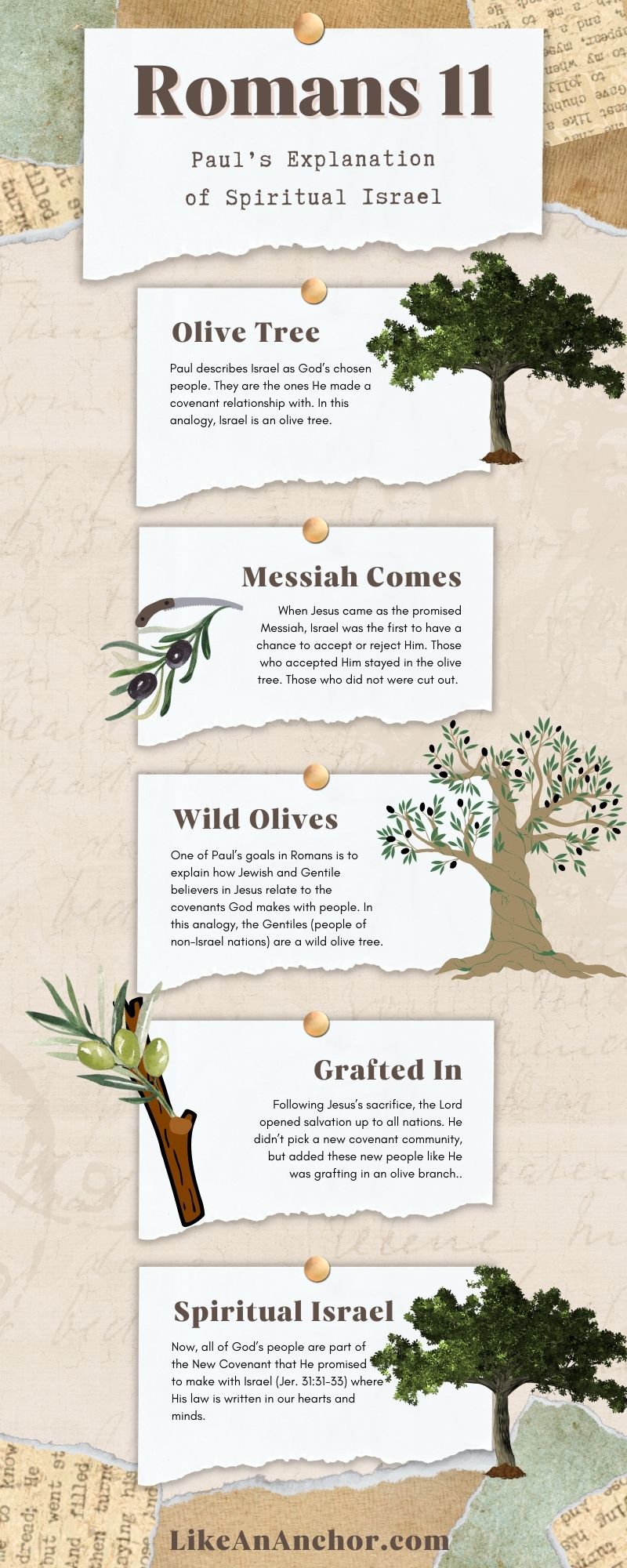
Infographic illustrating the "grafted in" analogy Paul uses for how Jewish and Gentile Christians enter the New Covenant community with God.

I usually go to Romans when I want to discuss covenants, which is where we were a couple weeks ago when I shared an infographic illustrating how all God’s people become spiritual Israel. Today, though, we’re going to spend some time in Galatians.

In this letter, Paul writes to a group of churches with the expressed purpose of countering distorted gospels (Gal. 1:6-8). He wants to ensure that they follow the pure gospel that he receive, not some distortion arising from human reasoning (Gal. 1:1, 11-12, 15-24). That’s the perspective Paul’s coming from when he discusses covenants in this letter.

It appears that the Galatian believers had been deceived by a person or group who told them they needed to keep the whole Jewish law in order to be saved. The Galatians were worried that the male believers needed to be circumcised, that they had to keep the whole Old Covenant law, and that they additionally had to keep Jewish additions to God’s law. Paul reminds them that it is Jesus’s faithfulness that brings us righteousness and justification, not our own efforts. That doesn’t mean we break God’s law; Christ in us most certainly does not encourage sin. But He also didn’t save us and give us the Spirit so that we could then save ourselves by our own efforts. Rather, we’re following the example of Abraham.

Just as Abraham believed God, and it was credited to him as righteousness, so then, understand that those who believe are the sons of Abraham. And the scripture, foreseeing that God would justify the Gentiles by faith, proclaimed the gospel to Abraham ahead of time, saying, “All the nations will be blessed in you.” So then those who believe are blessed along with Abraham the believer. 

Galatians 3:6-9, NET (bolt italics mark quotes from the Old Testament)

Here, Paul quotes from the record in Genesis of God cutting a covenant with Abraham (Gen. 15). This covenant is one of inheritance and blessing. We learn more about it in Genesis 17 and 18, which Paul also quotes. If you read that section, you’ll notice that God’s covenant with Abraham included people following the Lord’s way and doing what is right. But, as Paul emphasizes, the promises come to Abraham and his descendants because God is faithful, not because they kept the Law that God later shared as part of the Sinai Covenant or because they observed Jewish traditions added later.

God does want people to follow His law (it defines sin and, since sin is not consistent with God’s character, it damages relationships between us and Him). But God also knows that all people sin. It is very, very good for us that He upholds His part of covenants even when people aren’t faithful, because one of those covenant promises was that God would send Jesus as the Messiah. That’s how we inherit the Abrahamic Covenant promises: through Jesus Christ.

 Brothers and sisters, I offer an example from everyday life: When a covenant has been ratified, even though it is only a human contract, no one can set it aside or add anything to it. Now the promises were spoken to Abraham and to his descendant. Scripture does not say, “and to the descendants,” referring to many, but “and to your descendant,” referring to one, who is Christ. What I am saying is this: The law that came 430 years later does not cancel a covenant previously ratified by God, so as to invalidate the promise. For if the inheritance is based on the law, it is no longer based on the promise, but God graciously gave it to Abraham through the promise.

Galatians 3:15-18, NET (bolt italics mark quotes from the Old Testament)

A few verses later, Paul says that the Law was “added because of transgressions, until the arrival of the descendant to whom the promise had been made” (Gal. 3:19, NET). He also says the law was a guard to keep us safe and a “tutor to bring us to Christ, that we might be justified by faith” (Gal. 3:24, WEB). The law defines sin for us and reveals the penalties for breaking God’s covenant law. As transgressors of the covenant, we deserved to inherit the curses contained in the covenanting words (Deut. 11:26-32; 27:1-28:68). The only one who perfectly kept God’s covenant was Jesus Christ, and so He’s the only one who truly deserved to inherit all the promises. When He died, He “willed” those promises to us. We inherit the Abrahamic Covenant alongside Him, and through Him we’re brought into the New Covenant that God long ago promised would replace the Old (Sinai) Covenant (Jer. 31:31-34; Heb. 8).

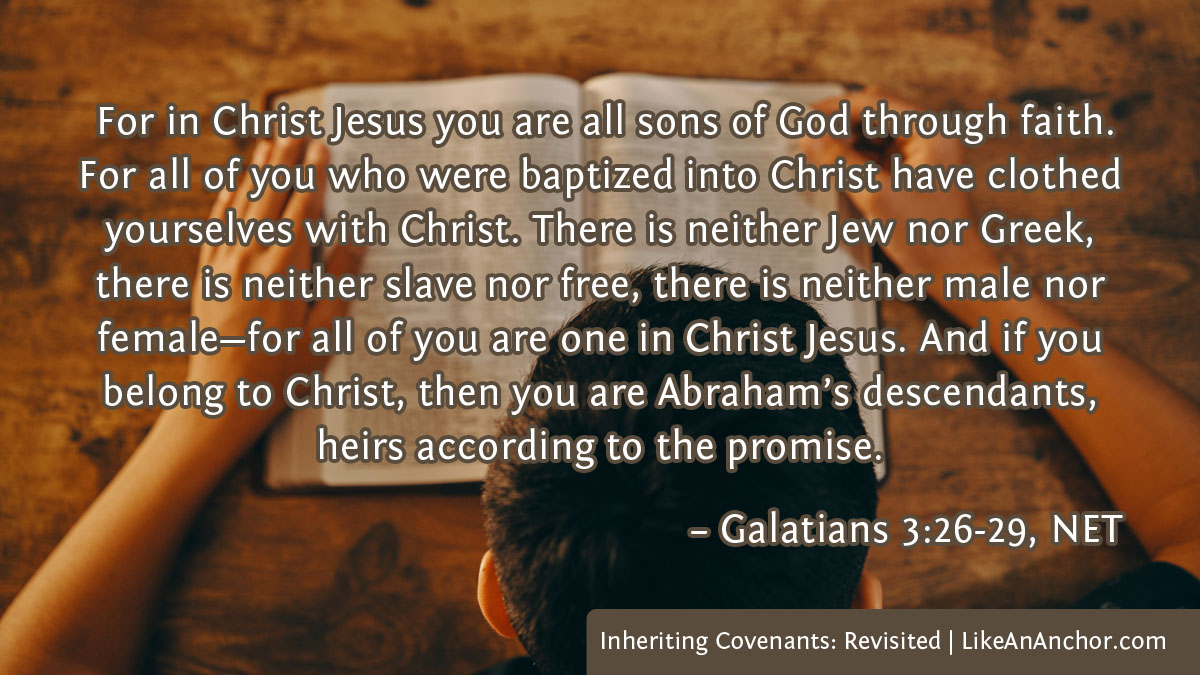
Image of a man reading the Bible overlaid with text from Galatians 3:26-29, NET version:  " For in Christ Jesus you are all sons of God through faith. For all of you who were baptized into Christ have clothed yourselves with Christ. There is neither Jew nor Greek, there is neither slave nor free, there is neither male nor female—for all of you are one in Christ Jesus. And if you belong to Christ, then you are Abraham’s descendants, heirs according to the promise."
Image by Matt Vasquez from Lightstock

Promises Through Jesus

I find it so fascinating that the New Testament writers use the fact that the Greek word for covenant also means last will and testament to connect the idea of covenant inheritance to our adoption as God’s children (Gal. 3:26-4:7; Rom. 8:14-17). The author of Hebrews spends quite a bit of time explaining this concept, particularly the transition from Old to New Covenant.

 And so he [Jesus] is the mediator of a new covenant, so that those who are called may receive the eternal inheritance he has promised, since he died to set them free from the violations committed under the first covenant. For where there is a will, the death of the one who made it must be proven. For a will takes effect only at death, since it carries no force while the one who made it is alive. 

Hebrews 9:15-17
Image of a man and woman reading the Bible together, overlaid with blog's title text and the words, "Jesus makes all who believe in and fellow Him heirs of God's covenant promises."
Image by Anggie from Lightstock

As the Word of God, Jesus is (almost certainly) the God-being who delivered the first covenants in the Old Testament. Then, as the original testator, He died so we can be freed from the Old Covenant and join Him in a New Covenant (Jer. 31:32-34; Rom 7:1-4). At the same time, as a human heir to all the covenants (and the only person who kept humanity’s side of the covenant bargain, since He never sinned), Jesus died to take on Himself the penalty we earned for breaking the covenant, purify us with His blood, and bring us into a new covenant (Heb. 9:18-28). Yet another layer is that He inherits all the promises, wills them to us at His death, then rises again to inherit as well (Eph. 1:3-21).

We were also assigned an inheritance in him, having been foreordained according to the purpose of him who does all things after the counsel of his will, to the end that we should be to the praise of his glory, we who had before hoped in Christ. …

For this cause I also …  don’t cease to give thanks for you, making mention of you in my prayers, that the God of our Lord Jesus Christ, the Father of glory, may give to you a spirit of wisdom and revelation in the knowledge of him, having the eyes of your hearts enlightened, that you may know what is the hope of his calling, and what are the riches of the glory of his inheritance in the saints, and what is the exceeding greatness of his power toward us who believe, according to that working of the strength of his might which he worked in Christ, when he raised him from the dead

Ephesians 1:11-12, 15-20, WEB

It’s amazing to me that God invites us to be covenant partners with Him and participate in the relationships that He’s been building with humanity since the world began (the word “covenant” isn’t used in the creation story, but the words of His promises to Adam and Eve are covenant-like, and some call it the Adamic Covenant). People often say that God wants a personal relationship with you, and covenants are the way that the Bible describes that relationship. They’re so important to understanding our role in God’s plan and His family, and I don’t think we talk about them enough. The more deeply and completely we understand covenants, the better we’ll understand God and the relationship He wants to have with us.


Featured image by falco from Pixabay

Don’t Despise Your Role

I caught myself doing something I’m not proud of a few weeks ago. I was talking with someone about why I’d been traveling last month for the Feast of Tabernacles (Sukkot) and made a comment about the “weird religious things” I do. I felt bad about it immediately, repented and asked God’s forgiveness, but it still kept bugging me. Why was my first reaction to downplay rather than to explain my faith?

Just a few weeks later in a sermon, I heard a speaker at church using a similar phrase in the context of explaining our “weird religious stuff” to people who have no background with our faith. I’m not the only one doing this, and I think I know why. We recognize that our faith is very different than what the world thinks is “normal” and that’s becoming increasingly apparent. Religious people are no longer the majority in the United States. According to Gallup, “In 2020, 47% of U.S. adults belonged to a church, synagogue or mosque,” which is 20 points lower than it was in 2000 (“U.S. Church Membership Falls Below Majority for First Time“).

When you’re going to church on Saturday and keeping God’s holy days (as I do), then you have some very visible differences from other Christians as well. We laugh self-consciously at the King James Version of 1 Peter 2:9, which says “ye are a chosen generation, a royal priesthood, an holy nation, a peculiar people,” and agree that we’re certainly peculiar. We know we’re odd, and so we laugh at ourselves before someone else can.

The thing is, “peculiar” comes from the Latin word peculiaris, which relates to private property (Oxford Languages via Google). That’s why modern translations say things like, “you are … a people for God’s own possession” (1 Pet. 2:9, WEB). Our peculiarity isn’t because we’re strange and odd; it’s because we belong to God. That will make us look strange to the world that we’re living in without being a part of it (John 17:14-16), but that doesn’t mean we should think of ourselves as weird.

Being self-effacing and deflecting conversations about your faith in certain situations isn’t necessarily a sin. You don’t always have to engage with people who are actively hostile or have zero interest in learning about God. But evading or downplaying is not the best thing to do. Especially if it might come across as you being embarrassed about your faith or unwilling to confess that you follow Jesus Christ, because then we are getting into sin territory. God wants us to be lights in a dark world, not cover up the light He’s shining through us. He wants us to speak about Him boldly because we love Him too much to stay silent and we respect Him too much to downplay His importance.

Image of a woman studying a Bible overlaid with text from 1 Peter 1:14-16, NET version: “Like obedient children, do not comply with the evil urges you used to follow in your ignorance, but, like the Holy One who called you, become holy yourselves in all of your conduct, for it is written, ‘You shall be holy, because I am holy.’”
Image by MarrCreative from Lightstock

Esau’s Problem

There’s a story in the Old Testament that comes to mind when I think about the value we place on God’s gifts. Part of God’s law includes a special place for the firstborn. He told Moses to write, “Sanctify to me all the firstborn, whatever opens the womb among the children of Israel, both of man and of animal. It is mine” (Ex. 13:2, WEB). Culturally and theologically, the firstborn had a special role in the ancient Biblical world. They were set apart for God’s own use, and they inherited a more significant blessing from their father. Even before Exodus, we see this pattern in the stories of the patriarchs. There were rights and privileges that should belong to the firstborn. We also see this disrupted several times–Isaac was the son of the promise, but not Abraham’s firstborn, and Joseph was chosen for special blessings over his older brothers. That disruption also happens for Isaac’s sons Jacob and Esau.

Jacob boiled stew. Esau came in from the field, and he was famished. Esau said to Jacob, “Please feed me with some of that red stew, for I am famished.” Therefore his name was called Edom.

Jacob said, “First, sell me your birthright.”

Esau said, “Behold, I am about to die. What good is the birthright to me?”

Jacob said, “Swear to me first.”

He swore to him. He sold his birthright to Jacob. Jacob gave Esau bread and lentil stew. He ate and drank, rose up, and went his way. So Esau despised his birthright.

Genesis 25:30-34, WEB

This didn’t turn out so well for Esau. He lost the firstborn blessing and it was his younger twin Jacob who became the patriarch of Israel and is part of the lineage of Jesus Christ. But what does that have to do with us?

Pursue peace with everyone, and holiness, for without it no one will see the Lord. See to it that no one comes short of the grace of God, that no one be like a bitter root springing up and causing trouble, and through it many become defiled. And see to it that no one becomes an immoral or godless person like Esau, who sold his own birthright for a single meal.

Hebrews 12:14-16, NET (italics mark allusions to Deut 29:18 and Gen 27:34-41)

There’s a danger that we could also become like Esau. The writer of Hebrews warned about it strongly. We’re to diligently follow peace, holiness, and grace, avoiding things like bitterness, immorality, and godlessness that’s here exemplified by Esau selling and despising his birthright. He didn’t value that gift and so he let it go in exchange for something relatively worthless. There’s little chance Esau was actually “about to die” after a day of hunting in the field, especially when he had a tent to go back to where his whole family lived. They likely had a whole household and if there wasn’t other food available right that moment there would be later. But he didn’t consider consequences or think through his options. He wanted immediate gratification of his hunger more than he wanted significant, long-term blessings.

Image of a man reading a Bible overlaid with text from Luke 9:25-26, NET version: “For what does it benefit a person if he gains the whole world but loses or forfeits himself? For whoever is ashamed of me and my words, the Son of Man will be ashamed of that person when he comes in his glory and in the glory of the Father and of the holy angels.”
Image by Creative Clicks Photography from Lightstock

Firstborn Inheritance with Jesus

There’s another question earlier in Hebrews that also seems relevant to this conversation. Near the beginning of this book, the writer reminds us of God’s revelation through Jesus Christ and of how important it is to properly reverence and appreciate Him. Then, he says this:

Therefore we must pay closer attention to what we have heard, so that we do not drift away. For if the message spoken through angels proved to be so firm that every violation or disobedience received its just penalty, how will we escape if we neglect such a great salvation? It was first communicated through the Lord and was confirmed to us by those who heard him, while God confirmed their witness with signs and wonders and various miracles and gifts of the Holy Spirit distributed according to his will.

Hebrews 2:1-4, NET

For Esau, the problem was that he despised his birthright. Here, the danger is that we might neglect the great salvation offered through our elder brother Jesus Christ, who is sharing His firstborn inheritance with us. In both situations, improperly valuing the gifts, inheritance, and roles that God gives you leads to a poor outcome.

And see to it that no one becomes an immoral or godless person like Esau, who sold his own birthright for a single meal. For you know that later when he wanted to inherit the blessing, he was rejected, for he found no opportunity for repentance, although he sought the blessing with tears.

Hebrews 12:16-17, NET

God offers abundant forgiveness for sins, but sometimes you still have to deal with the consequences. In Esau’s case, he couldn’t get his birthright back. In our case, continual and deliberate neglect of God’s word and despising His gifts can have eternal consequences.

Image of a woman reading a Bible overlaid with text from Phil. 3:13-15, NET version: “Brothers and sisters, I do not consider myself to have attained this. Instead I am single-minded: Forgetting the things that are behind and reaching out for the things that are ahead, with this goal in mind, I strive toward the prize of the upward call of God in Christ Jesus. Therefore let those of us who are ‘perfect’ embrace this point of view.”
Image by Pearl via Lightstock

Living With Joyful Integrity

The question of whether or not you can “lose” salvation is hotly debated in Christian circles. At one extreme, some say that anyone who confesses Jesus is permanently saved regardless of how they live after. At the other extreme, some say you can’t have any certainty that you’re saved until the very end and live in fear that they won’t measure up.

Bible writers strike an interesting balance between the two–teaching and displaying both a sense of urgency and a sense of confidence. Paul, for example, said in Philippians that he was still striving “to attain to the resurrection from the dead” (Phil. 3:8-16). He hadn’t been perfected yet, but he was confident God could get him there and by the time he wrote 2 Timothy he was sure that God would reward him for his faithfulness (2 Tim. 4:6-8). Similarly, Jesus promises that His father wants to give His children the kingdom and that no one will ever take them out of His hand (Luke 12:32; John 10:28-29) while also warning that people who claim to follow Jesus without sincerely doing God’s will won’t inherit the kingdom (Matt. 7:21-23; 25:1-13; 31-46).

Image of a man sitting on a beach with the blog's title text and the words "God has blessed us with incredible gifts and roles. When we see Him and His work in us as precious, we’ll align the way we talk about our faith and live our lives with the value we place on following Jesus."
Image by Aaron Kitzo via Lighstock

Basically, if we do our best to follow God, obey Him, honor Him, and keep growing closer to Him then He’ll make sure we succeed. He even calls us perfect so long as we’re heading that direction. On the other hand, if we “deliberately keep on sinning after receiving the knowledge of the truth” and show “contempt for the Son of God” then we’re not on a path toward eternal life in His kingdom (Heb. 10:19-39).

This might have taken too harsh a turn from our starting point of referring to some aspect of your faith as a “weird religious thing.” However, if we’re downplaying the importance of our faith in a little thing like that, will we be faithful when we’re confronted with choosing between our faith and fitting in with the world for a larger thing? It’s a question I ask myself, especially when I read stories of people being persecuted and killed for their faith. If someone put a gun to my head and told me to deny Jesus or die, I intend to stay faithful. But what if the compromise is easier to justify, such as staying quiet about a moral issue so you can get a promotion? Can I really expect to respond with faith then if I’m reluctant to express how important He is to me now when there aren’t even any negative consequences?

We need to live with integrity, aligning the way we talk about our faith and live our lives with the value that we say we place on following Jesus. In writing this, I’m speaking to myself as much as (and perhaps more than) anyone else. I pray this study helps keep me on-track. I pray the next time I could describe my faith as weird, I instead let others see how much joy following Jesus brings me. And I hope this gives you something to think about as well, even if you are always honest and joyful about your faith when talking with other people.

Featured image by Matt Vasquez via Lightstock

Titles of Jesus Christ: Firstborn and Heir

Who is Jesus Christ? Some consider Him a prophet, some a teacher who had some good things to say about peace and love, others say He was a madman. As Christians, we know Him as the Son of God who died to save us from our sins, rose again, and continues to be actively involved in our lives. But what does it really mean that He’s God’s Son, and why does that particular title matter to us?

God, having in the past spoken to the fathers through the prophets at many times and in various ways, has at the end of these days spoken to us by his Son, whom he appointed heir of all things, through whom also he made the worlds. (Heb. 1:1-2, all scriptures from WEB translation unless otherwise noted)

Firstborn’s Birthright

In Old Testament times, being a firstborn son was a big deal. You were the bekor (H1060), eldest son  and therefore the bekorah (H1062, birthright) was yours. You received a double portion when the father divided his inheritance (Deut. 21:15-17). There was a special blessing involved (Gen. 27). It was so important that any disruption to this birthright was cause for Biblical writers to take special note (Gen. 25:31-34; 48:9-19; 1 Chr. 5:1-2).

According to a message I recently watched on YouTube titled “Hebrews: Yeshua’s Amazing Qualifications,” the rights of the firstborn traditionally included a few other things as well. The eldest son acted as the family’s spiritual leader, acquired spiritual favor and honor, and inherited the blessings of Abraham. Heirship involved authority over the father’s possessions. Before there was a Levitical priesthood (which Yahweh accepted in place of the firstborns, as noted in Num. 3:12-13, 41; 8:16-18), the firstborn would even act as priest for the family.

Many parallels between Jesus and the Hebrew firstborns are easy to spot. He is the family’s spiritual leader, acting as “head of all things to the church” under the Father’s authority (Eph. 1:15-23). He is also High Priest of an order that supersedes the Levitical order as the Levites superseded what came before (Heb. 7:11-28). And that’s not where the parallels end. Read more

Inheriting Covenants

My renewed interest in studying covenants started with a Greek dictionary. Typically, I would define covenant as  “a binding agreement between two parties,” which is a very basic description of the Hebrew word berith (H1285). For the New Testament, though, Spiros Zodhiates says diatheke (G1242) refers to “the disposition which a person makes of his property in prospect of death, i.e. his testament” and shows “a unilateral demonstration of the will of the testator.”

I’ve always been confused by the discussion about testaments in the book of Hebrews because it didn’t all line-up with my idea of covenants. Do we enter covenant with God as a mutual agreement, or are we benefactors of God’s unilateral will (whether we want it or not)? And how, exactly, do we become partakers of this covenant? After 3 weeks of study, I realized the answer is a little bit of both and that clarity for this question is found in Jesus Christ (that should have been obvious, right?) Read more