Last week we started a study about whether or not the commands and instructions given to Biblical Israel apply to us as Christians today. I answered with a qualified “yes” — we are spiritual Israel, which is not so much separate from physical Israel as it was the next step in God’s plan for His chosen nation. Now, the question becomes, “How many of the laws given to Israel apply under the New Covenant?”
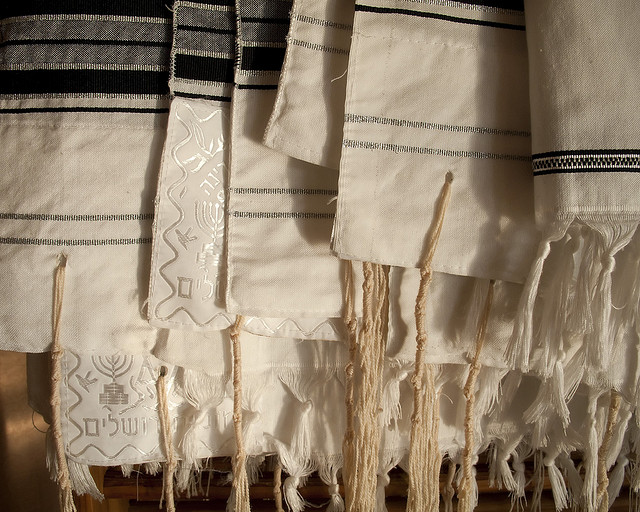
I’ve grown up believing that the Ten Commandments, including Sabbath keeping, carry over into the New Covenant, along with the Lev. 23 Holy Days and the clean and unclean meats laws. I still believe that, but now I’m starting to wonder why we keep those things and not others like the command to put tassels on our garments (Num. 15:37-41) or blow shofars on Holy Days (Ps. 81:3-4). When I ask this question, I’m usually told that not everything from the Old Covenant applies, and when I ask how they know which ones to keep they say, “It’s our tradition.” In my mind, that’s not a good enough answer, so it’s time for some Bible Study.
A New Priesthood
If you read through the laws of the Old Testament, you find quite a lot about the Levitical priesthood. Some of these are described as “a statute forever to their generations on behalf of the children of Israel” (Ex. 27:21), yet it is evident that Christ’s priesthood supersedes that system. If the switch to the New Covenant changed that, how much else was changed?
For the priesthood being changed, of necessity there is also a change of the law. (Heb. 7:12)
But now He has obtained a more excellent ministry, inasmuch as He is also Mediator of a better covenant, which was established on better promises. (Heb. 8:6)
When it talks about a change of the law, I think we often imagine quite a disconnect between the Old and New Testament. We think of change as in something old being replaced by something completely new, but I think perhaps the change is more in how God’s laws apply.
For this is the covenant that I will make with the house of Israel after those days, says the Lord: I will put My laws in their mind and write them on their hearts; and I will be their God, and they shall be My people. (Heb. 8:10)
The Old Covenant was replaced with the New (Heb. 8:13), but God’s laws were not done away with. Even before the Old Covenant was instituted at Mount Sianai, God had laws in place. We can see this in Genesis 26:5, where God says, “Abraham obeyed My voice and kept My charge, My commandments, My statutes, and My laws.” Since God is unchanging, His standards for what He expects from us do not change either.
Jesus said, “till heaven and earth pass away, one jot or one tittle will by no means pass from the law till all is fulfilled” (Matt. 5:18) In the Greek, this means “filled to the fullest extent.” The laws were brought to a spiritual plane, much as physical Israel became spiritual Israel. You still keep the physical laws, but there is a spiritual aspect as well, and we are held accountable for what goes on inside us as much as for what we actually do (Matt. 5:17-30).
Updating The Law
The laws governing the Levitical priesthood are examples of parts of the Old Covenant that have already been filled to the fullest extent by Jesus Christ. We don’t have a physical priesthood any more because He is our High Priest forever. We don’t sacrifice animals any more because Christ’s sacrifice completely fulfilled all the Old Testament commands for blood sacrifices.
For Christ has not entered the holy places made with hands, which are copies of the true, but into heaven itself, now to appear in the presence of God for us; not that He should offer Himself often, as the high priest enters the Most Holy Place every year with blood of another — He then would have had to suffer often since the foundation of the world; but now, once at the end of the ages, He has appeared to put away sin by the sacrifice of Himself. (Heb. 9:24-26)
Without a physical priesthood or temple, many of the ceremonial laws no longer apply to spiritual Israel. Though we as the New Testament church can examine and learn from them and how they foreshadowed Christ’s role as priest and sacrifice, people in the church no longer serve as priests and we no longer sacrifice animals.
Similarly, there were civil laws given to govern the nation of Israel that are not in effect now because the church is scattered through other physical nations with their own laws. Many of the civil laws had a moral aspect, though, and this is updated for us to follow under the New Covenant. Take, for example, the law that said a man and woman who commit adultery must both be put to death (Lev. 20:10). The Pharisees brought Jesus just such a case, and Jesus told them, “He who is without sin among you, let him throw a stone at her first” (John 8:7). When all her accusers left, Jesus told the woman, “Neither do I condemn you; go and sin no more” (John 8:11).
Jesus didn’t say that she hadn’t committed a sin. He said that there was room for mercy and forgiveness even of sins that had formerly incurred a physical death penalty. For judicial matters, Christians are now under the laws of the countries we live in. For moral matters, God’s laws are applied to spirit and in truth with an emphasis on mercy. Is there a guy in your church shaking up with his step-mother? We don’t stone them as was the case in ancient Israel (Lev. 20:11), but we do make it clear that behavior like this is morally wrong and won’t be tolerated in the church (1 Cor. 5:1-13). If he repents, you have to welcome him back just like God welcomes us back into relationship with Him when we repent of our sins (2 Cor. 2:3-11).

There are also aspects of the Old Testament laws that we are specifically commanded to continue observing. This includes the weekly Sabbath (Heb. 4:9) and Passover (Luke 22:19-20). We infer from these specific commands, and from the fact that Jesus and His disciples observed the other Holy Days, that all those days are still commanded observances. Even more obvious is the fact that we should be keeping the Ten Commandments, which are succinctly comprehended in the two greatest commandments.
Jesus answered him, “The first of all the commandments is: ‘Hear, O Israel, the Lord our God, the Lord is one. And you shall love the Lord your God with all your heart, with all your soul, with all your mind, and with all your strength.’ This is the first commandment. And the second, like it, is this: ‘You shall love your neighbor as yourself.’ There is no other commandment greater than these.” (Mark 12:29-31)
God’s focus is on our hearts, and whether or not we choose to keep His commandments tells Him what our hearts are like. Jesus said, “If you love Me, keep My commandments” (John 14:15). The implication is that if we don’t keep His commandments, we are telling Jesus we don’t love Him. If our hearts are right, obedience to God naturally follows.
My feelings on the question, “What is applicable under the New Testament?” is that everything God didn’t specifically replace/update to a spiritual level (the priest hood, physical temples, civil laws) are probably still in effect. It’s up to us to seek out the spiritual reasons for these commands and find a way to physically keep them. There are still some I’m not sure about — like those tassels on the borders of our garments or what we’re supposed to do on New Moons — but I want to keep searching and learning. I want to worship God the way He tells me to, not the way I think sounds like a good idea.

 For I will pour water on him who is thirsty, and floods on the dry ground; I will pour My Spirit on your descendants, and My blessing on your offspring; they will spring up among the grass like willows by the watercourses. (Is. 44:3-4)
 Like An Anchor