Reflecting on Psalm 37: Hope In Troubled Times

I had a different post topic in mind for this week, but I keep thinking about Charlie Kirk’s murder on September 10. I didn’t follow any of his work, and wasn’t even sure if his name sounded familiar when I saw the news of his assassination. But I immediately thought of how much other political violence I’ve been hearing about lately, and how much more prevalent it seems than ever before in my lifetime (“Charlie Kirk killing deepens America’s violent spiral,” Zachary Basu, Axios.com).

“With Charlie Kirk’s slaying, we’ve witnessed more high-profile assassinations or assassination attempts in the past 14 months — including two assassination attempts on President Trump, the killing of a Democratic Minnesota lawmaker and an arson attack on the residence of Pennsylvania Gov. Josh Shapiro (D) — than at any point since 1968, when the nation lost the Rev. Martin Luther King Jr., then Robert F. Kennedy just two months later.”

“Behind the Curtain: Four ominous trends,” Jim VandeHei and Mike Allen, Axios.com

It’s sobering to realize that my feeling that political violence (in my country at least) is the highest it’s ever been in my life is based on facts (King and Kennedy were killed more than 20 years before I was born). And while I do see people struggling to encourage unity and condemn political violence as a bi-partisan issue, it seems like many are becoming even more extremely polarized. It’s a frightening and uncertain time.

In the midst of all this, I happened to read Psalm 37 this past week. It’s one of David’s longer psalms, but I found it helpful to read through it slowly this week, and I want to quite it in it’s entirety for today’s post. This is a different format than we’ve done before, so quick word of explanation. If you’re on a computer, you’ll see Psalm 37 (WEB translation) in the column on the left and my commentary is in the column on the right. If you’re on mobile, you’ll see all of Psalm 37 first, then my comments underneath the psalm with numbers next to the comments to indicate which verse I’m reflecting on.

Psalm 37

Don’t fret because of evildoers,
    neither be envious against those who work unrighteousness.
For they shall soon be cut down like the grass,
    and wither like the green herb.
Trust in Yahweh, and do good.
    Dwell in the land, and enjoy safe pasture.
Also delight yourself in Yahweh,
    and he will give you the desires of your heart.
Commit your way to Yahweh.
    Trust also in him, and he will do this:
he will make your righteousness shine out like light,
    and your justice as the noon day sun.
Rest in Yahweh, and wait patiently for him.
    Don’t fret because of him who prospers in his way,
    because of the man who makes wicked plots happen.
Cease from anger, and forsake wrath.
    Don’t fret; it leads only to evildoing.
For evildoers shall be cut off,
    but those who wait for Yahweh shall inherit the land.
10 For yet a little while, and the wicked will be no more.
    Yes, though you look for his place, he isn’t there.
11 But the humble shall inherit the land,
    and shall delight themselves in the abundance of peace.
12 The wicked plots against the just,
    and gnashes at him with his teeth.
13 The Lord will laugh at him,
    for he sees that his day is coming.
14 The wicked have drawn out the sword, and have bent their bow,
    to cast down the poor and needy,
    to kill those who are upright on the path.
15 Their sword shall enter into their own heart.
    Their bows shall be broken.
16 Better is a little that the righteous has,
    than the abundance of many wicked.
17 For the arms of the wicked shall be broken,
    but Yahweh upholds the righteous.
18 Yahweh knows the days of the perfect.
    Their inheritance shall be forever.
19 They shall not be disappointed in the time of evil.
    In the days of famine they shall be satisfied.

20 But the wicked shall perish.
    The enemies of Yahweh shall be like the beauty of the fields.
    They will vanish—
    vanish like smoke.
21 The wicked borrow, and don’t pay back,
    but the righteous give generously.
22 For such as are blessed by him shall inherit the land.
    Those who are cursed by him shall be cut off.
23 A man’s steps are established by Yahweh.
    He delights in his way.
24 Though he stumble, he shall not fall,
    for Yahweh holds him up with his hand.
25 I have been young, and now am old,
    yet I have not seen the righteous forsaken,
    nor his children begging for bread.
26 All day long he deals graciously, and lends.
    His offspring is blessed.
27 Depart from evil, and do good.
    Live securely forever.
28 For Yahweh loves justice,
    and doesn’t forsake his saints.
    They are preserved forever,
    but the children of the wicked shall be cut off.
29 The righteous shall inherit the land,
    and live in it forever.

30 The mouth of the righteous talks of wisdom.
    His tongue speaks justice.
31 The law of his God is in his heart.
    None of his steps shall slide.
32 The wicked watch the righteous,
    and seek to kill him.
33 Yahweh will not leave him in his hand,
    nor condemn him when he is judged.
34 Wait for Yahweh, and keep his way,
    and he will exalt you to inherit the land.
    When the wicked are cut off, you shall see it.

35 I have seen the wicked in great power,
    spreading himself like a green tree in its native soil.
36 But he passed away, and behold, he was not.
    Yes, I sought him, but he could not be found.
37 Mark the perfect man, and see the upright,
    for there is a future for the man of peace.
38 As for transgressors, they shall be destroyed together.
    The future of the wicked shall be cut off.
39 But the salvation of the righteous is from Yahweh.
    He is their stronghold in the time of trouble.
40 Yahweh helps them and rescues them.
    He rescues them from the wicked and saves them,
    because they have taken refuge in him.

Commentary

1. Much easier to say “don’t fret” than to do it. I often find myself battling anxiety about things that might happen, which is the type of fretting I though of first. Here, though, David seems more focused on the temptation to envy those who seem like they’re “getting away with” unrighteousness.

4. This is one of my favorite verses. I prayed it for years before God granted my desire for a family of my own, and I always smile now when I read it, thinking of my husband and daughter.

5-6. There are so many verses in the Bible reminding us that our focus should be on trusting God and following Him. It’s so much simpler than we often make it.

7. Here is where the psalm starts to feel particularly relevant today. It feels almost impossible not to fret over those “who make wicked plots happen.”

8-11. A key set of verses for times like this, when it’s so easy to react with anger to things we see around us. We must remember that wrath leads to evildoing and evildoers, no matter how well-intentioned they think they are, will be stopped by God. We must wait humbly for God to act. See also Romans 12:14-21.

12-15. Further assurance from the Psalmist that no matter how much wickedness seems to run rampant, even to the point of killing upright people, we can be assured that the Lord will act to put an end to the evil that they do and repay their deeds.

17-19. “Yahweh upholds the righteous” is a recurring motif in the psalms and Isaiah. Here, we also start to get hints that David understand the cosmic timescale where God’s justice plays out: “their inheritance shall be forever.” Not all of God’s promised blessings on the righteous are fully realized in this life, but they will certainly come to pass.

20. Likewise, God’s justice on the wicked doesn’t always happen as quickly as we might like, but it will happen. He is victorious in the end, and what seems like delay to us is actually mercy (2 Pet. 3:9-10; 1 Tim. 2:1-4).

25. Here’s one of the spots that pops up frequently in the psalms where we see the writer’s personal experience rather than a general rule that applies to all time. This is what David has seen; it is not a promise that righteous people will never go hungry. Even earlier in this same psalm, David acknowledges that sometimes the wicked kill the righteous (v. 14). It is possible to hold both truths in our minds: that God is always faithful to His people, and that sometimes He allows bad things to happen.

28. The fact that “Yahweh loves justice” is very reassuring to me. The Hebrew word is mishpâṭ (H4941), and I’ve written about it before. The word encompasses all the functions of a proper government and reflects God’s desire and ability to set things right.

33-34. These are hard verses to reconcile when it does seem as if the wicked might be triumphing over the righteous. Once again, we must remember the timescale that God operates on. In the last days when the righteous are resurrected and stand before God in judgement, He will not condemn them. Those who wait on God and keep His way will be there to see Him bring justice to earth.

Image of people holding hands to pray, overlaid with blog's title text and the words, "God's word offers hope even during times of violence, unrest, and political polarization"
Image by Claudine Chaussé from Lightstock

Often during times of great stress, we feel like we ought to do something. That is true, but it’s not always the sort of thing we think. Two of the most powerful, and the most counterintuitive, things we can do is lament and pray. Lament is something I don’t think we talk about nearly enough in society today. It’s a Biblical model for talking to God about anguish, pain, grief, and confusion. All too often, we get angry or afraid when we ought to be sighing and crying (see Ezk. 9:4). We want to lash out or take action externally when the Biblical answer is to start with lament and prayer. That doesn’t mean we won’t say anything to take any action, but what we do and say must spring from godly motives rather than human impulses if we want to walk uprightly. I want to close with two more verses that I think are important to keep in mind right now, no matter which side of the intellectual/political divide you lean towards.

First of all, then, I urge that requests, prayers, intercessions, and thanks be offered on behalf of all people, even for kings and all who are in authority, that we may lead a peaceful and quiet life in all godliness and dignity. Such prayer for all is good and welcomed before God our Savior, since he wants all people to be saved and to come to a knowledge of the truth.

2 Timothy 2:1-4, NET

 “You have heard that it was said, ‘Love your neighbor’ and ‘hate your enemy.’ But I say to you, love your enemy and pray for those who persecute you, so that you may be like your Father in heaven, since he causes the sun to rise on the evil and the good, and sends rain on the righteous and the unrighteous. For if you love those who love you, what reward do you have? Even the tax collectors do the same, don’t they? And if you only greet your brothers, what more do you do? Even the Gentiles do the same, don’t they? So then, be perfect, as your heavenly Father is perfect.”

Matthew 5:43-48, NET

The Rightness of Trusting God’s Will Even When It’s Scary

One of the most astonishing statements in all of scripture was made on Passover evening nearly 2000 years ago, on the night in which Jesus was betrayed. Knowing exactly what was about to happen, Jesus still prayed “not my will but yours be done” (Matt. 26:36-46; Luke 22:39-46). This is the ultimate example of meekness–power submitted to the will of God. Jesus could have asked His Father for “more than twelve legions of angels” to free Him from the arresting mob if He’d wanted to(Matt. 26:51-45). Instead, He said, “Father, if this cup cannot be taken away from me unless I drink it, your will must be done” (Matt. 26:42).

Scripture describes Jesus as being “anguished and distressed” and feeling “deeply grieved” in His soul. Emotionally, that sounds like just about as bad as it can get for a human being. Yet even in such a dire situation, He prayed for God’s will to be done. I suspect He even prayed that in part because of the dire situation, using His conviction that God can be trusted and that His will is best to carry Him through what lay ahead.

For us today, who’ve committed to following Jesus’s example, “Your will be done” should also be our prayer during times of testing and trouble (as well as in good times). That’s not always easy to say, though. We might even be afraid or reluctant to pray for God’s will to be done, especially when the future seems uncertain. It comes down to an issue of trust and perspective.

God Knows Best

I often think about the spiritual implications of my struggles with anxiety. If I give in to catastrophizing and fear, what does that say about my level of (mis)trust in God? Connecting that idea to today’s post, it seems that whether or not we want to pray, “Your will be done,” is often tied-in to all those fears and worries. Is God really good all the time? Does He care enough to make this situation work out for me? What if praying for His will means I don’t get what I want or need?

I think we need to reject shaming people (including ourselves) for weaknesses and fears, and rather encourage each other to keep choosing trust and faith over and over again. Anxieties are “afflictions, not sins” (to quote C.S. Lewis), though they can lead us into sin if we let them. Overcoming fear is an ongoing process and it involves conscious choice, including the choice to trust that God knows what He’s doing.

We know that we should pray for God’s will to be done, but we’re often afraid to. Why? Because we do not trust that His will is best for us. We think His agenda and ours are by nature at odds with one another.

Because of our corruption, they may in fact be at odds. But if we could see the whole picture, we would understand that it is our own will that falls short of fulfilling our well-being, not His.

CHRIS TIEGREEN, 365 POCKET DEVOTIONS, DAY 114

It’s often easy to pray, “May your kingdom come, may your will be done on earth as it is in heaven” (Matt. 6:10, NET). When it’s less personal, sometimes it’s easier to wrap our minds around the idea that God changing things and making them better is a good thing (especially when it’s becoming more and more clear how much suffering and corruption is in the world). But it’s often harder to pray, “May your will be done (not mine)” in very personal situations that affect us immediately and directly (especially if we have a preferred outcome in mind). And yet that’s exactly what Jesus did, and what His disciples do.

His Good Plans Will Come to Pass

Paul’s a great example of one of Jesus’s disciples who submitted his own will and plans for his life to God. He started out by persecuting those who believed in Jesus the Messiah, then completely changed his life in response to God making His will known. That cost Paul greatly in terms of physical things, but also blessed him richly in terms of spiritual things.

I’m pretty sure I’ve written before about Paul’s view on trials–“that our present sufferings cannot even be compared to the coming glory that will be revealed to us” (Rom. 8:18, NET). It might not seem at first as if he’s talking about God’s will here, but he is. Going back to Romans 7:14-21, we find Paul describing the struggle between his unspiritual self and the spiritual law of God–his will versus God’s will. Next, Romans 8:1-17 talks about the leading of God’s spirit and Him saving us from sin, which is something He desires/wills for all people (1 Tim. 2:4; 2 Pet. 3:9). Then, Paul describes a struggle in creation, which was not willingly “subjected to futility … in hope,” but as part of God’s will for adopting children into His family (Rom. 8:19-26).

And he who searches our hearts knows the mind of the Spirit, because the Spirit intercedes on behalf of the saints according to God’s will. And we know that all things work together for good for those who love God, who are called according to his purpose …. What then shall we say about these things? If God is for us, who can be against us?

Romans 8:27-28, 31, NET

God has a plan. It’s a good plan. And because He’s the all-powerful Creator and Sustainer of the universe, His good plans for each of us and the whole of creation will come to pass. When we keep this in mind, there’s no need for us to fearfully grasp for control or to worry and fret about the future (Matt. 6:25-34).

We Follow in Christ’s Footsteps

I recently started reading C.S. Lewis’s collection of passages from George MacDonald’s writings. One of the quotes which caught my eye says that because God “is against sin,” sometimes it also feels as if He is against the things that we want, strive for, and dream about. Which might actually be the case, if we’re still living lives influenced by sin, but God is never against us. When God is against someone’s sinful desires,” He is altogether and always for them” (Unspoken Sermons, First Series, The Consuming Fire). God is for us, and sometimes that means showing us that the things we want aren’t good for us. MacDonald also said that God’s “wrath will consume what they call themselves so that the selves God made shall appear” (same source). Coming to the Light isn’t always a comfortable process, but it is always good for us.

What these quotes make me think of is the fact that because God’s will and His love always work for good in the end, sometimes the immediate result of submitting to His will is painful, as it was for Jesus. Jesus knew, though, that His suffering was part of God’s plan to bring about good for the whole world, and things happened exactly as the Father purposed (Acts 4:27-28). Jesus prayed for God’s will knowing with absolute certainty “that the Father had handed all things over to him, and that he had come from God and was going back to God” (John 13:3, NET). We also know that He focused on “the joy set out for him” when “he endured the cross, disregarding its shame,” and that He “has taken his seat at the right hand of the throne of God” (Heb. 12: 2, NET). Following His example, we can also pray for God’s will to be done knowing that God has good things in store for us and for the entire world.

Thinking about Jesus’s trust in His Father also adds another layer to how we can understand the verse, “Endure your suffering as discipline; God is treating you as sons” (Heb. 12:7, NET). Jesus did not need to be disciplined in order to correct bad behavior (since He never sinned), but He certainly suffered. Scripture is clear that following in His footsteps will involve suffering (sometimes from the world, sometimes as an attack from spiritual evil, and sometimes as part of God’s refining process that’s meant to strengthen us and help us grow). When we suffer, we know that we’re not going through anything that Jesus wasn’t willing to go through as well; God is not treating us any differently than He did His only begotten son. We also know that we can look forward to the same goal that Jesus focused on–the goal of eternal life together with God, as a family. We can also pray “your will be done” knowing that God is faithful, that He knows what He’s doing, and that He will work things out for good in the end.

Featured image by Jantanee via Lightstock

Shine! Let the Light Come Into Your Life

The word began with darkness overcome by light. Millenia after that, Light once again entered a world that had become dark and chaotic to start another great transformation–a recreation that will ultimately result in God’s kingdom being fully present here on earth. The opening sections of Genesis and John’s gospel both describe God as an active creator bringing light into darkness, and they talk about that action as profoundly meaningful. The contrast between light and darkness, and God’s role as Light, is mentioned again and again in scripture from psalmists and prophets to New Testament letter writers.

If you’ve ever had the power go out at night and couldn’t find a candle or flashlight, or been in a cave and turned out the lights to experience the profound blackness of being underground, then you know what a relief it can be to have light suddenly available when you’d been in darkness. But you might also know that light can hurt, such as when you step outside into blindingly bright sunlight or you’ve been half-dozing in a dark room and someone walks in and flips the light switch. In many ways, this is also how Light works on a spiritual level. We’ve all been in spiritual darkness, some longer or darker than others but all characterized by a separation from God. He’s in the business of bringing light to darkness, though, and when He enters our lives with Light it can be a relief, a shock, or both.

“Let There Be Light”

In the beginning there was formless emptiness, darkness, and chaos. Then God said, “Let there be light.” There’s depth to that phrase even in English, and it gets a whole lot deeper when we look at the Hebrew. First, right before God calls light into existence, the Hebrew word used in the creation story for water changes from “watery deep” (tehom, chaotic abyss, salty ocean) to “water” (mayim, general word for life-giving water). Then, “the first thing God does is correct the darkness; without light there is only chaos” (NET footnotes on Gen. 1:1-3). There’s also wordplay in the Hebrew so that “let there be” expresses “both the calling into existence and the complete fulfilling of the divine word” (NET). It’s a profound transformation accomplished by God speaking Light.

In the beginning was the Word, and the Word was with God, and the Word was fully God. The Word was with God in the beginning. All things were created by him, and apart from him not one thing was created that has been created. In him was life, and the life was the light of mankind. And the light shines on in the darkness, but the darkness has not mastered it.

A man came, sent from God, whose name was John. He came as a witness to testify about the light, so that everyone might believe through him. He himself was not the light, but he came to testify about the light. The true light, who gives light to everyone, was coming into the world.

John 1:1-9, NET

Light and dark, order and chaos, life and death. The contrasts are sharp between what God offers and any other option available in this world. And just like God spoke light into existence at the beginning, so He’s offering to speak light into our lives today. The Word–the Light–“took up residence among us,” and those who come to Him will be God’s children (John 1:10-14). That’s just as true now as it was for all of Bible history.

Children of Light

One of the most well-known passages in the Bible is John 3:16. Keep reading after that verse, and Jesus talks about how He was sent to save the world and that people are condemned (or not) based on whether they believe in Him (John 3:16-18). Then, He talks about light.

Now this is the basis for judging: that the light has come into the world and people loved the darkness rather than the light, because their deeds were evil. For everyone who does evil deeds hates the light and does not come to the light, so that their deeds will not be exposed. But the one who practices the truth comes to the light, so that it may be plainly evident that his deeds have been done in God.

John 3:19-21, NET

When I read this, I think of that fantasy/sci-fi trope of having nasty, skulking, dangerous creatures that want to eat you being unable to walk in sunlight (think vampires, fyrnocks from Star Wars Rebels, and Tolkein’s goblins). Light can be scary and even painful for the sort of people we are apart from God. Even after we’ve started following God, I dare say most of us have felt that urge to shy away from His light and try to hide the more shameful parts of ourselves. But even if we’re scared, deep down the truest version of ourselves is not the sort of thing that light kills. God’s light only burns away the things that don’t fit with who we’re truly meant to be–people made in the image of God with glorious potential to be just like Him one day.

for you were at one time darkness, but now you are light in the Lord. Live like children of light—for the fruit of the light consists in all goodness, righteousness, and truth—trying to learn what is pleasing to the Lord.

Ephesians 5:8-10, NET

Arise! Shine!

If we want to live as children of light, we need to be the sort of people who come to the Light. That’s just another way of saying we need to believe in and follow Jesus, who said “I am the light of the world! The one who follows me will never walk in darkness, but will have the light of life” (John 8:12, NET). It’s impossible to understate the importance of this idea; it’s at the center of the gospel.

Now this is the gospel message we have heard from him and announce to you: God is light, and in him there is no darkness at all. If we say we have fellowship with him and yet keep on walking in the darkness, we are lying and not practicing the truth. But if we walk in the light as he himself is in the light, we have fellowship with one another and the blood of Jesus his Son cleanses us from all sin.

1 John 1:5-7, NET

As I write this , we’re about a week away from Passover–the day commemorating Jesus’s sacrifice and the renewing of our commitment to follow Him. Before that day, Paul tells us in 1 Corinthians 11 to examine ourselves. Here, in these verses about light, we have a question we can ask as part of that: “I say that I’m walking with Christ, but is my life more reflective of His light or the world’s darkness?” If we can’t honestly answer that we’re walking in the light, then we need to change some things.

Arise! Shine! For your light arrives!
The splendor of the Lord shines on you!
For, look, darkness covers the earth
and deep darkness covers the nations,
but the Lord shines on you;
his splendor appears over you.

Isaiah 60:1-2, NET

I don’t know about you, but it often feels like there’s chaos and darkness pressing in on me, and I certainly see it filling up the world. But there’s good news! Our God is light. We can choose to walk in His light, and as we do the blood of Jesus covers our sins. We are not helpless victims of the darkness. We’ve been rescued and empowered. We get to shine, like Jesus does, because we’re sharing His light.

Featured image by DarkmoonArt_de from Pixabay

Looking for Jesus in All the Right Places

When Jesus was 12 years old, he and His “parents went to Jerusalem … for the Feast of the Passover,” as they did every year in obedience to the instructions in God’s law (Luke 2:41-42). After the Passover and the week-long Feast of Unleavened Bread (Chag haMatzot), his parents went a whole day’s journey home before realizing Jesus wasn’t with the traveling group and they’d lost the Son of God in Jerusalem. They went back, and searched for three days before finding Him in the temple. When Mary chided Him for making them so anxious, Jesus said they should have been able to figure out where He was.

But he replied, “Why were you looking for me? Didn’t you know that I must be in my Father’s house?”

Luke 2:49, NET

I wonder how many times when we’re running around anxiously wondering, “Where’s God when I need Him?” that we’re also looking in the wrong places. The “right place” isn’t a physical location, though; there isn’t an easy-to-find landmark spot for us to start our search like the temple in Jerusalem where Mary and Joseph found Jesus. For us, the task of looking for Jesus is both much simpler (because He is available anywhere) and also in some ways more challenging (since it’s not just about going to a certain place and doing a certain thing).

Seeking the Father and Son

A more literal translation of Jesus’s words to His parents would be, “Didn’t you know that I must be about the things of my Father?” (TLV). The “verse involves an idiom that probably refers to the necessity of Jesus being involved in the instruction about God” (NET footnote), which I suspect is why the Complete Jewish Bible opts for the translation, “Why did you have to look for me? Didn’t you know that I had to be concerning myself with my Father’s affairs?” The reason that so many modern translations say, “in my Father’s house” is because “the most widely held view today takes” the idiom used here “as a reference to the temple as the Father’s house” (NET footnote).

Whichever translation we think is correct, the basic meaning is the same. Jesus could be found associated with the things God was doing in the location where people who follow God gather. Even today, it is true that if we want to connect with God that is often easiest to do when associating ourselves with other believers. That’s not the only thing that’s involved in searching for Jesus or the Father, though.

“No one can come to me unless the Father who sent me draws him, and I will raise him up at the last day.”

John 6:44, NET

Jesus replied, “I am the way, and the truth, and the life. No one comes to the Father except through me.”

John 14:6, NET

We need the Father to open our eyes and invite us into the family if we want to get to Jesus, and then it’s through Jesus that we’re given access to God the Father at a level of intimacy that people who lived before Christ came in the flesh never had and relatively few people have today. Jesus and the Father are welcoming us into their oneness (John 17) and when we faithfully follow the Son, we have a relationship with the Father as well (1 John 2:22-24). We must seek Them both together.

The Temple of God Today

Back when 12-year-old Jesus went missing, He could be found at the temple. However, “the God who made the world and everything in it, who is Lord of heaven and earth, does not live in temples made by human hands” (Acts 17:24, NET), especially now that the veil separating the holy places of God and regular people is done away through Christ (Matt. 27:50-51; Eph. 2:13-19). Now, we are the temple of God.

For we are the temple of the living God, just as God said, “I will live in them and will walk among them, and I will be their God, and they will be my people.”

2 Corinthians 6:16, NET quoting Lev.26:11-12

Do you not know that you are God’s temple and that God’s Spirit lives in you?

1 Corinthians 3:16, NET

These verses tell us two things. One: if we are called by God to be part of His church and we’ve accepted that invitation, we are part of God’s temple and His spirit lives in each of us. Two: all the believers together make up God’s temple today (“you” is plural in Greek; “temple” is singular). If we’re seeking Jesus, we need to seek Him on both an individual and a cooperative level. The Lord wants to live in the midst of His people (Zec. 2:10-13), and being able to build each other up as we seek the Lord together is one of the most important reasons for God’s people to gather as a community of faith (Heb. 10:19-25). That community could be just “two or three assembled” in the Lord’s name (Matt. 18:20), or it could be a church group of hundreds.

Invited to be with the Lord

When Jesus was here on earth, He issued invitations to come to Him, seek Him, and become His friends. They’re not the first invitations from the Lord either; Jesus was making God more widely accessible, but God has always wanted relationships. Those same invitations are still open today, echoing down through thousands of years.

Pay attention and come to me.
Listen, so you can live.
Then I will make [an eternal covenant with] you,
just like the reliable covenantal promises I made to David.

Seek the Lord while he makes himself available;
call to him while he is nearby!

Isaiah 55:3, 6, NET (with footnote translation for v. 3)
Looking for Jesus in All the Right Places | LikeAnAnchor.com
Image by Pexels from Pixabay

Most of the Lord’s instructions for seeking Him involve “how” not “where.” We’re told to seek “diligently” (Prov. 8:17), with “prayer and worship” (Jer. 29:13), and “with all your heart and soul” (Deut. 4:29; 1 Chr. 28:9). And we ought to do this persistently and repeatedly, too–ask, and keep on asking; seek, and keep on seeking; knock, and keep on knocking (Matt. 7:7-8; Luke 11:9-10). But no matter how persistent you are, you’re also going to have trouble finding Him if you’re not looking in the right places.

We learn about God primarily through His word and His spirit, so it’s important to seek Him in the pages of the Bible and ask for understanding. There’s no substitute for reading God’s words (or listening ; I know several people who learn best from audio Bibles). We also learn about Him, and how to be like Him, though interactions with other believers. We are each part of God’s temple, but we’re not the only part and if at all possible it’s vital that we stay in contact with other Christians. So the next time you feel yourself wondering, “Where is God?” try looking in His word, seeking Him in prayer, and/or talking with a fellow believer. It may feel like it takes a while before He responds, but if we seek Him the way He tells us to in the places where He says He can be found, God will not fail to let us find Him.

Featured image by Jantanee via Lightstock

Shining as Lights on Fire for God

If we want light in our homes today, we just have to turn a light switch and the lamp comes on. Back in Bible times, though, a lamp involved fire. You had a container for the oil, a wick to carry that oil, and when the wick was lit the fire gave light. In the familiar parable of the 10 virgins, the reason they needed to have oil was to keep the fires in their lamps burning.

In this parable, 10 virgins take lamps and go out to meet the bridegroom. I assume they were friends of the couple, probably the women who watched with the bride as she waited for her groom to arrive on an unknown day at an unspecified time (in keeping with Jewish tradition). The five foolish virgins took lamps, but not extra oil. The five wise ones had lamps and extra oil. When the bridegroom took longer to arrive than they’d expected, all ten of them fell asleep.

When the shout announcing the bridegroom’s arrival woke them, the wise virgins had enough oil to keep the flames in their lamps burning but the unprepared women’s lamps were going out. In the time it took them to run out and buy more oil, the “bridegroom arrived and those who were ready went in with him to the wedding banquet. Then the door was shut.” When the other virgins showed up and knocked, they did not get in. They weren’t even recognized (Matt. 25:1-13).

Jesus ends this parable by saying, “Therefore stay alert, because you do not know the day or the hour.” It’s one of the kingdom of heaven parables (like we talked about last week) which teaches us something about what we must do if we want to be citizens of God’s kingdom. In this case, one thing it teaches is that we need to be prepared, with our lamps burning and properly fueled.

We’re Supposed to Shine Like Lamps

The idea of Jesus’s followers having or being light comes up more than once in the gospels (Matt 5:14-16, to mention one). We’re supposed to shine as lights, having been illuminated by Christ’s light.

“No one after lighting a lamp puts it in a hidden place or under a basket, but on a lampstand, so that those who come in can see the light. Your eye is the lamp of your body. When your eye is healthy, your whole body is full of light, but when it is diseased, your body is full of darkness. Therefore see to it that the light in you is not darkness. If then your whole body is full of light, with no part in the dark, it will be as full of light as when the light of a lamp shines on you.”

Luke 11:33-36, NET

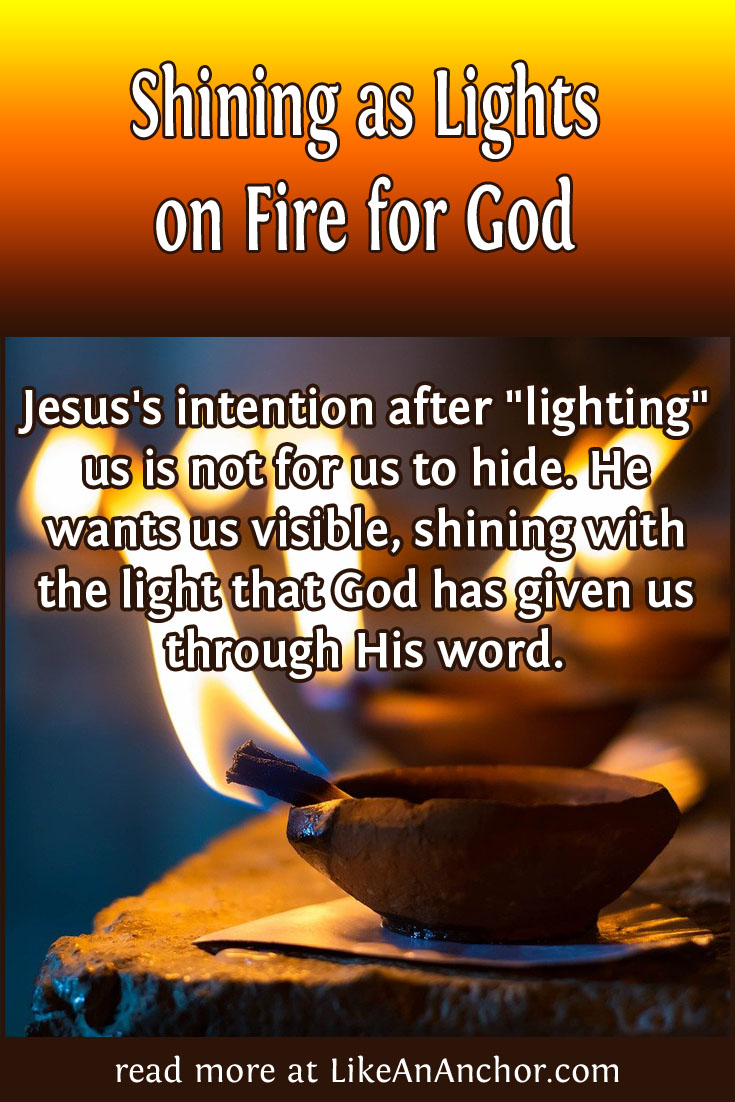
Jesus’s intention after “lighting” us is not to hide us in a cellar or snuff us out with a basket or bowl (NET footnotes). He wants us visible, shining with His light. Therefore, we need to be constantly watchful to make sure the light in us does not become darkness (the “therefore see to it” instruction is an ongoing, “present imperative” [NET footnote]). Like our eyes take in light to let us see, our minds take in Christ’s word to let us live in His light. Internalizing His words puts light inside us too, so it can shine out. If we internalize other (especially ungodly) things, though, that can change the way we shine. What we let into our eyes, hearts, and lives matters to God and it can affect the way our lamps are burning before Christ’s return.

Fueling our Lamps with the Word

If we want to fill our eyes with light and keep our lamps well fueled, we have a source for light readily available. Whether you use print Bibles, apps, or search online, for most of us in the modern world God’s word is right at our fingertips. The more time we spend with His word, the more exposure we get to the Light.

Your word is a lamp to walk by,
and a light to illumine my path.

Psalm 119: 105, NET

Your instructions are a doorway through which light shines.
They give insight to the untrained.

Psalm 119:130, NET

For the commandments are like a lamp,
instruction is like a light

Proverbs 6:23, NET

One of the ways that we fulfill Jesus’s instruction to shine as lights in the world is by internalizing the light that God has given us through His word. “God is light, and in him is no darkness at all,” so if we want to walk with Him in the light we need to listen to Him (1 John 1:5-7, NET). Getting “dressed for service” and keeping our “lamps burning” as we watch for the Master’s return (Luke 12:35-38) involves filling our minds with God’s commands, instructions, and teachings while asking Him to help us understand His mind through His spirit. It is only by spending time in God’s Light that we can be light (Ps. 36:9; 43:3).

Clothed With Jesus’s Light

When writing his second letter to Timothy, Paul urged him “to rekindle God’s gift” because “God didn’t give us a spirit of fear but of power and love and self-control” (2 Tim. 1:6-7, NET). The spirit in us is like a fire, and we can either stir it up (i.e. rekindle) or let it die down to coals. That’s up to us. God gives us His spirit and His word, but whether or not we are on fire for Him is a choice we get to make.

And do this because we know the time, that it is already the hour for us to awake from sleep, for our salvation is now nearer than when we became believers. The night has advanced toward dawn; the day is near. So then we must lay aside the works of darkness, and put on the weapons of light. Let us live decently as in the daytime, not in carousing and drunkenness, not in sexual immorality and sensuality, not in discord and jealousy. Instead, put on the Lord Jesus Christ, and make no provision for the flesh to arouse its desires.

Romans 13:11-14, NET

The statement “our salvation is now nearer than when we became believers” is as true for us today as it was for Paul’s first readers. The work God the Father and Jesus began in us will come to completion either with our deaths or at Christ’s return (Phil. 1:6), and that time is getting closer each day. We mustn’t waste any more time before we put off darkness and clothe ourselves instead with the true Light of Jesus Christ (John 1:4-5; 8:12; 9:5; 12:46). The more time we spend with Him and becoming like him, the more we will shine as lights on fire for God.

Featured image by Hans Benn from Pixabay

Gleaning Firstfruits

Before getting to today’s topic, I just wanted to mention how much I’ve enjoyed doing an actual count-down this year instead of just putting Pentecost on the calendar. It’s helped me focus my Bible study and kept me in mind of the timing for God’s calender rather than feeling like Pentecost sneaked up on me. Today is the 7th Sabbath in our count, which means Pentecost is tomorrow!

And you shall count for yourselves from the day after the Sabbath, from the day that you brought the sheaf of the wave offering: seven Sabbaths shall be completed. Count fifty days to the day after the seventh Sabbath; then you shall offer a new grain offering to the Lord. (Lev. 23:15-16)

Though this is one of the easiest Holy Days to see evidence of in the New Testament (largely due to the giving of the Holy Spirit in Acts), I think we’ll spend most of our time today in the Old Testament, particularly in the book of Ruth.

Lawns of Gleaning

Pentecost, also called the Feast of the Firstfruits/Harvest/Ingathering, is a harvest-time festival. The count to this day begins with a wave-sheaf “of the firstfruits of your harvest,” and the offerings on the day of Pentecost include “two wave loaves of two-tenths of an ephah” of “fine flour” “baked with leaven” that are described as “the firstfruits to the Lord” (Lev. 23:10, 17). After a lengthy passage of instructions for Pentecost, there is a verse that does not quite seem to fit.

When you reap the harvest of your land, you shall not wholly reap the corners of your field when you reap, nor shall you gather any gleaning from your harvest. You shall leave them for the poor and for the stranger: I am the Lord your God. (Lev. 23:22)

This is a repetition of a command also recorded in Leviticus 19:9-10, a command so important to God that He not only gave it twice, but He put one of those commands in the passage describing His most Holy Days. We can get some idea of how this practice works, and perhaps why it is so important, by looking at the book of Ruth.

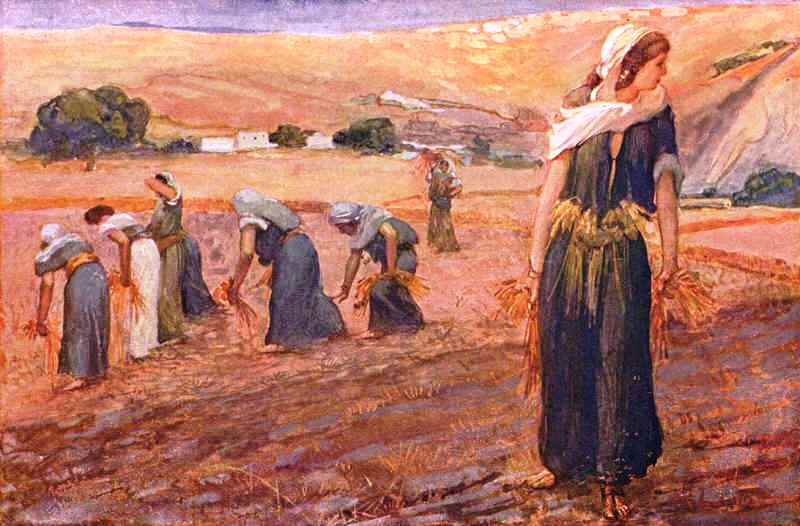
‘Ruth Gleaning’ watercolor by James Tissot (1896)

There’s a note in my study Bible that says, “by New Testament times” the book of Ruth was being “read at the Feast of Harvest (Pentecost) because much of the story is set in the harvest fields.” It was one of five books “read publicly at the Feasts of Israel.”

I dare say we all know the story. Naomi and her family moved to Moab during a famine in Israel. There, her two sons married. About 10 years later, Naomi’s husband and sons were dead and she returned home to Israel accompanied by her daughter in law, Ruth. We jump into the story as Ruth and Naomi arrive in “Bethlehem at the beginning of barley harvest” (Ruth 1:22).

So Ruth the Moabitess said to Naomi, “Please let me go to the field, and glean heads of grain after him in whose sight I may find favor.” And she said to her, “Go, my daughter.” Then she left, and went and gleaned in the field after the reapers. And she happened to come to the part of the field belonging to Boaz, who was of the family of Elimelech. (Ruth 2:2-3)

As we read further, we see Boaz went above and beyond what God’s law strictly required a landowner to leave for the poor. He offers Ruth protection and water, and asks her not to glean in any other field where he could not guarantee her safety (Ruth 2:8-9). Behind-the-scenes, he told his reapers to let grain fall for her on purpose and not to stop her if she wanted to glean even among the sheaves of grain (Ruth 2:15-16).

Unmerited Favor

There is much of Christ’s character visible in how Boaz treats Ruth when she first arrives in his field. Like Boaz did for Ruth, Jesus offers us His personal protection. He asks us not to stray from His laws because they are designed to keep us safe from the consequences of sin. He says, “If anyone thirsts, let him come to Me and drink” (John 7:37). Our response to this unearned favor ought to be much the same as Ruth’s.

So she fell on her face, bowed down to the ground, and said to him, “Why have I found favor in your eyes, that you should take notice of me, since I am a foreigner?” (Ruth 2:10)

This is much the same question David asked God in Psalms 8:4 and 144:3 — “What is man that You are mindful of him?” Every human is small and insignificant compared to God, and those of us who God has chosen for His particular attention are unimportant even by human standards.

But God has chosen the foolish things of the world to put to shame the wise, and God has chosen the weak things of the world to put to shame the things which are mighty; and the base things of the world and the things which are despised God has chosen, and the things which are not, to bring to nothing the things that are, that no flesh should glory in His presence. But of Him you are in Christ Jesus, who became for us wisdom from God—and righteousness and sanctification and redemption — that, as it is written, “He who glories, let him glory in the Lord.” (1 Cor. 1:27-31)

"Gleaning Firstfruits" marissabaker.wordpress.comGod is gleaning His firstfruits from the world’s rejects. He is taking people who are nothing and turning us into something glorious. He is taking strangers — like the Moabite Ruth — and adopting them into His family through Christ’s sacrifice.

But now in Christ Jesus you who once were far off have been brought near by the blood of Christ. …Now, therefore, you are no longer strangers and foreigners, but fellow citizens with the saints and members of the household of God (Eph. 2:13, 19)

Our Redeemer

The adoption process by which we become God’s children is, as we discussed last week, linked inseprably to Christ’s redeeming work (Eph. 1:5-7; Rom. 8:23; Gal. 4:3-7). There is a parallel for this as well in the story of Ruth, in the role Boaz plays as a kinsman redeemer.

And her mother-in-law said to her, “Where have you gleaned today? And where did you work? Blessed be the one who took notice of you.” So she told her mother-in-law with whom she had worked, and said, “The man’s name with whom I worked today is Boaz.” Then Naomi said to her daughter-in-law, “Blessed be he of the Lord, who has not forsaken His kindness to the living and the dead!” And Naomi said to her, “This man is a relation of ours, one of our close relatives.” (Ruth 2:19-20)

My study Bible says this last phrase could be translated “one that hath right to redeem.” We find the basis for the practice of a kinsman redeeming land in Leviticus 25: 25, 48-49. To prevent an inheritance from leaving the family, someone who was closely related, financially able, and willing to fill this role could redeem land that was sold. In some cases, as here in Ruth, when the man who the land originally belonged to had left a childless widow, the redeemer was expected to marry her per the command in Deuteronomy 25:5-10.

We see all this played out in Ruth 4:4-10 where Boaz must offer a more closely related kinsman the opportunity to redeem Naomi’s family’s land and marry Ruth.  This man refuses (which, being the hopeless romantic I am, I suspect was Boaz’s plan all along).

Stepping back a chapter and looking at Ruth’s request that Boaz play the part of a redeemer, we read about a practice that seems rather unusual. Since Naomi counsels this action and Boaz knew how to respond, I assume Ruth asking him to be her family’s redeemer (perhaps even this method of asking) was not considered unusual in their culture. Per Naomi’s instructions, Ruth lies down at Boaz’s feet when he is asleep and waits for him to notice her.

And he said, “Who are you?” So she answered, “I am Ruth, your maidservant. Take your maidservant under your wing, for you are a close relative.” (Ruth 3:9)

Looking at the Hebrew for “wing”, The Complete WordStudy Dictionary for the Old Testament says “the idiom to spread (one’s) wings over means to take to wife.” This same word is used in Ruth 2:12 when Boaz tells Ruth, “The Lord repay your work, and a full reward be given you by the Lord God of Israel, under whose wings you have come for refuge.” Ruth is asking Boaz for a type of protection that mirrors the relationship between God and Israel. The comparison is drawn even more strongly reading God’s words to Israel in Ezekiel 16.

“When I passed by you again and looked upon you, indeed your time was the time of love; so I spread My wing over you and covered your nakedness. Yes, I swore an oath to you and entered into a covenant with you, and you became Mine,” says the Lord God. (Ezk. 16:8)

In the same way, we who are part of the church have been “betrothed you to one husband” — Jesus Christ — and will be married “to Him who was raised from the dead” after He died in order to redeem us (2 Cor. 11:2; Rom. 7:4).

Taken together, the book of Ruth and the Feast of Pentecost teach us about the glorious unmerited favor that God pours out on us. We were strangers like Ruth and were not only invited to partake in what God provides, but cared for deeply and betrothed to His own Son, who gave His life to redeem His firstfruit Bride.