
We all know John 3:16. Even non-Christians know this verse. It’s displayed and quoted perhaps more than any other part of the Bible.
But do you know where it is, contextually? I’m fairly good at remembering where scriptures are, but it’s easy to get your memories mixed up and if I’d had to guess, I might have said it’s in one of Jesus’s many addresses to crowds of people. It’s actually part of his answer to a question Nicodemus asked when he came to Jesus privately, at night after the crowds were gone.
Knowing the context doesn’t change the profound truth that “God so loved the world, that he gave his one and only Son, that whoever believes in him should not perish, but have eternal life” (John 3:16, WEB). But it does enhance our understanding of Jesus’s point if we know what else Jesus said when He made this statement.
Setting the Stage
Unlike other gospel writers, John begins not with Jesus’s human birth but with pre-Creation. He establishes Jesus’s divinity before anything else (John 1:1-18), then goes into John the Baptist’s testimony about Jesus (John 1:19-26), and the first disciples gathering to Jesus (John 1:27-51). Then he records Jesus’s first miracle (John 2:1-11), then the first Passover during Jesus’s ministry, when He cleared those buying and selling out of the temple and began attracting attention from the religious leaders (John 2:12-25). Then, while Jesus is in Jerusalem for Passover, we come to the conversation we’re studying today.
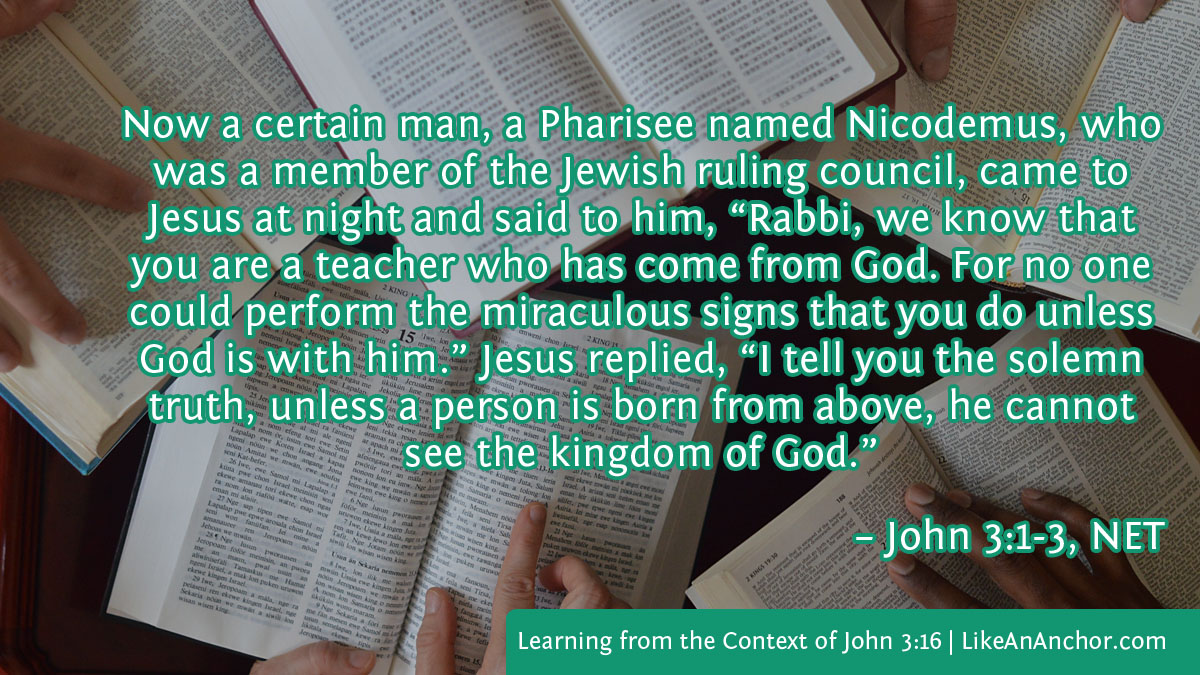
Now a certain man, a Pharisee named Nicodemus, who was a member of the Jewish ruling council, came to Jesus at night and said to him, “Rabbi, we know that you are a teacher who has come from God. For no one could perform the miraculous signs that you do unless God is with him.” Jesus replied, “I tell you the solemn truth, unless a person is born from above, he cannot see the kingdom of God.” Nicodemus said to him, “How can a man be born when he is old? He cannot enter his mother’s womb and be born a second time, can he?”
John 3:1-4, NET
We learn several things about Nicodemus in this introduction. First, he was a Pharisee, a member of an influential religious and political group whose members “were strict and zealous adherents to the laws of the OT and to numerous additional traditions” (NET footnote on John 1:24). In addition, he was “a member of the Sanhedrin, the highest legal, legislative, and judicial body among the Jews” (NET footnote on John 3:1). He was an expert in the scriptures and how to interpret them. It was enough to recognize Jesus as a teacher sent by God, based on the miracles He performed, and to prompt him to come to speak with Jesus privately to learn more. I have to wonder if he might have suspected Jesus to be the Messiah, but came privately because he didn’t want others to know what he was thinking.
As is often the case, Jesus jumped right in with a statement that doesn’t seem like a logical reply to the other person’s remark, but which starts the conversation that they need to have with Him. In this case, one of the words He uses has a double meaning in Greek. When Jesus says, “unless a person is born from above,” the word translated “from above” (anōthen) can also mean “again” (NET footnote on John 3:3). Nicodemus seems to assume Jesus meant the second meaning, since he asks if a man can be born from his mother a second time.
Jesus answered, “I tell you the solemn truth, unless a person is born of water and spirit, he cannot enter the kingdom of God. What is born of the flesh is flesh, and what is born of the Spirit is spirit. Do not be amazed that I said to you, ‘You must all be born from above.’ The wind blows wherever it will, and you hear the sound it makes, but do not know where it comes from and where it is going. So it is with everyone who is born of the Spirit.”
Nicodemus replied, “How can these things be?” Jesus answered, “Are you the teacher of Israel and yet you don’t understand these things?”
John 3:5-10, NET
I often marvel at how much people in New Testament times knew based just on reading the Old Testament. I’m not sure if I could have read those scriptures and realized what signs to look for to recognize the promised Messiah (of course, the main thing it would have depended on is if God decided to open my eyes). But here, Jesus is marveling at the fact that Nicodemus was a “teacher of Israel” and didn’t understand that someone would need to be born of the spirit. He should have known this already, at least in part, just like he should have been able to recognize from the law, prophets, and psalms that Jesus is the promised Messiah (Luke 24:44; John 5:39). Jesus doesn’t hold Nicodemus’s lack of knowledge against him, though. He continues the conversation and reveals more of God’s amazing plan.
Earthly and Heavenly Things,
Jesus answered, “Are you the teacher of Israel and yet you don’t understand these things? I tell you the solemn truth, we speak about what we know and testify about what we have seen, but you people do not accept our testimony. If I have told you people about earthly things and you don’t believe, how will you believe if I tell you about heavenly things? No one has ascended into heaven except the one who descended from heaven—the Son of Man. Just as Moses lifted up the serpent in the wilderness, so must the Son of Man be lifted up, so that everyone who believes in him may have eternal life.”
John 3:10-15, NET (italics mark an allusion to Num 21:5-9)
I find this part a little confusing. When Jesus said, “we speak,” who is “we”? I’m not sure if He’s referring to Him and His disciples or to Him and His Father. And what did He mean, “I have told you people about earthly things and you don’t believe?” Their conversation up to this point is about spiritual rebirth and resurrection, but is that an earthly thing? Or is He referring to something that happened earlier during Passover, like rebuking people for making the temple a marketplace?
We’re not the first to ask these questions. The NET translators have an extensive footnote on John 3:12. They suggest that, since it’s most logical to assume Jesus is speaking of what He just told Nicodemus, that “earthly things are not necessarily strictly physical things, but are so called because they take place on earth, in contrast to things like v. 16, which take place in heaven.” This would make “the necessity of a regenerating work from above, by the Holy Spirit” an “earthly thing,” but God’s love motivating His plans a “heavenly thing.”
Maybe we could think about it like this: the “earthly things” are related to what God is doing here on earth. Being “born of water and spirit” sounds like something that begins with baptism. The process of being born into God’s family as spirit beings starts now, during the physical lives of those who commit to following Him. It’s a process initiated by something God in heaven chose to do, a “heavenly thing” that’s described in the next part of this conversation.
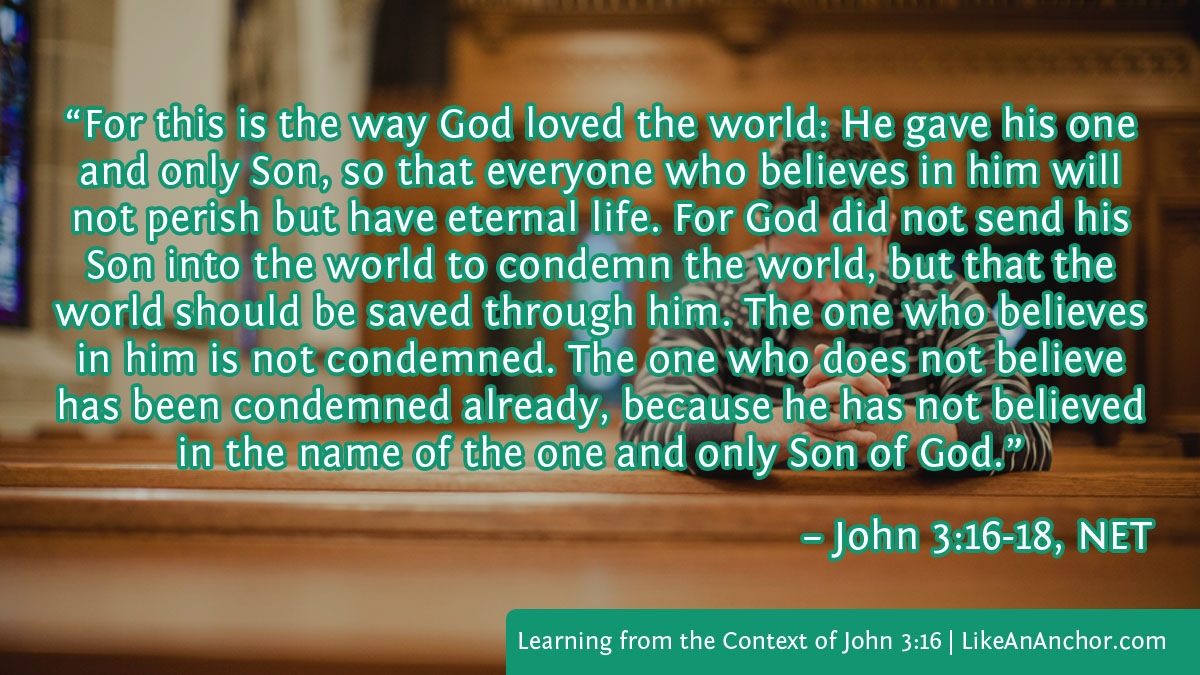
“For this is the way God loved the world: He gave his one and only Son, so that everyone who believes in him will not perish but have eternal life. For God did not send his Son into the world to condemn the world, but that the world should be saved through him. The one who believes in him is not condemned. The one who does not believe has been condemned already, because he has not believed in the name of the one and only Son of God.”
John 3:16-18, NET
We don’t have record of Nicodemus saying anything after verse 9, but I have to wonder what he was thinking at this point. Was he struck with awe at the revelation that God had sent His own Son to earth as the promised Messiah? Did he understand what Jesus was telling him here? Or did he walk away confused, unsure what it meant for God to give His son to save the world? We don’t know, but he does speak up for Jesus when other Pharisees tried to arrest Him (John 7:45-52) and he helped Joseph of Arimathea bury Jesus after His crucifixion (John 19:38-40). It seems logical to assume Nicodemus became one of Jesus’s disciples, though perhaps not very openly.
Life in the Son
We’re here to look at John 3:16, one of the most famous Bible verses. It shows up near the middle of Jesus’s conversation with Nicodemus. We’ve already looked at the lead-up to this verse and the discussion of being born from above/again. Now, let’s look at how Jesus concludes this discussion.
“For this is the way God loved the world: He gave his one and only Son, so that everyone who believes in him will not perish but have eternal life. For God did not send his Son into the world to condemn the world, but that the world should be saved through him. The one who believes in him is not condemned. The one who does not believe has been condemned already, because he has not believed in the name of the one and only Son of God. Now this is the basis for judging: that the light has come into the world and people loved the darkness rather than the light, because their deeds were evil. For everyone who does evil deeds hates the light and does not come to the light, so that their deeds will not be exposed. But the one who practices the truth comes to the light, so that it may be plainly evident that his deeds have been done in God.”
John 3:16-21, NET
It might seem a little weird to read about judgement and condemnation right after reading that Jesus came to save the world. But it really does fit very neatly into a whole-Bible understanding of the plan of God. When people choose sin (as all do [Rom. 3:23]) the natural consequences of that is death (Deut. 30:15-19; Rom. 5:12-15; 6:23). God’s justice and righteousness specifies that there is a consequence for sins. He also has the right to judge His creation. Now that the Light has come into the world, it is time for people to repent and change before the judgment (Acts 17:30-31).
When God judges, He doesn’t want to condemn. That’s one possible outcome, but that’s not His goal. God loves (agape) everyone and wants them to come to repentance, receive salvation, and gain eternal life (1 Tim. 2:1-4; 2 Pet. 3:8-9). That is made possible through Jesus and because of His and the Father’s love: “for God so loved the world, that he gave his one and only Son, that whoever believes in him should not perish, but have eternal life” (John 3:16, WEB). This incredible truth ought to prompt us to believe in Jesus, practice the truth, and come to the light to walk with our God.
Featured image by Pearl from Lightstock

Song Recommendation: “How Deep The Father’s Love For Us” by Selah

 Like An Anchor