Are We On Fire for God?

Last Shabbat, the Rabbi in my local Messianic congregation gave a message on zeal. One of the last things he said in the message was, “Christ is not coming back for a bride who has no fire.” We want to much to be the kind of people Christ will be looking for at His return, so if this is the case we do well to take heed, and learn what it means to be on fire, or have fire, for the Lord.

What is Zeal?

The Hebrew words translated “zeal” and “zealous” are qana (H7065), qanna (H7067), and qin’a (H7068). They can all be translated “jealous” as well. Both qana and qin’a can be used in a good or a bad sense, but qanna is exclusively used as a title or attribute of God. Exodus 34:14 even says the Lord’s “name is Jealous.”

In the positive connotations, these words express a strong emotion one person has for another person, or on behalf of someone else. It is “an intense furor, passion, and emotion that is greater than a person’s wrath or anger” (Baker and Carpenter’s WordStudy Dictionary of the Old Testament). Zeal is one of the strongest emotions there is.

When God tells us He is a “jealous God,” He is saying that He does not tolerate any competition for our adoration (Ex. 20:5; Deut. 4:24; Josh 24:19). In all three of these verses, the context is talking about the evils of being unfaithful to the Lord by worshiping idols and turning away to other religions. God has invested His strongest emotions and passions in us, and He expects us to be “on fire” for Him in return.

They have provoked Me to jealousy by what is not God; they have moved Me to anger by their foolish idols. But I will provoke them to jealousy by those who are not a nation; I will move them to anger by a foolish nation. (Deut. 32:21)

Are We On Fire for God? | marissabaker.wordpress.comGod won’t accept a stagnant, lackluster reaction to Him from His people. A half-hearted worship is thoroughly distasteful to Him.

I know your works, that you are neither cold nor hot. I could wish you were cold or hot. So then, because you are lukewarm, and neither cold nor hot, I will vomit you out of My mouth. … As many as I love, I rebuke and chasten. Therefore be zealous and repent. (Rev. 3:15-16, 19)

The Greek words for “zeal” and “zealous” are zelos (G2205), zeloo (G2206), and zelotes (G2207). Like the Hebrew, these can have a positive or negative meaning. We actually discussed the negative side of zeloo last week, in connection with 1 Corinthians 13:4.

I think perhaps the best example of how this trait can be good or bad is the apostle Paul. Before his conversion, he persecuted Christ’s church out of zeal for the Jewish faith (Phil. 3:6). But after his encounter with Jesus on the road to Damascus, he turned that zeal to preaching the true gospel.

In the Greek, zelos is derived form the word zeo (G2204), which means to be hot, either in the sense of fervency or actual warmth, so all the zeal-words carry this idea of heat. Focusing on the positive sides of the definitions, Zodhiates says, “zelos signifies the honorable emulation with the consequent imitation of that which presents itself to the mind’s eye as excellent.” When zeal sees good, it strives to become good. The next word, zeloo, means to be filled with zeal, jealousy, or love. Zelotes refers to a person who is “zealous for or eagerly desirous of something.”

Zealous Love

We just mentioned the relationship between zeal and love in defining the word zeloo. It seems fitting, then, to focus on that next. If God did not love His people so much, He would not be so jealous of our affection. Our God is described as “a consuming fire, a jealous God” (Deut. 4:24). How could we expect His love to lack zeal? He does not passively love us from some cold, aloof position. His love is active, and emotional.

 So the angel who spoke with me said to me, “Proclaim, saying, ‘Thus says the Lord of hosts: “I am zealous for Jerusalem and for Zion with great zeal. …” ‘Therefore thus says the Lord: “I am returning to Jerusalem with mercy; My house shall be built in it,” says the Lord of hosts, “And a surveyor’s line shall be stretched out over Jerusalem.”’ (Zech. 1:14, 16)

Notice that in connection with His zeal for His people, the Lord says, “My house shall be built.” This is not the only place where the Lord demonstrates a zeal for His house.

Now the Passover of the Jews was at hand, and Jesus went up to Jerusalem. And He found in the temple those who sold oxen and sheep and doves, and the money changers doing business. When He had made a whip of cords, He drove them all out of the temple, with the sheep and the oxen, and poured out the changers’ money and overturned the tables. And He said to those who sold doves, “Take these things away! Do not make My Father’s house a house of merchandise!” Then His disciples remembered that it was written, “Zeal for Your house has eaten Me up.” (John 2:13-17)

The people Christ threw out of the temple were making a mockery of worship. They had turned God’s house into a place of business. From what I’ve heard, they had probably set up a system where people had to purchase a sacrificial animal from them before going into the temple, rather than bringing a sacrifice of their own. The sellers were putting themselves in a position where the people had to deal with them before they could approach God, and Jesus did not approve. It  was unacceptable in the physical temple, and such things are unacceptable in God’s church today.

Do you not know that you are the temple of God and that the Spirit of God dwells in you? If anyone defiles the temple of God, God will destroy him. For the temple of God is holy, which temple you are. (1 Cor. 3:16-17)

Sounds a lot like what we just read in the gospel of John, doesn’t it? We are “members of the household of God” (Eph. 2:19), and Jesus has the same zeal for us today that He had for His Father’s house back then. He won’t tolerate impure worship practices, or those who try to get between Him and His church. He wants a bride whose heart is fully His, and who is eager for Him to come back and claim her.

What Will He Find In Us?

For I am jealous for you with godly jealousy. For I have betrothed you to one husband, that I may present you as a chaste virgin to Christ. But I fear, lest somehow, as the serpent deceived Eve by his craftiness, so your minds may be corrupted from the simplicity that is in Christ. (2 Cor. 11:2-3)

It is possible to let our love for and commitment to Christ wane, and we must be on guard against such a thing. Paul was filled with zeal about the church not loosing their commitment to Christ. In a very real way, he was zealous for His Father’s house. We should also be zealous about guarding our hearts and keeping them fixed on Christ, and on helping our brethren toward a passionate relationship with God as well.

Nevertheless I have this against you, that you have left your first love. (Rev. 2:4)

This is part of the letter to the church of Ephesus in Revelation 2. Christ commends this church for their works, labor, patience, and their diligence to root-out evil. But even with all those good things, He says that if they do not “repent and do the first works” He will “remove your lampstand from its place” (Rev. 2:1-7). Just like in 1 Corinthians 13 where gifts, knowledge, and other spectacular things are described as nothing without love, so is the faith and works of this church empty without their first passion for following God.

When we talk about this Greek word for love, agape (G26), we often bring out that agape doesn’t necessarily involve the emotions we typically think of as love. Thus the command “love your enemies” is more about active goodwill toward them than having “warm fuzzy feelings” about those who hate you. But this is the word used to say “God is love,” and we’ve seen that God’s love toward His people does contain strong emotions. Agape can, and in relation to God should, involve strong feelings. To truly love God, we need to learn to reciprocate the kind of love He has toward us.

And you shall love the Lord your God with all your heart, with all your soul, with all your mind, and with all your strength.” This is the first commandment. (Mark 12:30)

Are We On Fire for God? | marissabaker.wordpress.comJesus gave the perfect example of what it looks like to love God this way. On His last Passover, Jesus said His obedience to the Father’s commandments demonstrated to the world that He loves the Father (John 14:31). He tells us, “As the Father loved Me, I also have loved you; abide in My love. If you keep My commandments, you will abide in My love, just as I have kept My Father’s commandments and abide in His love” (John 15:9-10).

I think this willing obedience and sacrifice prompted by love is what Jesus was referring to when He told the Ephesian church to “do the first works.” Recapture the zeal you felt when you first started serving God. The relationship Christ modeled with the Father was close, personal, and sustained by frequent communication. He was perfectly obedient to His Father’s will, and was willing to give up His life because He loved God and He loved His friends (John 15:13-15). Now, He looks for us to have that kind of love for Him, for our Father, and for our brethren.

And it shall be, in that day,” says the Lord, “That you will call Me ‘My Husband,’ and no longer call Me ‘My Master’ …. I will betroth you to Me forever; yes, I will betroth you to Me in righteousness and justice, in lovingkindness and mercy; I will betroth you to Me in faithfulness, and you shall know the Lord.” (Hos. 2:16, 19-20)

How can we respond to this Being with anything other than a zealous love? Our Savior “gave Himself for us, that He might redeem us from every lawless deed and purify for Himself His own special people, zealous for good works” (Tit. 2:14). He wants His bride to be zealous about the things He cares about, to be faithful to Him because we owe Him our lives, and to love Him as He loves us.

 Nevertheless, when the Son of Man comes, will He really find faith on the earth?” (Luke 18:8)

It is so sad after all Christ has done for us, given to us, and offered us in the future that He has to ask this question: “When I come back, is anyone who loves Me going to be waiting?”

When we see Jesus in the future, will He find faith in us? If we could talk to Him now about the state of our faith today, would He tells us “you are not far from the kingdom of God,” as He did to the man who recognized loving God and his neighbor was the key to religion (Mark 12:32-34)? or would He say, as He did to the church in Sardis, “be watchful, and strengthen the things which remain, that are ready to die, for I have not found your works perfect before God” (Rev. 3:2)?
The Greatest Is Love

The Greatest Is Love | marissabaker.wordpress.comWhat’s the most important thing you can do as a Christian? What is it that sets followers of Jesus apart from the rest of the world? Is it baptism? professing Christ as their savior? doing “the work of God”? keeping the Sabbath? While these are all important, they are not what Christ described as the greatest commandments.

Then one of them, a lawyer, asked Him a question, testing Him, and saying, “Teacher, which is the great commandment in the law?” Jesus said to him, “‘You shall love the Lord your God with all your heart, with all your soul, and with all your mind.’ This is the first and great commandment.  And the second is like it: ‘You shall love your neighbor as yourself.’ On these two commandments hang all the Law and the Prophets.” (Matt. 22:35-40)

In Mark’s account, Christ says, “There is no other commandment greater than these” (Mark 12:31). Both these commandments begin with the instruction, “You shall love.” In Greek, the word is agapao (G25), and it “indicates a direction of the will and finding one’s joy in something” (all dictionary quotes from Zodhiates). I also find it interesting that, even though the lawyer only asked about the most important commandment, Jesus told him about the second as well. It was important to Christ that His hearers knew they had to love each other as well as God.

How Important is Love?

We’ve already seen Jesus describe “You shall love the Lord your God” and “You shall love your neighbor” as the two most important commandments. On His last Passover, He added another layer.

A new commandment I give to you, that you love one another; as I have loved you, that you also love one another. By this all will know that you are My disciples, if you have love for one another.” (John 13:34-35)

We are to love other people the way we love ourselves, and we are also to love our brethren the way Jesus loves us. Love among the believers is how Christ said “all men” would recognize His true church. It’s the key to how we should treat one another, as we talked about last week. We need to actively care for one another, to sacrificially love others as Christ did when He laid down His life for His friends (John 15:12-14). This sort of love isn’t just a feeling — it involves a choice to find our joy in our fellow believers and in our relationship with God. It is absolutely necessary for our personal growth and for peace in the church.

Though I speak with the tongues of men and of angels, but have not love, I have become sounding brass or a clanging cymbal. (1 Cor. 13:1)

Paul had just been talking about spiritual gifts and unity in the church body. Now, he says that those gifts are useless without love.

And though I have the gift of prophecy, and understand all mysteries and all knowledge, and though I have all faith, so that I could remove mountains, but have not love, I am nothing. (1 Cor. 13:2)

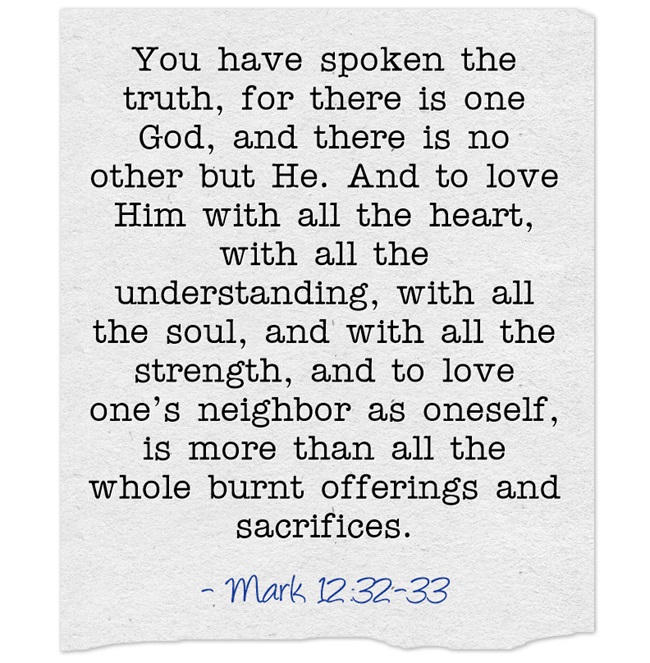
All these things that we find so impressive — inspired speaking, understanding the mysteries of God, knowing everything about the Bible, mountain-moving faith — they are all nothing without love. I know of a man who is convinced he’s close to having full knowledge of God, and he’s so caught up in this that he’s almost impossible to talk with. He’d probably scoff at the idea that love is more important than his pet Bible theories. Yet it was the person who knew that to love God “with all the understanding, with all the soul, and with all the strength, and to love one’s neighbor as oneself, is more than all the whole burnt offerings and sacrifices” to whom Jesus said, “You are not far from the kingdom of God” (Mark 12:32-34).

And though I bestow all my goods to feed the poor, and though I give my body to be burned, but have not love, it profits me nothing. (1 Cor. 13:3)

Now Paul tells us that we can go through all the motions that look like sacrificial love, and still not have genuine love. Unless our actions are motivated by true agape, they don’t do us any good. Our good actions will benefit others, but if our hearts are not right we will not reap the benefits of practicing the kind of love that Jesus Christ models.

What is Love?

The Greek word for “love” in 1 Corinthians 13 is agape (G26), a derivative of agapao. Zodhiates says this “word [is] not found in class Gr. but only in revealed religion.” He goes on to say that agape means benevolent love, which is “not shown by doing what the person loved desires but what the one who loves deems as needed by the one loved.” Think of God sending Jesus as the sacrifice for sins to a people who thought they didn’t want Him, or of Casting Crowns’ song Love You With The Truth. But this definition still isn’t a full picture of agape. For that, we need to read on in 1 Corinthians 13.

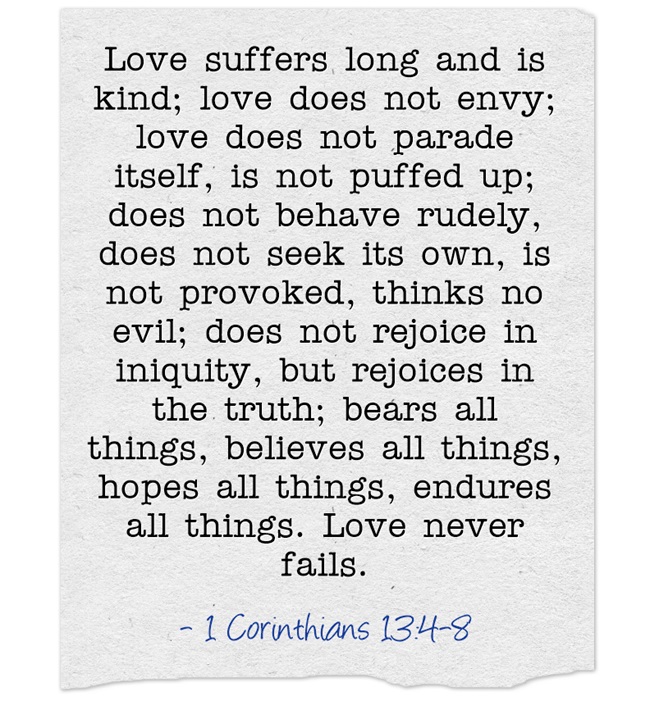
Love suffers long (1 Cor. 13:4)

“Suffers long” is from the Greek word makrothumeo (G3134). It means to be long-suffering and have endurance rather than giving up and losing faith or becoming angry. Specifically, “makrothumeo involves exercising understanding and patience toward persons” (there’s another word for patience with things and circumstances). It is used to describe God’s attitude toward us (2 Pet. 3:9), and is an attitude we should have toward every person (1 Thes. 5:14).

 and is kind (1 Cor. 13:4)

This verse is the only time the word chresteuomai (G5541) apears in scripture. It is, however, related to the word chrestos (G5543), which means “profitable, fit, good for any use.” Kindness is a willingness to be useful, a readiness to assist others. God is kind toward all (Luke 6:35; Eph. 2:7), and as with other attributes of God it is something we must also learn (Eph. 4:32; Col. 3:12).

love does not envy (1 Cor. 13:4)

The words translated “envy” is closely related to zeal, and can actually be used in a good or bad sense. Paul uses it both ways in Galatians 4:17-18, where zeloo (G2206) is translated  “zealous.” In 1 Corinthians 13, it means having a wrong kind of zeal that manifests itself in jealousy and envy (Acts 17:5-9).

love does not parade itself, is not puffed up (1 Cor. 13:4)

The Greatest Is Love | marissabaker.wordpress.comThese two attributes of love are similar. One involves not bragging about the things you have. The other involves avoiding pride and self-conceit. Proverbs 6:16-17 tells us that pride is an abomination to God. Humility is what He looks for in people who have His love inside them (1 Pet. 5:5-7).

does not behave rudely (1 Cor. 13:5)

To “behave rudely” is the Greek word aschemoneo (G807). It means to “behave in an ugly, indecent, unseemly, or unbecoming manner” that brings disgrace and reproach. Zodhiates says its use in 1 Corinthians 13 “succinctly means that love in its speech and action seeks to contain no evil, but seeks to change the evildoer.”

does not seek its own (1 Cor. 13:5)

Love isn’t concerned with accumulating wealth or glory for the self. Rather, those who love “esteem others better than himself” and look out “not only for his own interests, but also for the interests of others” (Phil. 2:3-4).

is not provoked (1 Cor. 13:5)

The basic meaning of the word parozuno (G3947) is to sharpen, but in the New Testament it is used “metaphorically, to sharpen the mind, tempter or courage of someone, to incite, to impel … to provoke or rouse to anger.” This reminds me of a verse in Ecclesiastes: “Do not hasten in your spirit to be angry, for anger rests in the bosom of fools” (Ecc. 7:9).

thinks no evil (1 Cor. 13:5)

Here again, looking at the Greek adds layers of meaning. The word “think” is logizomai (G3049), and it means “to put together with one’s mind, to count, to occupy oneself with reckonings or calculations.” This is telling us that love does not devote mental energy to wicked, evil, or corrupt schemes. Our minds must be occupied with good (Phil. 4:8).

does not rejoice in iniquity, but rejoices in the truth (1 Cor. 13:6)

Iniquity, translated from adikia (G93), is “not conformable with justice” and exists in opposition to truth. Truth, aletheia (G225), is “unveiled reality,” often referring to divine truth in the New Testament. It exposes iniquity, which is what Christ is alluding to in John 15:22 when He says His words have left people with “no excuse for their sin.”

I also find it interesting that the word for rejoicing in iniquity is a general word for being glad (chario, G5463), but the word for rejoicing in the truth is sugchario G4796), which involves rejoicing together with others. The rejoicing that love does it not isolated — it is shared joy.

bears all things, believes all things, hopes all things, endures all things. (1 Cor. 13:7)

“Bears” means “to cover over in silence.” Specifically, in 1 Corinthians 13, stego (G4722) means that “love hides the faults of others and covers them up.” The word “Believe” is from pisteuo (G4100), and it means to have faith or trust in something. In particular, “to be firmly persuaded as to something,” especially of belief in God. The Greek word elpizo (G1679) means to hope or “expect with desire.” It can also refer to putting hope or trust in God.

When we talked about the phrase “love suffers long,” I said that word referred to people and another word was for patience with circumstances. Hupomeno (G5278), translated “endures,” is that word. It means “to persevere, endure, sustain, bear-up under, suffer as a load of miseries, adversaries, persecutions, or provocations with faith.”

Things That Last

It is worth keeping in mind that, since “God is love” (1 John 4:8, 16), this definition of love in 1 Corinthians 13 is also a description of God. As we grow to have these characteristics of love, we are also becoming more like Him.

as His divine power has given to us all things that pertain to life and godliness, through the knowledge of Him who called us by glory and virtue, by which have been given to us exceedingly great and precious promises, that through these you may be partakers of the divine nature, having escaped the corruption that is in the world through lust. (2 Pet. 1:3-4)

God has given us all the tools we need to partake in His “divine nature.” His process of building a family involves making us like Him and like His Son by changing our minds and actions now, and our bodies in the future.

Beloved, now we are children of God; and it has not yet been revealed what we shall be, but we know that when He is revealed, we shall be like Him, for we shall see Him as He is. And everyone who has this hope in Him purifies himself, just as He is pure. (1 John 3:2-3)

The Greatest Is Love | marissabaker.wordpress.comThere are many things that we can’t take into the next life, including our physical possessions and physical bodies. There are also attitudes and beliefs that God won’t allow in because they are incompatible with His nature. But there are other things — things we can “lay up” as “treasures in heaven” (Matt. 6:20) — which we can take with us. That is why those who have hope of becoming like Jesus purify themselves “as He is pure,” because only the parts of ourselves that look like Him will endure.

Love never fails. But whether there are prophecies, they will fail; whether there are tongues, they will cease; whether there is knowledge, it will vanish away. For we know in part and we prophesy in part. But when that which is perfect has come, then that which is in part will be done away. … And now abide faith, hope, love, these three; but the greatest of these is love. (1 Cor. 13:8-10, 13)

Even some of the good things we have now — like knowledge, certain gifts, and prophecy — eventually won’t be relevant in their current form because they will be superseded “when that which is perfect has come.” Our understanding of these things now is limited and child-like, and will be replaced by something deeper (1 Cor. 13:11-12).

This is not the case with love. Love transfers to the next world. It is not put away and it never fails. That is because God is sharing His very nature with us, right now. It is a gift so great that it doesn’t need to be replaced with something better. Indeed, it cannot be.

Beloved, let us love one another, for love is of God; and everyone who loves is born of God and knows God. … If we love one another, God abides in us, and His love has been perfected in us. …

And we have known and believed the love that God has for us. God is love, and he who abides in love abides in God, and God in him. Love has been perfected among us in this: that we may have boldness in the day of judgment; because as He is, so are we in this world. (1 John 4:7, 12, 16-17)

God has shared His love with us, and intends to perfect that aspect of Himself in us right now. He wants us to be “as He is” even while we are in the world. We started out talking about how important it is that we love all our brethren, and we see it again here in 1 John. Loving one another proves that we are born of God, and it is a prerequisite for God dwelling in us. In fact, John tells us that if we don’t learn to love our brethren, we cannot claim to love God (1 John 4:20-21). It is vital to understand this, dear readers, because if we don’t have God’s love in us we are missing the greatest attribute designed to carry over into God’s kingdom. If we don’t have love, will there even be any point in God having us there?

How Should We View Other Church Groups?

How Should We View Other Church Groups? | marissabaker.wordpress.comWe all know there are divisions in the church today. There are large groups, small groups, corporate churches, independent churches, and then factions and rivalries inside and among many of them. I think we can all agree this is not an ideal situation — that Christ’s intention is for us to be “at one.” Often we think the way to achieve that unity is for “all those people out there” to just “come to their senses and join my church.”

But what if there isn’t anything wrong with “them”? What if they are already in God’s church, and the problems lie with us picking and choosing a “my church” to stick with? Take the churches of my faith background as an example. There are literally hundreds of different groups that are all keeping the 7th Day Sabbath and God’s Holy Days of Leviticus 23, and each of them considers that a defining “thing” about our particular variety of Christianity. Yet there are still people, especially in the larger or more exclusive groups, who think if you aren’t keeping the Sabbath with their church is doesn’t really count. And then we tell ourselves we’re better than “mainstream Christianity”!

Other Sheep

There was a similar problem in the New Testament church, with divisions between Jewish and Gentile believers. Up until Acts 10, the disciples assumed only Jews were being called to know Jesus Christ. Then, God showed very clearly that He was opening up the chance for salvation to everyone.

There was a certain man in Caesarea called Cornelius, a centurion of what was called the Italian Regiment, a devout man and one who feared God with all his household, who gave alms generously to the people, and prayed to God always. (Acts 10:1-2)

This man was already serving the God of Israel, but the Jews wouldn’t have had anything to do with him. Unless there were other Gentile believers around, he didn’t have anyone to fellowship with except his family. Some of us have probably been there, without a local group to fellowship with or feeling like we’re unwelcome in the ones that are there. In Cornelius’s case, God took care of this problem by sending him a vision telling him to send for Peter, and then God told Peter to go (Acts 10:3-27).

Then he [Peter] said to them, “You know how unlawful it is for a Jewish man to keep company with or go to one of another nation. But God has shown me that I should not call any man common or unclean. (Acts 10:28)

Then Peter opened his mouth and said: “In truth I perceive that God shows no partiality. But in every nation whoever fears Him and works righteousness is accepted by Him. (Acts 10:34-35)

And just to clear up any lingering doubts in the minds of Peter’s Jewish companions, God gave Cornelius and his family the Holy Spirit before they were even baptized.

While Peter was still speaking these words, the Holy Spirit fell upon all those who heard the word. And those of the circumcision who believed were astonished, as many as came with Peter, because the gift of the Holy Spirit had been poured out on the Gentiles also. (Acts 10:44-45)

They really shouldn’t have been so surprised. Christ’s ministry on earth was to “the lost sheep of the house of Israel” (Matt. 15:24), but He still spoke with a Samaritan woman in John 4, healed a Gentile woman’s daughter in Matthew 15, and had this to say in John 10:

And other sheep I have which are not of this fold; them also I must bring, and they will hear My voice; and there will be one flock and one shepherd. (John 10:16)

From the very beginning of the New Testament church, Jesus made it clear that He wasn’t going to work with just one group or one type of people. He had bigger plans.

Church Squabbles

Several things happened in the aftermath of Cornelius’s conversion. First, Peter had to defend his choice to even talk with a Gentile. Once the whole story was known, though, there wasn’t much to say.

When they heard these things they became silent; and they glorified God, saying, “Then God has also granted to the Gentiles repentance to life.” (Acts 11:18)

That wasn’t the end of the squabbling, however, because church culture started becoming an issue. The way I see it, the whole circumcision debate that became such an issue in the early church boiled down to a group of people who thought everyone else had to worship God the exact same way they did. They didn’t want the Gentiles bringing in any of their culture or ideas about how to worship, and they certainly didn’t want anyone to “get away with” anything.

And certain men came down from Judea and taught the brethren, “Unless you are circumcised according to the custom of Moses, you cannot be saved.” Therefore, when Paul and Barnabas had no small dissension and dispute with them, they determined that Paul and Barnabas and certain others of them should go up to Jerusalem, to the apostles and elders, about this question. (Acts 15:1-2)

There’s quite a discussion about this question in the rest of Acts 15. The basic decision was to lay no unnecessary burden on the new converts. Precisely why physical, male circumcision is unnecessary under the New Covenant is something addressed in Paul’s epistles (1 Cor. 7:18-19). My point is that this question was a big deal to some people, and it caused division, dissension, and dispute in the church. Yet the consensus upon examining the issue was that it wasn’t really anything to get worked up about either way. There were far more important things to focus on, like the keeping of God’s commandments and developing a relationship with Him.

So far we’ve seen church culture/background divisions and doctrinal divisions in the New Testament church. They also struggled with another sort of division that we face today, regarding which human teacher you follow.

Now I plead with you, brethren, by the name of our Lord Jesus Christ, that you all speak the same thing, and that there be no divisions among you, but that you be perfectly joined together in the same mind and in the same judgment. For it has been declared to me concerning you, my brethren, by those of Chloe’s household, that there are contentions among you. Now I say this, that each of you says, “I am of Paul,” or “I am of Apollos,” or “I am of Cephas,” or “I am of Christ.” Is Christ divided? Was Paul crucified for you? Or were you baptized in the name of Paul? (1 Cor. 1:10-13)

Paul would no doubt have much the same thing to tell us today — that we should stop squabbling about who we follow or what group we’re in and be unified in Christ. The message is not to convert everyone to your faction and then get along. It’s to be unified right now — to be peaceful with the people you’re currently squabbling with both inside and outside “your” group. There are Biblical guidelines for resolving conflict (Matt. 18:15-17; 1 Cor. 6:1-11), and none of them involve starting a new church group because you can’t agree on when the barley in Jerusalem is ripe, or excommunicating a family because they want to keep the land Sabbath on their farm (true stories).

Made One

We have different ways of dividing ourselves now other than Jews vs. Gentiles or circumcision vs. uncircumcision, but the principles laid-out for how these groups were to interact give us guidelines for how the churches of God should look today.

For there is no distinction between Jew and Greek, for the same Lord over all is rich to all who call upon Him. (Rom. 10:12)

There is no difference — how strange that must have seemed to them! As strange as telling a former Catholic and a former Baptist who meet in the same group now that there was never any difference between them in God’s eyes; as strange as telling a Sabbath keeper with a Worldwide Church of God background that there’s no difference between them and a Messianic believer.

Therefore remember that you, once Gentiles in the flesh — who are called Uncircumcision by what is called the Circumcision made in the flesh by hands — that at that time you were without Christ, being aliens from the commonwealth of Israel and strangers from the covenants of promise, having no hope and without God in the world. But now in Christ Jesus you who once were far off have been brought near by the blood of Christ. For He Himself is our peace, who has made both one, and has broken down the middle wall of separation (Eph. 2:11-14)

There used to be dividing lines, but no longer — they are all done away in Christ.

For through Him we both have access by one Spirit to the Father. Now, therefore, you are no longer strangers and foreigners, but fellow citizens with the saints and members of the household of God, having been built on the foundation of the apostles and prophets, Jesus Christ Himself being the chief cornerstone, in whom the whole building, being fitted together, grows into a holy temple in the Lord, in whom you also are being built together for a dwelling place of God in the Spirit. (Eph. 2:18-22)

There aren’t multiple groups in God’s eyes. Every person He has called into His family is part of the temple He is building. He doesn’t expect everyone in His family to look or act exactly alike, so why should we?

For as the body is one and has many members, but all the members of that one body, being many, are one body, so also is Christ. For by one Spirit we were all baptized into one body—whether Jews or Greeks, whether slaves or free—and have all been made to drink into one Spirit.  For in fact the body is not one member but many.

How Should We View Other Church Groups? | marissabaker.wordpress.comIf the foot should say, “Because I am not a hand, I am not of the body,” is it therefore not of the body?And if the ear should say, “Because I am not an eye, I am not of the body,” is it therefore not of the body? If the whole body were an eye, where would be the hearing? If the whole were hearing, where would be the smelling? But now God has set the members, each one of them, in the body just as He pleased. And if they were all one member, where would the body be?

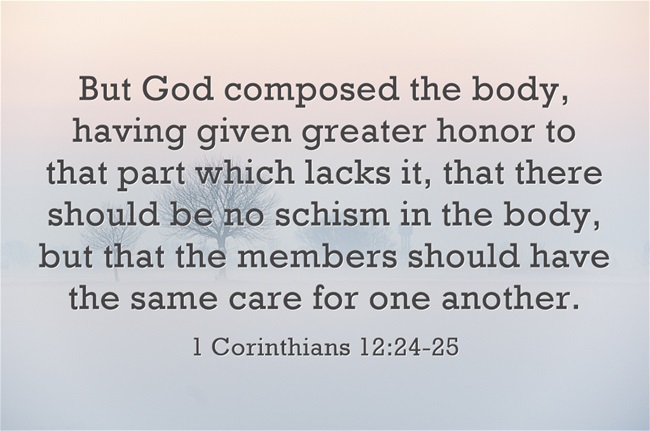
But now indeed there are many members, yet one body. And the eye cannot say to the hand, “I have no need of you”; nor again the head to the feet, “I have no need of you.” No, much rather, those members of the body which seem to be weaker are necessary. And those members of the body which we think to be less honorable, on these we bestow greater honor; and our unpresentable parts have greater modesty, but our presentable parts have no need. But God composed the body, having given greater honor to that part which lacks it, that there should be no schism in the body, but that the members should have the same care for one another. (1 Cor. 12:12-25)

And there you have it — God is working with a wide variety of people who are filling different roles as He sees fit. When we decide a certain person, or type of person, doesn’t have a place in our church group, that’s like saying our bodies would be just fine without an eye or a foot.

Say, “Come”

God knows what He’s doing. He doesn’t make a habit of calling people to follow Him unless He has a plan for working with them. It is not our place to decide who God is and is not working with, or who He should call. How arrogant is it for us to assume we can decide which people God takes an interest in?

Who are you to judge another’s servant? To his own master he stands or falls.  …

But why do you judge your brother? Or why do you show contempt for your brother? For we shall all stand before the judgment seat of Christ. … So then each of us shall give account of himself to God. Therefore let us not judge one another anymore, but rather resolve this, not to put a stumbling block or a cause to fall in our brother’s way. (Rom. 14:4, 10, 12-13)

There are times in the church when we have to make judgements concerning right and wrong. Sometimes the fruits seen in a person’s life call for them being excluded from fellowship until they return to God’s way of life, but those incidents should be rare and very carefully considered (Matt. 18:15-17; 1 Cor. 5:1-13). As a general rule, the actions we need to be most concerned about are our own. God isn’t going to have people in His family who can’t get along with each other and who refuse to work with certain people. His plan is for the whole world to repent and be saved (John 3:16-17). If you’re excluding people from God’s family, even just in your own mind, then your thoughts are not in line with His.

At the end of the book of Revelation there is a beautiful picture of the future where “a pure river of water of life” flows out “from the throne of God and of the Lamb.” A tree of life grows by this river, and the “leaves of the tree were for the healing of the nations” who will see God’s face and live in His light (Rev. 22:1-5). In this future, what do we see the Lamb’s wife — the church — doing?

And the Spirit and the bride say, “Come!” And let him who hears say, “Come!” And let him who thirsts come. Whoever desires, let him take the water of life freely. (Rev. 22:17)

We’re welcoming anyone who wants to come, inviting them to freely partake of what God is offering. We aren’t picking and choosing who’s allowed in — we’re inviting everyone to come and learn. This is something we have to start learning how to do now. I think sometimes we expect all this will be easy when we’re spirit beings, but if that was a magic cure-all for bad attitudes, Lucifer wouldn’t have fallen (Is. 14:12-21; Ezk. 28:11-19). It is imperative that we learn how to relate to one another now, for if we cannot be faithful and obedient on a physical level in a command so important as “love thy neighbor as thyself,” why would God entrust us with true riches? (Matt. 22:36-40; Luke 16:10-12).


God Will Save (Lessons from Hosea, part three)

The name Hosea means “salvation,” fitting since the Biblical book that bears his name has strong salvational themes running through it. Two weeks ago, we started studying this book by talking about how Hosea modeled God’s redemption of Israel by taking back his own unfaithful wife. Then last week, we looked at how warnings against rejecting God give us hope as well as caution, because the flip side of choosing to walk away from God is the ability to choose a relationship with Him. This week, we’ll wrap-up discussion of Hosea with more focus on this hope of salvation through relationship with our Savior.

Return To God

Last week, we said Israel’s main problem was that they rejected God and had no knowledge of Him. They also had another problem, one they share with the church of Laodicea.

So then, because you are lukewarm, and neither cold nor hot, I will vomit you out of My mouth. Because you say, ‘I am rich, have become wealthy, and have need of nothing’—and do not know that you are wretched, miserable, poor, blind, and naked (Rev. 3:16-17)

This is exactly what the people God was upset with said in Hosea:

And Ephraim said, ‘Surely I have become rich, I have found wealth for myself; in all my labors they shall find in me no iniquity that is sin.’ (Hos 12.8)

They claimed they were wealthy and self-sufficient, but the truth of the matter was that while  “Israel is a luxuriant vine that yields its fruit,” the fruit wasn’t any good — “You have plowed iniquity; you have reaped injustice; you have eaten the fruit of lies” (Hos. 10:1, 13, ESV). The solution for this problem, both in Hosea and Revelation, is essentially the same.

I counsel you to buy from Me gold refined in the fire, that you may be rich; and white garments, that you may be clothed, that the shame of your nakedness may not be revealed; and anoint your eyes with eye salve, that you may see. (Rev. 3:18)

“So you, by the help of your God, return; observe mercy and justice, and wait on your God continually. (Hos. 12:6)

The message is clear — stop acting as if you don’t need God. Trust Him, come back to Him, and ask for His help. It requires the humility to recognize you are lacking something, and admit you need God to supply it. It means choosing to produce good, rather than evil, fruit. At it’s most basic, it is seeking a relationship with your Creator and letting Him save you.

Sow for yourselves righteousness; reap in mercy; break up your fallow ground, for it is time to seek the Lord, till He comes and rains righteousness on you. (Hos. 10:12)

“I Will Love Them”

In Hosea 11, God compares Israel’s early history to a beloved child who He taught “to walk, taking them by their arms; but they did not know that I healed them” (Hos. 11:1, 3). They ignored Him and ran away from Him, which got them into all sorts of trouble.

My people are bent on backsliding from Me. Though they call to the Most High, none at all exalt Him. How can I give you up, Ephraim? How can I hand you over, Israel? How can I make you like Admah? How can I set you like Zeboiim? My heart churns within Me; My sympathy is stirred. I will not execute the fierceness of My anger; I will not again destroy Ephraim. For I am God, and not man, the Holy One in your midst; and I will not come with terror. (Hos. 11:7-9)

Israel was warned what would happen to them if they chose to walk away from God, and they were punished for their wrong decisions. Yet God still loved them so much that He continued showing mercy and calling for them to come back to a relationship with Him.

Yet I am the Lord your God ever since the land of Egypt, and you shall know no God but Me; for there is no savior besides Me. I knew you in the wilderness, in the land of great drought. When they had pasture, they were filled; they were filled and their heart was exalted; therefore they forgot Me. … O Israel, you are destroyed, but your help is from Me. I will be your King; where is any other, that he may save you in all your cities? (Hos. 13:4-6, 9-10)

God’s insistence on cultivating a friendship with people who have destroyed themselves is remarkable. Why would He want them — and why would He want us? — after all we have done? yet His promises to save us, to know us, and to redeem us stand firm.

I will heal their backsliding, I will love them freely, for My anger has turned away from him (Hos. 14:4)

These are promises we can count on. When God says, “I will ….”, He means it. He is committed to healing and loving his people. With such promises to rely on, we have no justifiable reason not to walk towards God. He wants very much to save us from sin and death, if only we’ll let Him.

O Israel, return to the Lord your God, for you have stumbled because of your iniquity … Who is wise? Let him understand these things. Who is prudent? Let him know them. For the ways of the Lord are right; the righteous walk in them, but transgressors stumble in them. (Hos. 14:1, 9)


Are We “Too Picky”?

If you’re single (and you don’t want to be), you’ve probably asked yourself the question, “Am I being too picky?” There’s got to be a reason why you’re not in a relationship with someone, right? and you’re sure the reason has something to do with you. People of the opposite sex do exist, and if you’re not in a relationship with one of them you might think that 1) you’re not attractive and so they aren’t asking you out, or 2) you’re too picky and so you’re avoiding/turning down relationships with certain people.

As a 25-year-old single woman, I ask myself this question, too. And I’ve been encouraged to do so by much of the relationship advice I’ve read. You might have read some of this, too. I’m talking about those articles that tell girls to tear-up their “perfect man” list and give any decent guy a chance if he asks them out. Which sounds pretty good in theory, but that’s pretty much how two of the three dates I’ve been on were with guys literally old enough to be my father, and the third was with an atheist who obviously didn’t meet my first requirement that a guy I date have a strong, Christian faith.

Now, I’m not saying you should hang onto unrealistic expectations that will leave you like this skeleton over here –> but you do need to have some standards, and you don’t have to feel guilty for insisting people meet those standards. You are under no obligation to “pity date” anyone, or fling yourself at the first living breathing human who shows the slightest bit of interest in you.

“The One”

This weekend, I spent a good bit of time catching up on Boundless.org articles that I’d missed and checking out TrueLoveDates.com. What stood out to me on Boundless was two articles that offer step-by-step guides for men and for women on how to get married. They can both be summed up in the deceptively simple advice “be more attractive.”

Well, thank you Boundless-author. Previous to reading this article I was going for unattractive. I’ll change that now, and dates will magically appear.

Or not.

“What if I meet the one?”

These articles are part of a three-part relationship series. The first article was devoted to debunking the myth of “the one.” I actually agree with most of what he writes in this one — many Christian singles are too passive, waiting for God to drop their perfect match in their lap or hit them with a revelatory bolt of lightning when he or she shows up. But usually when people tell you to stop looking for “the one”/”your soulmate,” they are also telling you “you’re too picky” (also see my article “Why I Still Believe In Soul Mates“).  And I think it’s a little more complicated than this Boundless authors seems to think.

He says that if you’re a guy, there are only two reasons you’re not in a relationship: “1. You’re not asking. 2. No one’s saying yes.” The solutions are equally simple: “Man up” and “Be awesome.”

If you’re a girl, the reasons you’re single are “1. You’re saying “no” a lot” or “2. No one’s asking.” We’re given three things we can do to turn this around: “Demonstrate respect,” “Look good,” and “Be fun.”

Be (at least a little) Picky

Much as I love Boundless, TrueLoveDates.com had much more helpful tips this time. It’s a website run by Christian relationship counselor Debra Fileta. I’m really looking forward to reading more of her blog posts, and eventually her book. She has some great insight into the whole dating vs. courtship thing, but I won’t digress on that topic right now.

Her most recent articles have been 10 Guys You Should NEVER Date, 10 Girls You Should NEVER Date, and The Boyfriend Checklist: 10 Guys You SHOULD Date (I assume her next post will be a girlfriend checklist). They are focused on qualities you should either avoid or look for in a potential boyfriend or girlfriend, and eventually spouse. And they presuppose a certain level of picky-ness — that you won’t settle for Mr. On Again & Off Again, or Ms. Nothin’ In There But Air, or Mr. Sorta Spiritual, or Ms. One-Way-Street.

Even more helpful lists can be found in Fileta’s article What Women Really Want in a Man and What Men Really Want in a Woman. They are great, both for “this is what you should look for” and “this is the kind of person you need to be.” She says women want honesty, purity, strength, compassion, and humility. Men want realness, confidence, beauty, and passion. These aren’t impossible standards, and you really should be “picky” enough not to settle for less.

Love Languages and MBTI Types

Myers-Briggs types have much to tell us about ourselves and other people. Our MBTI type reflects our preferences for crowded parties or small gathering, describes how we connect with other people, shows us how we naturally respond to stress, and gives us a picture of our innate strengths and weaknesses. Another thing it’s often used for is trying to predict what type of person we’ll be attracted to, and most compatible with, in a romantic sense. Unfortunately, MBTI only gives part of the picture in this regard.

Types in Love

Disclaimer: some of the links in this post are affiliate links. This means that, at no additional cost to you, I will receive a commission if you click on the link and make a purchase on that website.

Use of the MBTI for romance is subject to much debate. Isabel Myer wrote in Gifts Differing*, chapter 11, that “it seems only reasonable that the greater mutual understanding between couples with more likeness than difference should lead, on the whole, to greater mutual attraction and esteem.” This was supported by her study of 375 married couples who were most frequently “alike on three of their four preferences rather than on only two, as would be expected by chance.” However, Isabel Myer was an INFP woman happily married to an ISTJ man. According to her own personality theory, they “shouldn’t” have gotten along, especially since she thought that shared S-N preferences were the most important for predicting a couple’s happiness together and understanding of each other. Obviously type isn’t the only important ingredient for happiness.

Elizabeth and Darcy from Pride and Prejudice, an NF – NT couple

David Keirsey’s book Please Understand Me II* agrees with Myers on the importance of S-N pairings, saying that his SP Artisan types are most compatible with SJ Guardians, and that NF Idealists are most compatible with NT rationals. His ideal pairing is someone who shares your S-N preference and is your opposite in the other three preferences. For example, he would pair an INFJ with an ENTP.

Continuing with INFJs as our example, these theories have influenced many INFJ profiles online. Jennifer Soldner’s Guide To INFJ Relationships lists ENFP, ENTP, INTJ and INFJ as the best matches for an INFJ. The worst matches are ESFP, ESTP, ESTJ, and ENTJ (note that this last one contradicts Keirsey’s rule for pairing NF and NT types). For the most part, these suggestions seem logical at first, much like Isabel Myer said when theorizing that people will get along best if they are similar. It doesn’t explain, however, why one study found that INFJs were most likely to marry either INFJs or ESTPs, or why Myers herself was happy married to someone so dissimilar in terms of type. Clearly there’s something else going on here.

The “Something Else”

Even with their generalizations about which types get along most easily together, both Isabel Myers and David Keirsey admit there are other very important ingredients to a lasting romantic relationship.

Individual relationships defy generalizations, and it should be stressed that two well-adjusted people of any two temperaments can find ways of making their marriage work for them.” (Keirsey)

“Understanding, appreciation, and respect make a lifelong marriage possible and good. Similarity of type is not important, except as it leads to these three. Without them, people fall in love and out of love again; with them, a man and woman will become increasingly valuable to each other and know that they are contributing to each other’s lives.” (Myers)

The 5 Love Languages by Gary Chapman

A mutual willingness to work together and actively build-up the relationships is more important than compatible MBTI types. One aspect of this is understanding the other person and learning how to love them. Becoming familiar with their Myers-Briggs type will help tremendously, but it’s not enough by itself. You also benefit from an understanding of Love Languages.

The five love languages theory was first published in 1995 by Gary Chapman, a relationship counselor and pastor. He says every person has a “language” that they use to communicate and receive love, either Words of Affirmation, Quality Time, Receiving Gifts, Acts of Service, or Physical Touch. Everyone has one primary love language, and you might have a secondary love language as well. If someone’s partner is not speaking their love language, they will not feel loved. There’s a test on Chapman’s website if you don’t know what your love language is and want to find out.

Layering Love Languages

In theory, any MBTI type can be combined with any one of the five love languages. I’m guessing, however, that there are some love languages that are more likely for certain MBTI types. Let’s take a quick look at the characteristics for the four type groups as related to different love languages.

SP types are typically concerned with outward, concrete ways of viewing the world, and focus on the here and now. Keirsey describes their preferred role in a romantic relationship as “playmate.” I could see SP types being particularly inclined toward Receiving Gifts, Quality Time, or Physical Touch as a primary love language. These all involve doing something for or with the loved one, which would appeal strongly to SP types.

Duty-fulfilling SJ types tend to play what Keirsey described as a “helpmate” role in relationships. They are stable, traditional, and thoroughly dependable people.  SJ types might be most in tune with Acts of Service, Quality Time or Words of Affirmation as a love language. These love languages visibly or verbally confirm that a SJ’s loved ones appreciate their constant reliability.

NF types are idealistic, enjoy abstract thought, and are natural romantics. Keirsey described their role in a romantic relationship as “soulmate.” They search for deep, genuine connections. Quality Time and Words of Affirmation seem like the most likely love languages, though Physical Touch and Acts of Service are also good possibilities. The key for NF types is genuine depth in a relationship, so they are inclined towards a language that increases emotional intimacy.

The NT types are highly intellectual, and Keirsey described their relationship role as “mindmate.” They are logical, abstract, and have little tolerance for the superficial. Words of Affirmation and Quality Time seem like the most likely love languages for an NT type, but after reading two different forum topics on MBTI types and love languages (one on Typology Central and one on Personality Cafe) I learned many NTs favor Physical Touch as well. My personal theory is that NT types view Service and/or Gifts with suspicion, wondering what the other person wants from them, while the others seem more genuine.

What about you? What are your Myers-Briggs type and love language(s)? Do you see a connection between the two? Share in the comments!

*indicates affiliate links