5 Ways That We’re Just Like Old Testament Believers

A lot of times, I think we assume that Christianity is a New Testament religion and the Old Testament (OT) is just history or a book that the Jewish people use as their religious text. But if you read a translation of the New Testament (NT) like the New English Translation (NET) that highlights the times when Jesus and the NT writers quote the OT, you’ll see that the believers writing the NT were deeply connected to the OT.

When Jesus died and rose again, He didn’t invent a new religion and name it “Christianity.” He was there as the next step in God’s plan that stretches from Genesis to Revelation and beyond. Our faith is a continuation of what came before. Because of that, we have much more in common with Old Testament believers than we might initially assume. For one thing, we serve the same God. There are some major differences between the Old and New Testaments, but those differences have to do with updates and changes that God made to His relationship with people (and which He prophesied in the OT). God didn’t change, and His basic expectations for people as well as His preferred type of relationship with us didn’t change either.

Image of an open Bible with sunlight shining on it overlaid with text from Romans 15:4, NET version:  “For everything that was written in former times was written for our instruction, so that through endurance and through encouragement of the scriptures we may have hope.”
Image by Lamppost Collective from Lightstock

1) We Are In Covenant With God

If you want to understand how God relates to human beings, you have to study covenants. That’s the structure that God uses for His relationships with people in the Old and New Testaments. They are binding agreements with expectations for both parties. Those expectations–the terms of the relationship agreement, if you will–are established by God. We get to decide if we agree to enter the covenant with Him or not, but we don’t get the option to change how the covenant works.

There are multiple covenants in the OT, but the ones we discuss most often are the Abrahamic Covenant and the Sinai Covenant. The “Old Covenant” usually refers to the Sinai Covenant. The laws given alongside that covenant are part of that covenant agreement, but in many cases also pre-date it (e.g. Noah knew about clean and unclean meats and how to build an altar to Yahweh [Gen. 7:2; 8:20]; Abraham and Jacob knew about tithing [Gen. 14:19-20; 28:20-22]; Joseph knew sleeping with Potiphar’s wife was a sin against God [Gen. 39:7-9]).

Just like us today, Old Testament believers were in covenant with God. Some were in multiple covenants (David, for example, was under the Old Covenant and he received a kingship covenant we call the Davidic Covenant). They couldn’t perfectly keep the covenants, though. God always holds up His side of covenants perfectly, but human beings aren’t that reliable and He knows it. That’s why He promised the Messiah would come, end the Old Covenant, die to free everyone from their sins by taking the penalty for them on Himself, and establish a New Covenant (Jer. 31:31-34; Heb. 8). We’re part of that New Covenant, which was one of the promises contained in the Old Covenant.

2) We Fall Short of God’s Standards

Like Old Covenant believers, the covenant agreement we’ve made with God includes expectations for our behavior and the way we properly relate to Him (Rom. 6; Gal. 5). But we’re human, and we all fall short of God’s perfect standards. The only human being who ever perfectly kept covenant with God is Jesus Christ. We might look back at ancient Israel’s example and think we’d never be as unfaithful and ungrateful as them, but NT writers have some stern warnings against such an assumption.

For I do not want you to be unaware, brothers and sisters, that our fathers … were all drinking from the spiritual rock that followed them, and the rock was Christ. But God was not pleased with most of them, for they were cut down in the wilderness. These things happened as examples for us, so that we will not crave evil things as they did. …  These things happened to them as examples and were written for our instruction, on whom the ends of the ages have come. So let the one who thinks he is standing be careful that he does not fall.

1 Corinthians 10:1, 4-6, 11-12, NET

By and large, Old Covenant believers didn’t have the holy spirit or a personal relationship with God like we do (though there were exceptions, like David). But they weren’t unaware of God’s law or the covenant agreement they made. Two NT writers even go so far as to say they had the gospel preached to them just like we did (Heb. 4:1-2; 1 Pet. 4:5-6). Yet they still fell short. We have the same human tendencies, and we need to be on guard against making the same mistakes. And when we do sin (“miss the mark,” in Hebrew), we need to repent and ask for forgiveness.

Image of an open Bible and notebook overlaid with text from Deut. 10:12-13, WEB version:  “Now, Israel, what does Yahweh your God require of you, but to fear Yahweh your God, to walk in all his ways, to love him, and to serve Yahweh your God with all your heart and with all your soul, to keep Yahweh’s commandments and statutes, which I command you today for your good?”
Image by Alyssa Marie from Lightstock

3) Our Sins Are Purified by Blood

In the Old Covenant, God’s law commanded blood sacrifices of animals to atone for sins. God had very specific requirements for these sacrifices, and they needed to be repeated every time someone became aware of their own sin (see, for example, Leviticus 4:22-35). There was also a yearly sacrifice offered by the high priest on the Day of Atonement (Yom Kippur) to cleanse the people. God promised that if they did these things as commanded, “You shall be clean from all your sins before Yahweh” (Lev. 16:30, WEB).

The writer of Hebrews tells us that those sacrifices were not actually capable of perfecting the people worshiping God in the OT (Heb. 9:9; 10:1). In fact, “it is impossible for the blood of bulls and goats to take away sins” (Heb. 10:4, WEB). That does not mean God was lying when He told OT believers that He would forgive them. It means their forgiveness depended on something other than the animal sacrifices. Some of the OT believers even knew that; David wrote that sacrifices weren’t what God really desired (Ps. 40:6; 51:16-17) and Job knew that the Lord was his redeemer, not sacrificial offerings (Job 19:25-26).

For if the blood of goats and bulls and the ashes of a young cow sprinkled on those who are defiled consecrated them and provided ritual purity, how much more will the blood of Christ, who through the eternal Spirit offered himself without blemish to God, purify our consciences from dead works to worship the living God.

And so he is the mediator of a new covenant, so that those who are called may receive the eternal inheritance he has promised, since he died to set them free from the violations committed under the first covenant.

Hebrews 9:13-15, NET

The NT writers often treat us New Covenant believers as if we were once under the Old Covenant and are now free from it to live under the New Covenant. Paul in particular often talks about us previously living under that Old Covenant law even when he’s writing to Gentiles. He’s including us in the story of the plan of God, like we personally participate in the narrative of making a covenant with God, breaking it, needing redemption, being freed from sin by Christ, and entering a New Covenant with Him (e.g. Rom. 7:1-6). This connects us with the whole plan of God, and indicates that those who died in faith before Christ’s sacrifice are also set “free from the violations committed under the first covenant” by His redemptive work even though it happened after they’d lived and died.

But when this priest had offered one sacrifice for sins for all time, he sat down at the right hand of God, where he is now waiting until his enemies are made a footstool for his feet. For by one offering he has perfected for all time those who are made holy.

Hebrews 10:12-14, NET (italics mark allusion to Ps 110:1)

In Greek, “for all time” is translated from the phrase eis to dianekes. Eis (G1519) is a preposition meaning “into, unto, to, towards, for, among” (Thayer). To is the definite article (i.e. “the,” not always translated because Greek uses it more often than English). Dianekes (G1336) is an adjective meaning “continuously, continuous” (Thayer). The phrase only appears in Hebrews 10:12, 14 and it highlights that Jesus’s sacrifice is “continual, perpetual, protracted” (Zodhiates). Most certainly it covers from Jesus sacrifice onward into the future, but His sacrifice also covered those in the past to whom God had promised forgiveness.

4) We’re Called Out to be Different

We’re likely familiar with the New Testament instruction that Christians should be different from the world around us. We’re supposed to stand out like lights in a world of darkness (Matt. 5:13-16; Phil. 2:15). We’ve been chosen by God to belong to Him, to be different from the world, and to be visible examples of His way of life.

But you are a chosen racea royal priesthooda holy nationa people of his own, so that you may proclaim the virtues of the one who called you out of darkness into his marvelous light. You once were not a people, but now you are God’s people. You were shown no mercy, but now you have received mercy.

1 Peter 2:9-10, NET

The NET Bible marks allusions to OT passages with italics and direct quotes with bold italics. Here, Peter uses “various allusions and quotations from Exod 19:5-623:22 (LXX); Isa 43:20-21; and Mal 3:17” and quotes “from Hos 1:6, 9; 2:23” (NET footnotes). He’s making the point that New Covenant believers are called out as God’s special people who belong to Him, and he’s doing that using Old Testament passages like this one:

For you are a holy people to Yahweh your God. Yahweh your God has chosen you to be a people for his own possession, above all peoples who are on the face of the earth.

Deuteronomy 7:6, WEB

In addition to being chosen as God’s own special people, OT believers were also intended to shine as lights in the world. The OT just uses different phrasing to make that point.

Behold, I have taught you statutes and ordinances, even as Yahweh my God commanded me, that you should do so in the middle of the land where you go in to possess it. Keep therefore and do them; for this is your wisdom and your understanding in the sight of the peoples who shall hear all these statutes and say, “Surely this great nation is a wise and understanding people.” For what great nation is there that has a god so near to them as Yahweh our God is whenever we call on him? What great nation is there that has statutes and ordinances so righteous as all this law which I set before you today?

Deuteronomy 4:5-8, WEB

People were supposed to be able to look at ancient Israel living in covenant with God and marvel at their wisdom, understanding, and greatness. We see this happening only very occasionally in Israel’s history (the reign of Solomon is the only example I can think of [1 Kings 4:34]). God’s not giving up on this goal, though (Isa. 62:1-2). People should be able to recognize us as God’s people. Jesus specifically says they’ll know we’re His disciples by the love we have for each other, and Paul says the same thing can happen when someone witnesses us prophesying in church (John 13:34-35; 1 Cor. 14:24-25).

5) The Greatest Thing We Can Do

Image of on open Bible with sunlight shining on it, overlaid with blog's title text and the words, "Modern Christians might not think we have much in common with Old Testament believers, but the New Testament writers had a different perspective."
Image by Lamppost Collective from Lightstock

God’s expectation and purpose for us haven’t changed that much since the time of His very first interactions with human beings. Jesus highlights this by pointing back to the Old Covenant when someone asked Him about the greatest commandment.

Now one of the experts in the law came and heard them debating. When he saw that Jesus answered them well, he asked him, “Which commandment is the most important of all?” Jesus answered, “The most important is: ‘Listen, Israel, the Lord our God, the Lord is oneLove the Lord your God with all your heart, with all your soul, with all your mind, and with all your strength.’ The second is: ‘Love your neighbor as yourself.’ There is no other commandment greater than these.” 

The expert in the law said to him, “That is true, Teacher; you are right to say that he is one, and there is no one else besides him. And to love him with all your heart, with all your mind, and with all your strength and to love your neighbor as yourself is more important than all burnt offerings and sacrifices.” When Jesus saw that he had answered thoughtfully, he said to him, “You are not far from the kingdom of God.” Then no one dared any longer to question him.

Mark 12:28-34, NET

The NET footnotes on these verses say they’re quoting Deuteronomy 4:35; 6:4-5; Leviticus 19:18, and Joshua 22:5. Because the expert in the law properly understood these commands from the Old Testament, Jesus told him he wasn’t “far from the kingdom of God.” That kingdom is what we’re striving toward as NT believers. We might not think that looking back to God’s commands from the Old Testament would help with that, but Jesus says that they do.

In the Old Testament and the New, God wants a relationship with human beings. Since the very beginning, He’s been working with groups of people that He chose and called out from the world. He welcomes them into covenant with Him, makes provision for when they fall short of His expectations, purifies them from their sins through sacrifice, and asks them to follow Him with their whole hearts. Many of the things that He asks of us today are the same things He wanted in His relationships with people in the Old Testament. Indeed, one of the reasons for the change of covenant was so that He could get closer to achieving that relationship (Eze. 11:17-20; 36:22-28; Jer. 31:31-34; 2 Cor. 6:16-18). Now, just as back then, He wants to be our God and He wants us to be His people, His sons and daughters.


Featured image by Dakota from Lightstock

Finding Jesus in the Old Testament

Several times during Jesus’s ministry, He told people that the scriptures they read told them about Him. For example, He told some, “You study the scriptures thoroughly because you think in them you possess eternal life, and it is these same scriptures that testify about me” (John 5:39, NET). Remember, they would have just had the Old Testament at this time. The gospel events were happening in front of them, but they didn’t have written records yet pointing out which prophecies Jesus fulfilled and cross-referencing Old and New Testament writings the way we do today. And yet, Jesus told people that “everything written about me in the law of Moses and the prophets and the psalms must be fulfilled” (Luke 24:44, NET). He expected at least some of the people He spoke with to recognize that the law, prophets, and psalms all pointed to a Messiah and that He was that promised Messiah.

When I think about these scriptures, I wonder if I could have recognized that there was a coming Messiah from reading the Old Testament (OT). Even with the benefit of New Testament (NT) perspective, I struggle to see Him in the law of Moses. Not even all of the psalms and prophecies that NT writers identify as Messianic seem like something I’d have recognized when just reading the OT. Like the disciples on the road to Emmaus, we need Jesus to intervene in our minds to open our understanding (Luke 24:13-35). In fact, there are scriptures indicating it’s impossible to understand God’s word or have a relationship with Him unless the Father and Jesus take an active role in your life (John 6:44; 14:6).

At this point, we might ask ourselves several different questions, such as, “How much did believers in the Old Testament know?” and “How did salvation through Jesus (since you can’t be saved through anyone else [Acts 4:12]) work for people who lived and died before His sacrifice?” For today, though, I want to focus on the question, “Which verses in the Old Testament clearly point to Jesus Christ?” Or, since we’ll be looking at the OT that was written in Hebrew, to Yeshua the Messiah?

Image of a man studying the Bible overlaid with text from Matt. 16:16-17, NET version:  Simon Peter answered, “You are the Christ, the Son of the living God." Jesus answered, “Simon, Jonah's son, God has blessed you. No person on earth has showed you this. But my Father in heaven has showed you.”
Image by Matt Vasquez from Lightstock

Clarifying Names

The name “Jesus” is the English transliteration (representing a word from one language with the sounds and alphabet of another) of the Greek name Iēsous, which comes from the Hebrew name Yehoshua or Yeshua (H3091). The name means “Yahweh is salvation,” from the words Yahweh or Yehovah (H3068, God’s proper name [Ex. 4:15-16]) and yasha (H3467, “to save, be saved, be delivered” [BDB]). Yasha is the main root of a group of Hebrew words. Frequently used derivatives include yeshuah (H3444, salvation), teshuah (H8668, help, rescue, salvation) , and names such as Joshua, Hosea, Isaiah (Theological Wordbook of the Old Testament [TWOT] entry 929).

You won’t ever see the name “Jesus” in the Old Testament, but you frequently see the name Yeshua: it is translated into English as Joshua. There’s no prophecy in the Old Testament that says the Messiah will be named Yeshua. When Jesus was born, His name likely wouldn’t have stood out too much. Joshua is a popular name even today, and I doubt it was unusual in Jesus’s day considering the historic Yeshuas that people would have been familiar with (e.g. Moses’s successor Joshua son of Nun and Joshua the son of Josedech who appears in Haggai’s prophecies).

“Christ” is more of a title than a name. It is a transliteration into English of the Greek word christos (G5547), which is a translation (rendering the meaning of a word into the corresponding word in another language) of the Hebrew word mashiyah or Messiah (H4899). Both the Greek and Hebrew words mean “anointed” (Thayer; BDB). The root word mashach (H4886, anoint or rub with oil) is used most frequently of kings and priests sanctified for the Lord, and it’s also used twice of prophets (TWOT 1255). For example, it’s used when Yahweh chose Saul as the first king of Israel.

“Tomorrow about this time I will send you a man out of the land of Benjamin, and you shall anoint (mashach) him to be prince over my people Israel. He will save (yasha) my people out of the hand of the Philistines; for I have looked upon my people, because their cry has come to me.”

1 Samuel 9:16, WEB

Mashiyah (H4899, anointed one) is most frequently used in the Old Testament to refer to kings (TWOT 1255c). It also became closely associated with the God-being we now know as Jesus. By the time Jesus arrived, the Jews of His day were looking for the promised Messiah or Christ (Luke 3:15; 22:67; John 1:41-42; 4:25-29; 7:26). We still call prophecies from the OT that point to Jesus Messianic passages. It might surprise us, then, that if we compare all the verses using yasha and its related words to all the verses using masach and its related words, there are only 5 scriptures that use both and none of them are Messianic prophecies (1 Sam. 9:16; 2 Sam. 22:51; Psalm 8:50; 20:6; 28:8).

Image of a woman studying the Bible overlaid with text from John 4:25-26, NET version:  The woman said to him, “I know that Messiah is coming” (the one called Christ); “whenever he comes, he will tell us everything.”
Jesus said to her, “I, the one speaking to you, am he.”
Image by MarrCreative from Lightstock

Prophecies of the Messiah

There actually aren’t as many OT prophecies identifying the coming Messiah/Christ by the title “anointed” as you might think. It honestly surprised me, but when you realize that the Hebrew word mashiyah was “almost exclusively reserved as a synonym for ‘king'” (TWOT 1255c), then it becomes more understandable how OT readers realized that the spirit-filled, victorious, salvation-bringing God-being who would come in the name of the Lord should be called Messiah. We can see this in some of the disciples’ reactions to first meeting Jesus.

One of the two who heard John and followed him was Andrew, Simon Peter’s brother. He first found his own brother, Simon, and said to him, “We have found the Messiah!” (which is, being interpreted, Christ). He brought him to Jesus. … Philip found Nathanael, and said to him, “We have found him, of whom Moses in the law, and the prophets, wrote: Jesus of Nazareth, the son of Joseph.” …

Jesus saw Nathanael coming to him, and said about him, “Behold, an Israelite indeed, in whom is no deceit!”

Nathanael said to him, “How do you know me?”

Jesus answered him, “Before Philip called you, when you were under the fig tree, I saw you.”

Nathanael answered him, “Rabbi, you are the Son of God! You are King of Israel!”

John 1:40-42, 45, 47-49, WEB

Andrew called Jesus “the Messiah.” Phillip called Him the one “of whom Moses in the law, and the prophets, wrote.” Nathaniel called Him, “the Son of God” and “King of Israel.” They knew they were waiting for the Messiah, God’s son and the King of Israel, from reading the law and the prophets. Thanks to the Father’s revelation working in their lives, they could correctly identify that Jesus was the Christ (Matt. 16:13-20). Perhaps they were all thinking of Psalm 2, where the author talks about “Yahweh and … his Anointed,” who is also “King on my holy hill of Zion” and the Son of God.

Daniel also prophesied about “the Anointed One, the prince” (Dan. 9:25-26, WEB). Isaiah spoke of a descendent of David who would be full of God’s spirit and rule on David’s throne (implying an anointing even when it’s not explicitly mentioned) (Isaiah 9:1-7; 11:1-5; 61:1). Psalms talk about a strong, ruling, righteous, and anointed king (Ps. 45:1-7; 110:1-5). With those scriptures, as well as whatever oral traditions might have been passed down (depending on how much the people of God knew about His plan that didn’t make it into official scriptural writings), the people of Jesus’s day had the background needed to know they were looking for a Messiah. Even then, not everyone who met Jesus (Yeshua) was able to recognize that He was the Christ (Messiah). They needed God to give them eyes to see, ears to hear, and hearts to understand (Mat. 13:10-17).

Asking to Understand

Image of two hands holding a small Bible, overlaid with blog's title text and the words, "When you know where and how to look, you can see Jesus all throughout the Old Testament writings."
Image by Maura Griesse from Lightstock

When you know where to look, it’s not that hard to find Jesus in the Old Testament or to read the OT and see that there’s a coming Messiah. But without God working in your mind and heart, you won’t know to look. People can read the Bible over and over, even memorize huge sections, but still miss key truths because they’re just reading on their own with a human perspective. God is the one who makes His Bible come alive.

I think sometimes Christians forget how thankful we ought to be to God for letting us understand His word. And when we do that, we might also forget that we don’t yet know everything fully (1 Cor. 8:1-2; 13:12). For me at least, studying the prophecies of Jesus in the OT helps me realize that. Without God’s help and the records of fulfilled prophecies in the NT, I’d understand much less than I do now. And maybe there’s still more to learn, if I’m willing to ask.

“Ask and it will be given to you; seek and you will find; knock and the door will be opened for you. For everyone who asks receives, and the one who seeks finds, and to the one who knocks, the door will be opened. Is there anyone among you who, if his son asks for bread, will give him a stone? Or if he asks for a fish, will give him a snake? If you then, although you are evil, know how to give good gifts to your children, how much more will your Father in heaven give good gifts to those who ask him!”

Matthew 7:7-11, NET

We need to remember to thank God for the understanding He has granted us, and keep asking to know Him more deeply. One way we can participate in knowing Him at a deeper level is to prayerfully study His entire Bible. The questions I opened with today–“How much did believers in the Old Testament know?” and “How did salvation through Jesus work for people who lived and died before His sacrifice?”–are the types of questions a speaker at my church invited listeners to study in a message I heard last week.

That message focused on Abraham, and it’s fascinating to look at the conversations God had with him and at what the NT writers say about Abraham and God’s relationship. One verse even talks about the gospel being preached to Abraham, and in another Jesus said that Abraham “was overjoyed to see my day” (John 8:56; Gal. 3:7-16). Abraham probably knew a lot more about the Messiah than I’d realized just from reading his story, and he didn’t even have scrolls to study of the law, psalms, and prophets. Perhaps we can also understand more deeply by studying the relationships and revelation that God granted to those Old Testament heroes of faith (the people in Heb. 11, for example) and by asking God to speak into our lives similar to the way that He spoke to them.


Featured image by Inbetween from Lightstock

Song Recommendation: “Psalm 45 (A Noble theme)”

Lessons from The Kings of Judah

One thing I find fascinating when reading the Old Testament is thinking about how the ancient kings of Israel and Judah did at childrearing. I’m guessing they weren’t all that involved with raising their children given their other kingly responsibilities (and perhaps cultural expectations as well). Still, if we didn’t know the story we probably wouldn’t expect David, the “man after God’s own heart” to have children who end up in a situation where one rapes his half-sister, gets murdered by her brother, and then that brother rebels against David and sleeps with his concubines (2 Sam. 13-18). David’s son Solomon was a great king, but then Solomon’s son Rehoboam listens to bad advisors, messes everything up, and the kingdom splits into Israel and Judah (2 Chr. 10).

Reading the books of Kings and Chronicles, it often seems like the kings of Judah bounce back and forth from good, to bad, to okay, to really bad, to almost righteous with no real pattern. It just seems random, or perhaps it would be more accurate to say it’s deeply individual. We just don’t know that much about the kings and what influenced them to act the way they did. I suspect a closer look, though, will reveal some interesting things we can learn. This is going to be a pretty long post, mapping out the kings of Judah after Rehoboam through the fall of Judah. The first three sections of this post walk through the kings in order, then in the last section of the post I’ll share my thoughts looking back on this study (you can skim until then if you’re short on time).

Abijam to Athaliah

The scripture helpfully records summaries for each of the kings, giving us an overview of their deeds and character before (sometimes) filling in extra details. Before we dive into those summaries, here’s a link to a timeline of all the kings that should help with keeping all these names straight. Let’s start with Rehoboam’s son, along with the two kings after him.

Abijam began to reign over Judah. He reigned three years in Jerusalem. His mother’s name was Maacah the daughter of Abishalom. He walked in all the sins of his father, which he had done before him; and his heart was not perfect with Yahweh his God, as the heart of David his father. …

Abijam slept with his fathers, and they buried him in David’s city; and Asa his son reigned in his place. … He reigned forty-one years in Jerusalem. … Asa did that which was right in Yahweh’s eyes, as David his father did. He put away the sodomites out of the land, and removed all the idols that his fathers had made. … But the high places were not taken away. Nevertheless the heart of Asa was perfect with Yahweh all his days. …

Asa slept with his fathers, and was buried with his fathers in his father David’s city; and Jehoshaphat his son reigned in his place. … Jehoshaphat was thirty-five years old when he began to reign; and he reigned twenty-five years in Jerusalem. His mother’s name was Azubah the daughter of Shilhi. He walked in all the way of Asa his father. He didn’t turn away from it, doing that which was right in Yahweh’s eyes. However the high places were not taken away. The people still sacrificed and burned incense on the high places. 

1 Kings 15:1-3, 8-12, 4, 24; 22:42-43, WEB
  • note: bold words added throughout to help keep track of names when a new ruler takes over.

Here, we have a son (Abijam) who walked in all the sins of his father (Rehoboam), followed by a king (Asa) who refused to follow his father’s bad example. Then, that king’s son (Jehoshaphat) followed his father’s example of righteousness. The scriptures actually say their hearts were “perfect with Yahweh” (in Asa’s case) and they did “what was right in Yahweh’s eyes” (in Jehoshaphat’s case)–high praise indeed. Then the next king went back the other direction.

Jehoram the son of Jehoshaphat king of Judah began to reign. He was thirty-two years old when he began to reign. He reigned eight years in Jerusalem. He walked in the way of the kings of Israel, as did Ahab’s house; for he married Ahab’s daughter. He did that which was evil in Yahweh’s sight. However Yahweh would not destroy Judah, for David his servant’s sake, as he promised him to give to him a lamp for his children always. …

Jehoram slept with his fathers, and was buried with his fathers in David’s city; and Ahaziah his son reigned in his place. … Ahaziah was twenty-two years old when he began to reign; and he reigned one year in Jerusalem. His mother’s name was Athaliah the daughter of Omri king of Israel. He walked in the way of Ahab’s house, and did that which was evil in Yahweh’s sight, as did Ahab’s house; for he was the son-in-law of Ahab’s house.

2 Kings 8:16-19, 24, 26-27, WEB

In case you’re getting a bit lost with all the names, this is talking about the daughter of King Ahab of Israel whose wife was the infamous Queen Jezebel. They were so bad that scripture says, “there was no one like Ahab, who sold himself to do that which was evil in Yahweh’s sight, whom Jezebel his wife stirred up” (1 Kings 21:25, WEB). Here, scripture does give us hints as to why this king went bad–he brought evil influences into his life.

Ahaziah dies in the same uprising that takes out Jezebel and her son Jehu. When his mother Athaliah heard it, she slaughtered all but one of her grandchildren and took Judah’s throne for herself (2 Kings 9-11). Out of the six rulers of Judah from Abijam to Athaliah, only two made an effort to walk with God.

Image of a woman reading a Bible, overlaid with Jer. 21:11-12, WEB version: “Concerning the house of the king of Judah, hear Yahweh’s word: 12 House of David, Yahweh says,

‘Execute justice in the morning,
    and deliver him who is robbed out of the hand of the oppressor,
lest my wrath go out like fire,
    and burn so that no one can quench it,
    because of the evil of your doings.
Image by Pearl from Lightstock

Joash to Ahaz

Athaliah only ruled for six years before the people who’d rescued her one surviving grandson put him on the throne. This new child-king is called Joash or  Jehoash. He spent his childhood living in Yahweh’s temple, presumably raised by his uncle, Jehoiada the priest, and the aunt Jehoshabeath who’d saved his life (2 Chr. 22:11-12).

Jehoash was seven years old when he began to reign.

Jehoash … reigned forty years in Jerusalem. His mother’s name was Zibiah of Beersheba. Jehoash did that which was right in Yahweh’s eyes all his days in which Jehoiada the priest instructed him. However the high places were not taken away. The people still sacrificed and burned incense in the high places.

2 Kings 11:27-12:3, WEB

There’s an interesting qualifier here. Jehoash did what “was right in Yahweh’s eyes,” but only in the days when “Jehoiada the priest instructed him.” After that, things go terribly wrong. We learn the details about that by moving from 2 Kings to 2 Chronicles, where he’s called King Joash.

Now after the death of Jehoiada, the princes of Judah came, and bowed down to the king. Then the king listened to them. They abandoned the house of Yahweh, the God of their fathers, and served the Asherah poles and the idols …

The Spirit of God came on Zechariah the son of Jehoiada the priest; and he stood above the people, and said to them, “God says, ‘Why do you disobey Yahweh’s commandments, so that you can’t prosper? Because you have forsaken Yahweh, he has also forsaken you.’”

They conspired against him, and stoned him with stones at the commandment of the king in the court of Yahweh’s house. …

[Joash’s] own servants conspired against him for the blood of the sons of Jehoiada the priest, and killed him on his bed, and he died. They buried him in David’s city, but they didn’t bury him in the tombs of the kings.

2 Chronicles 24:17-18, 20-21, 25, WEB

Joash, who started out so well, wasn’t even buried with the kings of Judah. He’s one of the few kings whose childhood we know about; he was raised by a God-fearing uncle and most likely aunt as well. Then the moment the people influencing him change, Joash’s character changed as well. It’s a sobering lesson in being careful about those you trust as influences, as well as a lesson in having your own convictions and sticking to them. It makes you wonder how much of Joash’s flip-flopping between good and bad examples influenced the kings after him.

Amaziah was twenty-five years old when he began to reign, and he reigned twenty-nine years in Jerusalem. His mother’s name was Jehoaddan, of Jerusalem. He did that which was right in Yahweh’s eyes, but not with a perfect heart. Now when the kingdom was established to him, he killed his servants who had killed his father the king. But he didn’t put their children to death, but did according to that which is written in the law in the book of Moses …

Now from the time that Amaziah turned away from following Yahweh, they made a conspiracy against him in Jerusalem. He fled to Lachish, but they sent after him to Lachish, and killed him there. They brought him on horses, and buried him with his fathers in the City of Judah.

2 Chr. 25:1-4, 27-28 WEB

Amaziah did a little better than his father, but he didn’t say “perfect” with God. His son follows the same pattern once he brings ruling Judah. He starts out okay, but then he goes kind a crazy.

All the people of Judah took Uzziah, who was sixteen years old, and made him king in the place of his father Amaziah. … he reigned fifty-two years in Jerusalem. His mother’s name was Jechiliah, of Jerusalem. He did that which was right in Yahweh’s eyes, according to all that his father Amaziah had done. He set himself to seek God in the days of Zechariah, who had understanding in the vision of God; and as long as he sought Yahweh, God made him prosper. …

But when he was strong, his heart was lifted up, so that he did corruptly, and he trespassed against Yahweh his God; for he went into Yahweh’s temple to burn incense on the altar of incense. … He had a censer in his hand to burn incense, and while he was angry with the priests, the leprosy broke out on his forehead before the priests in Yahweh’s house, beside the altar of incense. … Uzziah the king was a leper to the day of his death, and lived in a separate house, being a leper; for he was cut off from Yahweh’s house. Jotham his son was over the king’s house, judging the people of the land.

2 Chr. 26: 1, 3-5, 16, 19, 21, WEB

Uzziah does not have other people to blame for influencing him in the wrong direction (though he does go off the right path after “the days of Zechariah,” so it seems he was better when he had a strong, positive influence in his life). He just let his success get the better of him, gave into pride, and thought he needed to act as a priest as well as a king. For his corruption, Uzziah becomes a leper and his son rules in his place (that’s why you’ll see them overlapping in a timeline of all the kings).

Jotham was twenty-five years old when he began to reign, and he reigned sixteen years in Jerusalem. His mother’s name was Jerushah the daughter of Zadok. He did that which was right in Yahweh’s eyes, according to all that his father Uzziah had done. However he didn’t enter into Yahweh’s temple. The people still acted corruptly. … Jotham became mighty, because he ordered his ways before Yahweh his God. … Jotham slept with his fathers, and they buried him in David’s city; and Ahaz his son reigned in his place.

Ahaz was twenty years old when he began to reign, and he reigned sixteen years in Jerusalem. He didn’t do that which was right in Yahweh’s eyes, like David his father, but he walked in the ways of the kings of Israel, and also made molten images for the Baals. Moreover he burned incense in the valley of the son of Hinnom, and burned his children in the fire, according to the abominations of the nations whom Yahweh cast out before the children of Israel. He sacrificed and burned incense in the high places, and on the hills, and under every green tree.

2 Chr. 27:1-2, 6, 9; 28:1-4, WEB

It seemed for a while that the kings were getting better. Uzziah was impious, but he didn’t forsake Yahweh like his father Amaziah. Then Jotham stayed with doing what “was right in Yahweh’s eyes,” even though the people he ruled over were corrupt. Then all of the sudden, his son Ahaz starts putting up idols and sacrificing children (a sin that so horrified God He hadn’t even imagined people should do it).

Image of five Bibles on a table with hands pointing to scriptures, overlaid with Isaiah 7:10:13, NET version: The Lord again spoke to Ahaz: “Ask for a confirming sign from the Lord your God. You can even ask for something miraculous.”
But Ahaz responded, “I don’t want to ask; 
I don’t want to put the Lord to a test.”
So Isaiah replied, “Pay attention, family of David. Do you consider it too insignificant to try the patience of men? Is that why you are also trying the patience of my God?”
Image by Inbetween from Lightstock

Hezekiah to Zedekiah

I told you this would be a long post 🙂 We’re now at one of the greatest kings of Judah, famous for his religious reforms and the detail the Bible gives us about events during his reign.

Hezekiah began to reign when he was twenty-five years old, and he reigned twenty-nine years in Jerusalem. His mother’s name was Abijah, the daughter of Zechariah. He did that which was right in Yahweh’s eyes, according to all that David his father had done. In the first year of his reign, in the first month, he opened the doors of Yahweh’s house, and repaired them. He brought in the priests and the Levites, and gathered them together into the wide place on the east, and said to them … “Now it is in my heart to make a covenant with Yahweh, the God of Israel, that his fierce anger may turn away from us.”

2 Chronicles 29:1-5, 10, WEB

We have a lot of details about Hezekiah’s reign; probably more than any other king besides David and Solomon (2 Kin. 18-20; 2 Chr. 29-32; Is. 36-39). None of those details tell us about his life before he was king, but by the age of 25 when he assumed the throne he was passionate about following God faithfully and he stayed that way until his death. He also surrounded himself with good influences, including the prophet Isaiah. Unfortunately, it seems he didn’t have much influence on his own 12-year-old son.

Manasseh was twelve years old when he began to reign, and he reigned fifty-five years in Jerusalem. He did that which was evil in Yahweh’s sight, after the abominations of the nations whom Yahweh cast out before the children of Israel. For he built again the high places which Hezekiah his father had broken down; and he raised up altars for the Baals, made Asheroth, and worshiped all the army of the sky, and served them. …  He also made his children to pass through the fire in the valley of the son of Hinnom. He practiced sorcery, divination, and witchcraft, and dealt with those who had familiar spirits and with wizards. He did much evil in Yahweh’s sight, to provoke him to anger. … Manasseh seduced the inhabitants of Jerusalem, so that they did more evil than did the nations whom Yahweh destroyed before the children of Israel. …

Therefore Yahweh brought on them the captains of the army of the king of Assyria, who took Manasseh in chains, bound him with fetters, and carried him to Babylon. When he was in distress, he begged Yahweh his God, and humbled himself greatly before the God of his fathers. He prayed to him; and he was entreated by him, and heard his supplication, and brought him again to Jerusalem into his kingdom. Then Manasseh knew that Yahweh was God.

2 Chronicles 33:1-3, 6, 9, 11-13, WEB

It’s a rollercoaster now. From one of the most righteous kings (Hezekiah), to a wicked child-sacrificing king who then did a 180° turn of repentance (Manasseh), to a brief yet very wicked king (Amon), then back to a righteous king (Josiah).

So Manasseh slept with his fathers, and they buried him in his own house; and Amon his son reigned in his place.

Amon was twenty-two years old when he began to reign; and he reigned two years in Jerusalem. He did that which was evil in Yahweh’s sight, as did Manasseh his father; and Amon sacrificed to all the engraved images which Manasseh his father had made, and served them. He didn’t humble himself before Yahweh, as Manasseh his father had humbled himself; but this same Amon trespassed more and more. His servants conspired against him, and put him to death in his own house. But the people of the land killed all those who had conspired against king Amon; and the people of the land made Josiah his son king in his place.

Josiah was eight years old when he began to reign, and he reigned thirty-one years in Jerusalem. He did that which was right in Yahweh’s eyes, and walked in the ways of David his father, and didn’t turn away to the right hand or to the left. For in the eighth year of his reign, while he was yet young, he began to seek after the God of David his father; and in the twelfth year he began to purge Judah and Jerusalem from the high places, the Asherah poles, the engraved images, and the molten images. …  All his days they didn’t depart from following Yahweh, the God of their fathers.

2 Chronicles 33:20-25; 34:1-3, 33 WEB

Josiah was the last really good king of Judah. Joahaz his son only reigned three months before he’s taken captive to Egypt and his evil brother Jehoiakim takes over. He reigned 11 years before being taken captive into Babylon. Jehoiachin his son reigned wickedly for just three months before the Babylonians took him as well and set up his brother Zedekiah. Zedekiah did evil, refused to “humble himself before Jeremiah the prophet speaking from Yahweh’s mouth,” rebelled against Babylon, and Jerusalem was destroyed (2 Chr. 36). Thus ends the reign of the Judean kings.

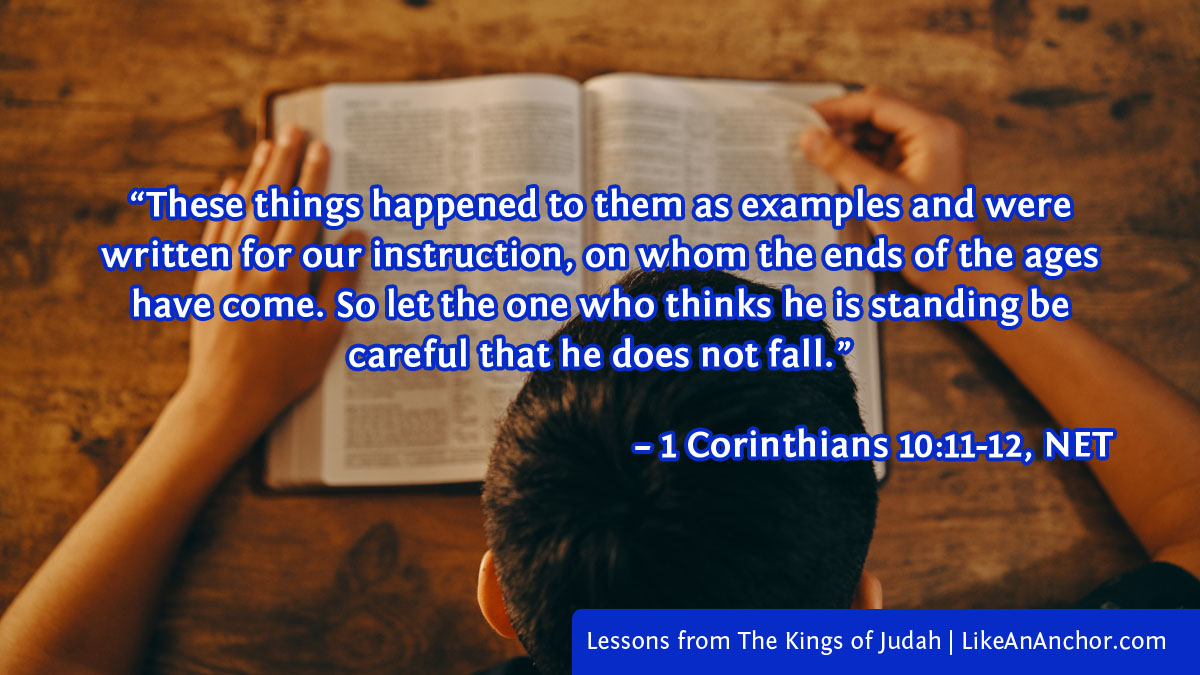
Image of a man reading a Bible overlaid with 1 Cor. 10:11-12, NET Version: “These things happened to them as examples and were written for our instruction, on whom the ends of the ages have come. So let the one who thinks he is standing be careful that he does not fall.”
Image by Matt Vasquez from Lightstock

Summary of Judah’s Kings

  • David—righteous with a perfect heart
  • Solomon—righteous, but not perfect with God in the end
  • Rehoboam—evil
    • Listened to bad advisors
  • Asa—righteous with a perfect heart
  • Jehoshaphat—righteous with a perfect heart
  • Jehoram—evil
  • Ahaziah—evil
    • Welcomed evil influences into his life
  • Athaliah—evil
  • Jehoash—righteous for a while, then turned wicked
    • Faithful only while he had good influences
  • Amaziah—righteous, but not perfect hearted
  • Uzziah—righteous at first, but disobeyed God later
    • Faithful only while he had good influences
  • Jotham—righteous
  • Ahaz—evil
  • Hezekiah—righteous with a perfect heart
    • surrounded himself with good influences
  • Manasseh—evil, but repented and changed
  • Amon—evil
  • Josiah—righteous
    • surrounded himself with good influences
  • Joahaz—evil
  • Jehoiakim—evil
  • Jehoiachin—evil
  • Zedekiah–evil

Lessons from the Kings

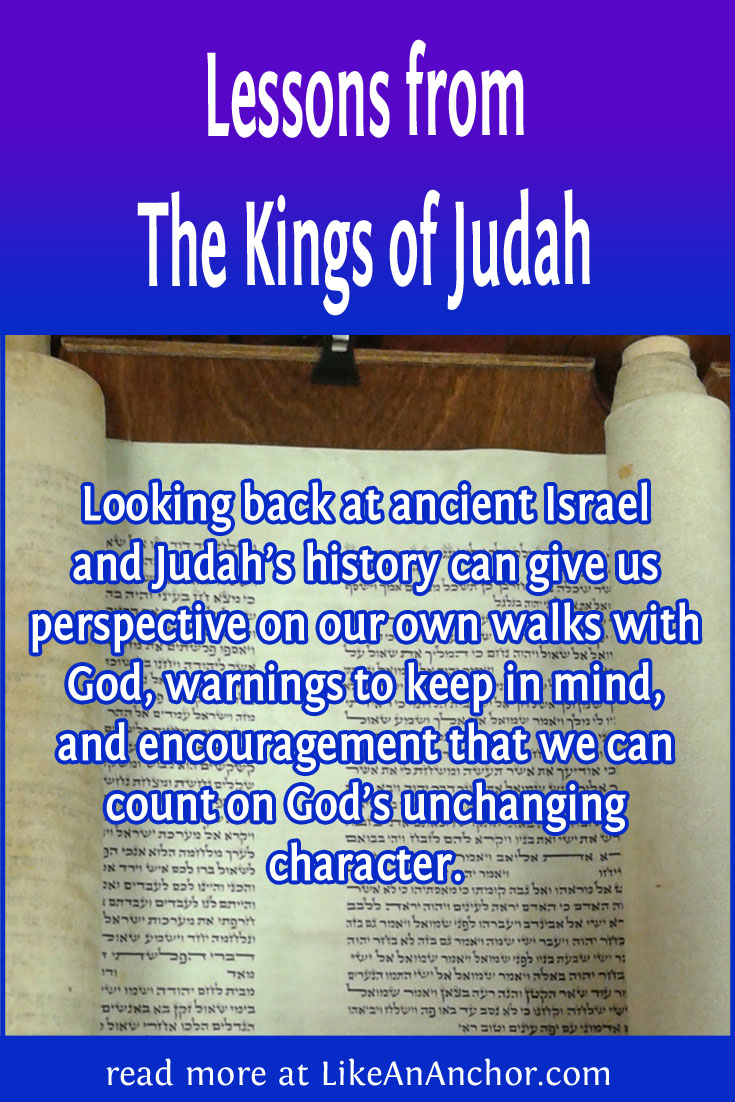
Image of a scroll written in Hebrew overlaid with the blog post's title and the words, "Looking back at ancient Israel and Judah’s history can give us perspective on our own walks with God, warnings to keep in mind, and encouragement that we can count on God’s unchanging character."

Alright, now that we’ve gone through a 3,000-word history lesson, what next? (I honestly didn’t intend for it to be that long; it just happened :lol:) One of the few patterns I did notice is probably obvious to you too based on how I’ve written about the kings–some of the really bad ones had evil influences, several that went from good to bad changed after a good influence died, and the good ones surrounded themselves with positive influences. It’s not all that shocking–we’ve all heard adages like “evil company corrupts good behavior.” We know the people around us influence how we live and act.

And yet, the influences don’t tell the whole story. Manasseh did some of the most horrible things any king of Judah ever tried, and yet he sincerely repented based not on the influence of another person but on a distress-prompted, character-redefining revelation that Yahweh is God. We see Asa, Jehoshapat, and Jotham all described as righteous with God and we’re not told anything about their influences. Some of the perfect-hearted kings came to power right after a father who was thoroughly wicked in God’s eyes, and some of the most evil kings rule right after seeing their righteous father lead the country.

It feels almost anti-climactic to go through that whole study and say it comes down to an individual issue of the heart. And yet, I also find this encouraging. The most famous kings are the ones that reformed all of Judah and brought the nation back into covenant with God, but Jehoshaphat and Jotham are still commended for doing what “was right in Yahweh’s eyes” even though they didn’t reform the entire country. Their individual faithfulness mattered a great deal to God, and it’s the same for us as well.

We also see real-life examples of the point God makes about himself in Ezekiel 18 and 33–He interacts with people according to the way their actions reveal their character. God says He delights when the wicked “return from his way, and live” (Ezk. 18:21, WEB), and we see that when He accepts Manasseh’s repentance even after he commits abominable sins like child sacrifice. God also says, “The righteousness of the righteous will not deliver him in the day of his disobedience” (Ezk. 33:12,WEB), and we see this as well when kings who started out doing well are labeled as unrighteous because they did not stay faithful to God all their lives.

Looking back at ancient Israel’s history can give us perspective on our own walks with God (1 Cor. 10:1-13). We learn from the examples of the past how to follow God with perfect hearts. We also see warnings about how not to live, and learn we need to avoid evil influences and take personal responsibility for obeying and following God. We can also take encouragement seeing that God’s character is unchanging–He still interacts with us in both righteousness and mercy.


Featured scroll images are photos taken by me.

Finding Treasures, New and Old, in the Pages of Scripture

Have you ever been reading a familiar part of the Bible–one of the gospels, for example–and came across something you’d never noticed before? I don’t know how many dozens of times I’ve read Matthew, and just a few weeks ago I noticed a verse that I don’t think I’ve ever thought about before. It comes right after a collection of several parables about the kingdom of heaven, and Jesus says,

“Have you understood all these things?” They replied, “Yes.” Then he said to them, “Therefore every expert in the law who has been trained for the kingdom of heaven is like the owner of a house who brings out of his treasure what is new and old.”

Matthew 13:51-52, NET

As I’ve pondered this verse over the past few weeks while studying the kingdom of God, one thing that jumps out at me is the importance Jesus puts on the old and the new. Treasuring both seems like a different recommendation than what some other scriptures teach us about how to relate to the old and the new. But Jesus also makes this sound like something we’re supposed to do. An “expert in the law” (also translated “scribe” or “Torah scholar/teacher”) who is trained (or “discipled”) for the kingdom seems like someone who has paid close attention to Jesus’s teachings and understand them. So how can we imitate this disciple-scholar’s approach to the kingdom of God?

An Old and New Commandment

Describing someone who is trained or discipled for the kingdom as bringing out old and new treasures can seem strange in light of Jesus’s other teachings. The parables of the new patch on an old garment and new wine in old wineskins make it seem like the new and old is incompatible (Luke 5:36-39). Later, Paul writes about cleaning out the old so we can be new, and of the old passing away because we are new in Christ (1 Cor. 5:7; 2 Cor 5:17). Part of figuring out this puzzle involves asking the question, “Old and new what?” because not all these passages are talking about the same old and new things. In addition to keeping that in mind, I think the key to unlocking this mystery is found in John’s writings:

Dear friends, I am not writing a new commandment to you, but an old commandment which you have had from the beginning. The old commandment is the word that you have already heard. On the other hand, I am writing a new commandment to you which is true in him and in you, because the darkness is passing away and the true light is already shining.

1 John 2:7-8, NET

Jesus did not do away with the old commandments and words of God (Matt. 5:17-20). He did, however, bring something new to add to it, including a new covenant which would supersede the old (Heb. 8-9). Part of participating in this new covenant involves us cleaning old things that are incompatible with godliness out of our lives (that’s what Paul was talking about in the Corinthians passages). It also involves properly balancing and appreciating the new and old treasures of God’s word.

Called into the New, Founded on the Old

People often think of Christianity as something new that Jesus started. The way scripture talks about it, though, “Christian” is just a new name applied to believers who were continuing to follow the teachings of the one true God and align with His unfolding plan as Jesus revealed the next steps. Our faith’s roots aren’t found in the first century C.E.–they’re found “in the beginning” when God created the heavens and the earth. Jesus coming as the Messiah was the next step in the plan God had laid out even before He laid the foundations for the earth (Matt. 25:34; Eph. 1:4; 1 Pet. 1:20).

As part of His work here on earth, Jesus revealed more fully how to worship God and invited us to “serve in the new life of the Spirit and not under the old written code” (Rom. 7:6, NET). Now, is Paul saying here that the old has no value? “Absolutely not!” Rather, he argues that “we uphold the law” when we live by faith” (Rom. 3:31; 6:15; 7:7).

For God, who said “Let light shine out of darkness,” is the one who shined in our hearts to give us the light of the glorious knowledge of God in the face of Christ.

2 Corinthians 4:6-7, NET

The work God is doing in us and the knowledge He gives us are amazing treasures. Part of this treasure of understanding involves an appreciation of the value both of the new and old things that God has given His people. Through His extraordinary power and mercy, we are called into a new thing founded on very old truths.

Finding and Keeping Kingdom Treasures

If we go back to the kingdom of heaven parables that Jesus shared before making the statement where we started this post, we find that He talked about treasure there, too.

“The kingdom of heaven is like a treasure hidden in the field, which a man found and hid. And because of his joy, he goes out and sells all that he has and buys that field.

“Again, the kingdom of heaven is like a merchant searching for fine pearls. Upon finding a pearl of great value, he went out and sold all that he had and bought it.” …

Then He said to them, “Therefore every Torah scholar discipled for the kingdom of heaven is like the master of a household who brings out of his treasure both new things and old.”

Matthew 13:44-46, 52, TLV

God’s kingdom is a treasure so precious we should be willing–and even joyful–to give up whatever is needed to get the kingdom (Matt. 10:21; Luke 18:22). And we should be collecting and treasuring things related to the kingdom, such as the “treasures of wisdom and knowledge” hidden in Jesus (Col. 2:3, see also Matt. 6:19-21). As we continue to learn and grow, let’s appreciate the rich history of our faith and our own personal experiences, as well as the new things God teaches and the glorious future He has planned.

Featured image by Oliver Eyth from Pixabay

Talking with God: What (And Who) Makes Prayer Possible?

Prayer is such an integral part of the Christian life that I rarely stop and think about how it works. Even in studies on how and why to pray, I haven’t focused much on what (and who) makes prayers possible.

Of course, it’s obvious that God Himself makes prayer possible. If He wasn’t listening we’d have no reason to pray. He also gives instructions about how we’re to approach Him, which is why most people I know end their prayers with some variation on the phrase “In Jesus’ name, amen.”

Jesus said, “ask in my name,” and so that is what we do. His instruction to pray in His name would be enough of a reason to do so, but I also think this aspect of prayer can teach us important things about how the God-family operates and how They relate to us. So today, I want to take a closer look at why we pray in Jesus’ name.

Ask in His Name

The passages where Jesus instructed His disciples to pray in His name are found in John’s gospel. Before sharing these instructions, though, Jesus makes an important foundational statement.

Jesus said to him, “I am the way, the truth, and the life. No one comes to the Father, except through me. If you had known me, you would have known my Father also. From now on, you know him, and have seen him.” (John 14:6-7, all scriptures from WEB translation)

As the Word, Jesus was always the member of the God-family that human beings had the most direct access to. Before Jesus came as a human being, people knew there were two Lords but they didn’t have access to the Father directly (the scriptures to back this point up would double the size of today’s post, so I’ll direct to my post “Who Was ‘God’ in the Old Testament?”). Read more

Who Was “God” In The Old Testament?

Almost four years ago, I wrote a post addressing the phrase “the God of the Old Testament.” Little did I know then that it was going to explode from being an interesting point of doctrinal dispute into a contention that could split churches. I know of at least one group that has already divided over the question, “Who was the God of the Old Testament?” And now the related issue of whether Jesus was created by the Father or existed before His human birth is starting to tear apart one of my local churches.

In the post from four years ago, I described the phrase “God of the Old Testament” as coming under the category of “stupid things we say in the church.” I still believe that. The wording is misleading and confusing, often causing inaccurate statements and doctrinal fallacies. In reality, the God we worship today is the exact same God (two beings in one) that has always existed. Scripture is quite clear on this point. And trying to argue that either the Word who became Jesus OR the Being we now know as the Father was the only “God of the Old Testament” is an exercise in futility (and quite possibly blasphemy as well).

The arguments on both sides are no longer just an intriguing discussion about scripture. They’re becoming a stumbling block . I’ve heard that some people in the group I mentioned which has already split are so confused they don’t even know who to pray to anymore. And studies into this topic, which may have started out with good-hearted Christians seeking to understand the word of God more fully, are turning into schisms, contentions, and heresies that cannot be pleasing to God. He does not look kindly on those who generate endless debates (Tit. 3:9), fracture His body (1 Cor. 1:10; 12:25), or lead His little ones into error (Matt. 18:6). This has to stop.Who Was "God" In The Old Testament? | marissabaker.wordpress.com

Why Is This So Contentious?

I think part of the issue with resolving questions like this is that we often fail to look at the Bible as a whole. We get so focused on digging out the slightest variations in meaning for a specific scripture that we don’t look up from analyzing a single sentence long enough to see there’s a whole narrative that clears things up. That’s something I talked about in my post titled, “Why Does It Matter If Jesus Existed Before He Was Human?

Another way we fall prey to deception in this area is what I call the two ditches problem. Human beings aren’t good at finding balance in our ideas. We tend to avoid the middle of the road. So if we discover that we’ve been taught an extreme view in one direction (for example, that Jesus is the only “God of the Old Testament”), there’s a temptation to head straight for the opposite ditch (e.g. that Jesus wasn’t around at all in the Old Testament). In trying to avoid one error we come up with a new one.

Something else that might be playing a role for certain people is the temptation to come up with their own doctrine. If you’ve been lied to by church leaders in the past (and far too many of us have), we might want to question everything we’ve been taught. There’s nothing wrong with that in and of itself. In fact, following blindly is a great way to end up in errors that could be avoided if we were studying the Bible for ourselves. But if you start feeling like you have to come up with a new or alternative way of seeing scripture that is “your own,” then you can run into problems. Chances are, you’re not the only person God is revealing “new truth” to. And if you have to argue your point out of obscure commentaries or a possible mistranslation when the people who believe something else have myriads of clear scriptures and the bulk of Biblical scholarship to back them up, then there’s a good chance you’re the one who’s wrong.

“God” Has Always Been Two

Let’s dive into the scriptures now. Some of this is going to be a repeat of the post I wrote four years ago, but I doubt most of you have read that and it’s good for context. We’ll begin in Genesis. Read more