INFJ User Guide

Congratulations on the procurement your new INFJ!* INFJs are highly sought after in the personality type collecting world given their extremely rare nature. INFJ spotting is a very difficult hobby, requiring forays into the deepest recesses of bookstores, yoga studios, and the internet. Keeping an INFJ in your life once you’ve found one can be even more of a challenge.

INFJs are widely considered one of the most amiable and empathetic personalities. Their minds offer a good balance of emotion and logic that helps them relate to most types of people, and they highly value commitment and relationships. As introverts, though, they have limited social energy and they don’t maintain relationships with most of the people they meet. Once you’ve found an INFJ, taking your acquaintance to the level or friendship, or relationship, isn’t simple. That is, unless you have this user guide.

INFJ User Guide | marissabaker.wordpress.com

Overview of the INFJ

The INFJ is a strange sort of creature, often compared to unicorns. Their uniqueness is a result of two things: the way their brains/personalities are hardwired and the rarity of their personality type. What’s perfectly normal for an INFJ seems unusual among humanity as a whole because so few people function this way. Understanding your INFJ’s basic functions is the first step towards successful interaction with the INFJ.

Read more

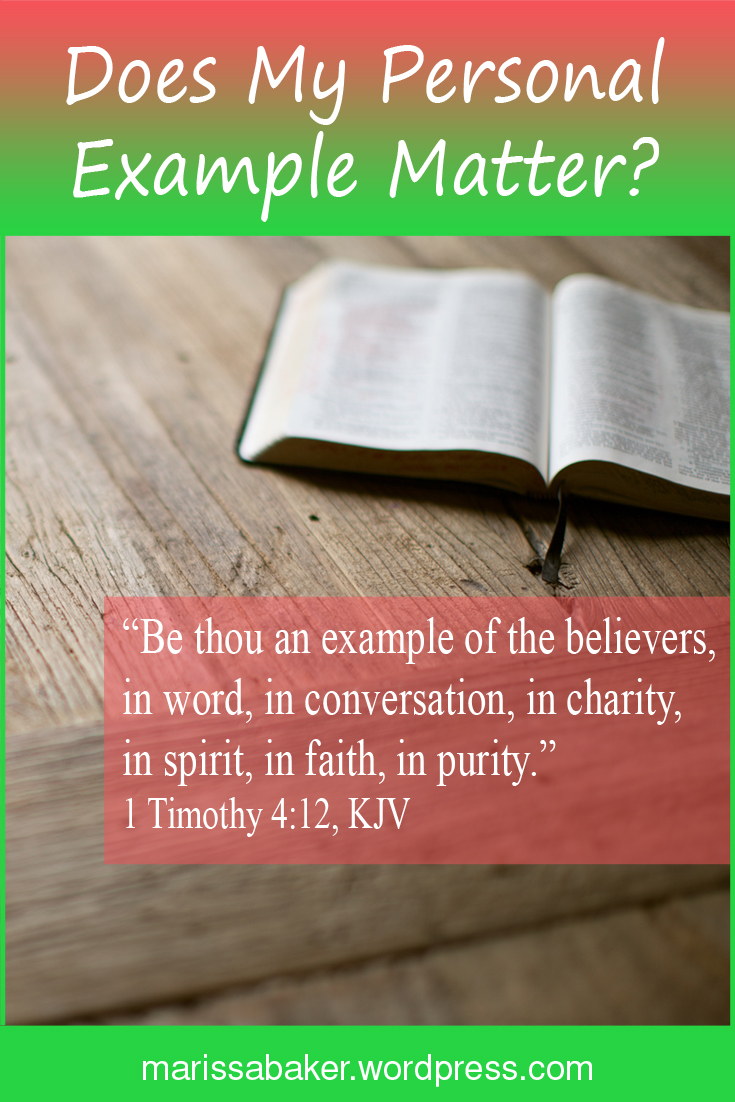
Does My Personal Example Matter?

I’m borrowing the title for this post from a sermon I heard last month. The speaker said “Does my personal example matter?” was a question Google didn’t have an answer for, and he was right — searching this phrase only turns up results on “personal matters” and “personal opinions.” Searching for “Why is it important to set a good example?”, though, turns up some interesting results. On the first page, you’ll see articles on parents setting a good example for children, leading by example in the workplace, and the importance of role models. Clearly, there are those who believe your personal example does matter.
Does My Personal Example Matter?  | marissabaker.wordpress.com

Most of the articles I saw connected setting an example with leadership. Indeed, this is inherent to the English definition of the word “example” (as found on Merriam-Webster.com):

: a person or way of behaving that is seen as a model that should be followed

: one that serves as a pattern to be imitated or not to be imitated

: one that is representative of all of a group or type

In the Greek, we have several words translated “example,” but they build a similar picture to our English idea. Tupos (G5179) means a print, prototype, pattern or model. Hupogrammos (G5261) is something that’s written down so it can be copied. Hupodeigma (G5262) refers to an example, pattern, or representative of a type. Deigma (G1164) means an example, specimen, or sample.

A Model To Follow

As Christians, we’re called both to follow an example and to be an example.

For to this you were called, because Christ also suffered for us, leaving us an example, that you should follow His steps (1 Pet. 2:21)

This verse is the only time hupogrammos is used in scripture. The word comes from hupo (before/under) and grapho (to write). It paints a picture of a teacher writing out letters and phrases for a student to copy. In effect, Peter is telling us to study and “trace over” the lines of Christ’s life exactly.

We can also learn from the examples of our fellow believers. James tells us to “take the prophets, who spoke in the name of the Lord, as an example of suffering and patience,” and mentions Job as a specific example (James 5:10-11). These and others, like the people in the faith chapter, are positive examples modeling Godly life.

Other examples show us what not to do. Israel’s history was “written for our admonition” and “these things became our examples, to the intent that we should not lust after evil things as they also lusted” (1 Cor. 10:11, 6). Ananias and  Sapphira are another example of how we ought not to act. Such examples serve as a model of what happens when we stray from God.

Jesus Christ is the key to knowing which examples to follow. Paul writes, “Imitate me, just as I also imitate Christ” (1 Cor. 11:1). We need to know the example of Christ, follow Him, and check our role models against the pattern He set. Only then will be be able to tell which examples are worth imitating.

Being An Example

I mentioned earlier that setting a good example is connected with being a leader. Everyone in the church has leadership and ministerial responsibilities, though to different extents and in different roles. We’re all part of “a royal priesthood, a holy nation, His own special people, that you may proclaim the praises of Him who called you” (1 Pet. 2:9). Part of this calling involves Jesus Christ making “us kings and priests to His God and Father” (Rev. 1:6). Those are roles of responsibility, roles that people look to for an example.

As we follow the Lord, we can inspire and reach others by our examples, as the Thessalonians did. Paul wrote to them, saying, “you became examples to all in Macedonia and Achaia who believe. For from you the word of the Lord has sounded forth,” and not just locally. Their faith in God “has gone out, so that we do not need to say anything” (1 Thes. 1:7-8). Their example was more effective at preaching than words.
Does My Personal Example Matter?  | marissabaker.wordpress.com

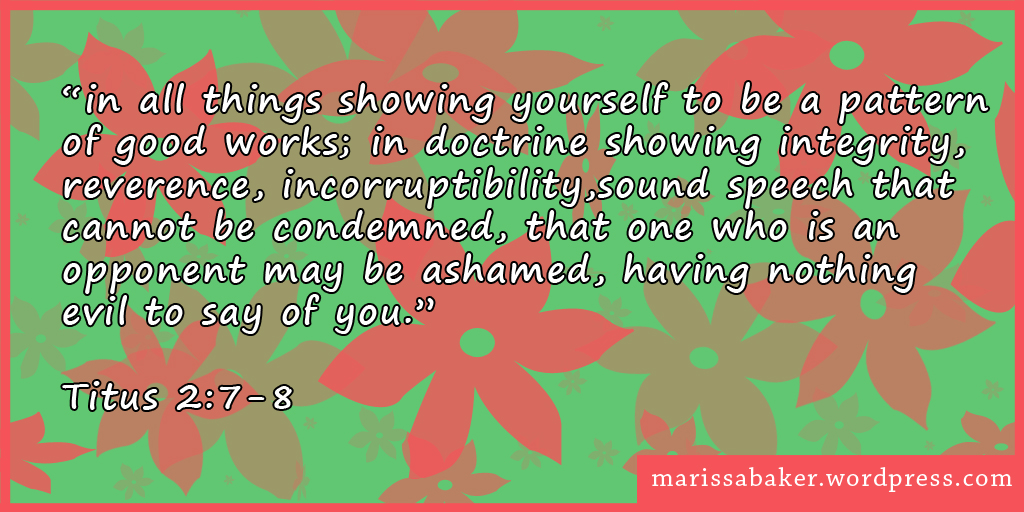
Indeed, we teach by what we do equally (if no more) effectively than by what we say. Writing to a young minister, Paul told him to teach “sound doctrine,” yes, but also to lead by example — “showing yourself to be a pattern of good works; in doctrine showing integrity, reverence, incorruptibility” (Tit. 2:1, 7).

Shepherd the flock of God which is among you, serving as overseers, not by compulsion but willingly, not for dishonest gain but eagerly; nor as being lords over those entrusted to you, but being examples to the flock (1 Pet. 5:2-3)

Representatives

In addition to patterning an example for other believers, we’re also supposed to be examples of what a Christ-follower looks like.

Let no man despise thy youth; but be thou an example of the believers, in word, in conversation, in charity, in spirit, in faith, in purity. (1 Tim. 4:12, KJV)

No matter our age, ability, gift, or role in the church, we can serve as a representative of the Christian type. We are “the epistle of Christ … written not with ink, but with the Spirit of the living God; not in tables of stone, but in fleshy tables of the heart.” (2 Cor. 3:3). We can be seen, “known and read of all men” (2 Cor. 3:2). Indeed, as some have said, you may be the only Bible some people ever read.

Our example doesn’t just “matter.” It’s powerful. We have the amazing opportunity, and responsibility, to show the world how God’s people are supposed to live — to be Christ’s body as we model His love for our brethren and for everyone on the planet.


Download God's Love Story at https://www.smashwords.com/books/view/577523


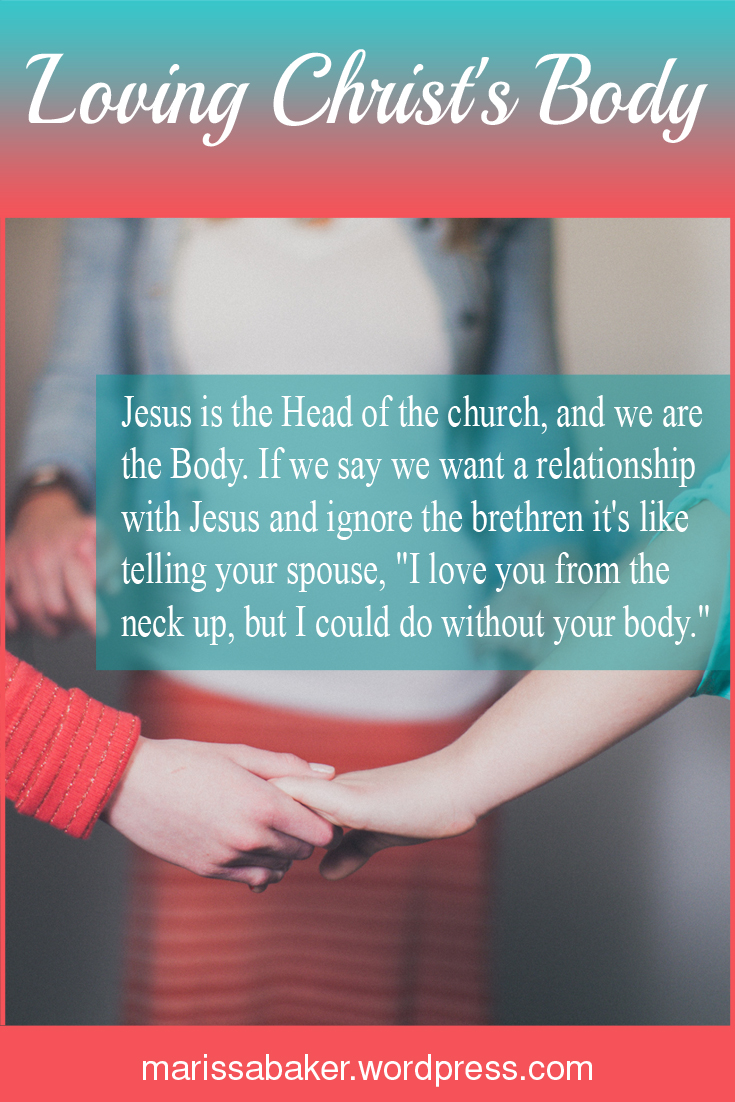
Loving Christ’s Body

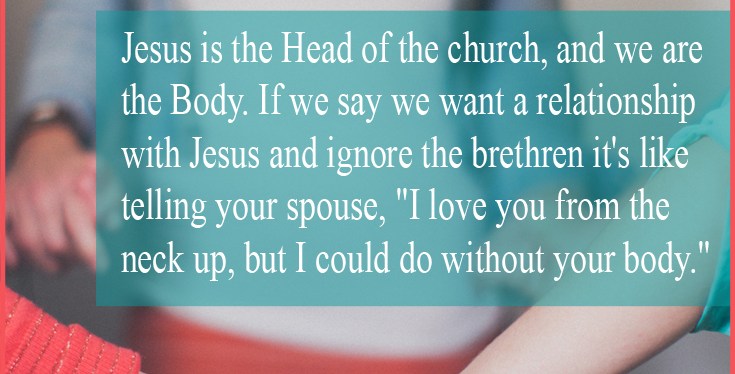
Not too long ago, I heard an analogy on a Christian radio station that stuck with me. It was a pastor trying to convince listeners they need a church to fellowship with. He said that since the church is Jesus Christ’s body and He is the Head, if we say we want a relationship with Jesus and ignore the brethren it’s like telling your spouse, “I love you from the neck up, but I could do without your body.”

Loving Christ's Body | marissabaker.wordpress.com

Vital Commandments

This analogy is not an exaggeration. John’s writings make very clear the high value Jesus puts on love among believers. If we can’t love our brethren, we’re actually incapable of loving God. Read more

My Mother’s Personality Type

My mother refuses to take a Myers-Briggs test and won’t answer any questions if I try to type her. I do have my suspicions about her four-letters, but this actually isn’t the topic of my post today. One of my mom’s reasons for not learning her type is that she doesn’t want put into a box. While I do find MBTI a useful tool, I also realize it contains stereotypes that can be limiting. People are so much more nuanced than a type description. We can (and should) love them, understand them, and value their “personality type” in a way that doesn’t have anything to do with Myers-Briggs theory.

I’m not exaggerating when I say I have an incredible mother. Here’s just one example: she has this super-human ability to get angry so rarely that her wrath might as well be nonexistent. This is an invaluable gift in any situation but considering she lives with three Extroverted Feelers (an ENFJ, an INFJ and ISFJ) who tend to get stressed-out and emotionally vent (which then triggers the other Extroverted Feelers in the house) it’s a wonder she hasn’t killed us yet. Instead, she’s a peacemaker and a willing sounding-board for all the emotions we’re not quite sure what to do with. I don’t need to know her four-letter type to appreciate that.

My mother’s personality is patience, kindness, and peace. She’s one of the most truly godly women I’ve ever known. Thought it’s a little surreal to have someone who knew her when she was my age recognize me as her daughter, I can’t think of many higher compliments than being compared to her. They say girls turn into their mothers as they grow older, and that’s perfectly okay with me. I love you, Mommy.

Happy Mother's Day! and a tribute to my mother  | marissabaker.wordpress.com

Jesus Christ’s First Words

My parents tell me my first words were “Dada” and “duck.” I’m sure many of your parents also shared with your how excited they were when you first started talking, or perhaps you have kids of your own and eagerly waited for the first words to come from their mouths. We view first words as important, even on into adulthood when we meet someone for the first time. Based on the words people speak, we form ideas about their priorities, character, and motives.

Christ's First Words | marissabaker.wordpress.com

We don’t know what baby Jesus’s first words were, but we do have four gospels that contain many words He spoke while walking on this earth. Looking at the first words each writer records Christ speaking gives us key insight into His character and priorities.
Read more

The Single INFJ

It’s strange that a personality type for which “homemaker” is one of the top recommended career options has such a difficult time finding love. While not true of all INFJs, many of us are romantics in every sense of the word. We’re idealists who still believe in soul-mates. We’re eager to dive deep into relationships and prioritize the people closest to us. We’re among the MBTI types least likely to cheat in a romantic relationship.

But we also shy away from any type of deep relationship if we don’t feel completely safe. Our idealism means we often have unrealistic expectations for our (potential) romantic partners. The soul-mate type of understanding we crave is hard to find. And so here I am, turning 27 this year having been on 4 dates since I was 19 (all with guys I chose not to go out with a second time) and yet still wanting to be in a relationships (almost) just as much as ever.

So what’s a single INFJ to do? It sounds cliche, but I agree with Amelia Brown on Introvert, Dear that it’s important  to focus  on “the relationship you have with yourself.” If you’re not comfortable with yourself, you’re never going to be happy, regardless of whether or not you’re in a relationship with someone else. Also, if you haven’t taken ownership of your life, your choices, and your struggles then you’re going to have a harder time cultivating the sort of strong, lasting relationship INFJs crave. Read more