Preparing For The Bridegroom To Come Back

In Christ’s day, a Jewish bride-to-be had to be ready for her bridegroom to arrive at any moment. She prepared herself, and listened for the trumpet blasts and shouts signaling his eminent arrival. Jesus’ first coming followed a similar pattern, with a “friend of the bridegroom” telling people he was on His way. Scripture indicates His return will also follow a pattern like this.

As we approach the fall holy days of Yom Teruah (Feast of Trumpets), Yom Kippur (Day of Atonement), and Sukkot (Feast of Tabernacles), my mind has been on Jesus’ return. These days picture parts of God’s plan that have not yet been fulfilled, including Messiah’s second coming.

Here on this blog, we’ve often talked about how Jesus’ relationship with the church is like that of a Jewish bridegroom with his bride (you can read more about this in my posts “The Bridegroom’s Pledge” and “The Bridegroom Cometh!“). After the betrothal, the bride wouldn’t know exactly when the groom was going to come back for the wedding. She had to be ready, listening for the trumpet blasts and shouts signaling his eminent arrival. In much the same way, we don’t know when Christ will return and it’s very important that we get ready and keep watching for Him to come back. Read more
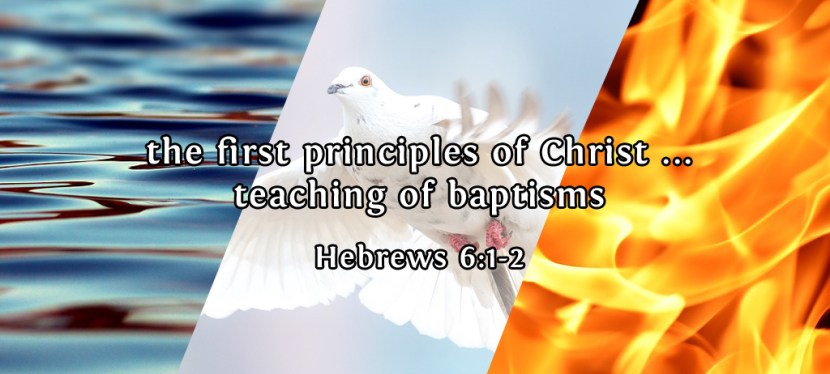
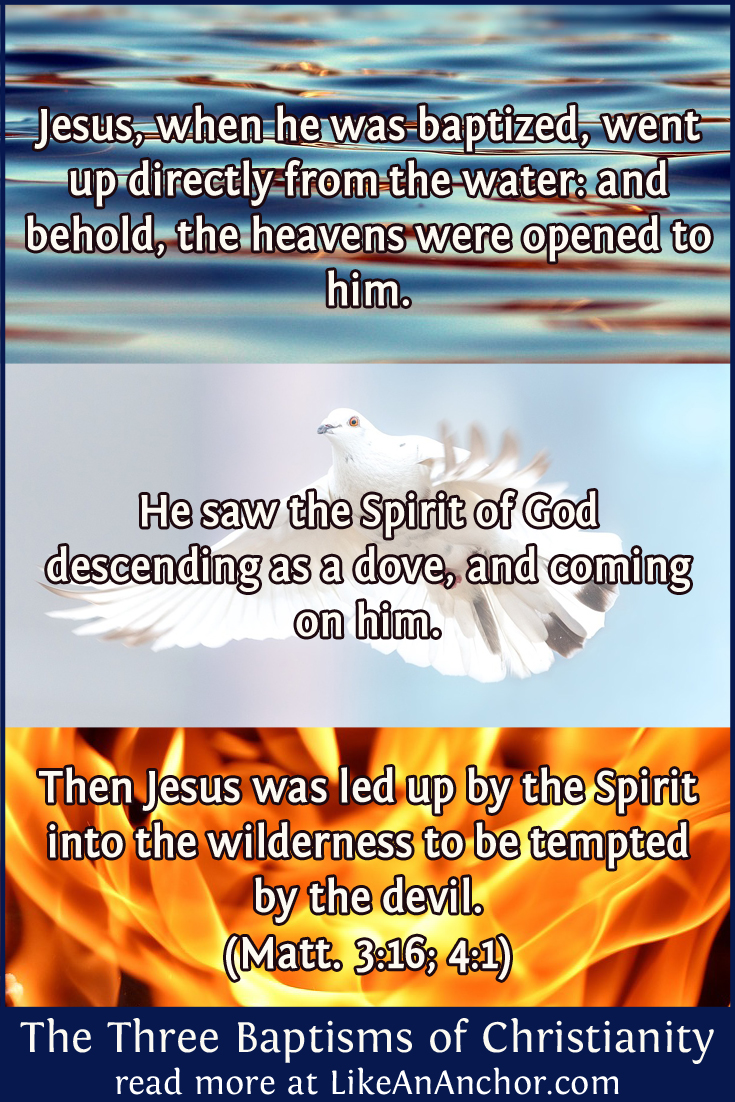
Water, Spirit, Fire: The Three Baptisms of Christianity

How many times have you been baptized?

Scripture talks about baptism — full immersion in water — as a first step in believers’ walks of faith. It’s an outward sign of our identification with God’s people and our commitment to leave our old lives behind. Some church groups stop there, some sprinkle people from a baptismal instead, and Messianics continue to mikvah on a semi-regular basis.

I thought practicing mikvah once a year (more or less) was an odd idea when I started attending a Messianic group. Part of me still does, though I don’t really see anything wrong with it. However, while we are supposed to undergo water baptism at least once, it doesn’t stop there. When Scripture talks about multiple baptisms they’re not all done with water. Here’s what John the Baptist said about the baptism he was doing and the baptisms Messiah would do:

I baptize you with water for repentance, but the one who comes after me is more powerful than I am, whose sandals I am not worthy to carry. He will baptize you with the Holy Spirit and fire. (Matt. 3:11, LEB)

Water, Spirit, Fire: The Three Baptisms of Christianity | LikeAnAnchor.com

Water, spirit, and fire — those are the three baptisms that John tells us believers in Jesus will go through. I think this is what the writer of Hebrews means when he describes “the doctrine of baptisms” (plural) as a foundation of Christianity (Heb. 6:1-2).

Read more

Does God Change His Mind About What He Expects Of Us?

Has God changed His mind about what He expects from people? Some think He has, or should. It’s the 21st century, they say. Those notions of morality are old-fashioned and need an update. Others think the change already happened and God doesn’t expect anything from you under the new covenant. You’re saved by grace and that’s it; no action required.

Neither of these ideas accurately reflects the picture God gives us in scripture. And while the idea of God brushing some rules under the rug can be a nice one if you plan to break those rules, it sets up a chilling precedent. Do you really want to serve a God who will change what’s expected of you or how He defines morality? If we can’t count on God to stay self-consistent we can’t trust Him and we’d have no hope to anchor our souls. Honestly, I find the idea of a God who changes the rules far more upsetting than that of a God who consistently expects certain things of His people.

God Wants You To Live

Thankfully, God reveals Himself in the Bible as reliable and consistent. That doesn’t mean He’s always predictable — He’s far too much for our minds to put Him in neat little boxes. But He will always act according to His character, keep His promises, and uphold His laws. Read more

Reasons To Pray: Getting Involved With God’s Plan

Why doesn’t God answer more prayers? Why don’t we see dramatic miracles today as often as they happened in the book of Acts? Those are questions that puzzle many a modern Christian. We know God could do more, so why doesn’t He? Why does He choose to use His power in some situations, but not in others?

In other words: If God is love, why doesn’t He do something about all this suffering?

Those are some of the questions tackled in Philip Yancey’s book Prayer: Does It Make Any Difference? (which I highly recommend). One of the things that he points out should be pretty obvious, but it’s something I hadn’t thought of much before. To borrow Yancey’s analogy, God’s not a vending machine. You can’t pop prayers in like quarters and have the answer you requested fall out. There’s more going on.

Prayer is for building relationships as much (or more) as it is for making requests. And while God does answer prayers, he often answers in a different way than we might expect. The “something” that He does in response to prayer has a great deal to do with His people’s relationship to Him.

Partners in the Kingdom.

Let’s start out with a couple quotes from Yancey’s book:

“I will build my church,” Jesus announced, proclaiming the new reign of God’s kingdom on earth. That, too, has taken shape gradually and fitfully over twenty centuries with many embarrassing setbacks to go along with the advances. I think of the profound grief God must feel over some chapters of church history. Yet, as Paul put in an astonishing metaphor, “the head cannot say to the feet, ‘I don’t need you!'” God has made the work of the kingdom dependent on the notoriously unreliable human species (p. 110)

It’s an astonishing thing to think about, really. God calls the foolish, weak, lowly, and despised people, then He entrusts them to act as the body of His son operating in the world (1 Cor. 1:27-28). With that thought in mind, I look at myself (and often others as well) and shake my head wondering, “Oh, Lord, what were you thinking?” And yet, for some reason, He welcomes all believers as partners in the kingdom. Read more

Reasons to Pray: Building Relationship With God

I have very little trouble believing that God is here with me, real, and listening when I pray. But I do struggle believing He’ll do something about it. I know He can, but I doubt that He will. I don’t ask, “Where are you, Lord?” nearly as much as I do, “Why this and not that?”

This struggle is why I recently read a book called Prayer: Does It Make Any Difference? by Philip Yancey. I’d picked it up about a year ago and it’s been staring at me from my bookshelf ever since. I highly recommend you read it, even though it really didn’t answer my main questions about prayer. Instead, it shifted how I think about prayer.

Responding to God’s Presence

“I have learned to see prayer not as my way of establishing God’s presence, rather as my way of responding to God’s presence that is a fact whether or not I can detect it. … My feelings of God’s presence — or God’s absence — are not the presence or the absence. … God is already present in my life and all around me; prayer offers the chance to attend to and respond to that presence” (Yancey, p. 51-53)

The Bible does talk about people fleeing from the Lord’s presence, leaving His presence, or being unable to enter His presence. And since we’re told “seek Yahweh while he may be found. Call on him while he is near,” it seems that there are times when He cannot be found and is not near (Is. 55:6, WEB). We’re also told our sins can block relationship with God (Is. 59:2). But that doesn’t actually mean He’s not present. Read more

Are You Spiritually Minded Yet?

One of the many issues Paul addressed in his first letter to the Corinthians was that of disunity. The church of Corinth was suffering from a spiritual malady all too common among churches today. They were split into factions, squabbling over which leader to follow, happily tolerating sin, and looking down on fellow believers. Paul’s words to them can give us guidance for finding a way out of similar problems today.

Disunity is Ridiculous

Now I beg you, brothers, through the name of our Lord, Jesus Christ, that you all speak the same thing and that there be no divisions among you, but that you be perfected together in the same mind and in the same judgment. For it has been reported to me concerning you, my brothers, by those who are from Chloe’s household, that there are contentions among you. Now I mean this, that each one of you says, “I follow Paul,” “I follow Apollos,” “I follow Cephas,” and, “I follow Christ.” Is Christ divided? Was Paul crucified for you? Or were you baptized into the name of Paul? (1 Cor. 1:10-13, WEB)

Paul is begging these people in the name of our savior to stop their contentions and divisions. His questions, “Is Christ divided? Was Paul crucified for you” shine a spotlight on how ridiculous their squabbles and disagreements really are. Christ is not divided and He’s the one into whom we were baptized. There is no division when we’re in Him.

The Mind of Christ

When Paul talks about being like-minded with each other in Philippians, he follows it with “Let this mind be in you which was also in Christ Jesus” (Phil. 2:1-5, KJV). Our unity comes from all of us learning to think like Jesus. It is the height of arrogance to think we could come up with a better plan, interpretation, or idea than what He has given us. Read more