The Second Greatest Commandment

Our relationship with God is the most important thing in our lives. How we stand in relationship with God determines whether or not we’re in His family and included as part of Christ’s church. It is not, however, the only important relationship.

Jesus said to him, “‘You shall love the Lord your God with all your heart, with all your soul, and with all your mind.’ This is the first and great commandment. And the second is like it: ‘You shall love your neighbor as yourself.’ On these two commandments hang all the Law and the Prophets.” (Matt. 22:37-40)

If we ignore the second commandment, then we’re not keeping the first one very well. Christ said, “If you love Me, keep My commandments” (John 14:15), so if we’re truly in a good relationship with God, we also have to be cultivating good relationships with other people.

From Death To Life

In the Greek, “neighbor” refers to anyone in your sphere of influence. If you know about them or are near them, they are your neighbor. For now, though, let’s focus on loving people we meet within the church. Sometimes it seems like they are the ones we have the hardest time getting along with, perhaps because we expect so much more from them than from people “out there” in the world. We’re less inclined to cut them some slack for being human.

A new commandment I give to you, that you love one another; as I have loved you, that you also love one another. By this all will know that you are My disciples, if you have love for one another.” (John 13:34-35)

If love is how people are supposed to identify Jesus’s followers, then I’m afraid there are far too may of us hiding our identities. I know many loving individuals who proclaim by their actions that they are true disciples, but loving churches seem few and far between.

The Second Greatest Commandment | marissabaker.wordpress.comChristian denominations are rife with division, disagreements, and fighting. It seems like there’s always someone with a new doctrine or a better way to run things, followed by arguments and people taking sides in a divided congregation. If we were all walking in the light, there would be love and not division (1 John 2:9-11). But we’re not always perfect, and it’s so easy to stumble right along with divisive people in an unloving reaction to their lack of love. We can’t control other people, but we are each responsible for how we respond to them, including those who really have done something wrong.

In this the children of God and the children of the devil are manifest: Whoever does not practice righteousness is not of God, nor is he who does not love his brother. For this is the message that you heard from the beginning, that we should love one another …. We know that we have passed from death to life, because we love the brethren. He who does not love his brother abides in death. Whoever hates his brother is a murderer, and you know that no murderer has eternal life abiding in him. (1 John 3:1-11, 14-15)

“We have passed from death to life because we love the brethren” — that’s how important love is. If we hate instead of love, we don’t get eternal life. Even brethren who have stumbled and fallen away from the faith still need and deserve our love, since they still come under the neighbor category or even “love your enemies” (Matt. 5:44).

Vital Friendships

We’ve talked about loving people because we have to, but there should also be people in our lives who we love because we want to — family and friends with whom we share common interests and who will be there for us as we go through life. We need other people, especially friends in the faith who will build us up and help us in our Christian walk. Jesus had 12 disciples who were closer than His other followers, as well as friends like Martha, Mary and Lazarus. When He sent people out to preach, He sent them in pairs (Luke 10:1). Paul also traveled with other believers, including Barnabus (Acts. 13:2), Silas (Acts 15:40) and Timothy (Acts 16:1-4).

And let us consider one another in order to stir up love and good works, not forsaking the assembling of ourselves together, as is the manner of some, but exhorting one another, and so much the more as you see the Day approaching. (Heb. 10:24-25)

“All you need is God” is true to a certain extent, but it is also true that God is the one who tells us it’s not good to lack human companionship. He is the source of our strength and our life, and He can sustain us through times when we have no friends or believers to fellowship with, but He also supplies our need for people around us because He knows friends and brethren are good for us.

Beloved, let us love one another, for love is of God; and everyone who loves is born of God and knows God. He who does not love does not know God, for God is love. (1 John 4:7-8)

The Second Greatest Commandment | marissabaker.wordpress.comI know people who say they don’t need friends because they have God, and people who stopped fellowshipping with brethren because no one agreed with their particular view of the sacred calendar. I am frightened for these people, because the God they say is all they need tells them in His Bible that they also need relationships with other believers.

If someone says, “I love God,” and hates his brother, he is a liar; for he who does not love his brother whom he has seen, how can he love God whom he has not seen? And this commandment we have from Him: that he who loves God must love his brother also. (1 John 4:20-21)

One of the ways we demonstrate our love for God is by loving other people, and we can’t do that if we deliberately isolate ourselves. It’s one thing to have no one else around who shares your faith, and if that’s the case I pray and believe that God will supply your need for fellowship. But it’s another thing entirely to avoid other people, no matter how tempting it might be for some of us introverts or for those of us who have been hurt by past associations with church goers. But if we aren’t around other people, then how can we keep the commandment to love our brethren? If we isolate ourselves, how will we keep the second greatest commandment?

Lovers of God

loveAs long as I can remember, and I’m told well before that, “Why are we here?” has been a familiar refrain in sermons. I’m not sure if other churches ask this question so religiously, but in mine it’s trundled out every Feast of Tabernacles (Sukkot), and at least once more on other Holy Days and/or Sabbaths throughout the year.

The answers are equally familiar by now: “Because God called us,” “Because today is a commanded assembly,” “Because you’ve been given understanding the rest of the world doesn’t have.” Last time I heard this question was a few weeks ago, and that time I tried to think beyond why I was sitting in an uncomfortable blue-upholstered chair on a Saturday afternoon. When we really boil it all down to the question of why God called us in the first place, why are we really here? What is our purpose as followers of God?

A Great Mystery

From the very beginning God’s focus has been on relationships. Looking back to Genesis 1, we see God speaking the world into existence, and proclaiming that it was good. Finally we come to the pinnacle of God’s creation.

Then God said, “Let Us make man in Our image, according to Our likeness” (Gen. 1:26)

This is the first time in the Bible where we see both The Word/Jesus Christ and God The Father talking about something together. I’m sure they collaborated on the rest of creation as well (Eph. 3:9), but mankind is the one creative act where They made sure we knew They acted together. “Let Us make man” is a collaborative, relational statement, announcing Their intent to make people “in Our Image,” and therefore capable of relationship.

The specific way humans were created also points out the importance of relationships. With other creatures, both male and female were apparently created at the same time. With humans, however, man was created first. This gave God a chance to point out, “It is not good that man should be alone” (Gen. 2:18). As Paul explains much later in the scriptures, the marriage relationship created here is a picture of the relationship God wants with His church.”

“For this reason a man shall leave his father and mother and be joined to his wife, and the two shall become one flesh.” This is a great mystery, but I speak concerning Christ and the church. (Eph. 5:31-32)

Here, Paul quotes Genesis 2:24 to teach us a great mystery about the relationship between Jesus Christ and the New Testament church. At its core, the goal of “Let Us make man” was to build familial relationships. We are made children of God and co-inheritors with Jesus Christ (Rom. 8:15-17), and betrothed to our adopted Brother (2 Cor. 11:2). We are designed to be in relationship with our Creator.

Lovers of God

In 2 Timothy, Paul describes “the last days,” warning that bad things are going to happen because men will turn away from loving God.

But know this, that in the last days perilous times will come: For men will be lovers of themselves, lovers of money, boasters, proud, blasphemers, disobedient to parents, unthankful, unholy, unloving, unforgiving, slanderers, without self-control, brutal, despisers of good, traitors, headstrong, haughty, lovers of pleasure rather than lovers of God, having a form of godliness but denying its power. And from such people turn away! (2 Tim. 3:4-5)

Note that these people have a “form of godliness.” As bad as they sound, they aren’t just people outside the churches — there are some inside our groups as well trying to pass themselves off as godly. But because they are not truly “lovers of God,” they are denying His true power and refusing to walk in His ways.

What does a “lover of God” look like? We’ve quoted John 14:15 several times over the past few weeks, where Christ says, “If you love Me, keep My commandments.” He expands on this idea through chapter 15 as well.

As the Father loved Me, I also have loved you; abide in My love. If you keep My commandments, you will abide in My love, just as I have kept My Father’s commandments and abide in His love. (John 15:9-10)

Obedience is key to being in a relationship with God. If we ignore His commands, we’re telling Him we don’t care about a relationship with Him. But if we keep His commandments, we’re saying how much we love Him and want to be close to Him.

Dearly Beloved

When was the last time you heard Song of Solomon quoted in a sermon? For that matter, how many Christians do you think would have included it in the Bible if canonization had been up to them? No one seems quite sure what to do with it. My KeyWord study Bible says that portions of the Song were sung at Passover, though, so with that coming up next week maybe today is the perfect time to take another look at the Song of Songs.

Jeremiah, Ezekiel, Second Isaiah and Lamentations all use this metaphor; the rabbis merely amplified what they had already found in the Bible. The Song of Songs, to the rabbis, was the completion of the metaphor. The prophets may have denounced infidelity but the Song of Songs spoke of reunion and love, the kind of love that the believing rabbinic Jew felt for God. Even the Psalms do not talk about God as the lover or bridegroom of Israel. The Song of Songs is seen as a dialogue between God and Israel, and this provides the book with a unique religious intensity.” (Benjamin Edidin Scolnic, “Why Do We Sing the Song of Songs on Passover?”, page 4)

Lovers of God | marissabaker.wordpress.comScholars can’t agree on who wrote the Song of Songs or when, much less how to interpret it. Some claim that it’s nothing more than a secular love song, others say it only has allegorical applications. The more balanced view is that it operates on two levels — as an account of human love, and as a picture of Christ’s love for the church and/or God’s love for Israel. That’s the one I like, and there is much to learn when we read this book looking for insight into our relationship with God.

I am my beloved’s, and his desire is toward me. (Song 7:10)

Do you feel like this about your relationship with Jesus? We should, for we do belong to Him since He desired us so much that he redeemed us by giving His own life. The only time we see God’s name in the Song of Songs, it is not translated into English. It’s in chapter 8:6, and “Thus at the end of the Song the woman describes her love for her man as being like ‘YHWH’s Flame,’ the love between them will not only be as strong as death; it will be as strong as YHWH’s love for His people” (Andrew Greele, quoted by Scolnic, page 6). With a love so strong offered to us, we should offer all our love to God in return. What’s why we are here — to be lovers of God.

The Lord Will Fight

The Lord Will Fight | marissabaker.wordpress.com
background image by Dimitry B., CC BY, via Flickr

I recently read Wild At Heart by John Eldredge. In chapter 2, titled “The Wild One Whose Image We bear,” he talks about God as a warrior. We often like to think of God as safe, loving, and gentle — and He is all those things. But He is also more than that, which is one of the most interesting points I took away from reading this book.

Christ draws the enemy out, exposes him for what he is, and shames him in front of everyone. The Lord is a gentleman??? Not if you’re in the service of His enemy. God has a battle to fight, and the battle is for our freedom. As Temper Longman says, ‘Virtually every book of the Bible — Old and New Testaments — and almost every page tells us about God’s warring activity.’ I wonder if the Egyptians who kept Israel under the whip would describe Yahweh as a Really Nice Guy?” – John Eldgredge

God isn’t distant, uninterested, or emotionless in His dealings with people. Often, His interest in us means going to battle on our behalf. He is fiercely committed to fighting for us against the enemy, and fighting to win our hearts.

Fighting For Us

We often teach that God saving Israel from slavery and leading them out of Egypt is a picture of our redemption from sin. With that in mind, let’s take a look at what Israel was told as they stood on the banks of the Red Sea, apparently trapped with the Egyptian armies closing in.

And Moses said to the people, “Do not be afraid. Stand still, and see the salvation of the Lord, which He will accomplish for you today. For the Egyptians whom you see today, you shall see again no more forever. The Lord will fight for you, and you shall hold your peace. (Ex. 14:13-14)

When you feel trapped and threatened, do you believe the Lord will actually fight for you? It’s so tempting to try to take things into our own hands instead of “holding our peace,” especially if we can’t picture God actually going into battle for us. The image of a long-haired Jesus cradling a lamb in His arms has saturated our culture. That gentleness is an aspect of God’s nature, but if that’s all we think of then we have a very narrow view of Him. He is also “the Lord of hosts,” the God of angel armies.

Who is this who comes from Edom, with dyed garments from Bozrah, this One who is glorious in His apparel, traveling in the greatness of His strength? “I who speak in righteousness, mighty to save.” Why is Your apparel red, and Your garments like one who treads in the winepress? “I have trodden the winepress alone, and from the peoples no one was with Me. For I have trodden them in My anger, and trampled them in My fury; their blood is sprinkled upon My garments, and I have stained all My robes. For the day of vengeance is in My heart, and the year of My redeemed has come. (Is. 63:1-4)

This isn’t how most of us picture God. It’s not how I usually picture God. But this image is just as valid as “the Lord is my Shepherd” (Ps. 23:1). In both cases, He is acting for our good. He gently leads and guides us, and He will fight as hard as necessary to redeem us.

Fighting With Us

We find verses that promise God’s protection, strength and aid comforting, but perhaps we don’t often realize those promises involve Him actively fighting on our behalf. There is a very real battle going on for us. In this battle, or God not only fights for us — He also equips us to defend ourselves with His strength.The Lord Will Fight | marissabaker.wordpress.com

Finally, my brethren, be strong in the Lord and in the power of His might. Put on the whole armor of God, that you may be able to stand against the wiles of the devil. For we do not wrestle against flesh and blood, but against principalities, against powers, against the rulers of the darkness of this age, against spiritual hosts of wickedness in the heavenly places. Therefore take up the whole armor of God, that you may be able to withstand in the evil day, and having done all, to stand. (Eph. 6:10-13)

Reading this description of our enemy, I have no delusions that I could fight them alone. Rulers of darkness? Wicked spirits in high places? I’m running the other direction! Even with the armor of God — described in detail in verses 14-17 — I don’t want to face this by myself. In Deuteronomy, the nation of Israel was given how-to instructions for waging war. Since the church today is spiritual Israel, I think it’s safe to say these directions are applicable for us on a spiritual level.

When you go out to battle against your enemies, and see horses and chariots and people more numerous than you, do not be afraid of them; for the Lord your God is with you, who brought you up from the land of Egypt. So it shall be, when you are on the verge of battle, that the priest shall approach and speak to the people. And he shall say to them, ‘Hear, O Israel: Today you are on the verge of battle with your enemies. Do not let your heart faint, do not be afraid, and do not tremble or be terrified because of them; for the Lord your God is He who goes with you, to fight for you against your enemies, to save you.’ (Deut. 20:1-4)

We are called to do battle against overwhelming odds in a fight we have no hope of winning on our own. But because we are not alone, we have no reason to be timid. God Himself is giving us His armor, fighting at our side, and carrying us through with His strength.

Fighting To Win Us

God is love. Now, that word agape can refer to an active benevolence that doesn’t necessarily involve emotion, but not when talking about God. God’s love is passionate, consuming, relentless.

For Zion’s sake I will not hold My peace, and for Jerusalem’s sake I will not rest, until her righteousness goes forth as brightness, and her salvation as a lamp that burns. The Gentiles shall see your righteousness, and all kings your glory. You shall be called by a new name, which the mouth of the Lord will name. You shall also be a crown of glory in the hand of the Lord, and a royal diadem in the hand of your God. You shall no longer be termed Forsaken, nor shall your land any more be termed Desolate; but you shall be called Hephzibah, and your land Beulah; for the Lord delights in you, and your land shall be married. For as a young man marries a virgin, so shall your sons marry you; and as the bridegroom rejoices over the bride, so shall your God rejoice over you. (Is. 62:1-5)

This is the end God is working toward. We are affianced to Jesus now (2 Cor. 11:2) and will become “the Lamb’s wife” in the future (Rev. 19:7-9). This doesn’t just happen, though. First there is a battle. One of the reasons Jesus came as a human being to live and die was so “that through death He might destroy him who had the power of death, that is, the devil” (Heb. 2:14). Jesus’s sacrifice was part of a battle plan, and since He accomplished that, victory is assured.

“O Death, where is your sting? O Hades, where is your victory?” The sting of death is sin, and the strength of sin is the law. But thanks be to God, who gives us the victory through our Lord Jesus Christ. (1 Cor. 15:55-57)

The outcome of the this fight is already decided — God wins. What the Father and Son are fighting for now is to save as many of Their people as possible. The Captain of our salvation wants to bring many children into glory (Heb. 2:10). When He is victorious, our Leader wants His family to be there with Him. He will fight to accomplish His goals, including the goal of winning your heart.

Good and Bad Fruits

As Christians, we’re asked to find a balance between being too judgmental and an “anything goes” mentality. We must not condemn others, but neither should we ignore sin. We have to exercise discernment, “judge righteous judgement” (John 7:24), and make decisions about right and wrong in our own lives, and in the lives of people we choose to associate with.

When we’re deciding that teachers to listen to, which groups to fellowship with, and who to count as our closest friends, God gives us guidelines for making decisions.

Beware of false prophets, who come to you in sheep’s clothing, but inwardly they are ravenous wolves. You will know them by their fruits. Do men gather grapes from thornbushes or figs from thistles? Even so, every good tree bears good fruit, but a bad tree bears bad fruit. A good tree cannot bear bad fruit, nor can a bad tree bear good fruit. Every tree that does not bear good fruit is cut down and thrown into the fire. Therefore by their fruits you will know them. (Matt. 7:15-20)

A parallel scripture in Luke 6:43-45 shows this principle applies to people in general, not just leaders. It also applies to us. Before we can recognize good and bad fruits in other people, we have examine ourselves. We must remove the plank from our own eye before we can clearly see the speck in our brother’s eye (Matt. 7:3-5). This is especially important as we approach the Passover season, traditionally a time of reflection and self-examination (1 Cor. 11:28-31).

Bad Fruits

When we’re trying to discern good and bad fruits, what should we be looking for? The Bible outlines many good and bad traits that individuals may have, but today let’s focus on a list given in Galatians. We’re very familiar with the fruits of the spirit, but leading up to that there is also a list of undesirable traits and actions.

 Now the works of the flesh are evident, which are: adultery, fornication, uncleanness, lewdness, idolatry, sorcery, hatred, contentions, jealousies, outbursts of wrath, selfish ambitions, dissensions, heresies, envy, murders, drunkenness, revelries, and the like; of which I tell you beforehand, just as I also told you in time past, that those who practice such things will not inherit the kingdom of God. (Gal. 5:19-21)

Credit:  oatsy40, CC BY, via Flickr
Credit: oatsy40, CC BY, via Flickr

This is serious stuff. Those who have these “bad fruits” in their lives will not be welcomed in God’s kingdom. It’s easy to just read over lists like these, pick out a few traits that seem particularly bad, then pat ourselves on the back because we’re not practicing witchcraft or murdering people. But let’s take a closer look. We need to be able to recognize these sort of bad fruits in church congregations, in leaders, and in ourselves.

Does a church congregation overlook sexual sins among its members or ignore them in society? Is that teacher impure in his deeds? Am I allowing an absence of restraint to characterize my life? Does this church group put anything before God on their priority list? Do they teach that it’s okay to dabble in the occult?

Is a minister acting out of hostility or hatred? Am I stirring up debates and contentions? Are we jealous of others, or easily made indignant? Are the people in that congregation known for their anger? Does their leader encourage strife and divisions, or teach things contrary to sound doctrine? Do we envy each other, or hate someone so much that we’ve wished them dead? Am I lacking self-control and moderation, or engaging in riotous conduct?

Christ made it clear in His sermon on the mount that the laws of God are still in effect, and operating on a spiritual plane. Even a longing to sin is a sin (Matt. 5:17-30). We need to be on guard against bad fruits showing up in our lives, as well as being wary of associating with a church or following a minister who is producing bad fruit. God expects better from us than that.

Good Fruits

God expects us to bear good fruits for His glory, and to associate with other Christians who are also bearing good fruits. We do this by developing a strong relationship with Him and with Jesus Christ.

Abide in Me, and I in you. As the branch cannot bear fruit of itself, unless it abides in the vine, neither can you, unless you abide in Me. I am the vine, you are the branches. He who abides in Me, and I in him, bears much fruit; for without Me you can do nothing. … By this My Father is glorified, that you bear much fruit; so you will be My disciples. (John 15:4-5, 8)

Credit: net_efekt, CC BY, via Flickr

If an individual or church group has a strong relationship with Jesus and the Father, it is made visible in the kind of fruits that show up in their lives.

But the fruit of the Spirit is love, joy, peace, longsuffering, kindness, goodness, faithfulness, gentleness, self-control. Against such there is no law. And those who are Christ’s have crucified the flesh with its passions and desires. If we live in the Spirit, let us also walk in the Spirit. Let us not become conceited, provoking one another, envying one another. (Gal. 5:22-23)

Let’s ask ourselves the same kinds of questions about this list. Is that church congregation characterized by active goodwill and godly love towards all? Is this minister filled with joy and gladness, and encouraging that in his brethren? Do I “live peaceably with all men”? (Rom. 12:18).

Do the people of our church congregation show self-restraint before acting, and choose to suffer long rather than taking vengeance? Does this teacher have a “grace which pervades the whole nature, mellowing all which would be harsh and austere”? (Zodhiates, G5544). Can God look at me and say that I am actively practicing goodness?

Is this church group defined by their faithfulness to the Word of Truth? Is that minister a humble man who calmly accepts God’s will in His life? Do I have self-control that lets me moderate my desires? If we can answer these questions with a “yes,” then we can be assured that our churches, our leaders, and we ourselves are bearing “good fruit.”

Examine Yourself

We’re less than three weeks away from Passover, and whether or not you observe it as part of your Christian walk this is a good season to take a close look at ourselves and what kinds of fruits we’re producing. When John the Baptist was preaching, he warned the Pharisees about how important it was to produce good instead of bad fruits

Therefore bear fruits worthy of repentance, and do not think to say to yourselves, ‘We have Abraham as our father.’ For I say to you that God is able to raise up children to Abraham from these stones. And even now the ax is laid to the root of the trees. Therefore every tree which does not bear good fruit is cut down and thrown into the fire. (Matt. 3:8-10)

A sense of complacency will not get you in to the kingdom of God. Jesus told the Jews near the end of His ministry, “the kingdom of God will be taken from you and given to a nation bearing the fruits of it” (Matt. 21:43) We don’t want that to happen us us as individuals. We must abide in Christ and bring forth good fruits while getting rid of bad fruits in our lives.

And those who are Christ’s have crucified the flesh with its passions and desires. If we live in the Spirit, let us also walk in the Spirit. Let us not become conceited, provoking one another, envying one another. (Gal. 5:24-26)

That’s the concluding thought at the end of the “works of the flesh” and “fruits of the spirit” lists. We belong to Jesus – there should be no room in our lives for evil fruits. We have to battle against that fleshly, rotten side and truly walk in the spirit as we follow Jesus

Can We Lose Our Salvation?

The notion that we could lose our salvation is not a popular one among Christians. It is far more comfortable to believe that God will welcome us back with open arms no matter what we do. And yes, we do see that God rejoices over repentant sinners (Luke 15:4-7) and welcomes back prodigal children (Luke 15:11-32). We have all sinned and we’ve all been “justified freely by His grace through the redemption that is in Christ Jesus” (Rom. 3:24).

But where sin abounded, grace abounded much more, so that as sin reigned in death, even so grace might reign through righteousness to eternal life through Jesus Christ our Lord. What shall we say then? Shall we continue in sin that grace may abound? Certainly not! How shall we who died to sin live any longer in it? (Rom. 5:20-6:2)

Though we are not suddenly incapable of sin once we receive grace, the direction of our lives must be moving away from sin. God’s love covers a multitude of slips and stumbles on our walk with Him, but our hearts must change so we can learn to practice righteousness instead of sinfulness. We could talk about this in theory indefinitely, but let’s go to an example instead.

A Lost Kingdom

We all know about King David, the “man after God’s own heart” who was so faithful that God promised to establish his kingdom forever (1 Kings 9:5), even including him in the genealogy of Messiah (Matt. 1:1). David is an example to a man who sinned, sincerely repented, and received grace so he could continue to walk with God. He was even forgiven for what we think of as Really Big Sins, like committing adultery and then murdering the woman’s husband.

But before David, there was a king who did not measure up. Saul was offered the same promise made to David — that his kingdom would be established forever. He could have been in the line of Messiah. He could have been David, but he lost that opportunity.

And Samuel said to Saul, “You have done foolishly. You have not kept the commandment of the Lord your God, which He commanded you. For now the Lord would have established your kingdom over Israel forever. But now your kingdom shall not continue. The Lord has sought for Himself a man after His own heart, and the Lord has commanded him to be commander over His people, because you have not kept what the Lord commanded you.” (1 Sam. 13:13-14)

This happened after Saul’s first sin at Gilgal, when he stepped out of line by offering a sacrifice that could only be offered by a priest. On the surface, that doesn’t look as serious as David’s sins, but at it’s core there was a much bigger issue. Saul’s heart was not obedient, and he didn’t change. In fact, he just kept getting worse.

Can We Lose Our Salvation? | marissabaker.wordpress.comSaul’s second sin at Gilgal was also one of direct disobedience. He was ordered to “utterly destroy” Amalek, but he thought it would be a good idea to spare the king of Amalek’s life and save some of the best livestock. Compounding sin upon sin, Saul insisted that he had “performed the commandment of the Lord” (1 Sam. 15:13). When he was confronted about his disobedience, he kept back-peddling and blaming everyone but himself, insisting he was actually doing what was right because he intended to sacrifice the livestock to God. This is in stark contrast with David’s attitude after being confronted with his sins (2 Sam. 12:7-14; Ps. 51:1-19).

So Samuel said, “When you were little in your own eyes, were you not head of the tribes of Israel? And did not the Lord anoint you king over Israel? Now the Lord sent you on a mission, and said, ‘Go, and utterly destroy the sinners, the Amalekites, and fight against them until they are consumed.’ Why then did you not obey the voice of the Lord? Why did you swoop down on the spoil, and do evil in the sight of the Lord?”

So Samuel said: “Has the Lord as great delight in burnt offerings and sacrifices, as in obeying the voice of the Lord? Behold, to obey is better than sacrifice, and to heed than the fat of rams. For rebellion is as the sin of witchcraft, and stubbornness is as iniquity and idolatry. Because you have rejected the word of the Lord, He also has rejected you from being king.” (1 Sam. 15:17-23)

Saul was rejected because he thought he had a better idea for how to conduct himself than God did. He rejected the leadership of God, and so God said, “I greatly regret that I have set up Saul as king, for he has turned back from following Me, and has not performed My commandments” (1 Sam. 15:11).

Could that happen to us? could we do something that would make God “regret” choosing us? Are there things we read about in the Bible and rebel against, thinking we could come up with something better than what God commands? How about some of these (just as an example to give us something to think about):

“I Never Knew You”

Jesus told us that if we love Him, we will keep His commandments (John 14:15). The love comes first — what God is chiefly concerned with is having a relationship with us, like He had with David. But obedience is also essential, and that is something Saul lacked.

 Let us hold fast the confession of our hope without wavering, for He who promised is faithful. And let us consider one another in order to stir up love and good works, not forsaking the assembling of ourselves together, as is the manner of some, but exhorting one another, and so much the more as you see the Day approaching. (Heb. 10:23-25)

This is one reason why fellowship and friendship with other believers is so important. We help keep each other on-track and encourage each other to never give up. God gives us these people to help save us.

For if we sin willfully after we have received the knowledge of the truth, there no longer remains a sacrifice for sins, but a certain fearful expectation of judgment, and fiery indignation which will devour the adversaries. Anyone who has rejected Moses’ law dies without mercy on the testimony of two or three witnesses. Of how much worse punishment, do you suppose, will he be thought worthy who has trampled the Son of God underfoot, counted the blood of the covenant by which he was sanctified a common thing, and insulted the Spirit of grace? (Heb. 10:26-29)

Brethren, these are scary scriptures. It’s talking about turning our backs on and actually despising what God has offered us. This is doubly scary when we read Matthew 7:21-23, where Christ says that there will be people who thought they were being faithful but were really “practicing lawlessness.” To them, He will say, “I never knew you; depart from Me.”

Never Let Go

The good news is that this doesn’t have to happen. God is committed to pursuing a real, life-giving relationship with each one of us. He doesn’t just sit around twiddling His thumbs waiting for people to wander towards Him. He is constantly working to develop real relationships that save lives.

The Lord is not slack concerning His promise, as some count slackness, but is longsuffering toward us, not willing that any should perish but that all should come to repentance. (2 Pet. 3:9)

God gives us every opportunity to come to Him. We are precious in His sight, and He is pursuing our hearts in the greatest romance ever told (Is. 43:1-7). If we do lose our salvation, it will be because we turned away from Him and walked away, not because He gave up on us.

Therefore do not cast away your confidence, which has great reward. For you have need of endurance, so that after you have done the will of God, you may receive the promise: “For yet a little while, and He who is coming will come and will not tarry. Now the just shall live by faith; but if anyone draws back, My soul has no pleasure in him.” But we are not of those who draw back to perdition, but of those who believe to the saving of the soul. (Heb. 10:35-39)

Can We Lose Our Salvation? | marissabaker.wordpress.comThese are the verses which follow the warning in Hebrews about rejecting Christ’s sacrifice. It’s like the writer is telling us, “Look, you need to know how serious it is to turn away from God. Let that scare you — it should. Now that you know how bad it is to reject the Lord, don’t do it! We’re not that kind of people. We are the ones who can and will continue in the faith with God. Take courage, because the Creator of the whole universe is on your side and He wants you to succeed.”

Unchanging Laws

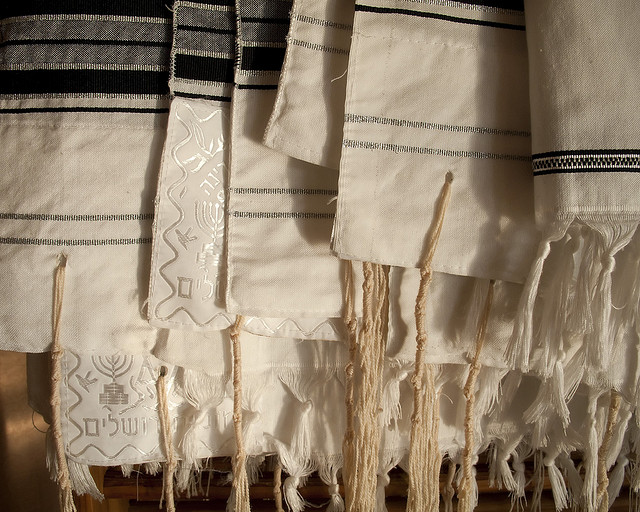
Tallitot (prayer shawls) by  Robert Couse-Baker, CC BY via Flickr
Tallitot (prayer shawls) by Robert Couse-Baker, CC BY via Flickr

Last week we started a study about whether or not the commands and instructions given to Biblical Israel apply to us as Christians today. I answered with a qualified “yes” — we are spiritual Israel, which is not so much separate from physical Israel as it was the next step in God’s plan for His chosen nation. Now, the question becomes, “How many of the laws given to Israel apply under the New Covenant?”

I’ve grown up believing that the Ten Commandments, including Sabbath keeping, carry over into the New Covenant, along with the Lev. 23 Holy Days and the clean and unclean meats laws. I still believe that, but now I’m starting to wonder why we keep those things and not others like the command to put tassels on our garments (Num. 15:37-41) or blow shofars on Holy Days (Ps. 81:3-4). When I ask this question, I’m usually told that not everything from the Old Covenant applies, and when I ask how they know which ones to keep they say, “It’s our tradition.” In my mind, that’s not a good enough answer, so it’s time for some Bible Study.

A New Priesthood

If you read through the laws of the Old Testament, you find quite a lot about the Levitical priesthood. Some of these are described as “a statute forever to their generations on behalf of the children of Israel” (Ex. 27:21), yet it is evident that Christ’s priesthood supersedes that system. If the switch to the New Covenant changed that, how much else was changed?

 For the priesthood being changed, of necessity there is also a change of the law. (Heb. 7:12)

But now He has obtained a more excellent ministry, inasmuch as He is also Mediator of a better covenant, which was established on better promises. (Heb. 8:6)

When it talks about a change of the law, I think we often imagine quite a disconnect between the Old and New Testament. We think of change as in something old being replaced by something completely new, but I think perhaps the change is more in how God’s laws apply.

For this is the covenant that I will make with the house of Israel after those days, says the Lord: I will put My laws in their mind and write them on their hearts; and I will be their God, and they shall be My people. (Heb. 8:10)

The Old Covenant was replaced with the New (Heb. 8:13), but God’s laws were not done away with. Even before the Old Covenant was instituted at Mount Sianai, God had laws in place. We can see this in Genesis 26:5, where God says, “Abraham obeyed My voice and kept My charge, My commandments, My statutes, and My laws.” Since God is unchanging, His standards for what He expects from us do not change either.

Jesus said, “till heaven and earth pass away, one jot or one tittle will by no means pass from the law till all is fulfilled” (Matt. 5:18) In the Greek, this means “filled to the fullest extent.” The laws were brought to a spiritual plane, much as physical Israel became spiritual Israel. You still keep the physical laws, but there is a spiritual aspect as well, and we are held accountable for what goes on inside us as much as for what we actually do (Matt. 5:17-30).

Updating The Law

The laws governing the Levitical priesthood are examples of parts of the Old Covenant that have already been filled to the fullest extent by Jesus Christ. We don’t have a physical priesthood any more because He is our High Priest forever. We don’t sacrifice animals any more because Christ’s sacrifice completely fulfilled all the Old Testament commands for blood sacrifices.

For Christ has not entered the holy places made with hands, which are copies of the true, but into heaven itself, now to appear in the presence of God for us; not that He should offer Himself often, as the high priest enters the Most Holy Place every year with blood of another — He then would have had to suffer often since the foundation of the world; but now, once at the end of the ages, He has appeared to put away sin by the sacrifice of Himself. (Heb. 9:24-26)

Without a physical priesthood or temple, many of the ceremonial laws no longer apply to spiritual Israel. Though we as the New Testament church can examine and learn from them and how they foreshadowed Christ’s role as priest and sacrifice, people in the church no longer serve as priests and we no longer sacrifice animals.

Similarly, there were civil laws given to govern the nation of Israel that are not in effect now because the church is scattered through other physical nations with their own laws. Many of the civil laws had a moral aspect, though, and this is updated for us to follow under the New Covenant. Take, for example, the law that said a man and woman who commit adultery must both be put to death (Lev. 20:10). The Pharisees brought Jesus just such a case, and Jesus told them, “He who is without sin among you, let him throw a stone at her first” (John 8:7). When all her accusers left, Jesus told the woman, “Neither do I condemn you; go and sin no more” (John 8:11).

Jesus didn’t say that she hadn’t committed a sin. He said that there was room for mercy and forgiveness even of sins that had formerly incurred a physical death penalty. For judicial matters, Christians are now under the laws of the countries we live in. For moral matters, God’s laws are applied to spirit and in truth with an emphasis on mercy. Is there a guy in your church shaking up with his step-mother? We don’t stone them as was the case in ancient Israel (Lev. 20:11), but we do make it clear that behavior like this is morally wrong and won’t be tolerated in the church (1 Cor. 5:1-13). If he repents, you have to welcome him back just like God welcomes us back into relationship with Him when we repent of our sins (2 Cor. 2:3-11).

"Shema Israel" by  Yaniv Ben-Arie, CC BY-SA, via Flickr
“Shema Israel” by Yaniv Ben-Arie, CC BY-SA, via Flickr

There are also aspects of the Old Testament laws that we are specifically commanded to continue observing. This includes the weekly Sabbath (Heb. 4:9) and Passover (Luke 22:19-20). We infer from these specific commands, and from the fact that Jesus and His disciples observed the other Holy Days, that all those days are still commanded observances. Even more obvious is the fact that we should be keeping the Ten Commandments, which are succinctly comprehended in the two greatest commandments.

Jesus answered him, “The first of all the commandments is: ‘Hear, O Israel, the Lord our God, the Lord is one. And you shall love the Lord your God with all your heart, with all your soul, with all your mind, and with all your strength.’ This is the first commandment. And the second, like it, is this: ‘You shall love your neighbor as yourself.’ There is no other commandment greater than these.” (Mark 12:29-31)

God’s focus is on our hearts, and whether or not we choose to keep His commandments tells Him what our hearts are like. Jesus said, “If you love Me, keep My commandments” (John 14:15). The implication is that if we don’t keep His commandments, we are telling Jesus we don’t love Him. If our hearts are right, obedience to God naturally follows.

My feelings on the question, “What is applicable under the New Testament?” is that everything God didn’t specifically replace/update to a spiritual level (the priest hood, physical temples, civil laws) are probably still in effect. It’s up to us to seek out the spiritual reasons for these commands and find a way to physically keep them. There are still some I’m not sure about — like those tassels on the borders of our garments or what we’re supposed to do on New Moons — but I want to keep searching and learning. I want to worship God the way He tells me to, not the way I think sounds like a good idea.