Kindling The Spirit

Sabbath number 5 out of 7 in our count to Pentecost! Last week, we looked at what happens as God begins to work with us through His Spirit — baptism, a new way of life, a change in how we worship. This time, let’s focus on “how” instead of what, including how we should respond, starting once again with the baptism of the Holy Spirit.

Unity and Gifts

For as the body is one and has many members, but all the members of that one body, being many, are one body, so also is Christ. For by one Spirit we were all baptized into one body—whether Jews or Greeks, whether slaves or free—and have all been made to drink into one Spirit. (1 Cor. 12:12-13)

Jesus Christ baptizes us into His body, the church, as a beginning to His and the Father’s work in us. That key moment in our lives begins an ongoing process of spiritual growth.

If we back-up to the beginning verses of 1 Corinthians 12, we see the subject is spiritual gifts and unity. Paul tells us how to recognize the Holy Spirit in another person — “no one speaking by the Spirit of God calls Jesus accursed, and no one can say that Jesus is Lord except by the Holy Spirit” (1 Cor. 12:3). He emphasizes that while our gifts and roles differ, we all have the same Spirit, Lord, and God (1 Cor. 12:4-6).

But the manifestation of the Spirit is given to each one for the profit of all: for to one is given the word of wisdom through the Spirit, to another the word of knowledge through the same Spirit, to another faith by the same Spirit, to another gifts of healings by the same Spirit, to another the working of miracles, to another prophecy, to another discerning of spirits, to another different kinds of tongues, to another the interpretation of tongues. But one and the same Spirit works all these things, distributing to each one individually as He wills. (1 Cor. 12:7-11)

Spiritual gifts are the manifestation of God’s Holy Spirit in us, and we have a responsibility in this, to use the gifts we are given. Paul told Timothy to “stir up the gift of God” and not to “neglect the gift that is in you” (2 Tim. 1:6; 1 Tim. 4:14). We ought to do likewise.

Rekindling Fire

There is a short phrase in 1 Thessalonians that is pivotal in discussing how we should respond when God places His Holy Spirit in us.

Do not quench the Spirit. (1 Thes. 5:19)

The word translated “quench” is sbennumi (G4570), which means to extinguish, go out, or quench. It has the sense of putting out a literal or figurative fire (Matt. 12:20; Eph. 6:16; Heb. 11:34). It can also be passive, as when the foolish virgins let their lamps go out and the flame died through inattention (Matt. 25:8). Applying this to the Spirit, we see that not only should we avoid forcibly smothering God’s Spirit in us, but we also cannot neglect it. If we do not use what we have been given by God — including the manifestation of His Spirit — the gifts will be taken away (Matt. 25:24-29).

Therefore take heed how you hear. For whoever has, to him more will be given; and whoever does not have, even what he seems to have will be taken from him. (Luke 8:18)

The metaphor of tending a fire is continued in 2 Timothy 1:6. We’ve already quoted part of this but here’s the whole verse, with the context that shows it’s talking of the Spirit.

Therefore I remind you to stir up the gift of God which is in you through the laying on of my hands.  For God has not given us a spirit of fear, but of power and of love and of a sound mind. (2 Tim. 1:6-7)

This phrase “stir up,” from the Greek anazopureo (G329), is a compound word that means to revive a fire again. Strong’s lists the meaning as “rekindle.” It is the opposite of sbennumi. So, one way we can think of God’s Spirit in us is as a fire that needs fed and stirred up to prevent it from going out.

Indwelling

There are enormous benefits for us in choosing to continually rekindle God’s Spirit in us rather than smother it. One is a continuing relationship with God and Jesus. Another is that the Spirit makes it possible to walk in Christ’s footsteps and be given eternal life (Rom. 8:1-11). Yet another is the aid and assurance poured out on us through the Spirit as we try to lead a Christian life.

Likewise the Spirit also helps in our weaknesses. For we do not know what we should pray for as we ought, but the Spirit itself makes intercession for us with groanings which cannot be uttered. Now He who searches the hearts knows what the mind of the Spirit is, because He makes intercession for the saints according to the will of God. And we know that all things work together for good to those who love God, to those who are the called according to His purpose. (Rom. 8:26-28)

From Hebrews 7:25, we know Jesus Christ is the One who “always lives to make intercession for” us. This connection between Jesus Christ’s personal work in us and the indwelling of the Holy Spirit keeps coming up in these studies. We see it in John 14-16, in Romans 8:9-10, in Christ’s role as the One who baptizes with the Holy Spirit.

Having Christ in us is directly tied to having “the Spirit of Christ” (Rom. 8:9-10; John 14:18; 16:7). He cannot be present in us if we are smothering His Spirit in us. From what I’ve been studying these past few weeks, I would say that the Holy Spirit is the means by which Christ and God dwell in us.

For this reason I bow my knees to the Father of our Lord Jesus Christ, from whom the whole family in heaven and earth is named, that He would grant you, according to the riches of His glory, to be strengthened with might through His Spirit in the inner man, that Christ may dwell in your hearts through faith; that you, being rooted and grounded in love, may be able to comprehend with all the saints what is the width and length and depth and height — to know the love of Christ which passes knowledge; that you may be filled with all the fullness of God. (Eph. 3:14-19)
 

Beginning To Walk

We’re up to week 4 out of 7 in the count to Pentecost, and deep in a study about the Holy Spirit. The reason I wrote last week’s post explaining my beliefs about the Holy Spirit was so I could better write an exploration of what the Holy Spirit does and is used for by God. There is much to cover, so this will probably spill over into at least one more post.

Baptism

When John the Baptist was preaching and answering questions about the water baptism he was performing, he spoke of a greater Baptist who would baptize in something greater than water.

I indeed baptize you with water unto repentance, but He who is coming after me is mightier than I, whose sandals I am not worthy to carry. He will baptize you with the Holy Spirit and fire. (Matt. 3:11)

"Begining To Walk" by marissabaker.wordpress.comMy Dad has an excellent series of posts on his blog (starting with this one) dealing with the ongoing baptism of the Holy Spirit. If you’re interested, click over there and check them out. Here, though, I’m going to focus on just a small aspect of this baptism.

Just as water is the medium of our physical baptisms, so is the Holy Spirit the substance with which Jesus Christ baptizes us. Fittingly, then, the Spirit is compared to “rivers of living water” in John 7:37-39 and is said to be poured out in Isaiah 44:3. The Spirit is something we can be immersed in, and which works a real change in us.

Jesus answered, “Most assuredly, I say to you, unless one is born of water and the Spirit, he cannot enter the kingdom of God.” (John 3:5)

Being born into God’s family takes time and is an ongoing process. The starting point is when God’s Spirit begins interacting with our spirits and opening our minds to understand His mind.

Family

God’s calling goes beyond a mental awakening, though. The interaction of His Spirit with us changes our entire way of life.

For those who live according to the flesh set their minds on the things of the flesh, but those who live according to the Spirit, the things of the Spirit. For to be carnally minded is death, but to be spiritually minded is life and peace. Because the carnal mind is enmity against God; for it is not subject to the law of God, nor indeed can be. (Rom. 8:5-7)

The Holy Spirit is essential for us to even be capable of keeping God’s laws. Without God’s Spirit essence present and working in us with power, we “cannot please God” (Rom. 8:8) and we could not be part of His family.

Therefore, brethren, we are debtors—not to the flesh, to live according to the flesh. For if you live according to the flesh you will die; but if by the Spirit you put to death the deeds of the body, you will live. For as many as are led by the Spirit of God, these are sons of God. For you did not receive the spirit of bondage again to fear, but you received the Spirit of adoption whereby we cry out, “Abba, Father.” The Spirit itself bears witness with our spirit that we are children of God, and if children, then heirs—heirs of God and joint heirs with Christ, if indeed we suffer with Him, that we may also be glorified together. (Rom. 8:12-17)

From these verses, we learn that it is the presence of God’s Spirit in us that makes us His children. This comes as a result of Christ’s indwelling presence (Rom. 8:9-11). Two weeks ago, we read parts of John 14, 15, and 16 and talked about how the Holy Spirit acts as Christ’s representative on earth and in us. Through the Spirit, He and God the Father dwell in us and work directly with our innermost being.

 For this reason I bow my knees to the Father of our Lord Jesus Christ, from whom the whole family in heaven and earth is named,  that He would grant you, according to the riches of His glory, to be strengthened with might through His Spirit in the inner man, that Christ may dwell in your hearts through faith; that you, being rooted and grounded in love, may be able to comprehend with all the saints what is the width and length and depth and height — to know the love of Christ which passes knowledge; that you may be filled with all the fullness of God. (Eph. 3:14-19)
Worship

So, we see Jesus baptizing us with the Holy Spirit to begin a process of making us part of God’s family. Both the Father and Christ then work in us through Their Spirit to change our hearts and minds to bring us into fellowship with Them.

For through Him [Jesus] we both have access by one Spirit to the Father. Now, therefore, you are no longer strangers and foreigners, but fellow citizens with the saints and members of the household of God, having been built on the foundation of the apostles and prophets, Jesus Christ Himself being the chief cornerstone, in whom the whole building, being fitted together, grows into a holy temple in the Lord, in whom you also are being built together for a dwelling place of God in the Spirit. (Eph. 2:18-22)

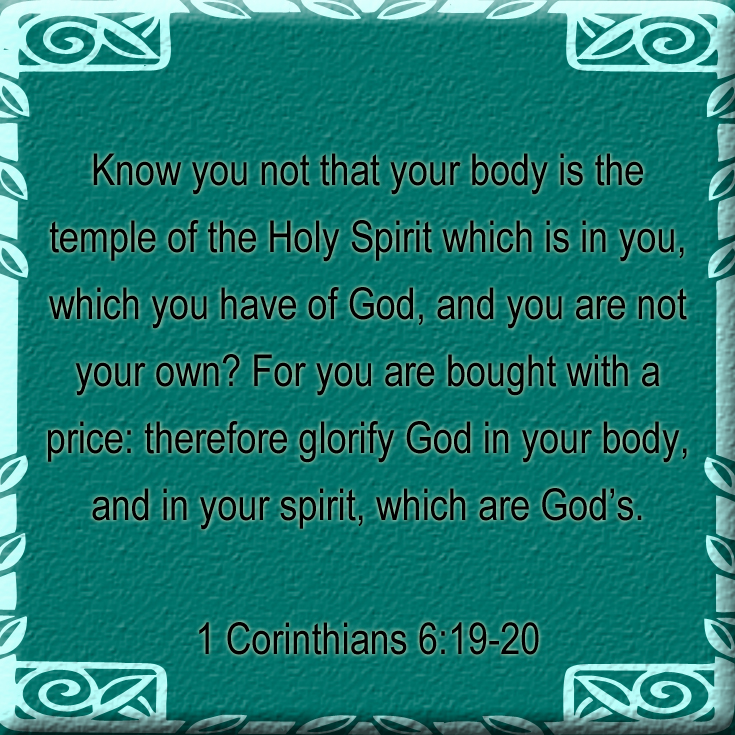
"Begining To Walk" by marissabaker.wordpress.comWhen God’s Spirit dwells in us, we become His temple (1 Cor. 3:16). It is our responsibility to live in a way that glorifies “God in your body and in your spirit, which are God’s” (1 Cor. 6:20).

But the hour is coming, and now is, when the true worshipers will worship the Father in spirit and truth; for the Father is seeking such to worship Him. God is Spirit, and those who worship Him must worship in spirit and truth. (John 4:23-24)

We can’t truly worship God unless we are doing so in our spirits — in the part of us that is immaterial and given by God. The interaction between our spirits and God’s Spirit must go both ways. He cannot work in us unless we respond to Him in spirit and in truth. As Matthew Henry said in his commentary on Romans 8:26, “We must not sit still, and expect that the Spirit should do all; when the Spirit goes before us we must bestir ourselves. We cannot without God, and he will not without us.”

This is just the beginning, my friends. Once God starts to communicate with our spirits, and we respond to Him, we begin a journey toward being part of His family. And His presence — His Holy Spirit — is there with us every step of the way.

What Is The Holy Spirit?

One of the big ways that my faith diverges from “standard” Christian doctrine has to do with the Holy Spirit. I don’t believe that a Trinity is the best way to describe the nature of God as revealed in scripture. If you’re reading how I talk about the Holy Spirit and how more well-known Christian authors talk about the Spirit you’ll notice few differences, but we are approaching this topic from very different assumptions.

This post is week 3 of 7 in our count to Pentecost, which makes it a good time to talk about the Holy Spirit. I grew up in a church that teaches that the Holy Spirit is the power of God and the part of Him that communicates with our spirits rather than a third person in a Trinity. We believe the Godhead consists of two Beings — God the Father and The Word who became Jesus Christ.

As I’ve studied the topic for myself, this has become my belief as well. The governing principle for how I (try to) approach faith and study is that because the Bible is God’s word it acts as the ultimate authority on any subject. Church traditions and teachings can be valuable resources, but if they ever contradict the Bible then they’re the ones who are wrong. That’s how I approach the topic of the Holy Spirit. Start with the Bible, then see which teachings and traditions line-up with what God has revealed through His word.

Understanding And Relationship

One of the core principles of the doctrine of the Trinity is that it cannot be understood. Walter Martin says, “the Trinity is still largely incomprehensible to the mind of man. Perhaps the chief reason for this is that the Trinity is a-logical, or beyond logic” (Essential Christianity, 1975, page 21). Proponents of the Trinity get around this problem by saying we shouldn’t try to fully understand God anyway because He is so far above us.

This sounds good at first — after all the Lord’s judgments are “unsearchable” and “His ways past finding out” (Rom. 11:33). It would be the height of hubris to think that a statement God makes about Himself is invalid because we can’t understand it. However, He does not tell us He exists as a Trinity. I find it hard think that the God who makes eternal life contingent on knowing Him would make the most basic fact of His nature so obscure, hidden, and mysterious. Read more

Comfort and Peace

It’s Sabbath number 2 out of 7 in our count to Pentecost (Lev. 23:15-16). As we get closer to Pentecost, I wanted to focus more of my studies on the Holy Spirit. I’ve already written about the Holy Spirit in the book of Acts, but there is so much more to cover.

This week, while reading through John 14, 15, and 16, what stood out to me was the word “comforter” (KJV) to refer to the Holy Spirit, particularly in connection with this verse:

Peace I leave with you, My peace I give to you; not as the world gives do I give to you. Let not your heart be troubled, neither let it be afraid. (John 14:26)

I have a troubled heart. By myself, I’m worried, fearful, distracted, anxious, and would rarely leave the house. But the better my relationship with God is, the more at peace I am. This is a subject close to my heart, because I know first-hand how much worse my anxiety gets if I drift away from God and the comfort of His presence.

Comfort

The word “comforter,” or “helper” in the NKJV, is used in John 14:16, 14:26, 15:26; and 16:7. It’s from the Greek word parakletos (G3875), which is the same word used to describe Jesus Christ as our “advocate” in 1 John 2:1. According to the Complete Word Study Dictionary of the New Testament by Dr. Spiros Zodhiates, it refers “to an aid of any kind. … one who comes forward on behalf of and as the representative of another.” It is translated “comforter” or “helper” because the root word, parakaleo (G3870), means “to aid, help, comfort, encourage.”

"Comfort and Peace" marissabaker.wordpress.com

The use of this word here in John seems to tie the work of the Holy Spirit directly to Christ’s role as our Comforter. He said the Spirit “will testify of Me” and that it was good for the disciples that He leave them so that He could send the Holy Spirit (John 15:26; 16:7). Again quoting Zodhiates’s dictionary, it says the Spirit “undertakes Christ’s office in the world while Christ is not in the world as the God-man in bodily form,” acting as “Christ’s substitute on earth.”  Perhaps this is why we are told “if anyone does not have the Spirit of Christ, he is not His” (Rom. 8:9).

On Our Behalf

One of the themes in the book of Hebrews is what Christ does on our behalf. He was made like us and suffered in our place so that He could be our “merciful and faithful High Priest” who makes “propitiation for the sins of the people” and “is able to aid those who are tempted” (Heb. 2:176-18).

For we do not have a High Priest who cannot sympathize with our weaknesses, but was in all points tempted as we are, yet without sin. Let us therefore come boldly to the throne of grace, that we may obtain mercy and find grace to help in time of need. (Heb. 4:15-16)

Because of what Christ did, and does, for us, we have assurance that we can obtain help from God. Our High Priest “is also able to save to the uttermost those who come to God through Him, since He always lives to make intercession for them” (Heb. 7:25). He died to obtain our “eternal redemption,” and now appears “in the presence of God for us” (Heb. 9:12, 24).

These roles Christ is filling for us should be a great comfort. Read Hebrews 10:19-25 — it is not a description of someone who is fearful or discomfited. We have boldness in Jesus, a “full assurance of faith,” and know that we can receive abundant comfort from Him and the Father through the Holy Spirit.

Blessed be the God and Father of our Lord Jesus Christ, the Father of mercies and God of all comfort, who comforts us in all our tribulation, that we may be able to comfort those who are in any trouble, with the comfort with which we ourselves are comforted by God. For as the sufferings of Christ abound in us, so our consolation also abounds through Christ. (2 Cor. 1:3-5)

Peace

The assurance of having Jesus present through the Holy Spirit as our Comforter, Advocate, and Helper should work a change in the state of our hearts. In John 14, He said that He gives His peace to us. This word “peace” is from the Greek eirene (G1515), and it means “a state of untroubled, undisturbed, well-being.” It can mean an “absence or end of strife,” but that is not necessary for the inner peace which Christ is referring to here, and which is a fruit of the Spirit (Gal. 5:22).

Be anxious for nothing, but in everything by prayer and supplication, with thanksgiving, let your requests be made known to God; and the peace of God, which surpasses all understanding, will guard your hearts and minds through Christ Jesus. (Phil. 4:6-7)

In Ephesians, Jesus Christ is called “our peace” because He brought us into covenant with God and gave us “access by one Spirit to the Father”  (Eph. 2:13-18). He made peace between us and God by removing the sin which separated us from Him, and gives us inner peace as a result of this new relationship.

For God has not given us a spirit of fear, but of power and of love and of a sound mind. (2 Tim. 1:7)

Look at what we are given. Power that makes us able and capable (G1411 dunamis). Love which actively and benevolently does good (G26 agape). Discipline, self-control and sound judgement (G4995 sophronismos). That is just part of the comfort and peace that God makes available to us through His Spirit if we remain in fellowship with Him.


The “God Of The Old Testament”

After celebrating a lovely Feast of Unleavened Bread that concluded this past Monday, it’s time to start counting down to Pentecost. Per Leviticus 23:15-16, this Sabbath is the first of seven in the count to Pentecost. I’ll probably talk about this more over the next few weeks, but first I want to post about a topic that has been on my mind of late.

The phrase “God of the Old Testament” just seems to keep coming up in arguments and messages in the churches. It typically goes one of two ways: either we’re trying to pin-down who the God of the Old Testament was (i.e. the Father or the One who became Christ), or we’re contrasting the God of the Old Testament with the God of the New as if they were two different beings.

In some ways, I think this comes under the category of “stupid things we say in the church.” It’s misleading and confusing. For one thing, scripture is very clear that there wasn’t just one “God of the Old Testament” — there had always been two Beings mentioned and recognized in scripture.

Two in the OT

As you’ve probably read/heard before, the word translated “God” in the opening chapters of Genesis is plural. We can see two Beings so closely related They can be refereed to by one plural name. In the same way, we use a family’s last name to encompass several individuals, e.g. the Bakers or the Martins. Even without knowing Hebrew, the fact that there are two Beings here is made clear when They say, “Let Us make man in Our image, according to Our likeness” (Gen. 1:26).

Throughout the Old Testament, there are examples of people who knew there were two God-beings. The most well-known is probably Psalm 110:1 — “The Lord said to my Lord, ‘Sit at My right hand, till I make Your enemies Your footstool.'” There were other writer’s besides David, though. Take Agur for example.

Who has ascended into heaven, or descended? Who has gathered the wind in His fists? Who has bound the waters in a garment? Who has established all the ends of the earth? What is His name, and what is His Son’s name, if you know? (Prov. 30:4)

Two God-beings appear in Daniel’s prophesies, too.

I was watching in the night visions, and behold, One like the Son of Man, coming with the clouds of heaven! He came to the Ancient of Days, and they brought Him near before Him. Then to Him was given dominion and glory and a kingdom, that all peoples, nations, and languages should serve Him. His dominion is an everlasting dominion, which shall not pass away, and His kingdom the one which shall not be destroyed. (Dan. 7:13-14)

Christ referred to this scripture as part of His affirmative answer when the high priest asked him, ““Are You the Christ, the Son of the Blessed?” (Mark 14:61-62).

The Word

The fact that Old Testament writers knew about two God-beings does not answer the question of which of Them interacted directly with Their people. Though “God of the Old Testament” is an ill-fitting phrase, it is often used as short-hand for “the member of the Godhead who interacted with people throughout the Old Testament.”

We can, at least, determine from scripture the answer to that question. One of the clearest passages addressing this is in 1 Corinthians when Paul is talking about Israel’s history.

Moreover, brethren, I do not want you to be unaware that all our fathers were under the cloud, all passed through the sea, all were baptized into Moses in the cloud and in the sea, all ate the same spiritual food, and all drank the same spiritual drink. For they drank of that spiritual Rock that followed them, and that Rock was Christ. (1 Cor. 10:1-4)

It really can’t get much plainer than that. Paul additionally says, “nor let us tempt Christ, as some of them also tempted,” identifying The Word, the One who came to be known as Jesus Christ, as the God who Israel tempted (1 Cor. 10:9). We can conclude, therefore, that the One who spoke with Moses about Israel tempting Him was The Word.

because all these men who have seen My glory and the signs which I did in Egypt and in the wilderness, and have put Me to the test now these ten times, and have not heeded My voice, they certainly shall not see the land of which I swore to their fathers, nor shall any of those who rejected Me see it. (Num. 14:22-23)

One of the many things Jesus said which upset the Jews of His day was that He had seen Abraham. The implication that accompanied this statement — that He was God — made them want to stone Him.

“Your father Abraham rejoiced to see My day, and he saw it and was glad.” Then the Jews said to Him, “You are not yet fifty years old, and have You seen Abraham?” Jesus said to them, “Most assuredly, I say to you, before Abraham was, I AM.” (John 8:56-58)

The Being Abraham talked to when “the Lord appeared to him by the terebinth trees of Mamre” before the destruction of Sodom and Gomorrah is typically interpreted as a pre-incarnate appearance of Jesus Christ (Gen 18:1). As The Word, Jesus has been entrusted with expressing the thoughts of the Godhead to man. That’s what logos, the Greek word used in John 1:1, means — an expression of intelligence. Since we know from Hebrews 13:8 that Christ’s character is constant, it makes sense that this role would be consistent throughout the Bible.

No one has seen God at any time. The only begotten Son, who is in the bosom of the Father, He has declared Him. (John 1:18)

Christ repeats this, saying He is the only one who has seen the Father (John 6:46) and that no one else at that time knew the Father (John 7:28-29). There’s also 1 John 4:12 — “no one has seen God at any time.” These verses are uncomplicated and clear, leaving little room for doubt that while there have always been two Beings in the God-family, the Word who became Christ was responsible for interacting with Their creation.

Redeeming His Creation

In the beginning was the Word, and the Word was with God, and the Word was God. He was in the beginning with God. All things were made through Him, and without Him nothing was made that was made. (John 1:1-3)

The “let us” phrase in Genesis 1 shows that both the Father and Son were involved in creation. When we add John 1, we start to see a more complete image of Their roles with The Word being the One who spoke everything into existence (Ps. 33:6). Some will argue, however, that it’s a mistranslation or something of the kind. Perhaps we could say this of one verse, but what about seven?

Two of these remaining 6 verses that I found talk about God creating the universe though Jesus Christ:

To me, who am less than the least of all the saints, this grace was given, that I should preach among the Gentiles the unsearchable riches of Christ, and to make all see what is the fellowship of the mystery, which from the beginning of the ages has been hidden in God who created all things through Jesus Christ (Eph. 3:8-9)

God, who at various times and in various ways spoke in time past to the fathers by the prophets, has in these last days spoken to us by His Son, whom He has appointed heir of all things, through whom also He made the worlds (Heb. 1:1-2)

Another verse that fits in here is Revelation 3:14, which describes Jesus as “the Beginning of the creation of God.” Zodhiates’ study Bible points out that the Greek word translated “beginning” is arche, which “literally refers to Him as the originator or cause of creation.” That Christ’s work was a focus in the act of creation is brought forward by three more verses that say “by Him are all things” (Heb. 2:10; 1 Cor. 8:6).

He is the image of the invisible God, the firstborn over all creation. For by Him all things were created that are in heaven and that are on earth, visible and invisible, whether thrones or dominions or principalities or powers. All things were created through Him and for Him. And He is before all things, and in Him all things consist.  (Heb. 1:15-17)

As the One responsible for the act of creation, it was fitting for The Word to redeem His creation by His own sacrifice. That this was planned from the beginning, we can see from His description as “the Lamb slain from the foundation of the world” (Rev. 13:8). We also see that God gave us grace ” in Christ Jesus before time began” (2 Tim. 1:9). This also fits in with the narrative arch that runs throughout the Bible of Jesus redeeming a Bride, which I talk about at greater length in chapters 2-4 of “God’s Love Story.”

The Constancy of God

The other thing I want to briefly address is the idea that God was a different person in the Old and New Testaments. We hear, and perhaps say, that God in the Old Testament was a vengeful, angry God and that God in the New Testament is all peace and forgiveness. But this does not fit with verses that say there is “no variation or shadow of turning” with the Father, and Jesus Christ is “the same yesterday, today, and forever” (James 1:17; Heb. 13:8).

“And it shall be, in that day,” says the Lord, “That you will call Me ‘My Husband,’ and no longer call Me ‘My Master,’ … “I will betroth you to Me forever; yes, I will betroth you to Me in righteousness and justice, in lovingkindness and mercy; I will betroth you to Me in faithfulness, and you shall know the Lord. … And I will have mercy on her who had not obtained mercy; then I will say to those who were not My people, ‘You are My people!’ and they shall say, ‘You are my God!’” (Hos. 2:16, 19-20, 23)

This kind of love, the longing for a personal relationship with His people, can be found throughout the Old Testament, just as reminders of the righteous judgement of God can be found in the New Testament.

Anyone who has rejected Moses’ law dies without mercy on the testimony of two or three witnesses. Of how much worse punishment, do you suppose, will he be thought worthy who has trampled the Son of God underfoot, counted the blood of the covenant by which he was sanctified a common thing, and insulted the Spirit of grace? For we know Him who said, “Vengeance is Mine, I will repay,” says the Lord. And again, “The Lord will judge His people.” It is a fearful thing to fall into the hands of the living God. (Heb. 10:28-31)

God, both the Father and the Son, are unchanging and faithful. Both have always been here, and each has fulled a consistent role in Their dealings with Their Creation. “The God of the Old Testament” is a misleading phrase that has led to offense and confusion regarding what should be a relatively straight-forward topic. Both God-beings have always been present and active, though Jesus Christ’s role as the Word is more visible in interactions with the creation.

Finding Christ in Me

For my family and me, Passover and the Feast of Unleavened Bread are just around the corner, so I thought this would be a good time to share one of my Bible studies leading up to this spring Holy Day season.

Therefore whoever eats this bread or drinks this cup of the Lord in an unworthy manner will be guilty of the body and blood of the Lord. But let a man examine himself, and so let him eat of the bread and drink of the cup. For he who eats and drinks in an unworthy manner eats and drinks judgment to himself, not discerning the Lord’s body.(1 Cor. 11:27-29)

We read this scripture many times leading up the Passover service, both in individual study and while listening to messages in our church congregations. I heard it again last weekend when listening to a Steve Buchanan message titled “The Focus of the Passover.” He pointed out that the phrase “discerning the Lord’s body” gives us a guide for how to examine ourselves. The more we learn about Jesus Christ, the better we will be able to examine our conduct in the light of His life.

Examine yourselves as to whether you are in the faith. Test yourselves. Do you not know yourselves, that Jesus Christ is in you?—unless indeed you are disqualified. (2 Cor. 13:5)

Since Jesus Christ is our example (1 Pet. 2:21) and we are “to walk just as He walked” (1 John 2:6), it is His conduct that we are measured by. Walking after His example and obeying his commandments, goes hand-in-hand with abiding in Him and being a fit dwelling place for His presence.

Need For Christ In Us

The mutual indwelling that must occur for us to grow as Christians is described in John 15.

"Finding Christ In Me" marissabaker.wordpress.comAbide in Me, and I in you. As the branch cannot bear fruit of itself, unless it abides in the vine, neither can you, unless you abide in Me.  I am the vine, you are the branches. He who abides in Me, and I in him, bears much fruit; for without Me you can do nothing. (John 15:4-5)

Like a branch must rely on its vine and rootstock for everything that keeps it alive, so must we rely on Christ. If He is not in us, our spirits are dead.

But you are not in the flesh but in the Spirit, if indeed the Spirit of God dwells in you. Now if anyone does not have the Spirit of Christ, he is not His. And if Christ is in you, the body is dead because of sin, but the Spirit is life because of righteousness.  (Rom. 8:9-10)

Christ in us is our “hope of glory” (Col. 1:27). Without Him we can do nothing, but with Him we can do all things (Phil 4:13). When we examine ourselves, we should be looking for evidence of His presence in our lives.

Start In The Mind

Our becoming like Christ starts in our minds and hearts, then spills out into external action. We are told, “out of the abundance of the heart the mouth speaks,” and that we will be expected to “give account for “for every idle word” that we speak (Matt. 12:34, 36). Since the product of our hearts is so pivotal in how we measure up to God’s standard, it is imperative that our hearts and minds be reshaped to look like Jesus Christ.

Let this mind be in you which was also in Christ Jesus, who, being in the form of God, did not consider it robbery to be equal with God, but made Himself of no reputation, taking the form of a bondservant, and coming in the likeness of men. And being found in appearance as a man, He humbled Himself and became obedient to the point of death, even the death of the cross. (Phil. 2:5-8)

"Finding Christ In Me" marissabaker.wordpress.comThe aspects of Christ’s personality emphasized here are His humility, his service-mindedness, and His obedience. We need to prayerfully examine ourselves in these areas. Am I becoming humble the way Jesus is humble? Do I follow His example of service to God and other people, both in and out of the church? How well am I keeping His commandments “in spirit and in truth” as well as in the letter of the law?

Another question we can ask is, “How much do I really want to be like Christ?” That’s an aspect of our minds as well. If we don’t have an attitude that sincerely wants to be like Christ and then acts on that desire, we are hobbling our spiritual growth. Christianity is not for people who are content to remain as they are.

But what things were gain to me, these I have counted loss for Christ. Yet indeed I also count all things loss for the excellence of the knowledge of Christ Jesus my Lord, for whom I have suffered the loss of all things, and count them as rubbish, that I may gain Christ and be found in Him, not having my own righteousness, which is from the law, but that which is through faith in Christ, the righteousness which is from God by faith; that I may know Him and the power of His resurrection, and the fellowship of His sufferings, being conformed to His death, if, by any means, I may attain to the resurrection from the dead. (Phil. 3:7-11)

Do we have this attitude about becoming like Christ? Our goal must be to get rid of anything in us that doesn’t lead us closer to Him. Our life, feelings, thoughts, and actions  must start to look more and more like His.

Remaking Us

Those of us who have been “baptized into Christ Jesus were baptized into His death” and “should walk in newness of life (Rom. 8:3-4). Our old self, the aspects of our character that are not Christ-like, need to be replaced. Our way of thinking, feeling, and living is meant to be radically impacted by the conviction that we are alive only through Jesus Christ our Lord. If we are in Christ, we are being remade in His image and should be able to see that when we examine ourselves honestly.

Therefore, if anyone is in Christ, he is a new creation; old things have passed away; behold, all things have become new. (2 Cor. 5:17)

Just before the “let this mind be in you” passage starting in Philippians 2:5, Paul writes to the brethren that they should be “like-minded, having the same love, being of one accord, of one mind” (Phil. 2:2). This mind, which causes peace in the church, is the mind of Christ, and this love is the kind of love which He connected with obedience to God’s commandments (John 14:15; 15:10). Paul further writes, “Let nothing be done through selfish ambition or conceit, but in lowliness of mind let each esteem others better than himself” (Phil. 2:3). This attitude of humble service is yet another trait of Jesus Christ that we should be looking for when we examine ourselves to see how closely we resemble Him.