The God of [Your Name Here]

Did you ever notice how often God introduces himself as “The God of Abraham, Isaac, and Jacob” in the Old Testament, or how often people refer to Him as “the God of” a specific person or group of people?

Even today, connections help define us. When we meet new people, we often help them understand who we are by explaining who we work with or mentioning relatives they might know. Knowing the connections of new people we meet helps us understand who they are if we already know their spouse, kids, parents, or coworkers. A connection with someone we like helps ensure the new person makes a positive impression on us. On the other hand, if they’re connected with someone we don’t have a good experience with, that will color our first impression of them. We can still remind ourselves to judge the other person based on their own merits, but their associations impact our reaction to them.

Similarly, when a voice spoke to Moses from the burning bush and said, “I am the God of your father, the God of Abraham, the God of Isaac, and the God of Jacob” (Ex. 3:6, WEB), the association with Moses’s ancestors helped him understand who was speaking to him. It was only after introducing Himself as the God of Abraham, Isaac, and Jacob and claiming Israel as His people that God shared His name. Even then, He reiterated His association with His follower as part of His identity.

God said to Moses, “I AM WHO I AM,” and he said, “You shall tell the children of Israel this: ‘I AM has sent me to you.’” God said moreover to Moses, “You shall tell the children of Israel this, ‘Yahweh, the God of your fathers, the God of Abraham, the God of Isaac, and the God of Jacob, has sent me to you.’ This is my name forever, and this is my memorial to all generations.”

Exodus 3:6-8, 14, WEB

When you think about it, it’s mindboggling that Almighty God decided to connect His reputation to human beings. What if Moses had heard Abraham’s name and thought, “You mean you’re the God of a guy who let two kings take his wife because he thought lying would save his own skin? who banished his firstborn son and the slave-girl who gave birth to him, and didn’t seem to care if they lived or died?” Those are things that Abraham did, and they were not good things. At the end of the day, though, those mistakes are not what Abraham is known for. He is remembered for his faithfulness and his friendship with God (James 2:21-23; Heb. 11:8-10, 17-19).

What does that have to do with us? Much like Moses’s understanding of Yahweh was impacted by knowing Him as “the God of Abraham, Isaac, and Jacob,” the people we meet might have their understanding of God the Father and Jesus Christ impacted by our lives as Christians.
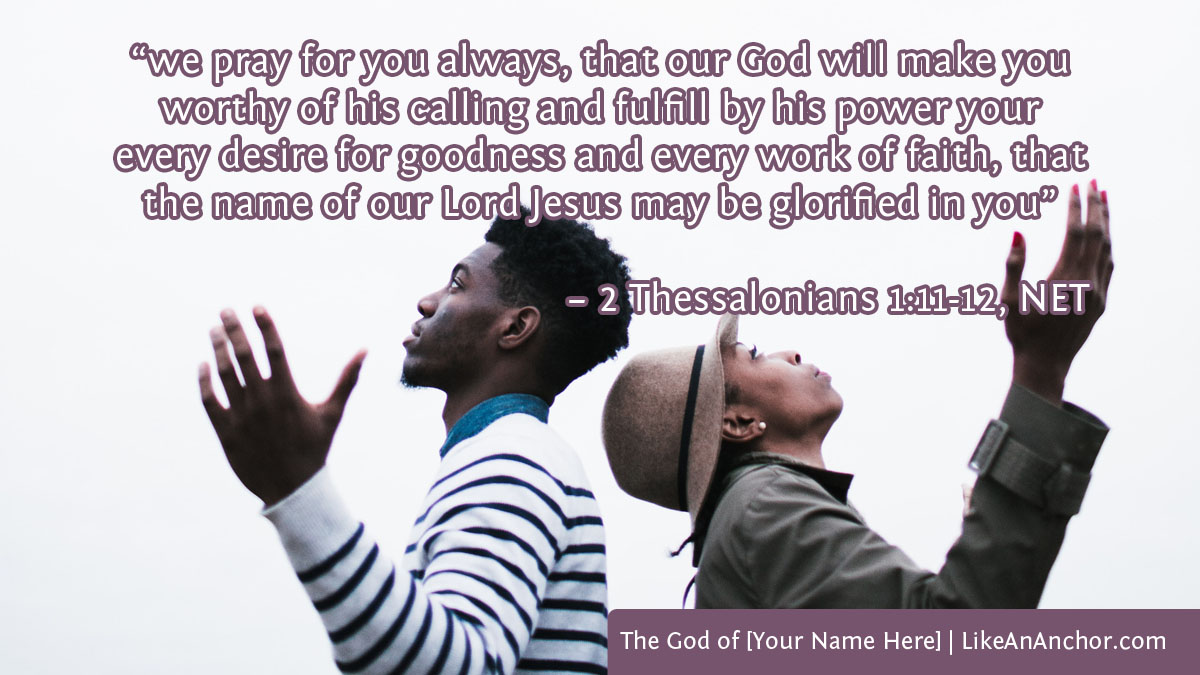
Image of a man and a woman with their hands raised looking up to heaven, overlaid with text from 2 Thess. 1:11-12, NET version: “we pray for you always, that our God will make you worthy of his calling and fulfill by his power your every desire for goodness and every work of faith, that the name of our Lord Jesus may be glorified in you”
Image by Temi Coker from Lightstock

Names and Reputations

Much like God chose to connect His reputation to Abraham, Isaac, and Jacob, He did the same for ancient Israel. In Hebrew thought, names are linked to reputation. So when God says He’s putting His name on someone, He’s linking them to His family and to His reputation.

Yahweh spoke to Moses, saying, “Speak to Aaron and to his sons, saying, ‘This is how you shall bless the children of Israel.’ You shall tell them,

‘Yahweh bless you, and keep you.
    Yahweh make his face to shine on you,
    and be gracious to you.
Yahweh lift up his face toward you,
    and give you peace.’

“So they shall put my name on the children of Israel; and I will bless them.”

Numbers 6:22-27, WEB

Several times through scripture, God refers to His people as the ones who are called by His name (Deut. 28:10; 2 Chron. 7:14; Is. 43:7). Placing His name on people indicates they belong to Him. With His name on us, there are certain things we are and are not supposed to do.

“You shall not misuse the name of Yahweh your God, for Yahweh will not hold him guiltless who misuses his name.

Exodus 20:7, WEB

A more traditional rendering of this verse is “Thou shalt not take the name of the Lord thy God in vain.” The Hebrew words behind “take in vain” or “misuse” include the idea of us carrying God’s reputation with us. An expanded translation could be something like, “You shall not lift up or invoke the name/reputation of Yahweh your Elohim in a false, empty, or worthless manner.”

Leaving a Legacy

Image of a woman praying with one hand raised, overlaid with blog's title text and the words, "God identifies Himself with His people, and how we live reflects on His reputation."
Image by Pearl from Lightstock

We ought to be careful how we conduct ourselves as representatives of God. Our actions reflect on Him. When King David committed adultery with Bathsheba and had her husband Uriah killed, Nathan the prophet said, “Yahweh also has put away your sin. You will not die. However, because by this deed you have given great occasion to Yahweh’s enemies to blaspheme, the child also who is born to you will surely die” (2 Sam. 12:13-14, WEB). David’s actions did not change God’s nature, but by acting in a way contrary to God’s character he gave God’s enemies ammunition to use in their railing against God.

It is good to remember that we don’t have the power to ruin God’s reputation with our mistakes, or to make Him so angry that He refuses to forgive us when we repent. Even as high-profile as some of Abraham’s and David’s mistakes were, sincere repentance and humility repaired the relationships they had with God. God called Abraham His friend and David a man after His own heart. Both left a legacy that speaks to God’s faithfulness, forgiveness, and investment in humanity.

“I know that you have little strength, but you have obeyed my word and have not denied my name. … I am coming soon. Hold on to what you have so that no one can take away your crown. The one who conquers I will make a pillar in the temple of my God, and he will never depart from it. I will write on him the name of my God and the name of the city of my God (the new Jerusalem that comes down out of heaven from my God), and my new name as well.”

Revelation 3:8, 11-12, NET

We can also leave a legacy that reflects well on God, despite our inevitable human shortcomings, so long as we continue following Him and repenting when we miss the mark. Sometimes, we’ll be demonstrating that our God can forgive and work with deeply flawed people. Overall, though, we should be showing how much God can transform us into better people as we carry His name and reputation in a true, meaningful, and worthy manner.


Featured image by WhoisliketheLord Studio from Lightstock
Isaiah Study: God is Incomparable and Irreplaceable

Last week, I started studying Isaiah 40-66. These are the last 27 chapters of the book, and they record an extended dialog where God speaks candidly about His feelings, desires, and plans. In this passage, He revealed His plans for ancient Israel’s immediate future at the time, for the Messiah’s coming (included the four famous Servant Song passages), and for events that are still in the future for those of us reading Isaiah today.

If you go back and read last week’s post, you’ll see I made a list of key themes that I want to study more extensively in this section of scripture. The list included (among other things) God’s defense of His reputation and His power to achieve all He’s promised. Another related point is that God is incomparable and sovereign, so trying to replacing Him with idol worship is foolish.

God shows so much emotion in this section of scripture, and much of it is related to the topic of who He is and how people ought to relate to Him. He’s angry and heartbroken when His people turn away, cutting off contact with Him. He’s confused by Israel’s forgetfulness about all He’s done in the past. He wants them to see Him for who He is and give up their foolish attachment to gods made from wood and stone. Though some of the specific wording is closely connected to Israel of Isaiah’s day, the passages also hold meaning for us today. The specifics of our struggles might be different but we’re not immune from developing an inaccurate view of the Lord.

Mi Chamocha

After God parted the Red Sea in Exodus, Moses and Miriam led the people in a song of joy that includes these words: “Who is like you, Yahweh, among the gods? Who is like you, glorious in holiness, fearful in praises, doing wonders?” (Ex. 15:11, WEB). In Hebrew, “who is like you?” is mi chamocha (which is where we get the names Michael and Michelle). You can hear parts of this Hebrew prayer in The Prince of Egypt’s soundtrack (click here for lyrics with a translation; click here for the song).

As I read through Isaiah 40-66, the phrase mi chamocha kept coming to mind. In the Exodus song, the question, “Who is like you, Lord?” is a rhetorical one. The answer should be obvious when we look at His creation and marvelous miracles, such as rescuing Israel from Egypt–there’s no one who can compare to the Lord. Many years later, though, the descendants of those people who once sang mi chamocha aren’t so sure of the answer. And so God asks a series of questions near the beginning of the passage we’re studying in Isaiah.

Who has measured the waters in the hollow of his hand,
and marked off the sky with his span,
and calculated the dust of the earth in a measuring basket,
and weighed the mountains in scales,
and the hills in a balance?
Who has directed Yahweh’s Spirit,
or has taught him as his counselor? …

To whom then will you liken God?
Or what likeness will you compare to him? …

“To whom then will you liken me?
Who is my equal?” says the Holy One.

Isaiah 40:12-13, 18, 25, WEB

Isaiah’s readers–past and present–need this reminder. In our modern world, it’s easy to forget how awe-inspiring God is. We’re jaded, tired, and distracted; often out-of-touch with the marvels of God’s creation and forgetful of His wonderful works. We need reminders of our insignificance and God’s mighty power (Is. 41:14-20). Yet like Isiah’s first audience, we’ve already witnessed God’s goodness. Now we need to remember it and worship Him accordingly, recognizing that there is no other god (Is. 43:10-13; 44:6-8; 46:5-11; 63:7-14; 64:4).

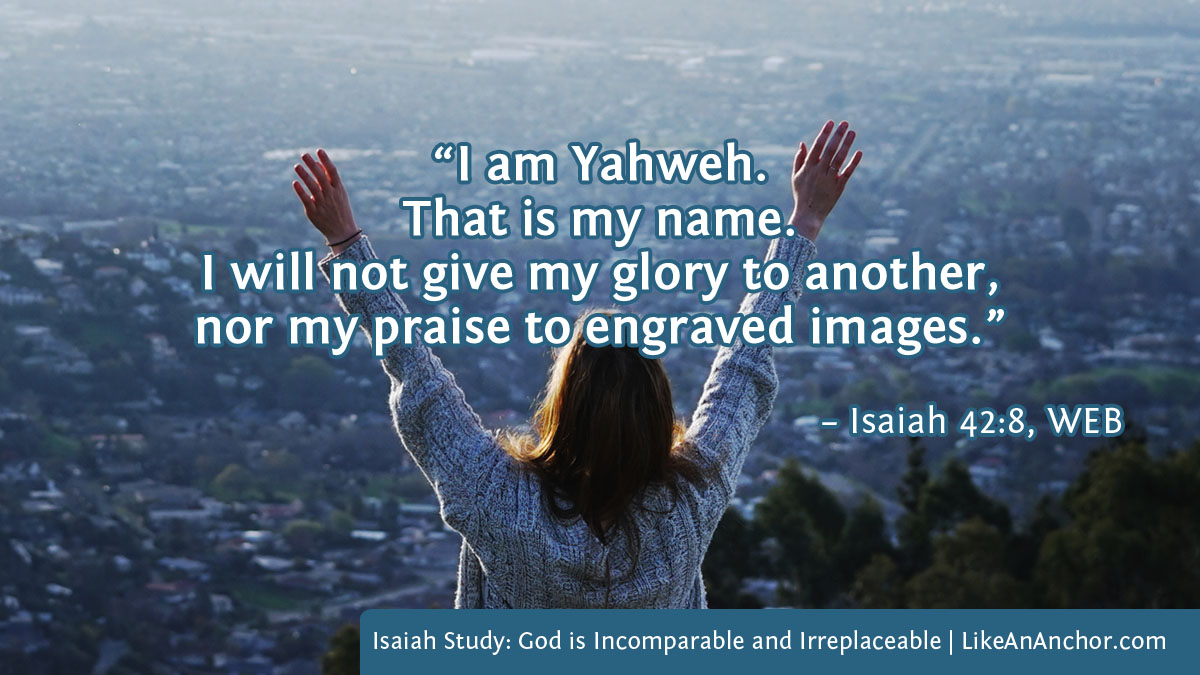
Image of a woman worshiping with her arms raised and a quote from Isaiah 42:8, WEB version: “I am Yahweh. That is my name. I will not give my glory to another, nor my praise to engraved images.”
Image by Ruby-Rose from Lightstock

Foolish Idolatry

When we turn away from God and put something else in His place, we’re guilty of idolatry. In ancient Israel’s case, this often took the form of literally worshiping other gods. My guess is that most of you reading this today aren’t tempted to carve a block of wood into a shape and bow down to it. Our idolatry temptations are more subtle. They’re still there, though, and it’s still important to be careful of them. The Apostle John makes this clear with the final admonition of his first letter: “Little children, keep yourselves from idols” (1 John 5: 21).

God’s feelings about idolatry take up huge parts of Isaiah 40-66. He keeps coming back to this topic. He seems genuinely puzzled by how a people to whom He’s revealed Himself and who’ve seen Him work wonders could turn from Him and bow down to images they made themselves. It’s simply absurd.

Everyone who makes a carved image is vain.
The things that they delight in will not profit.
Their own witnesses don’t see, nor know, that they may be disappointed. …

No one thinks,
neither is there knowledge nor understanding to say,
“I have burned part of it in the fire.
Yes, I have also baked bread on its coals.
I have roasted meat and eaten it.
Shall I make the rest of it into an abomination?
Shall I bow down to a tree trunk?”

Isaiah 44:9, 19, WEB

God is a logical, rational being and He gave humans the ability to think that way, too. Sometimes, though, understanding is clouded to the point that people can’t even figure out that the same wood they cook their food over doesn’t turn into a god just because someone carved it into a shape.

Over and over God and Isaiah come back to the topic of idolatry, challenging their readers to think about what they’re doing (Is. 44:9-20; 46:5-7; 57:3-11). If people really realized who and what God is, they’d know they could never replace Him. As such, proving who He is and that He’s the one responsible for what happens to His people is a key part of God’s purpose in this section of scripture. He even says one of the main reasons for prophecy is to disprove idols.

I have declared the former things from of old.
    Yes, they went out of my mouth, and I revealed them.
    I did them suddenly, and they happened.
Because I knew that you are obstinate,
    and your neck is an iron sinew,
    and your brow bronze;
therefore I have declared it to you from of old;
    before it came to pass I showed it to you;
    lest you should say, ‘My idol has done them.
    My engraved image and my molten image has commanded them.’

Isaiah 48:3-5, WEB

God is all-powerful. He created everything that exists and He determines the shape of the future. We can rest assured that, just as He accomplished His purposes in the past, so He will bring His future plans to pass as well. And if we ever start losing sight of Who God is and wondering if He has the power to follow-through on all the things He’s promised, we can come back to passages like Isaiah 40-66 for reassurance and reminders (Is. 41:20; 45:7; 46:9-10; 55:8-17; 59:1).

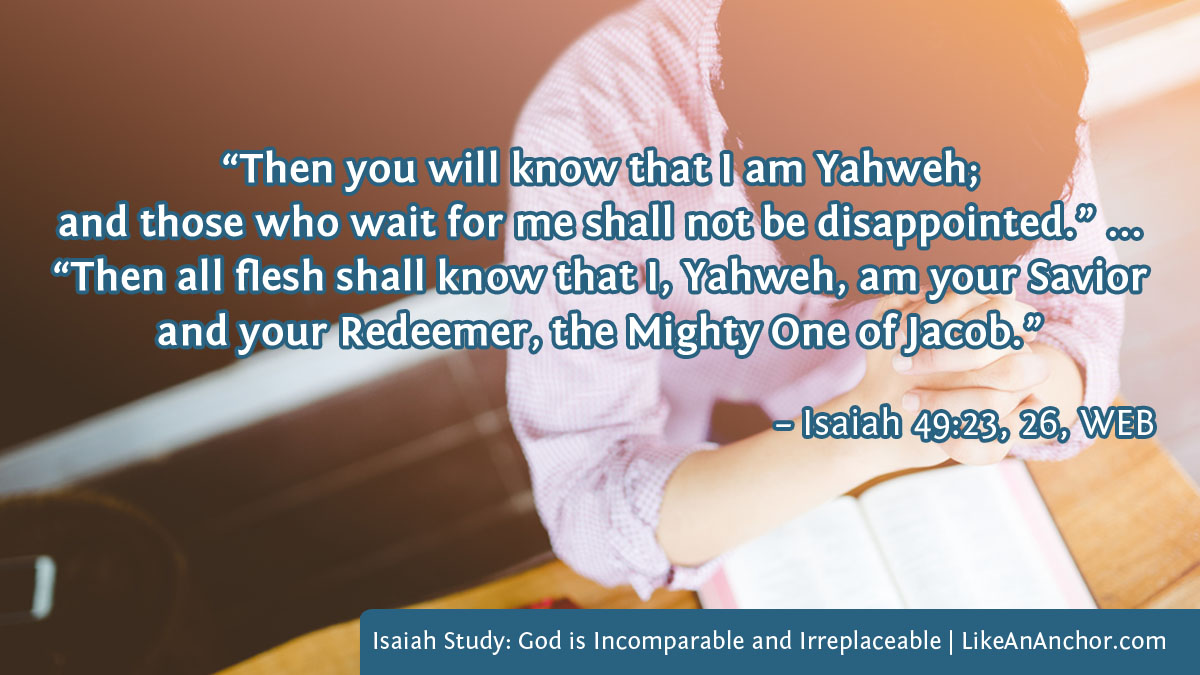
Image of a man praying while studying and a quote from Isaiah 49:23, 26, WEB version: “Then you will know that I am Yahweh; and those who wait for me shall not be disappointed.” ... “Then all flesh shall know that I, Yahweh, am your Savior and your Redeemer, the Mighty One of Jacob.”
Image by WhoisliketheLord Studio from Lightstock

God is Incomparable and Sovereign

Have you ever noticed how much the Bible talks about names? That’s because names in Hebrew culture are connected to a person’s reputation. In an Eastern society, like the one where the people in the Bible lived, family connections, honor, and reputation are extremely important (for more on this topic, see Misreading Scripture with Western Eyes by E. Randolph Richards and Brandon J. O’Brien and Reading the Bible with Rabbi Jesus by Lois Tverberg).

God uses this cultural trait to emphasize how much He cares about the way people perceive Him. It is vitally important to Him that we remember who He is and realize that nothing and no one can compare to Him. Notice these words in part of God’s commission to Cyrus that’s recorded in these final chapters of Isaiah:

I am Yahweh, and there is no one else.
Besides me, there is no God.
I will strengthen you,
though you have not known me,
that they may know from the rising of the sun,
and from the west,
that there is no one besides me.
I am Yahweh, and there is no one else.
I form the light
and create darkness.
I make peace
and create calamity.
I am Yahweh,
who does all these things.

Isaiah 45:5-7, WEB
Image of a smiling woman worshipping with the blog's title text and the words "God’s reputation in our eyes affects our relationship with Him. The more we accurately we see Him, the more properly we relate to and respect Him. "
Image by Pearl from Lightstock

What people think of God doesn’t change who He is; He is the sovereign Lord and creator of all things whether humans believe it or not. Still, He cares about how people–especially His people–view Him. He puts His name on us and tells us not to misuse that Name (Ex. 20:7; Num. 6:27). His reputation in our eyes affects our relationship with Him; the more accurately we see Him, the more properly we relate to Him.

“Listen to me, O Jacob,
and Israel my called:
I am he.
I am the first.
I am also the last.
Yes, my hand has laid the foundation of the earth,
and my right hand has spread out the heavens.
when I call to them, they stand up together.

Isaiah 48:12-13, WEB

The world is full of distracting and worrisome things. That’s true for us today just as it was true in Isaiah’s day. We battle things that vie for our attention and hearts, offering to fill our time with comforting distractions rather than what really matters. We also hear and see constant reminders that the world is violent, unstable, and full of threats to our security and way of life.

God’s word cuts through that whole thick pile of distractions and worries like a sharp blade. How could we spend time in useless distractions when the Creator of the universe wants to speak to our hearts? How could we waste our time worrying about “what ifs” when the all-powerful Lord says He will deliver and preserve us?

God is incomparable and irreplaceable. Who is like the Lord? Only He Himself. There’s no one who can compare and nothing which can replace Him. We need to remember that. It will help keep our hearts in the right place and our eyes on the goal of eternal life with the Lord.

Featured image by Inbetween from Lightstock

Another 5 Favorite Proverbs

Another Five Favorite Proverbs by marissabaker.wordpress.comI’ve finished making my way through a study of Proverbs, in preparation for my church’s women’s group discussion about favorite proverbs that is taking place this afternoon. My first post covered five proverbs from chapters 1-10, the second covered five from chapters 11-20, and this last post is for chapters 21-31. I still haven’t decided which of these 15 is my favorite, but at least I’ve narrowed it down to 15.

11: Reputation

A good name is to be chosen rather than great riches, loving favor rather than silver and gold. (Prov. 22:1)

I just heard a sermonette last week about God giving people names with meanings that fit the roles He designated them for — Jesus = savior; Paul = small; Peter = a little stone; Abraham = father of a multitude. From what I understand, names in Hebrew thought are inseparable from the essence, character, and reputation of a person. Therefore, it is better to have a good reputation, a name worthy of respect, than to have great riches.  The word for “favor,” which is described as better than silver and gold, is from the word chen (H2580), and it means “favor, kindness, grace, loveliness, charm, preciousness.”

12: Deliverance

For a righteous man may fall seven times and rise again, but the wicked shall fall by calamity. (Prov. 24:16)

It doesn’t promise that if you are a just person you will never fall — it says you will be able to get back up rather than fall deeper into mischief. “Many are the afflictions of the righteous,” David said, “but the Lord delivers him out of them all” (Ps. 34:19). If — when — we fall, we  can be assured that God is holding our hand and will help pick us back up (Ps. 37:24).

13: Friends

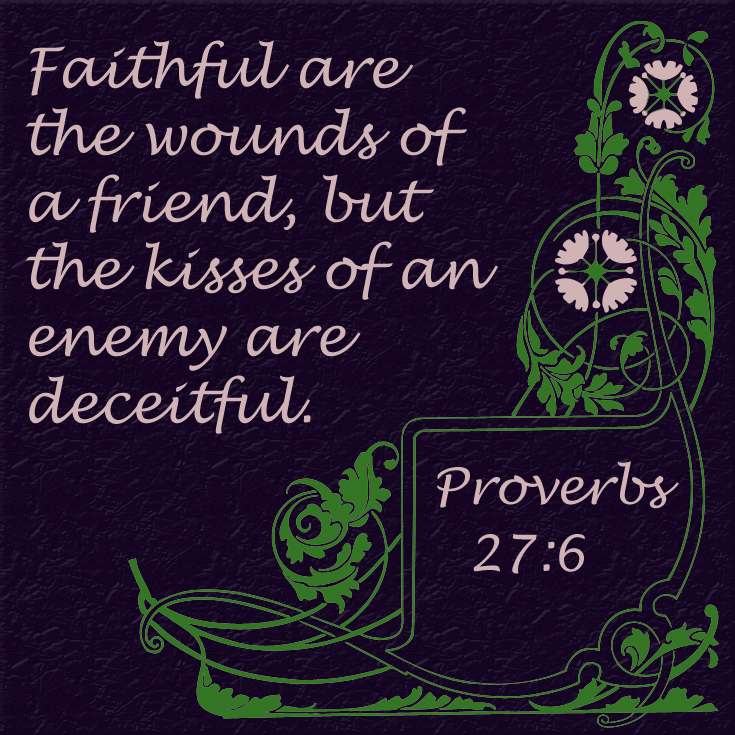
Faithful are the wounds of a friend, but the kisses of an enemy are deceitful. (Prov. 27:6)

King Lear would have been a very different play had the titular character been heeding this advice. When a friend wounds you, it is generally 1) an accident, or 2) with a view to your good. David wrote, “Let the righteous strike me; it shall be a kindness. And let him rebuke me; it shall be as excellent oil; let my head not refuse it” (Ps. 141.5). It might make us angry at first, but if we are honest with ourselves, we can often see that we were reproved out of love, and that we become better people with a stronger friendship as a result. In contrast, listening to the flattering words of those who secretly seek our hurt can only lead to grief.

14: Guardrail

Every word of God is pure; He is a shield to those who put their trust in Him. (Prov. 30:5)

“The Guardrail,” from joyfultoons.com

Here we leave Solomon’s proverbs and read “the words of Agur the son of Jakeh” (Prov. 30:1). This is a two-fold promise. Firstly, that God’s words are free of imperfections. As such, it is all profitable and no part should be ignored or neglected (2 Tim. 3:16). Secondly, that the Lord shields those who trust in Him. This was a frequent subject in Psalms, such as “For the Lord God is a sun and shield; the Lord will give grace and glory; no good thing will He withhold from those who walk uprightly” (Ps. 84:11). Connecting these two points is the fact that God’s commands are designed to protect us, as illustrated by this comic I saw on Facebook the other day.

15: Beauty

Charm is deceitful and beauty is passing, but a woman who fears the Lord, she shall be praised. (Prov. 31:30)

This is from the end of the virtuous woman passage contained in “words of King Lemuel, the utterance which his mother taught him” (Prov. 31:1). When I was younger, I latched on to this verse as a substitute for my perceived lack of beauty — if I couldn’t be pretty, I could at least fear God and earn praise that way. As I’ve become more comfortable with myself and more mature as a Christian, my views on this verse have changed. I concentrate more on the last half of the verse, asking “How can I be a woman who fears the Lord?”

Do not let your adornment be merely outward—arranging the hair, wearing gold, or putting on fine apparel — rather let it be the hidden person of the heart, with the incorruptible beauty of a gentle and quiet spirit, which is very precious in the sight of God. (! Pet. 3:3-4)