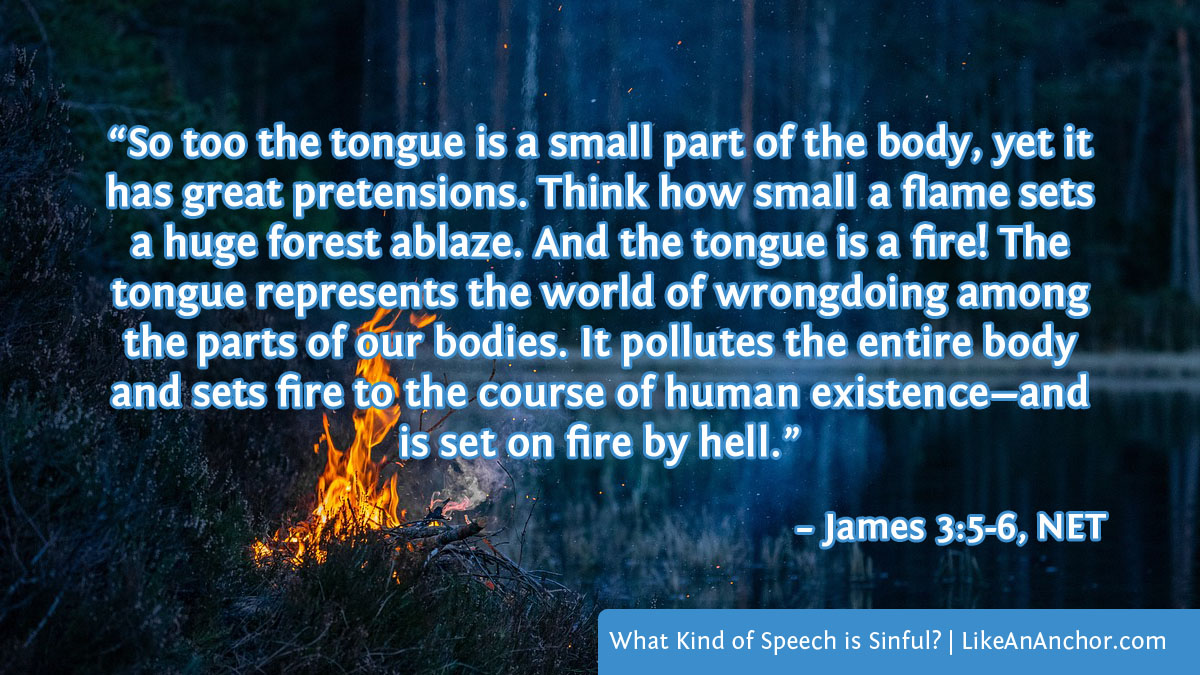
We Need To Watch Our Words

In the aftermath of another polarizing United States election, I think it’s a good time to revisit the topic of how God’s people should use language, especially when speaking about other people. Even though most of us in the U.S. agree) that there aren’t any really good politicians we could vote for, we often have very strong opinions about which is the “lesser of two evils” and equally strong opinions about people who come to a different conclusion than we ourselves did. These other people are very likely in a similar position to us, not agreeing 100% with either candidate but coming to a different conclusion about which option is a little better.

There’s a temptation to mock, belittle, and despise others who vote differently than us or have different viewpoints (whether or not they chose to vote). But when we stand before Christ, we will answer for every idle or worthless word we speak (Matt. 12:36), the times we judged, despised and condemned other people (Matt. 5:22; Rom. 14:10), and our coarse jesting or foolish talking (Eph. 5:4). Our thoughtless, angry words or the things we excuse by saying, “I was just joking,” might be something that God takes very seriously.

Today, we’re going to look at three key areas where we need to be careful about what we say: 1) passing judgement on others, 2) despising them or calling them foolish, and 3) coarse jesting. Finally, we’ll look at one overriding principle for how we ought to interact with other people: love.

Passing Judgement

There’s a difference between passing judgement (condemning) and making a judgement call (discernment). That’s one reason that you see seemingly contradictory scriptures like “Judge not” (Matt. 7:1) and “judge righteous judgement” (John 7:24). We must be careful not to usurp a role that God reserves for Himself as judge, and so bring harsher judgement on ourselves (Matt. 7:1-5; James 2:13).

Now receive the one who is weak in the faith, and do not have disputes over differing opinions. One person believes in eating everything, but the weak person eats only vegetables. The one who eats everything must not despise the one who does not, and the one who abstains must not judge the one who eats everything, for God has accepted him. Who are you to pass judgment on another’s servant? Before his own master he stands or falls. And he will stand, for the Lord is able to make him stand. …

But you who eat vegetables only—why do you judge your brother or sister? And you who eat everything—why do you despise your brother or sister? For we will all stand before the judgment seat of God. For it is written, “As I live, says the Lord, every knee will bow to me, and every tongue will give praise to God.” Therefore, each of us will give an account of himself to God. Therefore we must not pass judgment on one another, but rather determine never to place an obstacle or a trap before a brother or sister.

Romans 14:1-4, 10-13 NET (bold italics mark a quotation from Isa 45:23)

Here, Paul used the example of disagreements about what we should or shouldn’t eat to make a point. When you disagree with someone about an opinion, your duty as a Christian is to refrain from passing judgement or despising them. Rather, you should guard your behavior to make sure you’re not putting a stumbling block in front of them.

To be clear, this does not mean we can’t make judgement calls about sinful actions. It is love (agape) to point out a sin in a fellow Christian for the purpose of restoring someone to a right relationship with fellow believers and with God (Matt 18:15-22; 2 Tim. 2:24-26). Our goal should always be restoration rather than condemnation, even when we have to stop associating with someone because they refuse to repent (1 Cor. 5). Even when Paul ” judged the one who” committed “the kind of immorality that is not permitted even among the Gentiles” (1 Cor. 5:1-2, NET), it wasn’t to mock the sinner or call them names. We should be grieved by other’s sins and moved by love to help them reach a point of repentance. How much more, then, should we withhold condemnation when we disagree with someone on an opinion?

Despising Others

When someone disagrees with us on something we see as important, fails to see our point of view, or cannot be convinced by our arguments, the natural human response is to label them a fool. But despising someone else, particularly a “brother” (either by blood or because they’re fellow children of God), is not the way Jesus said to do things.

“You have heard that it was said to an older generation, ‘Do not murder,’ and ‘whoever murders will be subjected to judgment.’ But I say to you that anyone who is angry with a brother will be subjected to judgment. And whoever insults a brother will be brought before the council, and whoever says ‘Fool’ will be sent to fiery hell.”

Matthew 5:21-22, NET (bold italics mark a quotation from Exod 20:13Deut 5:17)

Let’s look at two of the original words used in this passage. “Whoever insults a brother” could also be translated, “whoever says to his brother ‘Raca,'” which is “an Aramaic word of contempt or abuse meaning ‘fool’ or ’empty head'” (NET footnote “b” on Matt. 5:22). The word translated “fool” is the Greek moros, which is where the English word “moron” comes from. Most scholars assume it means “you fool” but a few argue it could mean “rebel” (NET footnote “e” on Matt. 5:22). God holds His followers to a high standard of conduct, higher even than what was outlined in the Old Testament laws like “do not murder.”

Remind them to be subject to rulers and authorities, to be obedient, to be ready for every good work.  They must not slander anyone, but be peaceable, gentle, showing complete courtesy to all people. For we too were once foolish, disobedient, misled, enslaved to various passions and desires, spending our lives in evil and envy, hateful and hating one another. 

Titus 3:1-3, NET

In Paul’s letter to Titus, he instructs this pastor to remind the people he’s teaching that they need to be mindful of their speech. Specifically, “they must not slander” (“‘discredit,’ ‘damage the reputation of'” [NET translators’ note]) anyone. This verse is also translated with the instruction, “to speak evil of no one” (Tit. 3:2, WEB). When we’re considering how to talk about someone else, we must remember that if we think someone is foolish, misled, evil, or hateful that we were once like that too, and we’re not supposed to be like that anymore now that we have God’s spirit and have committed to following Him. We have to stop talking out of bitterness or malice, and remove slander and insults from our speech (Eph. 4:31-32; 1 Peter 3:9).

Coarse Jesting

Humor is such a tricky subject (as I mentioned in my newsletter earlier this week). One person might find something hilarious that another person would find offensive, repulsive, or hurtful. What people find funny varies between cultures and individuals. Because it’s so subjective, people often say that if someone is offended by our humor they just “didn’t get the joke” or they “need to lighten up.” But just because we find something funny doesn’t mean it can’t hurt someone else. All too often, people use humor to cover up the fact that they’re being mean or thoughtless. Jokes that hinge on cruelly mocking, belittling, and hurting people shouldn’t be something we find funny.

You must let no unwholesome word come out of your mouth, but only what is beneficial for the building up of the one in need, that it would give grace to those who hear. And do not grieve the Holy Spirit of God, by whom you were sealed for the day of redemption. You must put away all bitterness, anger, wrath, quarreling, and slanderous talk—indeed all malice. Instead, be kind to one another, compassionate, forgiving one another, just as God in Christ also forgave you.

Therefore, be imitators of God as dearly loved children and live in love, just as Christ also loved us and gave himself for us, a sacrificial and fragrant offering to God. But among you there must not be either sexual immorality, impurity of any kind, or greed, as these are not fitting for the saints. Neither should there be vulgar speech, foolish talk, or coarse jesting—all of which are out of character—but rather thanksgiving. For you can be confident of this one thing: that no person who is immoral, impure, or greedy (such a person is an idolater) has any inheritance in the kingdom of Christ and God.

Ephesians 4:29-5:5, NET

In this passage, Paul covers a lot of sins that are related to our speech. These include:

  • unwholesome word” (translated from sapros [G4550] and logos [G3056])– “unwholesome” refers to something that’s corrupt, rotten, putrefied, or worthless and “word” is speech or communication. Hebrews 13:5 tells us the “fruit of our lips” should praise God and acknowledge his name, but this is the opposite: disgusting, rotting, foul words.
  • vulgar speech” (translated from aischrotes [G151])–obscenity, filthiness. Comprises “improper conduct whether in action or word or even thought and intent” that brings shame when it is “exposed by the light” (Zodhiates).
  • foolish talk” (translated from morologia [G3473])–“silly talk, that is, buffoonery” (Strong). It’s from the same Greek root word as our English word “moron.” This is the “type of speech that betrays a person as foolish” (Zodhiates).
  • coarse jesting” (translated from eutrapelia [G2160])–in a bad sense, this word for “humor” includes “scurrility, ribaldry, low jesting” (Thayer). Basically, it is someone skilled at twisting their words wittily, which can be used to amuse others or to manipulate (Zodhiates).

Clearly, there are some types of humor that God would not excuse as “just a joke.” If the words we’re speaking are rotten and disgusting, improper or shameful, moronic and foolish, or twisted to amuse others with coarse or scurrilous jests, then they’re not funny–they’re sinful. And right after telling us these things are wrong, Paul warns that we “can be confident of this one thing: that no person who is immoral, impure, or greedy (such a person is an idolater) has any inheritance in the kingdom of Christ and God” (Eph. 5:5, NET). This is a very serious matter. People who misuse their words to hurt others are not going to be in God’s kingdom.

Love

Now that we’ve looked at scriptures telling us what not to do with our words, let’s turn our attention to what we ought to do instead. It’s not enough to just take the ungodly types of speech out of our conversation; we also have to put godly speech in. Thankfully, there are plenty of guidelines in the bible for how to do that.

Some of the verses we’ve already looked at include instructions on how we should talk right alongside the instructions about what not to say. In Titus, Paul said, “be peaceable, gentle, showing complete courtesy to all people” (Tit. 3:2, NET). In Ephesians, he said, “be kind to one another, compassionate, forgiving one another” (Eph. 4:32, NET). And if we keep reading in Romans 14, we come to this passage:

Therefore we must not pass judgment on one another, but rather determine never to place an obstacle or a trap before a brother or sister. … For if your brother or sister is distressed because of what you eat, you are no longer walking in love. Do not destroy by your food someone for whom Christ died. Therefore do not let what you consider good be spoken of as evil. For the kingdom of God does not consist of food and drink, but righteousness, peace, and joy in the Holy Spirit

Romans 14:13, 15-17 NET

Here, Paul continues addressing the disagreement about whether to eat meat, the principle applies to how we interact with each other through our words as well. Peace, gentleness, courtesy, kindness, compassion, forgiveness, righteousn0ess, joy–all those should be characteristics of our speech. It’s summed-up by the second greatest commandment: “You shall love your neighbor as yourself” (Matt. 22:36-40).

 “I give you a new commandment—to love one another. Just as I have loved you, you also are to love one another. Everyone will know by this that you are my disciples—if you have love for one another.”

John 15:34-35, NET

We’re supposed to love our fellow Christians so much that people observing our interactions can tell that we’re followers of Jesus Christ. And it isn’t confined just to fellow Christians: it’s for our neighbors as well (i.e. anyone we’re aware of and have any sort of interaction with). As Paul said in Romans (shortly before the passage about not judging those with different opinions), “Love does no wrong to a neighbor. Therefore love is the fulfillment of the law” (Rom. 13:10, NET). Unless we’re loving “in deed and truth” as well as in our words, we’re not Jesus’s disciples (1 John 3:18, NET; see 1 John 3:10-18; 4:20-21).

All of our words, thoughts, and actions have to be motivated by love. That’s how God is, and that’s how He wants us to be. Will we do it perfectly? Of course not, but we still need to try. We also need to study the Bible, learn what God expects from us (i.e. how to become more like Him and to walk in obedience with Him), and repent when we catch ourselves missing the mark. Ultimately, the goal is to “take every thought captive to make it obey Christ” (2 Cor. 10:5, NET) and then to speak out of the abundance of good and godly things in our hearts “for by your words you will be justified, and by your words you will be condemned”(Matt. 12:37, NET; see Matt. 12:33-37).


Featured image by Petra from Pixabay

Song Recommendation: “Speak Life” by TobyMac

What Kind of Speech is Sinful?

I’ve been thinking about this question off-and-on for many years. Over a decade ago, I took an art class with some students who were so foul-mouthed that I asked the instructor for permission to work in another room. I still feel uncomfortable around people who habitually swear, though I wonder sometimes if that has more to do with being sensitive to the tone of voice (often angry) than with the words themselves.

Christians tend to describe swearing, profanity, and foul language as sinful. We often try to keep our kids from watching movies rated for language, avoid using it ourselves, and frown on people who do. But on the other hand, there isn’t a verse in the Bible that says something as clear as, “Thou shalt not say ‘shit’ when you are upset.” So how would we respond if someone were to say it’s okay to swear as long as they’re not taking God’s name in vain? I wonder if there is a distinction between speech that is culturally crude and speech that is sinful in God’s eyes.

I suspect, though, that as we study this topic we’ll find that God expects more from us rather than less. This isn’t an examination of the scriptures looking for reasons we can “get away with” swearing. As New Covenant believers, we need to keep the spirit of the law, not just the letter. God doesn’t simply expect us to avoid a few crude words. He expects us to guard our tongues all the time and avoid speaking in a sinful way.

Must Stop Speaking Sinfully

I decided to write on this topic now because a verse in Isaiah caught my eye as I read chapter 58 this past Monday as part of my daily devotional. In this chapter, God says, “Shout loudly! Don’t be quiet! Yell as loudly as a trumpet! Confront my people with their rebellious deeds; confront Jacob’s family with their sin” (Is. 58:1, NET). The people say they want to follow Him and lament that all their good things aren’t catching His attention, but God counters that they aren’t really following Him at all. They’re doing things their way, rather than worshiping and obeying God as He wants. God won’t respond to them the way they want until they change their behavior to align with His character.

Then your light will shine like the sunrise;
your restoration will quickly arrive;
your godly behavior will go before you,
and the Lord’s splendor will be your rear guard.
Then you will call out, and the Lord will respond;
you will cry out, and he will reply, ‘Here I am.’
You must remove the burdensome yoke from among you
and stop pointing fingers and speaking sinfully.

Isaiah 58:8-9, NET

If we want to have “godly behavior,” then we must “stop pointing fingers and speaking sinfully.” The phrase “speaking sinfully” is translated from the Hebrew words dabar (H1696) and aven (H205). Let’s take a closer look at those words.

The noun (“word”) and verb (“to speak”) forms of dabar “occur more than 2500 times in the OT” (Theological Wordbook of the Old Testament [TWOT] entry 399). The basic meaning includes “to speak, declare, converse, command, promise, warn, threaten, sing, etc.” If you’re familiar with the Greek word logos, the two are roughly equivalent. Both have to do with communication, or speaking that has thought behind it.

The word aven has two primary facets: “A stress on trouble which moves on to wickedness, and an emphasis on emptiness which moves on to idolatry” (TWOT 48a). Authors of the Theological Wordbook of the Old Testament note that this “word stresses the planning and expression of deception and points to the painful aftermath of sin.” Common translation choices include “evil,” “iniquity,” “trouble,” and “wicked.”

Putting the two words together, we get the idea of conversation/speaking that is troubling, wicked, empty, and even idolatrous. This is not the only verse cautioning us against sinful speech, but even looking at this verse on its own we already see that it encompasses much more than profanity and swearing. It has to do with the substance of what is said even more than the presence or absence of “colorful metaphors.”

Image of ___ overlaid with text from Isaiah 58:9, WEB version:  “Then you will call, and Yahweh will answer. You will cry for help, and he will say, ‘Here I am.’ If you take away from among you the yoke, finger pointing, and speaking wickedly”
Image by Dan Fador from Pixabay

Do Not Take the Lord’s Name In Vain

Probably the most common scripture we think of when discussining the Christian view of profanity is the 10 commandments (in Hebrew, the 10 dabar). The third commandment says, “You shall not take the name of the Lord your God in vain, for the Lord will not hold guiltless anyone who takes his name in vain” (Ex. 20:7, NET). While this does include a prohibition against speaking the Lord’s name in an empty or profane way (as one would if using it as a swear word), it is so much more than that.

“Take” is translated from the word nasah, which appears here in the Qal stem and means “to lift,” “to bear, carry, support, sustain,” and “to take” (Brown, Driver, Briggs entry H5375). The TWOT says nasah can also mean “to lift (anything) with the voice,” and they link that meaning with Exodus 20:7 (TWOT 1421). In general, though, it can mean lifting in the literal or metaphorical sense, including things like carrying something with you, such as the guilt of sin, or of lifting up your hand to take action.

In Hebrew thought, names are inseparably connected with reputation. When we lift up God’s name on our lips or by associating ourselves with Him as Christians, He’s trusting us to be good stewards of his reputation. You could avoid speaking God’s name as a swear word–or avoid saying it at all–but still be carrying His name in a vain manner if you say you’re a Christian but don’t act and speak in a way that honors God. If we want to obey the command not to “take the name of the Lord your God in vain,” then we need to pay attention to all our words and actions.

Image of sunlight shining from clouds overlaid with text from Psalm 19:14, WEB version:  “Let the words of my mouth and the meditation of my heart  be acceptable in your sight,  Yahweh, my rock, and my redeemer.”
Image by RÜŞTÜ BOZKUŞ from Pixabay

Avoid All Types of Sinful Speech

Paul also has several things to say about how we use our words. In both Ephesians and Colossians, he lists several sinful things that we must put out of our lives if we are going to live faithfully in obedience to God. These lists include several that are specific to how we use our words. We’ll focus on the one in Ephesians, since it is the longest of the two.

Therefore, having laid aside falsehoodeach one of you speak the truth with his neighbor, because we are members of one another. Be angry and do not sin; do not let the sun go down on the cause of your anger. Do not give the devil an opportunity. … You must let no unwholesome word come out of your mouth, but only what is beneficial for the building up of the one in need, that it would give grace to those who hear. And do not grieve the Holy Spirit of God, by whom you were sealed for the day of redemption. You must put away all bitterness, anger, wrath, quarreling, and slanderous talk—indeed all malice. Instead, be kind to one another, compassionate, forgiving one another, just as God in Christ also forgave you.

Therefore, be imitators of God as dearly loved children and live in love, just as Christ also loved us and gave himself for us, a sacrificial and fragrant offering to God. But among you there must not be either sexual immorality, impurity of any kind, or greed, as these are not fitting for the saints. Neither should there be vulgar speech, foolish talk, or coarse jesting—all of which are out of character—but rather thanksgiving. For you can be confident of this one thing: that no person who is immoral, impure, or greedy (such a person is an idolater) has any inheritance in the kingdom of Christ and God.

Ephesians 4:25-27, 29-32; 5:1-5 NET (bold italics mark quotations from  Zech 8:16 and m Ps 4:4)

Here in Ephesians, Paul warns against several types of sinful speech. He covers slander and lying again in Colossians, when he says, “But now, put off all such things as anger, rage, malice, slander, abusive language from your mouth. Do not lie to one another” (Col. 3:8-9, NET). That passage in Colossians also adds one more speech-connected sin, “abusive language.” Let’s take a closer look at all the Greek words used to describe prohibited language in these two passages.

  • “falsehood” pseudos (G5579)–an intentional lie and “lying in general.” It also “refers to making a lie, i.e., making idols” (Zodhiates). This links us back to the Hebrew word aven (from “speaking sinfully), which includes “an emphasis on emptiness which moves on to idolatry” (TWOT 48a).
  • “lie” pseudomai (G5574)–“to speak deliberate falsehoods” (Thayer).
  • “unwholesome word” sapros (G4550) and logos (G3056)– corrupt, rotten putrefied, worthless + a word of speech; communication. Zodhiates points out that saphros usually refers to “vegetable or animal substances” (like fruit) rotting. Hebrews 13:5 tells us the “fruit of our lips” should praise God and acknowledge his name. This is the opposite–disgusting, rotting, foul “fruit” coming from our words.
  • “slanderous talk”/”slander” blasphemia (G988)–speech that injures “another’s good name” or reproaches “divine majesty” (Thayer).
  • “vulgar speech” aischrotes (G151)–obscenity, filthiness. Comprises “improper conduct whether in action or word or even thought and intent” that brings shame when it is “exposed by the light: (Zodhiates).
  • “foolish talk” morologia (G3473)–“silly talk, that is, buffoonery” (Strong’s). It’s from the same Greek root word as our English word “moron.” This is the “type of speech that betrays a person as foolish” (Zodhiates).
  • “coarse jesting” eutrapelia (G2160)–can mean humor, but in a bad sense it includes “scurrility, ribaldry, low jesting” (Thayer). Basically, it is someone skilled at twisting their words wittily, which can be used to amuse others or to manipulate (Zodhiates). In the negative sense, it makes me think of people who take things too far and hurt others just to get a laugh (and who, if you confront them, would say, “it’s just a joke; lighten up”), or those who purposefully make mischief and manipulate to amuse themselves or get out of consequences for something they did.
  • “abusive language” aischrologia (G148)–“foul speaking, low and obscene speech” (Thayer). It comes from the root words aischros (G150), “filthy or improper,” and lego (G3004), “to say” (Zodhiates). In the New Testament, it is only used in Colossians.

That covers a lot, doesn’t it? We could even expand it to add things like “speech motivated by anger,” “words inspired by lust,” and “things spoken when quarreling,” since those are all actions listed here as sinful and which are often accompanied by speech. But even just focusing on the ones Paul specifically connects with speech, the list is extensive.

Sinful speech includes profanity, but it also includes so much more. Telling a deliberate falsehood or crafting something to deceive others (especially if it’s to draw them away from God) is a sin. When we speak rotten, disgusting things, it’s a sin. When we slander another person or God’s good name, it’s a sin. When we say something obscene that we ought to be ashamed of if it were exposed in public, it’s a sin. When we speak foolishly and act like morons, it’s a sin. When our jesting turns course and we twist our words to hurt or manipulate others, it’s a sin. When we say something low, obscene, or filthy, it’s a sin.

How we speak is a very serious matter. As Paul reminds us at the end of the Ephesians passage we just read, “you can be confident of this one thing: that no person who is immoral, impure, or greedy (such a person is an idolater) has any inheritance in the kingdom of Christ and God” (Eph. 5:5, NET). If our speech is characterized by any of these sinful things, we need to repent, ask for forgiveness, and change the way we talk.

A Better Way to Speak

There should be a marked difference between how those in a covenant relationship with God talk and how those in the world think it’s okay to speak. Deception and profanity are things we know we need to get rid of. But we also have to put aside speaking with vitriol, slandering others, and being vulgar. We need to guard our humor as well, making sure that it’s not shameful, foolish, hurtful, or manipulative.

This does not mean we need to be serious all the time. But we do need to be very conscious of how our words reflect on God and how they affect other people. There are plenty of Bible verses that focus on how we should be talking, and we can turn to them for guidance on how to make our speech something that honors God and uplifts those around us.

Paul weaves instructions about how we should talk in with his instructions on the types of speech not to use. If you re-read Ephesians 4:25-5:5, you’ll see he tells us to “speak truth” and say words that are “beneficial for the building up of the one in need, that it would give grace to those who hear.” When speaking together, we should “be kind to one another, compassionate, forgiving one another.” Paul adds even more instructions about how to speak in Colossians, shortly after his warnings about how not to speak.

Therefore, as the elect of God, holy and dearly loved, clothe yourselves with a heart of mercy, kindness, humility, gentleness, and patience, bearing with one another and forgiving one another, if someone happens to have a complaint against anyone else. Just as the Lord has forgiven you, so you also forgive others. And to all these virtues add love, which is the perfect bond. Let the peace of Christ be in control in your heart (for you were in fact called as one body to this peace), and be thankful. Let the word of Christ dwell in you richly, teaching and exhorting one another with all wisdom, singing psalms, hymns, and spiritual songs, all with grace in your hearts to God. And whatever you do in word or deed, do it all in the name of the Lord Jesus, giving thanks to God the Father through him.

Colossians 3:12-17, NET

Be devoted to prayer, keeping alert in it with thanksgiving.  … Let your speech always be gracious, seasoned with salt, so that you may know how you should answer everyone.

Colossians 4:2, 6, NET

Another good place to go when you’re studying how to use your tongue is Proverbs. Ninety-seven verses in this book use the keywords “tongue,” “lip,” “mouth,” “speech,” or “speak.” These proverbs advise us on how to speak, how not to speak, and contrast the righteous’s and the wicked’s use of speech. They also point out that we can trust the words that come out of God’s mouth, and use those words to get wisdom, knowledge, and understanding that will guide not only how we speak, but every aspect of our lives.

God wants us to use our words constructively. There is great potential for sin and damage in the tongue (James 3:1-12), but there is also great potential for good. We can use our speech to praise God and share His truths with others. We can use them to say kind, encouraging things to each other. We can ask for wisdom and grace to season our words, making them exactly what someone else needs to hear. The only person who ever perfectly controlled His tongue is Jesus, and He’s eager to help us learn to become like Him in how we speak just as in every other aspect of our lives. We just need to ask for His help and diligently apply ourselves to guarding our mouths and speaking things acceptable in the Lord’s eyes.


Featured image by Engin Akyurt from Pixabay

Song Recommendation: “Speak Life” by TobyMac